Cognitive science ranks two study techniques above almost every other, retrieval practice and spaced repetition, and both reward you for going over the same material more than once. An AI podcast for studying makes those repeats painless, because it turns your lecture notes, slides, or a textbook chapter into a two-host audio episode you can replay on a commute, a walk, or while doing chores. You read the material once, then you listen to it five times without sitting back down at your desk.
This guide shows you how to use an AI podcast as a revision tool, not just a novelty. We cover what to feed it, how to structure a source so the episode actually helps you remember, the study workflow that fits it into a real week, and the limits you should know before you trust it for an exam. If you just want the fastest way to build one, our step-by-step guide to making an AI podcast covers the clicks.
The Key Takeaways
- An AI podcast for studying converts your notes, slides, or PDFs into a two-host review episode, turning reading time into listening time.
- It plays to the two highest-rated study methods, retrieval practice and spaced repetition, by making it effortless to revisit the same material.
- The output quality tracks your input; a clean, well-structured source produces a sharper revision episode than a messy copy-paste.
- Best for review and reinforcement, not first-contact learning of dense technical material like formula-heavy maths.
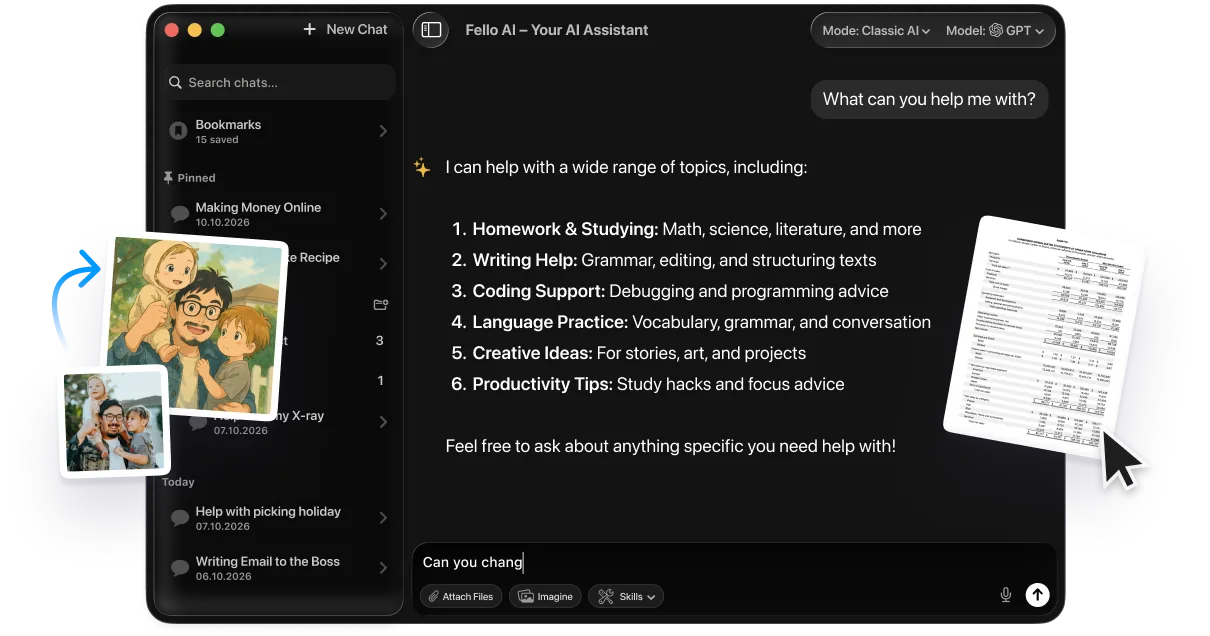
- Tools like Fello AI build a study episode in the same chat that also makes flashcard-style summaries, slides, and documents.
What Is an AI Podcast for Studying?
An AI podcast for studying is an audio episode that an AI tool writes and voices from your own study material, designed to be replayed for revision. You upload your lecture notes, a set of slides, a PDF chapter, or paste in a summary, and the tool produces a two-host conversation that walks through the key points. Instead of reading the same page again, you listen to two voices discuss it.
The format works for studying because it is active, not flat. Most tools generate a back-and-forth between two hosts who ask each other questions, define terms, and explain the tricky parts, which mirrors how a good study group sounds. That dialogue structure is easier to follow and stickier than a single voice reading your notes word for word. If you want the full background on the format, our explainer on what an AI podcast is covers how the technology works.
Why an AI Podcast Helps You Revise
The biggest win is converting dead time into study time. A 20-minute commute, a gym session, or a walk between classes becomes a revision slot when your notes are sitting in your headphones as an episode. You get repetition for free, and repetition is exactly what long-term memory needs.
It also lowers the friction of going back over material. Re-reading is boring, so most students skip it, but pressing play is easy. Because you can regenerate an episode for each topic, you build a small library of audio summaries you can shuffle through in the days before an exam. That naturally creates the spacing effect, where revisiting content across several days beats one long cramming session.
The third benefit is comprehension. Hearing a concept explained as a conversation, with one host pushing back and the other clarifying, often lands differently than reading a bullet list. It forces the material into plain language, which is a useful test of whether you actually understand a topic or just recognise the words.
How to Make an AI Podcast for Studying
The workflow is short and the same across most tools. The trick is in how you prepare the source, because the model can only discuss what you give it.
1. Gather and clean your source
Pull together the notes, slides, or PDF for one topic, not your whole semester. A focused source produces a focused episode. Strip out obvious noise like page headers, broken formatting, and duplicate slides, since a tidy input produces a sharper, more accurate script. You can turn text, notes, or a PDF into a podcast directly, so a clean copy-paste of your study guide is often the fastest path.
2. Set the length and style
Pick a length that matches the topic; 6 to 10 minutes is a good default for a single subject, long enough to cover it and short enough to replay. Choose a conversational or deep-dive style depending on whether you want a quick refresher or a thorough walkthrough. If the tool supports it, set the language to the one you study in.
3. Generate, then sharpen
Run the generation, then listen once with your notes open to catch anything the model got wrong or skipped. If a section is thin, add detail to your source and regenerate. Save the final MP3 with a clear name like the topic and week, so your revision library stays organised.
What to Feed It for the Best Study Episodes
Some sources produce far better revision audio than others. The table below shows what tends to work and why.
| Source type | Works for studying? | Why |
|---|---|---|
| Lecture notes | Excellent | Already in your words and structured by topic, so the script stays on point. |
| Lecture slides (PDF) | Very good | Headings and bullets give the model clear structure to expand into dialogue. |
| Textbook chapter | Good | Rich and accurate, but trim to the relevant sections so the episode stays focused. |
| A study guide or summary | Excellent | A condensed source yields a tight, high-signal episode with little filler. |
| Formula-heavy maths or code | Weak | Audio struggles with notation and step-by-step symbols; use it for concepts only. |
The pattern is clear. Conceptual, language-based material turns into great study audio, while anything that depends on seeing symbols, diagrams, or worked steps is better left to the page.
How to Fit It Into a Study Routine
The strongest use is review, layered on top of your normal studying. Read or take notes on a topic first, the same as always, then generate an episode from those notes and treat it as your repetition layer. Listen to it the next day, again a few days later, and once more the night before the exam, which spaces your exposure across the revision period.
You can also use it for previewing. Generating a short episode from a chapter before a lecture gives you the gist, so the lecture itself becomes reinforcement rather than first contact. Either way, keep your active recall practice, like flashcards or past papers, separate; the podcast feeds your understanding, but testing yourself is what proves it stuck. Pairing audio revision with a structured course works well, and our roundup of the best free AI courses is a good place to find that structure.
The Limits You Should Know
An AI podcast is a revision aid, not a replacement for studying. It is excellent for reinforcing material you have already met and poor at teaching something dense from scratch, especially technical subjects where notation matters. Treat it as the second or third pass, not the first.
Accuracy is the other watch-point. The hosts sound confident even when they are wrong, and a model can occasionally misstate a fact or smooth over a nuance your exam will test. Always check the episode against your source the first time you listen, and never let a generated summary be your only record of a topic. The voices are convincing, but the substance is only as good as what you fed in.
Conclusion
An AI podcast for studying turns your notes and slides into a two-host audio episode you can replay anywhere, which makes the repetition that memory depends on almost effortless. Used as a review layer on top of real studying, it converts commutes and chores into revision time and gives you a fresh way to hear the material that often clarifies it.
The best way to judge it is to try one on a topic you are about to revise. Build an episode from this week’s notes, listen to it twice before your next session, and see whether it sticks better. When you are ready to pick a tool, our roundup of the best AI podcast generator options compares the free limits and features side by side.
FAQ
What is the best AI podcast for studying?
The best tool is one that accepts your notes or PDFs, lets you set a short length and a clear language, and produces an accurate two-host episode. Fello AI, NotebookLM, and similar tools all work well; the right pick depends on price and whether you want podcasts inside an app that also makes summaries and slides. Our podcast generator roundup compares the options.
Can I turn my lecture notes into a podcast?
Yes. Paste your notes or upload them as a document, set a length and style, and the tool writes a two-host script and voices it into an audio file. Clean, well-organised notes produce the sharpest study episode, so tidy the source before you generate.
Does listening to an AI podcast actually help you learn?
It helps most as a review tool. It plays to retrieval practice and spaced repetition by making repeated exposure easy, and hearing concepts explained as a conversation can aid comprehension. It is weaker for first-time learning of dense or symbol-heavy material, so use it to reinforce, not to replace, your main studying.
Is an AI study podcast accurate?
Mostly, but not always. The hosts sound confident even when they make a mistake, so check the first listen against your source and fix your input if a section is wrong. The episode is only as accurate as the material you feed it.
How long should a study podcast be?
For a single topic, 6 to 10 minutes is a good target. It is long enough to cover the key points and short enough to replay several times across your revision period, which is where the memory benefit comes from.