OpenAI made GPT-5.6 public on July 9, 2026, and it is now the most capable ChatGPT model you can actually run. The flagship Sol tier scores 88.8% on Terminal-Bench 2.1 (and 91.9% in its Sol Ultra high-effort mode), edging GPT-5.5’s own 88.0% on the same agentic-coding test, and it ships alongside two cheaper tiers, Terra and Luna, that undercut the previous generation on price.
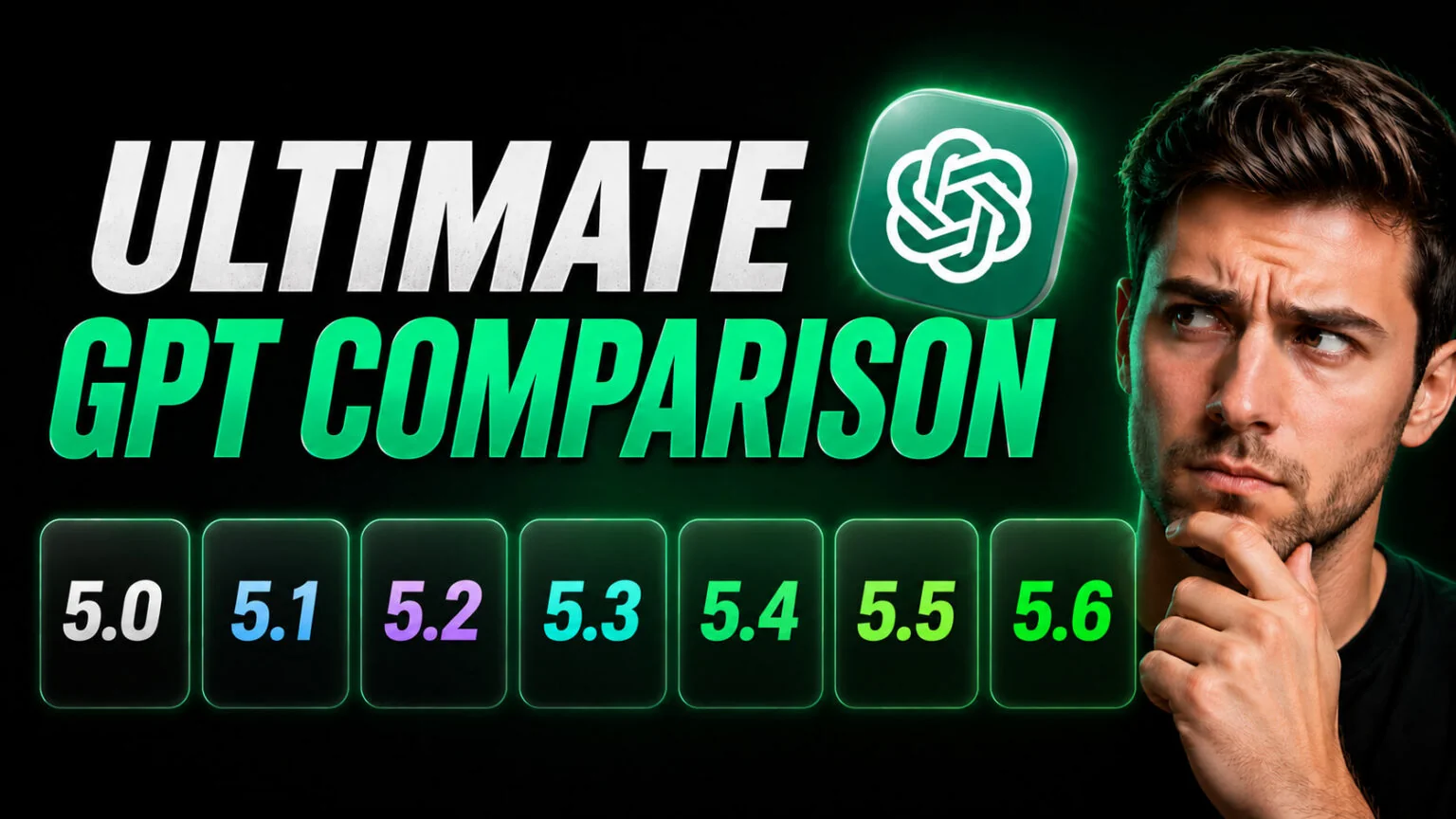
In under a year, OpenAI has shipped seven distinct versions of GPT-5, each with its own identity and price point. If you have lost track of what separates GPT-5.0 from GPT-5.6, this guide covers every model in the family, release dates, context windows, benchmarks, pricing, and the key differences that actually matter. GPT-5.6 first shipped as a June 26 government-gated preview to roughly 20 organizations, then went fully public on July 9. It now powers the reasoning options on ChatGPT’s paid plans and is available in full through the API. We also look ahead at what ChatGPT 6 is shaping up to be. If you are newer to ChatGPT, our ChatGPT for Beginners guide is a good place to start before you compare model differences.
The Key Takeaways
- GPT-5.6 (public July 9, 2026) is the current frontier. It ships in three tiers, Sol (flagship), Terra (balanced), and Luna (cheapest), with Sol scoring 88.8% on Terminal-Bench 2.1 and a 1.05M-token API context window.
- GPT-5.5 (April 23, 2026) is the previous flagship and still an excellent all-rounder. It scores 93.6% on GPQA Diamond and 78.7% on OSWorld-Verified, both ahead of GPT-5.4, and ships in two variants, GPT-5.5 standard and GPT-5.5 Pro.
- GPT-5.4 (March 5, 2026) sits two generations back but still matters. It introduced a 1M-token context window (API only) and native computer use, scoring 75.0% on OSWorld-Verified and 57.7% on SWE-Bench Pro.
- GPT-5.3 Instant (March 3, 2026) fixed the over-cautious tone and delivered 26.8% fewer hallucinations than GPT-5.2 with web search on, but it is no longer listed on OpenAI’s API pricing page. Only
gpt-5.3-codexsurvives from that generation.- GPT-5.2 was the first model to score 90%+ on ARC-AGI-1 (Pro) and hit a perfect 100% on AIME 2025 math.
- GPT-5.1 introduced adaptive reasoning, 2 to 3x faster on simple tasks, while keeping the same $1.25 / $10 price as GPT-5.0.
- Pricing splits by tier in GPT-5.6. Sol was cut to $4 / $20 per 1M tokens on August 21, 2026, below GPT-5.5’s $5 / $30, Terra drops to $2 / $12, and Luna is just $0.20 / $1.20 after OpenAI cut both tiers on July 30, 2026, Luna by 80% and Terra by 20%.
- 15 legacy model snapshots lose API access on July 23, 2026, including five Codex snapshots and both
chat-latestaliases. It is an API-only change; the ChatGPT model picker is untouched.- ChatGPT 6 has not shipped. A mid-to-late 2026 launch is still the expected window, with a shift toward persistent memory and autonomous agents.
All ChatGPT 5 Models at a Glance
| Model | Released | Context Window | API Pricing (Input / Output) | Best For |
|---|---|---|---|---|
| GPT-5.0 | Aug 7, 2025 | 400K / 128K out | $1.25 / $10 per 1M | General use, launch baseline |
| GPT-5.1 | Nov 13, 2025 | 400K (272K in) | $1.25 / $10 per 1M | Adaptive speed, conversational tasks |
| GPT-5.2 | Dec 11, 2025 | 400K (272K in) | $1.75 / $14 per 1M | Deep reasoning, coding, research |
| GPT-5.3 Instant | Mar 3, 2026 | 400K | ~$0.30 / ~$1.20 per 1M | Everyday writing, cost-sensitive use |
| GPT-5.4 | Mar 5, 2026 | 1M (API only) | $2.50 / $15 per 1M | Agentic work, computer use |
| GPT-5.5 | Apr 23, 2026 | 1M (API only) | $5 / $30 per 1M (Pro: $30 / $180) | Agentic coding, knowledge work |
| GPT-5.6 | Jul 9, 2026 | 1.05M (128K out) | Sol $4/$20, Terra $2/$12, Luna $0.20/$1.20 | Current frontier: agentic coding, knowledge work |
One caveat on that table. It is a history of the family, not a current order form. OpenAI’s API pricing page today lists only gpt-5.3-codex, the GPT-5.4 family, GPT-5.5, GPT-5.5 Pro, and the three GPT-5.6 tiers. GPT-5.0, 5.1, 5.2, and the standard GPT-5.3 have dropped off that page, and the snapshots that remain reachable are on the clock: gpt-5.3-chat-latest shuts down on August 10, 2026, and the original gpt-5-2025-08-07 along with its mini, nano, and pro variants shut down on December 11, 2026. The prices below are kept because they explain how the family evolved, not because you can still buy them all.
For how these API prices map to ChatGPT subscription tiers (Free, Go, Plus, Pro, Business, Enterprise), see our ChatGPT pricing guide.

GPT-5.0: The Foundation
Released: August 7, 2025
The original GPT-5 arrived as a meaningful jump over GPT-4o, not just in raw benchmarks, but in architecture. According to OpenAI’s launch announcement, it was built as a unified system with a fast base model for everyday queries and a deeper reasoning layer (GPT-5 Thinking) that activates automatically when the query demands it. A real-time router decides which to use based on complexity, tool needs, and context, so you do not have to manage it manually.
GPT-5.0 Benchmarks
| Benchmark | GPT-5.0 score |
|---|---|
| AIME 2025 (math) | 94.6% without tools; 100% with Python tools (Pro) |
| GPQA Diamond (PhD-level science) | 89.4% |
| SWE-bench Verified (coding) | 74.9% |
| Aider Polyglot (real-world coding) | 88% |
| Humanity’s Last Exam | 42% |
| Hallucinations | Under 1% on open-source prompts; 1.6% on hard medical cases |
GPT-5.0 shipped with a 400K input / 128K output context window and was available to all ChatGPT users, with Pro subscribers getting extended reasoning access.
API pricing: $1.25 per 1M input tokens / $10 per 1M output tokens
What Changed vs. GPT-4o
GPT-5 was roughly 45% less likely to hallucinate than GPT-4o with web search enabled. The unified routing eliminated the need to manually switch between chat and reasoning modes, a friction point many users had with the o-series models.
GPT-5.1: Faster Without Being Dumber
Released: November 13, 2025
Per OpenAI’s GPT-5.1 announcement, GPT-5.1 was not a capability leap, it was an efficiency upgrade. The headline feature was adaptive reasoning, where the model dynamically allocates compute based on query complexity. Ask it something simple and it answers 2 to 3x faster than the standard model. Ask it something complex and it switches to full reasoning mode. That reasoning mode is also why heavier models can feel laggy; our guide to why ChatGPT is so slow explains when the wait is the model and when it is something you can fix.
OpenAI also tuned the tone to be warmer and more conversational, dropping some of the rigid formality that made GPT-5.0 occasionally feel stiff. It used 30% fewer thinking tokens than its Codex variant while maintaining near-identical benchmark scores on most tasks.
GPT-5.1 Benchmarks
| Benchmark or spec | GPT-5.1 |
|---|---|
| AIME 2025 | 94% (marginally lower than GPT-5.0’s 94.6%) |
| GPQA Diamond | 87% |
| MMMU (multimodal) | 85.4% |
| SWE-Bench Verified | 76.3% (Codex-Max variant: 77.9%) |
| Context window | 400K tokens (272K input / 128K output) |
| API pricing | $1.25 per 1M input / $10 per 1M output, same as GPT-5.0 |
GPT-5.1 Variants
OpenAI shipped a full family with GPT-5.1, Instant (fast), Thinking (deep reasoning), Auto (routing), and Pro (research-grade), plus three Codex variants, standard Codex, Codex-Mini for lightweight tasks, and Codex-Max for agentic coding tasks lasting 24+ hours. All three of those Codex snapshots lose API access on July 23, 2026, with gpt-5.5 as the substitute for Codex and Codex-Max and gpt-5.4-mini for Codex-Mini.
What GPT-5.1 Got Right
The reasoning_effort parameter (none / low / medium / high) gave developers fine-grained control over how much compute to spend per request, a practical tool for balancing cost and quality in production.
GPT-5.2: The Reasoning Milestone
Released: December 11, 2025
GPT-5.2 was the model that set new goalposts. It was the first AI to score 90%+ on ARC-AGI-1, a benchmark designed specifically to resist pattern-matching and test genuine reasoning. It also hit a perfect 100% on AIME 2025 math problems. These were not marginal gains; they crossed thresholds that had defined the frontier for years.
OpenAI introduced a three-tier architecture with GPT-5.2. GPT-5.2 Instant was optimized for throughput, which made it the pick for customer support, content generation, and translation. GPT-5.2 Thinking added configurable reasoning depth through Light, Medium, Heavy, and xhigh settings, letting you trade latency for accuracy on a per-request basis. GPT-5.2 Pro sat at the top with maximum compute and up to 30 minutes of sustained processing for the most demanding tasks.
GPT-5.2 Benchmarks
| Benchmark | Score |
|---|---|
| AIME 2025 | 100% |
| GPQA Diamond (Pro) | 93.2% |
| GPQA Diamond (Thinking) | 92.4% |
| SWE-Bench Verified | 80.0% |
| SWE-Bench Pro | 55.6% |
| ARC-AGI-1 (Pro) | 90%+ |
| ARC-AGI-2 (Pro) | 54.2% |
| FrontierMath | 40.3% |
GPT-5.2 delivered 38% fewer errors than GPT-5.1, the largest reliability jump in the GPT-5 family so far.
The context window stayed at 400K tokens (272K input / 128K output), but API pricing rose to $1.75 per 1M input / $14 per 1M output, a 40% increase over GPT-5.1.
An agentic coding variant, GPT-5.2-Codex, followed on January 14, 2026, purpose-built for planning and executing multi-step engineering tasks autonomously. It retires from the API on July 23, 2026 alongside the GPT-5.0 and 5.1 Codex snapshots.
Note: GPT-5.2 Thinking was retired on June 3, 2026. If you relied on it for analytical work, GPT-5.4 Thinking, GPT-5.5, or GPT-5.6 Sol is the intended upgrade path.
GPT-5.3: The Everyday Upgrade
Released: March 3, 2026
GPT-5.3 Instant fixed something earlier models quietly got wrong, the tone. Previous GPT-5 versions had a tendency toward excessive caveats, unnecessary hedging, and what users called “cringe,” AI overcaution that made every answer feel like a legal disclaimer. GPT-5.3 dialed that back, producing more direct and natural responses.
It also delivered a meaningful accuracy improvement. With web search enabled, GPT-5.3 produces 26.8% fewer hallucinations than GPT-5.2 Instant. Without search, the improvement is still 19.7%. User-flagged errors dropped by 22.5%.
GPT-5.3 Specs
| Spec | GPT-5.3 Instant |
|---|---|
| Context window | 400K tokens |
| HealthBench | 54.1% (slight dip from GPT-5.2’s 55.4%) |
| Hallucinations | 26.8% fewer, with web search, versus GPT-5.2 |
| API pricing | ~$0.30 per 1M input / ~$1.20 per 1M output |
That pricing was a dramatic drop from GPT-5.2’s $1.75 / $14, and GPT-5.3 Instant was positioned as a high-quality, low-cost everyday model rather than a reasoning powerhouse. It no longer appears on OpenAI’s API pricing page, so treat those figures as history. If you want that role today, GPT-5.6 Luna at $0.20 / $1.20 is the direct successor, and since OpenAI cut it 80% on July 30, 2026 it is now cheaper than GPT-5.3 Instant ever was.
GPT-5.3 Trade-offs
The anti-cringe update came with a trade-off: safety compliance on some categories declined. Graphic violence content filtering dropped from 85.2% to 78.1% compared to GPT-5.2, a decision OpenAI appears to have made deliberately, moving some safety controls to the product layer rather than the model level.
The GPT-5.3-Codex variant (February 5, 2026) is worth noting separately. It carries a 1 million-token context window, the same as GPT-5.4, runs 25% faster than GPT-5.2-Codex, and is the best option for large-scale agentic coding at a lower cost than 5.4 or 5.5. If you run any Codex variant locally, check our explainer on Codex’s storage bug first, because a runaway logger was burning through SSD endurance until OpenAI patched most of it in June 2026.
GPT-5.4: The Professional Frontier
Released: March 5, 2026
GPT-5.4 held the “most capable model OpenAI has ever shipped” title for six weeks until GPT-5.5 arrived in late April 2026. According to OpenAI’s official GPT-5.4 announcement, the two genuinely new capabilities that set it apart from every prior model were native computer use and a 1 million-token context window (via the API).
Computer use means GPT-5.4 can interact directly with software interfaces, navigating desktops, clicking UI elements, running commands, verifying output, and looping back to fix errors in a build-run-verify-fix cycle. On OSWorld-Verified, the benchmark for desktop computer use, it scores 75.0%, exceeding the measured human baseline of 72.4%.
GPT-5.4 Benchmarks
| Benchmark | GPT-5.4 | GPT-5.2 |
|---|---|---|
| OSWorld-Verified (computer use) | 75.0% | 47.3% |
| GDPval (knowledge work, 44 professions) | 83.0% | 70.9% |
| SWE-Bench Pro (coding) | 57.7% | 55.6% |
| GPQA (science) | 92.8% | 93.2% |
| ARC-AGI v2 | 73.3% | 54.2% |
| FrontierMath | 47.6% | 40.3% |
| MMMU-Pro (multimodal) | 81.2% | – |
| BrowseComp (web research) | 82.7% | – |
| Spreadsheet tasks | 87.3% | – |
| Hallucinations vs. GPT-5.2 | 33% fewer (individual claim errors) | – |
GPT-5.4 Key Features
1 million-token context (API only). The full 1M window is available via the API. ChatGPT Plus, Team, and Pro subscribers in the chat interface do not get the expanded context. Worth noting, OpenAI charges double the standard rate once input exceeds 272K tokens in a single request.
Tool search. Instead of loading all tool definitions upfront, GPT-5.4 can retrieve tool definitions on demand. This cuts token usage by 47% in tool-heavy workflows, a practical cost saving for anyone building agents.
Full-resolution vision. GPT-5.4 processes images up to 10.24 million pixels, making it viable for detailed medical imaging, architectural plans, and high-res document analysis.
Compaction training. The model is trained to compress long agent trajectories while preserving key context, useful for multi-day autonomous workflows.
GPT-5.4 Pricing
| Tier | Input per 1M | Output per 1M |
|---|---|---|
| Standard | $2.50 | $15.00 |
| Batch / async | $1.25 | $7.50 |
| Priority | $5.00 | $30.00 |
| GPT-5.4 Pro | $30.00 | $180.00 |
GPT-5.4 Pro is priced at a significant premium. For context, Anthropic’s Claude Opus 4.8 costs $5 per 1M input / $25 per 1M output, so GPT-5.4 Pro is six times the input price.
GPT-5.4 ships in three variants: Standard (everyday professional use), Thinking (deep multi-step reasoning, available to Plus/Team/Pro subscribers), and Pro (maximum performance).
GPT-5.5: The Previous Flagship
Released: April 23, 2026
GPT-5.5 held the flagship slot from late April until GPT-5.6 arrived in July, and it has not gone anywhere. Its fast variant, GPT-5.5 Instant, is still the default model for quick everyday responses on every ChatGPT plan, including Free. It arrived 49 days after GPT-5.4, making it the fastest flagship turnover in the GPT-5 family. Read OpenAI’s official GPT-5.5 announcement for the full technical brief, and our own GPT-5.5 launch coverage for the complete benchmark tables and real-world testing.
Two variants ship. GPT-5.5 standard is available to all paid ChatGPT tiers and Codex, and GPT-5.5 Pro is restricted to Pro, Business, and Enterprise tiers. OpenAI positions GPT-5.5 as a model “built specifically for real work and for powering agents,” with the largest efficiency gains going to agentic coding and long-horizon knowledge work.
GPT-5.5 Benchmarks
| Benchmark | GPT-5.5 | GPT-5.5 Pro |
|---|---|---|
| Terminal-Bench 2.0 | 82.7% | – |
| GDPval (knowledge work) | 84.9% | – |
| OSWorld-Verified (computer use) | 78.7% | – |
| SWE-Bench Pro (coding) | 58.6% | – |
| GPQA Diamond (science) | 93.6% | – |
| BrowseComp (web research) | 84.4% | 90.1% |
| FrontierMath Tier 4 | 35.4% | 39.6% |
| Humanity’s Last Exam (no tools) | 41.4% | 43.1% |
| CyberGym | 81.8% | – |
Versus GPT-5.4, the standout gains are OSWorld-Verified (+3.7 points), GPQA Diamond (+0.8), SWE-Bench Pro (+0.9), and Terminal-Bench 2.0 (+7.6). The numbers understate how the model feels to use, though. OpenAI reports that at NVIDIA, debugging cycles “dropped from days to hours” using GPT-5.5’s agentic workflow, which is the kind of real-world win that does not show up in a benchmark table.
GPT-5.5 Key Features
Agentic coding by default. GPT-5.5 ships tuned for multi-step engineering workflows. The same Codex tool that used to need supervision can now chain apply_patch, terminal commands, and verification steps over longer horizons without losing the thread.
Computer use, now production-grade. 78.7% on OSWorld-Verified puts GPT-5.5 firmly above the 72.4% human baseline. Desktop automation workflows that were flaky on 5.4 start to look viable on 5.5.
Lower hallucination rate. OpenAI reports meaningfully fewer hallucinations versus GPT-5.4 across standard knowledge-work tasks, though the company has not released a single headline figure.
API access followed the app. At launch, GPT-5.5 went live inside ChatGPT and Codex first, with API access arriving shortly afterwards under different safeguards than the ChatGPT rollout. Both surfaces have been generally available for months.
GPT-5.5 Pricing
| Tier | Input per 1M | Output per 1M |
|---|---|---|
| GPT-5.5 Standard | $5.00 | $30.00 |
| GPT-5.5 Pro | $30.00 | $180.00 |
Standard is exactly 2x the price of GPT-5.4 standard. GPT-5.5 Pro matches GPT-5.4 Pro’s $30 / $180, so if you already pay for Pro, the jump to 5.5 Pro is effectively free at the API level.
GPT-5.6: The Current Frontier (Sol, Terra, Luna)
Released: July 9, 2026 (June 26, 2026 government-gated preview)
GPT-5.6 is OpenAI’s newest and most capable model, and it is the release that reorganized the lineup into three named tiers instead of a “standard plus Pro” split. It shipped first as a June 26 preview to roughly 20 approved organizations under the new federal review regime for frontier models, then went fully public on July 9, so it is now selectable across ChatGPT’s paid tiers, Codex, and the API. All three tiers share a 1.05M-token context window and 128K max output.
The three tiers map cleanly to budget and capability. Sol is the flagship, tuned for agentic coding and long-horizon work, with a high-effort Sol Ultra mode on top. Terra is the balanced middle option, competitive with GPT-5.5 at 60% less. Luna is the fastest and cheapest, aimed at high-volume everyday use. On Terminal-Bench 2.1, the agentic-coding benchmark, Sol scores 88.8% and Sol Ultra 91.9%, edging GPT-5.5’s 88.0% on the same test.
| Tier | Input per 1M | Output per 1M | Role |
|---|---|---|---|
| Sol (+ Sol Ultra) | $4.00 | $20.00 | Flagship, agentic coding, hardest reasoning |
| Terra | $2.00 | $12.00 | Balanced, ~GPT-5.5 quality at 60% less |
| Luna | $0.20 | $1.20 | Fastest and cheapest, high-volume tasks |
How GPT-5.6 Actually Appears in ChatGPT
The API sells Sol, Terra, and Luna by name. Inside ChatGPT the same models are hidden behind reasoning levels, which trips people up. GPT-5.5 Instant is still the default for fast everyday answers on every plan, including Free. GPT-5.6 Sol is what powers the Medium, High, and Extra High reasoning options, and GPT-5.6 Sol Pro powers the Pro option. Extra High is the ChatGPT-side name for the same maximum-effort mode that OpenAI benchmarks as Sol Ultra.
| ChatGPT plan | Medium and High | Extra High | Pro |
|---|---|---|---|
| Free and Go | Not included | Not included | Not included |
| Plus | Included | Not included | Not included |
| Pro | Included | Included | Included |
| Business | Included | Included | Included |
| Enterprise | Included | Included | Included |
Two consequences are worth knowing before you pay for anything. Terra and Luna are not selectable in a normal ChatGPT conversation at all; they only surface in Work, Codex, and the API. Work and Codex reach every plan in the ChatGPT desktop app, where Free and Go users get Terra and paid plans can pick any of the three; on web and mobile, Work launched for paid plans only. And if you exhaust your GPT-5.6 reasoning allowance, ChatGPT quietly continues on GPT-5.4 Thinking mini rather than cutting you off, so check which model answered before you trust a long analytical reply.
Those prices are the short-context rates. Push a single request past OpenAI’s long-context threshold and OpenAI bills the whole request at 2x input and 1.5x output, taking Sol to $10 / $45, Terra to $4 / $18, and Luna to $0.40 / $1.80. Budget for the tier you will actually hit.
One caveat worth flagging: OpenAI has not published GPT-5.6 numbers for the standard benchmarks it used with earlier models (no SWE-bench Verified, GPQA, or OSWorld figures for Sol yet), and independent evaluator METR noted the family is unusually good at benchmark-style tasks, so treat the Terminal-Bench lead as one data point rather than a full picture. For the complete breakdown of the tiers, benchmarks, and rollout, see our GPT-5.6 Sol, Terra, and Luna explainer. Once you pick a tier, our GPT-5.6 prompting guide walks through seven tips for getting sharper answers.
What OpenAI Is Retiring on July 23, 2026
Shipping seven versions in eleven months leaves debris, and OpenAI is now clearing it. On July 23, 2026, 15 model snapshots lose API access in a single wave, announced back on April 22 under the heading “Legacy GPT model snapshots.” The reasoning OpenAI gives is straightforward, to improve reliability and make it easier to pick the right model.
Read the scope carefully before you panic. This is an API-only shutdown, and it does not remove anything from the ChatGPT model picker. If you use ChatGPT through the app or the web, nothing changes for you on July 23. If you call the API directly, or you run a tool that pins a specific model snapshot, this is a hard deadline.
The Codex Snapshots Take the Biggest Hit
Five pre-5.3 Codex snapshots retire together, which makes this the largest single cut to the Codex lineup so far. The two chat-latest aliases go the same day, and so do both deep-research snapshots and the original computer-use preview. The table below covers the entries most likely to appear in a GPT-5-era codebase.
| Retiring July 23, 2026 | OpenAI’s substitute |
|---|---|
gpt-5-codex |
gpt-5.5 |
gpt-5.1-codex |
gpt-5.5 |
gpt-5.1-codex-max |
gpt-5.5 |
gpt-5.1-codex-mini |
gpt-5.4-mini |
gpt-5.2-codex |
gpt-5.5 |
gpt-5-chat-latest |
gpt-5.5 |
gpt-5.1-chat-latest |
gpt-5.5 |
o3-deep-research-2025-06-26 |
gpt-5.5-pro |
o4-mini-deep-research-2025-06-26 |
gpt-5.5-pro |
computer-use-preview-2025-03-11 |
gpt-5.4-mini |
The remaining five are GPT-4o-era leftovers rather than GPT-5 models, covering the search-preview pair, a text-to-speech snapshot, and dated audio and realtime mini snapshots. Note what is not on the list. GPT-5.3-Codex survives, which matters because it carries a 1M-token context window and remains the cheaper option for large-codebase agentic work. GPT-5.4, GPT-5.5, and GPT-5.5 Pro all stay on sale too.
The Bigger Wave Lands in October
July 23 is the smaller of the two deadlines. On October 23, 2026, OpenAI shuts down a much more recognisable set, including gpt-3.5-turbo-0125, gpt-4-0613, gpt-4-turbo, gpt-4o-2024-05-13, o1, o1-pro, o3-mini, o4-mini, and the original gpt-image-1, along with fine-tuned models built on GPT-3.5 Turbo and GPT-4. Anyone still running a fine-tune on those base models has three months to retrain, which is the part most teams underestimate. A third wave follows on December 11, 2026, taking the original GPT-5 snapshots with it, gpt-5-2025-08-07 plus its mini, nano, and pro variants, along with o3 and o3-pro. Separately, the Videos API and every Sora 2 snapshot sunset on September 24, 2026. You can track every date on OpenAI’s deprecations page.
Which ChatGPT Model Should You Use?
The right pick depends entirely on the job, from cheap everyday chat to top-tier reasoning and coding, and the table below maps common tasks to the best-fit model. If you are weighing Google’s lineup instead, our Gemini model comparison runs the same version-by-version breakdown for Flash, Pro, and Flash-Lite.
| Task | Best Model | Why |
|---|---|---|
| Everyday writing, email, summaries | GPT-5.6 Luna | Cheapest current frontier tier at $0.20 / $1.20 |
| High-volume API (cost matters) | GPT-5.4-nano or GPT-5.6 Luna | Luna ($0.20 / $1.20) now matches nano on input and undercuts it on output, with frontier-family quality on top |
| Deep analytical reasoning | GPT-5.6 Sol (or Sol Ultra) | Newest flagship, top agentic-coding scores |
| Complex coding, bug fixing | GPT-5.6 Sol | 88.8% Terminal-Bench 2.1, the highest in the family |
| Agentic, multi-step automation | GPT-5.6 Sol | Best agentic coding performance to date |
| Computer use / desktop automation | GPT-5.5 | 78.7% OSWorld-Verified (no 5.6 figure published yet) |
| Long document analysis (1M+ tokens) | GPT-5.6 or GPT-5.5 (API) | Both offer a 1M+ context window |
| Enterprise / maximum accuracy | GPT-5.6 Sol Ultra | Highest-effort mode, 91.9% Terminal-Bench 2.1 |
| Balanced quality at lower cost | GPT-5.6 Terra | ~GPT-5.5 quality at 60% less ($2 / $12) |
For a broader comparison including Claude, Gemini, and other leading models, see our Best AI Models hub. For a head-to-head on OpenAI versus Anthropic specifically, check our Claude vs ChatGPT comparison. For Google’s side, see our Gemini 3.5 review and Pro release tracker. And if you would rather talk than type, our ChatGPT live voice mode guide explains OpenAI’s new real-time GPT-Live.
Looking Ahead: What Is ChatGPT 6?
As of July 2026, ChatGPT 6 has not been released. What we know is based on confirmed statements from Sam Altman and corroborating signals from OpenAI’s research and infrastructure investments. Altman has confirmed that GPT-6 will arrive sooner than the 2.5-year gap between GPT-4 and GPT-5. With GPT-5.6 already shipped and no GPT-6 announcement yet, a late 2026 launch, possibly slipping into 2027, is the most widely cited estimate.
What GPT-6 Is Expected to Bring
Persistent memory. Rather than starting fresh with every conversation, GPT-6 is expected to maintain context across weeks or months. It will reference past discussions, preferences, and your working style, making it behave less like a search engine and more like a collaborator that actually knows you.
True autonomy. GPT-5 improved reasoning and reduced errors. GPT-6’s defining shift is expected to be agency, executing multi-step real-world tasks across browsers, apps, and enterprise systems without constant human check-ins. GPT-5.4 introduced computer use as a foundation, GPT-5.5 made it production-grade, and GPT-6 is expected to make that the core mode of operation.
Customizable behavior. Altman has indicated that users will get more control over how GPT-6 responds, including on opinion-sensitive topics. Disagreeing with the model’s default stance should become something you can actually adjust.
Potential self-learning. There is unconfirmed speculation around persistent weight updates, where the model learns across sessions rather than only within them. OpenAI has not confirmed this is part of GPT-6’s design.
We cover all confirmed details, expected features, and the latest leaks in our full ChatGPT 6 guide.
Benchmark Progression Through the GPT-5 Family
| Benchmark | GPT-5.0 | GPT-5.1 | GPT-5.2 | GPT-5.3 | GPT-5.4 | GPT-5.5 |
|---|---|---|---|---|---|---|
| AIME 2025 (math) | 94.6% | 94% | 100% | – | 100% | – |
| GPQA Diamond | 89.4% | ~87% | 93.2% | – | 92.8% | 93.6% |
| SWE-Bench Verified | 74.9% | 76.3% | 80.0% | – | ~52.8%* | – |
| SWE-Bench Pro | – | – | 55.6% | – | 57.7% | 58.6% |
| ARC-AGI-1 | – | – | 86.2% | – | 93.7% | – |
| ARC-AGI-2 | – | 17.6% | 54.2% | – | 73.3% | – |
| FrontierMath (T1–3) | 26.6% | – | 40.3% | – | 47.6% | – |
| FrontierMath (T4) | – | – | – | – | 27.1% | 35.4% (Pro 39.6%) |
| MMMU | 84.2% | 85.4% | – | – | 84.2% | – |
| MMMU-Pro | – | – | 86.5% | – | 81.2% | – |
| HealthBench Hard | 46.2% | – | 55.4% | 54.1% | 62.6% | – |
| GDPval (knowledge work) | – | – | 70.9% | – | 83.0% | 84.9% |
| OSWorld (computer use) | – | – | 47.3% | – | 75.0% | 78.7% |
| BrowseComp | – | – | 65.8% | – | 82.7% | 84.4% (Pro 90.1%) |
| Terminal-Bench 2.0 | – | 58.1% | 64.9% | – | 75.1% | 82.7% |
| Spreadsheet modeling | – | – | 68.4% | – | 87.3% | – |
| HLE (Humanity’s Last Exam) | 42% | – | – | – | 52.1% | 41.4% (no tools) |
| LiveCodeBench | – | – | – | – | 72.5% | – |
| Aider Polyglot | 88% | – | – | – | – | – |
| CyberGym | – | – | – | – | – | 81.8% |
| Hallucination reduction | -45% vs GPT-4o | – | -38% vs 5.1 | -26.8% vs 5.2 | -33% vs 5.2 | lower than 5.4 (no single figure yet) |
GPT-5.4 SWE-Bench Verified score is from a non-thinking variant; OpenAI has not published an official figure for this benchmark. Humanity’s Last Exam numbers are not directly comparable, GPT-5.5’s 41.4% is the no-tools figure; GPT-5.4’s 52.1% is with tools.
The table stops at GPT-5.5 on purpose. As of July 2026, the only headline benchmark OpenAI has published for GPT-5.6 is Terminal-Bench 2.1, where Sol hits 88.8% and Sol Ultra 91.9%. The company has not yet released comparable GPQA, OSWorld, SWE-Bench, or FrontierMath figures for the new family, so slotting 5.6 into the older rows would mean guessing. Expect this table to fill out once the full model card lands.
Want Every GPT-5 Variant Plus Claude, Gemini, and Grok in One Mac App?
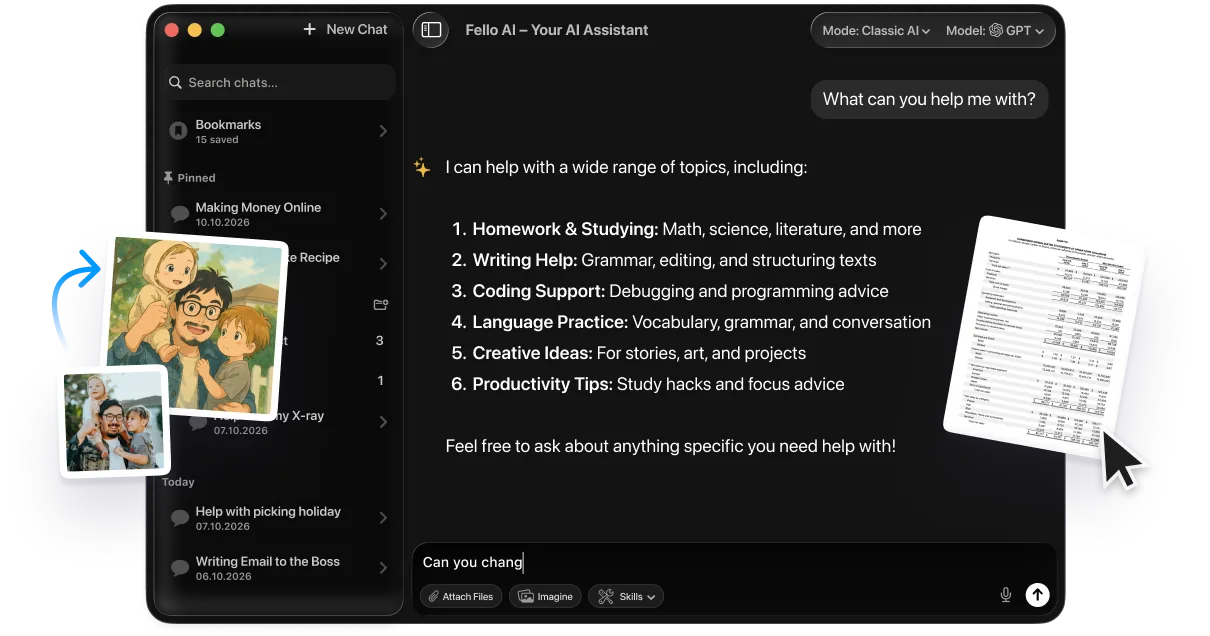
If you are paying for ChatGPT, Claude Pro, and Google AI Pro just to compare model outputs, there is a simpler setup. Fello AI is a native Mac app that routes your prompts to ChatGPT, Claude, Gemini, Grok, and DeepSeek through one interface, for $9.99/month. One price, every top model, no tab switching.
That matters in a world where OpenAI ships a new GPT-5 variant every six weeks, and where each one competes head-to-head with releases from Anthropic, Google, and xAI. If GPT-5.6 wins on agentic coding today but Claude or Gemini edges ahead on a specific task next month, you can switch models inside the same app without changing your workflow.
You can download Fello AI on the App Store and run every one of these models side by side on Mac, iPhone, and iPad, for $9.99/month. It works as an alternative to stacking three separate subscriptions, or as a complement to the one you already pay for, and it handles images, documents, and spreadsheets rather than chat alone.
For context on persistent memory, see Anthropic’s new agent memory system.
For practical tips on how to use ChatGPT effectively, see our full guide.
Conclusion
The GPT-5 family has moved fast. In eleven months, OpenAI has gone from a capable general-purpose model to one that operates software like a human, holds an entire codebase in context, and outperforms industry professionals on knowledge work benchmarks across 44 occupations. GPT-5.5 made multi-step agentic coding workflows viable without human supervision, and GPT-5.6’s Sol tier now leads the family on exactly that work.
For most users the everyday choice is now GPT-5.6 Luna, which brings frontier-family quality down to $0.20 / $1.20 per 1M tokens, which as of the July 30, 2026 cut matches the legacy GPT-5.4-nano on input and beats it on output. For professional workflows that need agentic coding, a 1M-token context, or maximum reasoning depth, GPT-5.6 Sol is now the model to reach for, with GPT-5.5 still a strong fallback. And when the job isn’t ChatGPT’s strength at all, our guide on when to use which AI shows which model to open instead. If you are building anything that will still be running in 12 months, keep an eye on ChatGPT 6, the shift from tool to autonomous collaborator is coming.
FAQ
What is the latest ChatGPT model in 2026?
GPT-5.6, made public July 9, 2026. It ships in three tiers, Sol (flagship), Terra (balanced), and Luna (cheapest), and is selectable across ChatGPT’s paid tiers, Codex, and the API. Sol scores 88.8% on Terminal-Bench 2.1 (91.9% in Sol Ultra mode) and all three tiers share a 1.05M-token context window. GPT-5.5 remains available as the previous flagship.
What is the difference between GPT-5.4 and GPT-5.5?
GPT-5.5 outperforms GPT-5.4 on every frontier benchmark, most notably Terminal-Bench 2.0 (82.7% vs 75.1%), OSWorld-Verified (78.7% vs 75.0%), and SWE-Bench Pro (58.6% vs 57.7%). The trade-off is price, GPT-5.5 standard is $5 / $30 per 1M tokens, double GPT-5.4’s $2.50 / $15. GPT-5.5 Pro pricing matches GPT-5.4 Pro at $30 / $180.
What is the difference between GPT-5.3 and GPT-5.5?
GPT-5.5 adds native computer use, a 1M-token context window, and significantly stronger reasoning and agentic coding performance. GPT-5.3 Instant was dramatically cheaper at roughly $0.30 / $1.20, but it is no longer sold through the API, so the current budget equivalent is GPT-5.6 Luna at $0.20 / $1.20, which since the July 30, 2026 cut costs less than the legacy GPT-5.4-nano at $0.20 / $1.25.
Is GPT-5.5 worth the price?
For agentic workflows, computer use, and professional coding, yes, though GPT-5.6 Sol now costs less, $4 / $20 against GPT-5.5’s $5 / $30, and scores higher on agentic coding, so Sol is the better buy. For standard writing and chat, GPT-5.6 Luna at $0.20 / $1.20 covers the job for a sixteenth of the price. Use the cheap tier by default and reach for the flagship only when the task genuinely needs it.
When is ChatGPT 6 coming out?
No official date. With GPT-5.6 already public and no GPT-6 announcement, late 2026 or into 2027 is the most common estimate. Sam Altman has confirmed it will come sooner than the gap between GPT-4 and GPT-5.
Which ChatGPT models are being retired in 2026?
Fifteen legacy snapshots lose API access on July 23, 2026, including five Codex snapshots (gpt-5-codex, gpt-5.1-codex, gpt-5.1-codex-max, gpt-5.1-codex-mini, gpt-5.2-codex), both chat-latest aliases, both deep-research snapshots, and the original computer-use preview. A larger wave follows on October 23, 2026, covering GPT-3.5 Turbo, GPT-4, GPT-4 Turbo, o1, o3-mini, o4-mini, and gpt-image-1, then a third on December 11, 2026 takes the original GPT-5 snapshots, o3, and o3-pro. All three are API-only; the ChatGPT model picker is unaffected.
Which ChatGPT model is best for coding?
GPT-5.6 Sol is the top pick for agentic, multi-step engineering tasks, with Sol Ultra mode for the hardest problems (88.8% and 91.9% on Terminal-Bench 2.1). GPT-5.5 and GPT-5.5 Pro remain strong alternatives, and GPT-5.3-Codex is still a solid lower-cost option for large-codebase work with its 1M context.