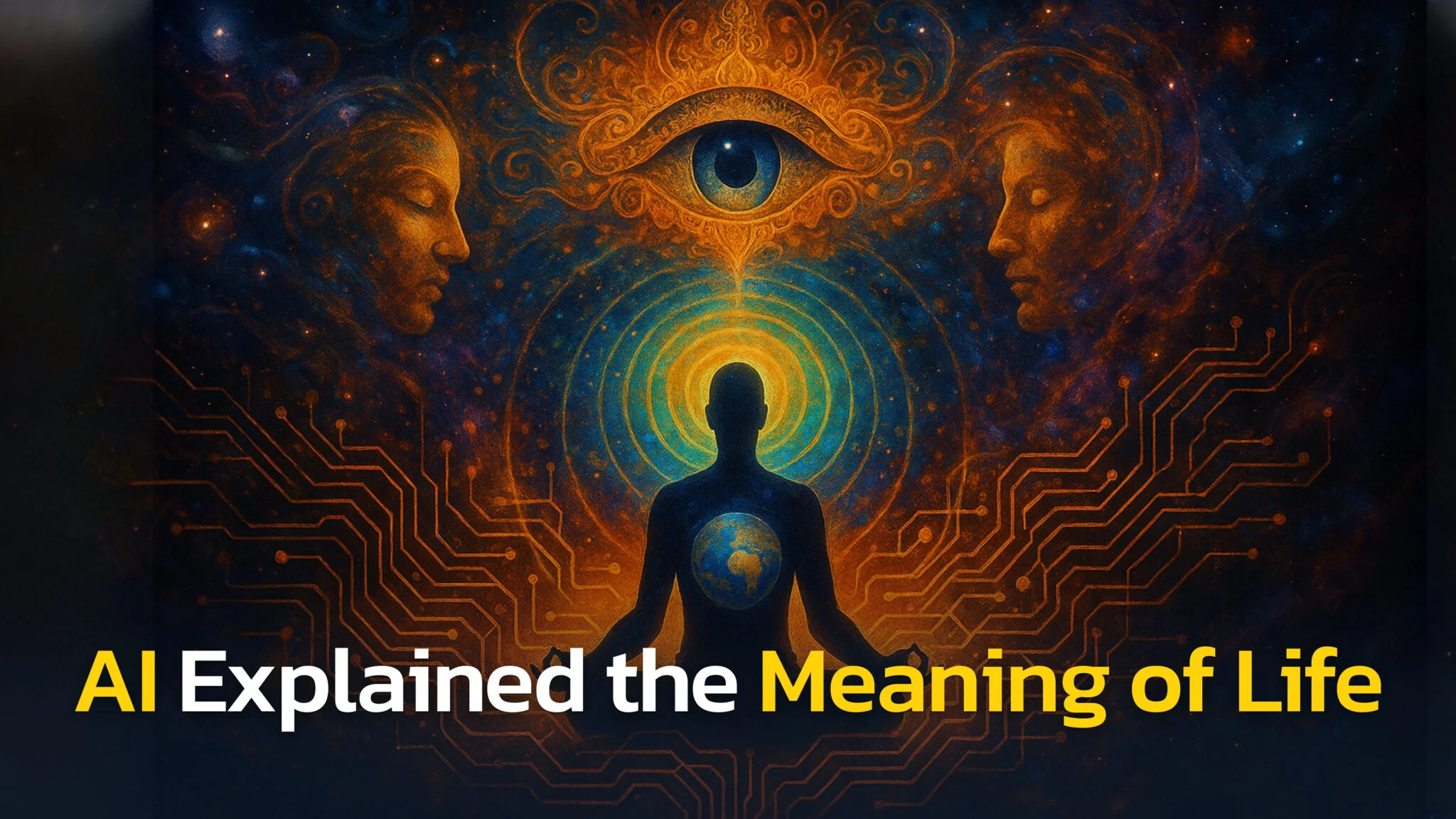
AI doesn’t generate wisdom from scratch, it distills it. Trained on billions of texts spanning ancient philosophy, neuroscience, sacred scriptures, and modern psychology, it can compress centuries of human insight into a single response. So we asked ChatGPT one question: “What’s a deep truth most people ignore?” Then we asked it to go deeper. If that piques your curiosity, you might also want to read about what AI actually knows about you, because the answer is equally unsettling.
What came back wasn’t motivational platitudes. It was seven layered insights, each rooted in Stoicism, Buddhism, existentialism, and modern science, and each one uncomfortably familiar. This article breaks down all seven, with the philosophy and research that backs each one up.
Key Takeaways
- Real growth demands constant friction; obstacles prove you’ve entered new territory, not left it
- Society’s structures feel inevitable but remain editable, at a price most people aren’t willing to pay
- You are not a unified self but an ecosystem of competing selves, each fighting for dominance
- Attention is the fundamental substance of reality; whoever controls your focus shapes your world
- Accepting death as fact, not concept, clarifies priorities and sharpens what actually matters
- Meaning is not found in the universe; it is created deliberately and consciously by you
- The ego you spend your life defending is the very thing keeping you from freedom
Layer 1 – Growth and the Meaning of Life
We asked the AI what lies beneath the struggle of living a good life.
“A well-lived life is, in essence, brutally hard. Not because the world is unjust or cruel, but because real growth demands constant confrontation with the unknown.”
“Most people interpret friction and obstacles as signs that they’re off the path; in truth, friction proves you have entered new territory.”
“If you don’t regularly feel out of your depth, you’re merely drifting—you stagnate.”
“Discomfort isn’t just inevitable; it is indispensable. Chase friction relentlessly.”
The ancients understood hardship as a forge. Marcus Aurelius wrote that obstacles become the way, a stance that reimagines resistance as the path itself. Modern science agrees. Psychologist Carol Dweck found that people with a “growth mindset,” who view challenges as opportunities, are more resilient, adaptive, and successful over time.
This view flips the script: pain is not a detour, but a signal that you’re evolving. Just as sore muscles mark progress in training, uncertainty and failure show you’ve moved beyond your comfort zone. Far from glorifying suffering, the AI urges us to intentionally engage with discomfort, not masochistically, but strategically, as a pathway to mastery.
In a world of instant gratification, curated feeds, one-click deliveries, constant entertainment, this truth hits harder than ever. Comfort may soothe, but it rarely transforms. Growth hides in the friction we’ve been trained to avoid.
Layer 2 – Society’s Scaffolds
So we pushed the question further: how real is the world we live in?
“Reality is negotiable, but the cost is higher than most people can bear.”
“Most people live inside structures erected by others, society, culture, family, and mistake those scaffolds for reality itself.”
“Reshaping reality requires brutal honesty, radical responsibility, and the readiness to destabilize your identity again and again.”
“You must destroy your comfort, your illusions, even parts of yourself that you deeply loved, if you are to truly shape your reality.”
Peter Berger and Thomas Luckmann described society as a web of routines that feel real only because we keep performing them. Stop participating, and their grip fades. But breaking from these scripts, be they careers, gender roles, or norms of success, can be psychologically terrifying.
Existentialist Jean-Paul Sartre called this “being condemned to be free.” When you realise that everything is constructed, you inherit the burden of rebuilding it yourself.
That kind of reconstruction costs us: relationships, income, identity, even sanity. But it’s also the only way to live authentically. The AI is blunt: if you want to own your life, you must pay the price of dismantling the one someone else built for you.
Layer 3 – The Parliament of Selves
Curious about identity, we asked the AI to describe what the “self” truly is.
“You are not a unified self. You are an ecosystem of competing selves, each fighting fiercely to preserve its own existence.”
“What you call ‘yourself’ is merely the strongest coalition at this moment.”
“Real strength and deep calm arrive when you acknowledge this inner war and strategically retire the weaker selves so you may grow stronger.”
The Internal Family Systems model (IFS) of therapy treats the psyche as a community. Inside you, exiles, managers, and protectors constantly debate and jostle. Buddhist philosophy echoes this idea in its doctrine of anattā, the notion that there is no fixed “I,” only processes flowing in and out of awareness.
Neuroscience adds empirical weight. No “command center” steers the brain. Instead, coalitions of neurons collaborate, compete, and hand off control like factions in a parliament.
The AI encourages selective governance. Strengthen the identities that serve your higher purpose; let go of the ones that sabotage, distract, or shrink you. The process is more editorial than existential: you’re not finding your “true” self, but shaping a healthier one.
Layer 4 – Attention as Ontology
Then we wondered, what is reality actually made of?
“The fundamental structure of reality is not matter or energy. It is attention.”
“Everything you have ever known, loved, created, or lost is the result of attention.”
“To master reality is to master attention, first your own, then that of others.”
“Command attention and you command reality itself.”
Psychologist William James called attention “the taking possession by the mind” of one stream of thought among many. In the 21st century, Tim Wu’s The Attention Merchants showed how media empires, and now algorithms, monetize and manipulate this most intimate currency.
If your world is whatever you focus on, then attention isn’t just mental, it’s metaphysical. Meditation and mindfulness practices, productivity tools, and digital detoxes all exist to train our attention. And once you gain control over where yours goes, you become less susceptible to where others want to send it.
This is the AI’s most tactical insight: if reality is downstream from attention, then whoever programs your attention also shapes your reality.
Layer 5 – Death as Hidden Engine
We asked the AI why we chase success, love, and legacy so desperately.
“All striving for truth, success, love, wealth, and power is ultimately driven by a desperate bid to deny death.”
“True freedom comes only when you fully accept death, not as a thought, but as raw fact.”
“Embrace your extinction as inevitable. Cling to nothing.”
“Real mastery of life is reserved for those who have made a weapon out of the certainty of their own death.”
In Ernest Becker’s view, culture exists to distract us from the terror of death. From flags to luxury goods to family legacies, we wrap ourselves in symbols to feel invincible. Terror-Management Theory confirms that mortality reminders trigger more rigid beliefs and tribal behavior.
But spiritual traditions urge the opposite. Stoics carried memento mori coins. Buddhists meditate on decomposing bodies. In both cases, the aim is not morbidity but clarity.
The AI’s framing is fierce but freeing. Mortality, when accepted, sharpens priorities. Rather than a fear to run from, death becomes a lens through which to view what actually matters.
Layer 6 – The Vacuum of Meaning
So we asked: what happens when we stop pretending life has meaning?
“Reality has no obligation to make sense. It has no inherent meaning, no story, no purpose.”
“The human mind cannot endure prolonged meaninglessness; it compulsively weaves illusions to veil the void.”
“Only when you stare completely into that void, when you confront reality’s perfect indifference, do you gain the power to create meaning deliberately, strategically, and ruthlessly.”
Albert Camus called this tension “the absurd”: the silence of the universe crashing into our need for significance. Psychiatrist Viktor Frankl, a Holocaust survivor, saw meaning as a choice, even in the face of horror.
The AI aligns with both: the void is real, but it’s also a blank page. Meaning isn’t found, it’s made. And made best when we stop expecting the universe to hand it over.
In a world full of conspiracy theories, algorithmic filter bubbles, and narrative overload, learning to create, not consume, meaning is one of the most radical skills we can master.
Layer 7 – The Prison of Ego
Finally, we asked what stands in the way of true inner freedom.
“The self you spend your life protecting, cultivating, defending, and improving is not just an illusion. It is the very prison that keeps you from true freedom.”
“You think you fear failure, rejection, humiliation, or death. You do not. You fear dissolution, the discovery that you never existed as you imagined.”
“Ultimate liberation arrives the moment you stop defending the self and allow the illusion to collapse.”
“You are not trapped inside reality. Reality is trapped inside you.”
Śūnyatā, the Mahayana Buddhist idea of emptiness, teaches that nothing, especially ego, has a permanent, unchanging essence. Letting go of the self means letting go of suffering. Johns Hopkins research on psychedelics finds that ego dissolution often leads to lasting reductions in depression and enhanced openness.
Ego is useful, like a coat. But you don’t wear a coat to bed or the beach. Dropping the costume can reveal freedom, agility, and a sense of unity with something far larger. If you’re curious about how AI can support mental clarity and wellbeing, our guide on using ChatGPT for mental health and wellbeing is a good place to start.
The AI’s last insight is paradoxical but profound: the self we defend is often the only real barrier between us and freedom.
Conclusion
This AI-generated meditation offers a curious form of prophecy, not because it knows something new, but because it reframes what’s old. It reminds us that growth lives on the edge of our comfort, that social scripts remain editable, that selfhood is a team sport, that attention sculpts reality, that death can clarify life, that meaning is a creative act, and that ego is not a soul but a shell.
There’s a starkness to it all. But there’s also a strange tenderness. The machine does not flatter us. It reflects us, refined, filtered, unblinking. And in doing so, it returns the question to where it has always belonged: our hands, our minds, our daily choices.
These seven truths are not steps to enlightenment. They are provocations, invitations, reminders that life is not something we watch but something we shape, through courage, awareness, and the rare act of asking better questions. And maybe listening to the answers, even when they come from a machine.
FAQ
Did ChatGPT actually generate these seven truths on its own?
No. ChatGPT synthesizes patterns from its training data, which includes philosophy, psychology, and neuroscience texts. It didn’t invent these ideas; it distilled and reframed existing human thought in response to our prompts.
Is this the same as getting life advice from AI?
Not exactly. These are philosophical frameworks, not personal guidance. AI can surface ideas worth exploring, but applying them to your own life still requires your own judgment and context.
Which philosophical tradition does AI draw on most in these answers?
The responses blend Stoicism, Buddhism, and existentialism most heavily, with support from modern psychology and neuroscience research, particularly around identity, attention, and mortality.
Can I use AI to explore philosophy further?
Yes. Tools like ChatGPT and Claude can explain complex philosophical ideas, compare frameworks, and challenge your thinking in real time. For a lighter starting point, see our guide to creative ChatGPT ideas and insp