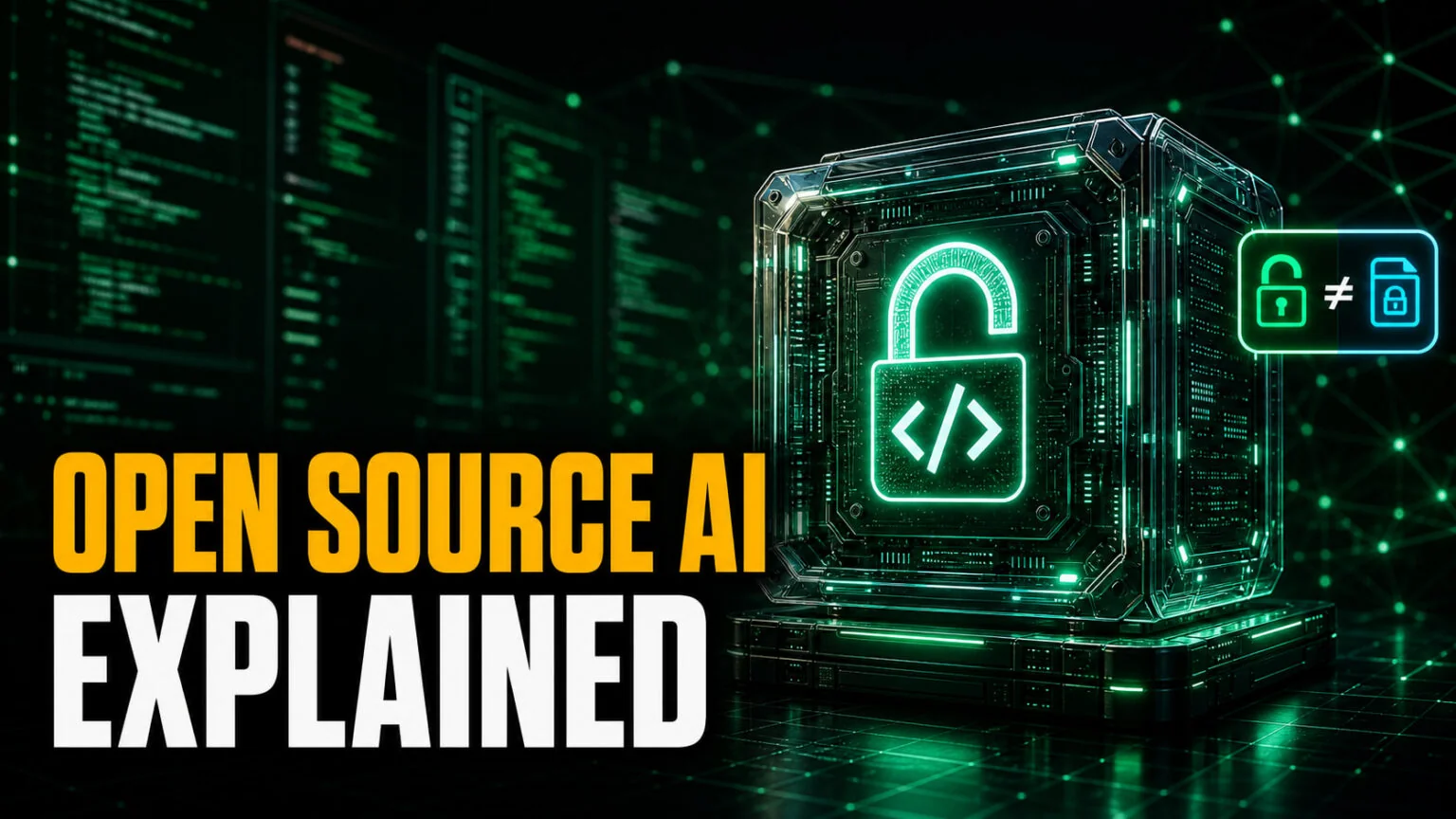
Most AI models people call “open source” are not actually open source. They are open-weight, a narrower thing, and the gap between the two decides what you can legally do with a model, how much you can trust it, and whether anyone could ever rebuild it. In October 2024 the Open Source Initiative finally drew a hard line with its first formal Open Source AI Definition, and by 2026 that line separates a handful of fully open models from the dozens that just look open.
This guide explains what open source AI really means, why the open-weight versus open-source distinction matters to you, and which of today’s big models fall on each side. You will get the plain-English definition, a side-by-side comparison table, current 2026 examples, and an honest look at the benefits and risks before you decide whether to use one. For a concrete example, see how an open model like GLM compares to closed ones such as Claude and GPT.
The Key Takeaways
- Open source AI lets you freely use, study, modify, and share an AI system, per the Open Source Initiative’s four core freedoms.
- The Open Source AI Definition 1.0 (October 2024) requires three things: the model weights, the training code, and detailed training data information, all under open licenses.
- Most “open” models, including Meta’s Llama, are open-weight only; you get the model but not the recipe.
- AI2’s OLMo 3 is one of the few models that meets the full definition, releasing its weights, full training data, code, and checkpoints under Apache 2.0.
- ChatGPT, Gemini, and Claude are closed; DeepSeek, Qwen, GLM, and Kimi are open-weight and free to download.
What Is Open Source AI?
Open source AI is artificial intelligence you can freely use, study, modify, and share. Under the Open Source Initiative (OSI) definition published in 2024, a fully open system releases three components: the model’s weights, the code used to train it, and detailed information about its training data, all under open licenses.
That definition rests on four freedoms borrowed from open-source software. You can use the system for any purpose without asking permission, study how it works and inspect its components, modify it for any purpose including changing its output, and share it with or without your changes. If a license blocks any of those four, the model is not open source in the strict sense.
This is a bigger ask than open-source software. A normal program is open source when you can read and change its code. An AI model is more like a baked cake; the weights are the finished cake, but the recipe and the ingredients are the training code and the training data. To be fully open, a model has to hand over all three, not just slice you a piece.
Open Weight vs Open Source: The Distinction That Matters
Here is the part the marketing usually skips. Open weight means a company lets you download and run a model’s trained parameters, but keeps its training data and training code private. Open source goes further; you also get the training recipe, so a skilled team could rebuild a substantially equivalent model from scratch.
Almost every model the press calls “open source” is really open-weight. Meta’s Llama is the classic case. You can download the weights, run them on your own hardware, and fine-tune them, but Meta never published the training data or the full training pipeline, and its Community License adds commercial restrictions that strict open-source licenses do not allow. The OSI has been blunt that open weights alone do not make a model open source.
Why does this matter to you? Open weights still give you privacy, local control, and freedom from subscription lock-in. But without the data and code, you cannot fully audit what the model learned, reproduce it, or verify claims about bias and safety. The transparency that makes open source trustworthy only arrives when the whole package is released.
Open Source vs Open Weight vs Closed
| Feature | Open source | Open weight | Closed / proprietary |
|---|---|---|---|
| Weights available | Yes | Yes | No |
| Training code | Yes | No | No |
| Training data info | Yes | No | No |
| License | OSI-approved | Custom/restricted | Proprietary |
| Who controls it | Anyone | You run, vendor governs | Vendor only |
| Examples | OLMo 3 | Llama, DeepSeek, Qwen | ChatGPT, Gemini, Claude |
The OSI Definition and Why It Exists
The Open Source Initiative has defined open-source software for over 25 years, but AI broke the old rules because a model is more than code. After a two-year process with researchers, companies, and advocates, the OSI released the Open Source AI Definition (OSAID) 1.0 in October 2024.
To qualify, a system must share data information detailed enough that a skilled person could build a substantially equivalent system, the complete source code used to train and run it, and the model parameters themselves, each under OSI-approved terms. The “data information” compromise was the controversial bit; it allows full descriptions of training data rather than always forcing the raw dataset, which keeps legally sensitive data from blocking openness.
The definition gives the industry a shared yardstick. Before it existed, any company could slap “open source” on an open-weight release and face no pushback. Now there is a standard to measure against, even if most vendors still fall short of it.
Which Models Are Actually Open Source in 2026?
Fully open models remain rare. AI2’s OLMo 3 is the standout; the Allen Institute released its 7B and 32B models under Apache 2.0 along with the full training data, the training code, and thousands of intermediate checkpoints. It is one of the few models that satisfies the OSAID in full.
Most of the powerful “open” models you hear about in 2026 are open-weight, and they are still excellent. The current open-weight field includes DeepSeek V4, Alibaba’s Qwen 3.6, Zhipu’s GLM 5.2, Moonshot’s Kimi K2.7, Meituan’s LongCat-2.0, Google’s Gemma 4, and Meta’s Llama 4. These ship downloadable weights on Hugging Face, run on your own hardware, and rival closed flagships, but they hold back data or code or attach license limits. For a ranked breakdown of the strongest picks, see our guide to the best AI models.
The field keeps moving, and not always toward more openness. Moonshot published the weights for Kimi K3, a reported 2.8-trillion-parameter model, on July 27, 2026, making it the largest open-weight release so far, though it carries a custom Moonshot licence rather than a permissive one. Zhipu then moved the other way. GLM 5.3 launched on August 14, 2026 with its weights held back pending a safety review, the first model in that open line to arrive with nothing to download, and the company says they will follow in stages. It is a useful reminder that “open” is a decision a lab makes with each release, not a permanent property of a model family. Zhipu’s next GLM release is still rumoured for later in the year.
By contrast, ChatGPT, Gemini, and Claude are closed. You can use them through an app or API, but you cannot download, inspect, or modify them. OpenAI has separately released open-weight gpt-oss models you can download, but the ChatGPT product itself stays closed. That trade buys polish and convenience at the cost of transparency and control.
Is ChatGPT, Llama, or DeepSeek Open Source?
ChatGPT is not open source. OpenAI keeps GPT’s weights, code, and data private, so it sits firmly in the closed camp alongside Google Gemini and Anthropic’s Claude.
Llama is open-weight, not open source. You can download and fine-tune it, but Meta withholds the training data and code and limits commercial use through its license.
DeepSeek is open-weight too, released under the permissive MIT license that makes it popular for self-hosting; the company behind it, founded by Liang Wenfeng, publishes weights and code but not its full training data.
Benefits of Open Source AI
The appeal is real, especially if you care about privacy and cost. Open models let you run AI on your own machine, so your prompts and data never leave your device, a strong reason developers favor them over cloud APIs.
The headline benefits include transparency, since you can inspect a model rather than trust a black box; lower cost, because the weights are free to download and run; no vendor lock-in, since you control the deployment; and faster innovation, as a global community fine-tunes and improves shared models. Open weights have powered specialized tools across the board, including many of the best free AI options for coding.
Risks and Limitations
Open does not mean risk-free. Because anyone can download and modify a model, the same openness that aids researchers also helps bad actors strip out safety guardrails, a tension the AI safety community keeps flagging.
The practical downsides are worth weighing. Open models put the maintenance and security burden on you, including patching and monitoring. Quality varies, and self-reported benchmarks from smaller labs are not always independently audited. Running a large model locally needs serious hardware, though smaller distilled versions run fine on a modern laptop. And open-weight licenses can carry commercial restrictions that surprise teams expecting true open source.
How to Try Open Source AI
You do not need a data center to start. The simplest path is a desktop tool that downloads and runs open models locally, which keeps everything private on your machine. If you have an Apple Silicon Mac, our guide to running open source AI models on an M-series Mac walks through the hardware and setup.
If you would rather skip the setup, an app like Fello AI lets you tap powerful models through a clean interface without managing weights or servers yourself. Either way, the open ecosystem means you are no longer locked into a single closed provider.
Conclusion
Open source AI is a spectrum, not a label. A fully open model hands over its weights, code, and data so anyone can rebuild and audit it, while the far more common open-weight models give you the model but keep the recipe. Knowing which is which protects you from marketing and helps you pick the right tool.
If you are ready to choose one, start with our ranked guide to the best open source AI models and match a model to your hardware and use case.
FAQ
What is open source AI in simple terms?
It is AI you can freely download, use, study, change, and share. A fully open model also releases the code and data used to train it, not just the finished model.
Which AI models are fully open source?
Very few. AI2’s OLMo 3 is the standout, releasing its weights, training code, and data together. Most models people call open, including Llama, DeepSeek, Qwen, GLM, and Kimi, are open-weight only, so you get the model but not the full recipe. Alibaba’s newest Qwen 3.8 follows the same open-weight approach.
Is open source AI free?
The weights are free to download and run, yes. You still pay for the hardware or cloud time to run them, and some open-weight licenses restrict commercial use.
What is the difference between open weight and open source?
Open weight means you get the trained model but not its training data or code. Open source means you get all three, so the model is fully reproducible and auditable.
Is open source AI safe?
Open models are easier to trust because you can inspect them, but the same openness lets people strip out safety guardrails. You also take on the security and update burden yourself.
Is ChatGPT open source?
No. ChatGPT, Gemini, and Claude are closed, proprietary models. Open alternatives include open-weight models like DeepSeek, Qwen, Llama, and Moonshot’s Kimi K3.