The best free AI courses in 2026 come from Elements of AI, IBM SkillsBuild, Google Cloud, OpenAI Academy, Anthropic Academy, Harvard’s CS50, MIT OpenCourseWare, and fast.ai. The catch nobody tells you is that “free” usually means free to watch, not a free certificate. Most roundups still list Google AI Essentials as free, but it now sits behind Coursera’s $49/month plan, so the course is only free for a 7-day trial.
This guide sorts every major free AI course into three honest tiers. The first tier is fully free with a free certificate, the second is free to learn but charges for the certificate, and the third is free with no certificate at all. You’ll see exactly what each one costs, how long it takes, and who it’s for, whether you’ve never written a line of code or you want to train your own models. Pick the one that fits your goal, then start practising what you learn. If you want the bigger picture first, our guide on how to learn AI maps out the full beginner-to-builder roadmap.
The Key Takeaways
- Elements of AI is the best fully free pick for beginners, with a free downloadable certificate and over 2 million sign-ups.
- “Free” rarely means a free certificate. Many courses are free to watch but charge for the credential.
- Google AI Essentials is no longer free; it now needs Coursera’s $49/month subscription after a 7-day trial.
- IBM SkillsBuild and Google Cloud’s Introduction to Generative AI both give a free badge with no payment details required.
- Coders should head to fast.ai, Harvard CS50, and MIT OpenCourseWare, all free to learn from.
The best free AI courses in 2026 at a glance
Here are the ten best free AI courses worth your time this year, grouped by how free they actually are. Use the table to scan the trade-off between price, certificate, and depth before you read the full breakdowns below.
| Course | Provider | Free to take? | Free certificate? | Length / level |
|---|---|---|---|---|
| Elements of AI | University of Helsinki | Yes | Yes | Self-paced, beginner |
| IBM SkillsBuild: AI Fundamentals | IBM | Yes | Yes (Credly badge) | ~10 hours, beginner |
| Introduction to Generative AI | Google Cloud | Yes | Yes (badge) | 45 minutes, beginner |
| OpenAI Academy | OpenAI | Yes | Partial (rolling out) | Self-paced, all levels |
| Anthropic Academy | Anthropic | Yes | Yes | Self-paced, beginner |
| Google AI Essentials | Google / Coursera | 7-day trial | No ($49/mo) | ~10 hours, beginner |
| CS50’s Introduction to AI with Python | Harvard | Yes | Yes (CS50 cert) | 7 weeks, intermediate |
| MIT OpenCourseWare (AI) | MIT | Yes | No | Self-paced, advanced |
| Practical Deep Learning for Coders | fast.ai | Yes | No | ~14 hours, coders |
| DeepLearning.AI short courses | DeepLearning.AI | Yes | No | ~1 hour each, all levels |
Fully free AI courses with a free certificate
These are the rare courses that stay free from start to finish, including the credential. If you want something to add to your CV or LinkedIn without paying a cent, start here. All five are beginner-friendly and need no prior coding. If you are studying to protect your income rather than switch careers, it is worth knowing which careers stay AI-proof before you commit ten hours to a syllabus.
Elements of AI (University of Helsinki)
Elements of AI is the most respected free AI course on the internet, built by the University of Helsinki and MinnaLearn. More than 2 million people across 170-plus countries have signed up, and finishing it earns a free downloadable certificate. It covers what AI is, what it can and cannot do, and how it affects daily life, with no math or programming required.
The intro course is fully self-paced, and learners in Finland can convert it into 2 ECTS university credits through the Open University. A follow-up course, Building AI, adds light Python for anyone who wants to go further. This is the single best starting point if you’re new to the whole field.
IBM SkillsBuild: AI Fundamentals
IBM SkillsBuild offers a free Artificial Intelligence Fundamentals learning plan that ends with a verifiable Credly digital badge. You create a free SkillsBuild account, search for the course, and start immediately with no payment details required. It runs around 10 hours and is open to students, graduates, and working professionals alike.
The syllabus covers machine learning, deep learning, neural networks, natural language processing, computer vision, and AI ethics, plus a quick hands-on look at running a model in IBM Watson Studio. The badge carries IBM’s name, which gives it more weight on a resume than most free credentials. It’s the strongest free certificate for anyone targeting a tech career.
Google Cloud: Introduction to Generative AI
This 45-minute microlearning course from Google Cloud is the fastest way to earn a real badge. It explains what generative AI is, how it differs from traditional machine learning, and which Google tools you can use to build with it. The course is free and ends with a shareable completion badge.
It’s short and high-level, so treat it as a primer rather than a deep dive. Pair it with one of the longer courses on this list for a fuller picture. If you only have a lunch break, this is the most efficient free win available.
OpenAI Academy
OpenAI Academy is OpenAI’s own free learning hub, with lessons, workshops, and tutorials that span everyday ChatGPT use up to developer-level work. Everything is free to access, and OpenAI’s AI Foundations certification, launched in late 2025, is expanding to the public through 2026. It’s the most direct way to learn the tools straight from the company that builds them. Our guide on how to learn ChatGPT maps the same path step by step.
Because the content is broad, pick a track that matches your goal rather than trying to watch all of it. Beginners should start with the prompting and productivity material. If you want to compare paid plans first, our guide to free AI tool trials shows what each one includes.
Anthropic Academy
Anthropic Academy teaches you how to get the most out of Claude, from prompting basics to building with the API. The courses are free, take only a quick sign-up to start, and several end with a free completion certificate. It’s ideal if Claude is your main assistant or you want to learn prompt design from the team behind it. Our guide to how to learn Claude and Claude Code walks through the full path. Those completion certificates are not the same thing as Anthropic’s paid, proctored exams, which we break down in our guide to Claude certification.
The material leans practical, with real examples you can copy into your own work. Students should also check whether Claude’s student discount applies before paying for any plan. Combined, the Academy and the discount make Claude one of the cheapest serious tools to learn on.
Free to learn, certificate varies
Both of these are excellent and cost nothing to study. One gives you a free certificate if you finish the projects; the other puts the credential behind a paywall. Knowing which is which saves you a nasty surprise at the end.
Google AI Essentials (the one everyone gets wrong)
Google AI Essentials is a solid 10-hour beginner specialization built by Google’s own AI practitioners, covering prompting, productivity, and responsible AI across five short courses. The problem is that almost every “free courses” list still calls it free. On Coursera it now requires a $49/month subscription after a 7-day free trial, so finishing it for free is only realistic if you race through the trial or qualify for financial aid.
The content itself is strong and the certificate looks credible to employers. If you want the credential, budget for at least one month of Coursera. If you don’t, Elements of AI covers similar ground for free.
Harvard CS50’s Introduction to AI with Python
Harvard’s CS50 AI is the gold standard for a free, rigorous introduction to how AI actually works. The full 7-week course is free to study, covering search, knowledge representation, uncertainty, optimization, machine learning, neural networks, and natural language processing through hands-on Python projects. Score at least 70% on every project and you earn a free CS50 certificate from Harvard, with an optional paid edX verified certificate (around $219) if you want that version too.
You’ll need some comfort with Python to keep up, so it suits people who can already code or are willing to learn alongside it. It’s more demanding than the beginner picks above and far more rewarding if you stick with it. For most learners the free CS50 certificate is all you need.
Free AI courses with no certificate (the best content)
Some of the best AI education on the planet comes with no certificate at all. These are for people who care about skills over paperwork, especially anyone who wants to build. They’re free in the fullest sense, just don’t expect a badge at the end.
MIT OpenCourseWare
MIT OpenCourseWare publishes full AI and machine learning courses, including lectures, problem sets, and exams, completely free. The material is more technical than most, with a heavy emphasis on the math and theory behind modern AI. There’s no certificate, but you can list it as self-study from MIT’s curriculum.
This is the route for serious self-learners who want depth over convenience. Pair it with a coding course so you’re applying the theory as you go. It rewards discipline more than any other option here.
fast.ai: Practical Deep Learning for Coders
fast.ai, led by Jeremy Howard, is the most loved free course for people who want to build real models fast. Across roughly nine lessons you train deep learning models for computer vision, natural language, and tabular data using PyTorch and Hugging Face. It assumes about a year of coding experience, preferably in Python, but only high-school math.
The teaching style is top-down, so you build working models early instead of grinding through theory first. There’s no certificate, and that’s the point; the portfolio you build is the proof. It’s the best free path from “I can code” to “I can ship AI.”
DeepLearning.AI and Stanford CS229
DeepLearning.AI runs a library of free short courses, most around an hour, on topics like prompt engineering, building with LLMs, and AI agents. They’re hands-on, frequently updated, and perfect for filling a specific skill gap. There’s no certificate, but the practical value is high. If prompting is the gap you want to close, start with our guide on how to learn AI prompting.
For the academic foundation, Stanford’s CS229 Machine Learning with Andrew Ng is free on YouTube and as a Coursera audit. It’s the canonical machine learning course and pairs well with fast.ai’s practical approach. Together they cover both the why and the how.
Which free AI course should you pick?
If you’ve never coded and just want AI literacy, start with Elements of AI for the foundations and add Google Cloud’s Introduction to Generative AI for a quick badge. Both are free end to end and need no technical background. Add IBM SkillsBuild if you want a stronger certificate for your CV.
If you can already code, go straight to fast.ai and Harvard CS50 AI, then layer in MIT OpenCourseWare and Stanford CS229 for theory. To learn a specific assistant rather than the whole field, OpenAI Academy and Anthropic Academy teach ChatGPT and Claude straight from the source. Our guide on how to learn Google Gemini does the same for Google. Whichever you choose, knowing the best AI models right now helps you decide which tools are worth your practice time.
Are free AI courses worth it?
Free AI courses are worth it for building real AI literacy and prompting skills, and several still give a free certificate. The catch is that many “free” courses are free to watch but charge for the credential, so always check before you start. Elements of AI, IBM SkillsBuild, and Google Cloud stay free end to end, while Google AI Essentials now needs a paid Coursera plan for the certificate.
Employers increasingly care more about what you can do than which badge you hold. A free course plus a small project or portfolio often beats a paid certificate on its own. The fastest way to learn is to take a course and immediately apply it, which is where having the right tools matters.
Practise across every AI model in one place with Fello AI
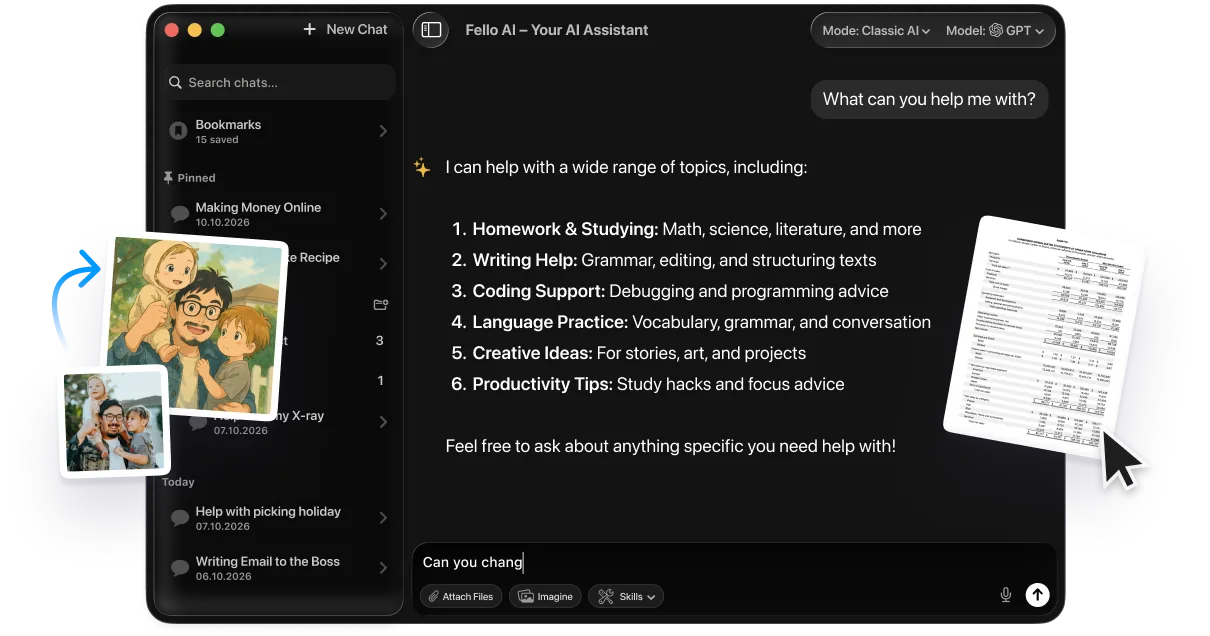
A course teaches you the theory, but you only get good by practising prompts on real models. Fello AI is a Mac app that puts ChatGPT, Claude, Gemini, Grok, and DeepSeek in a single window, so you can run the same prompt across each and see how the answers differ. That side-by-side practice is the fastest way to turn course knowledge into real skill.
Instead of paying for several separate subscriptions, you get many of the top models for one price of $9.99 a month, including DeepSeek. It’s a practical companion to any of the courses above, especially the prompting-focused ones. You can get started with Fello AI in a couple of minutes and start practising what you just learned.
If you’re still deciding which assistant to focus on, our Grok vs ChatGPT comparison is a good place to weigh the strengths of each before you commit your study time. And if you learn better by listening, our guide to using an AI podcast for studying turns your course notes into replayable episodes.
Conclusion
You can learn AI for free in 2026, you just need to know where the real free ends. For a free certificate, start with Elements of AI, IBM SkillsBuild, or Google Cloud’s Introduction to Generative AI. For deeper, build-focused skills, fast.ai, Harvard CS50 AI, and MIT OpenCourseWare are unbeatable value.
Whichever you pick, pair it with hands-on practice across real models so the lessons actually stick. Choose one course today, block out a few hours this week, and start applying what you learn straight away.
FAQ
Are free AI courses worth it?
Yes. Free courses like Elements of AI and IBM SkillsBuild build genuine AI literacy and give a free certificate. Just check whether the certificate is free before you start, since many “free” courses charge for it.
Which free AI course is best for beginners?
Elements of AI from the University of Helsinki is the best beginner pick. It needs no math or coding, takes about 30 hours, and ends with a free downloadable certificate.
Is Google AI Essentials still free?
Not really. The course now sits behind Coursera’s $49 per month subscription after a 7-day free trial, so it’s only free during the trial or with financial aid.
Do free AI courses give a certificate?
Some do. Elements of AI, IBM SkillsBuild, Google Cloud’s Introduction to Generative AI, Anthropic Academy, and Harvard CS50 all include a free certificate or badge. MIT OpenCourseWare and fast.ai don’t offer one.
What’s the best free AI course for coders?
fast.ai’s Practical Deep Learning for Coders is the top free choice for programmers. Pair it with Harvard CS50 AI and Stanford CS229 for a complete, no-cost path into building real AI models.