70% of Americans have little to no confidence that companies will use AI responsibly with their personal data, according to Pew Research. That number tells you everything about where we are right now. AI chatbots are more useful than ever, but the privacy trade-offs are real, and most people feel powerless to do anything about it.
The good news is that you don’t have to choose between using AI and protecting your privacy. From simple settings changes to running AI models entirely on your own device, there are practical steps you can take right now to keep your data under your control. This guide covers every layer of protection available to you in 2026, with links to our detailed platform-by-platform walkthroughs.
The Key Takeaways
- 70% of Americans distrust how companies handle their AI data (Pew Research)
- ChatGPT, Claude, Gemini, DeepSeek, and Grok all collect data by default, but each offers some form of privacy control
- Local AI tools like Ollama and LM Studio run entirely on your device with zero data leaving your machine
- Apple Intelligence processes most AI tasks on-device through Private Cloud Compute
- Simple habits like never sharing passwords or financial details with AI chatbots are your first line of defence
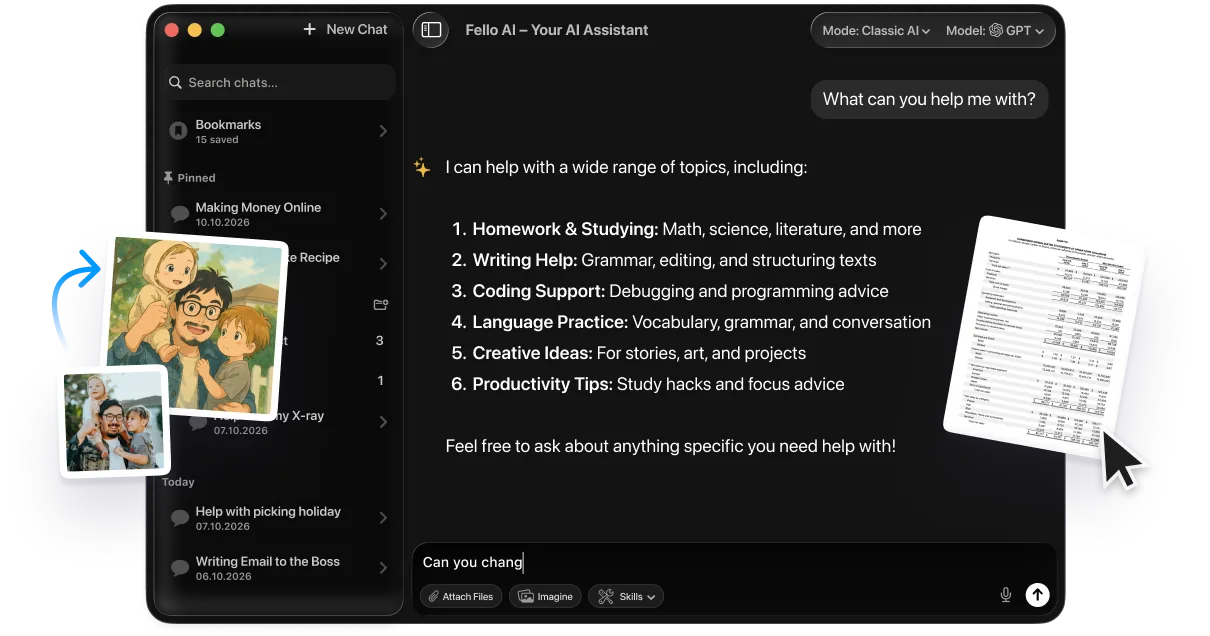
- Fello AI gives you one app to access ChatGPT, Claude, Gemini, and 10+ other models, so you only share your data with one service instead of many
Use Fello AI to Simplify Your AI Privacy
Every time you create an account with a new AI provider, you’re handing your data to another company with its own privacy policy, its own data retention rules, and its own training practices. Fello AI reduces that exposure by giving you one interface to access all the major AI models, including ChatGPT, Claude, Gemini, Grok, Perplexity, and DeepSeek.
To be clear: Fello AI is not a local AI tool. Your prompts do leave your device and are processed in the cloud, just like any other AI chatbot. The privacy advantage is practical rather than absolute.
- One account instead of many — fewer providers with access to your data
- Access to 10+ AI models — ChatGPT, Claude, Gemini, Grok, Perplexity, DeepSeek, and more
- Native macOS and iOS app — built for Apple devices, not a web wrapper
- Image generation included — Flux, GPT Images, and more
- $9.99/month — one subscription replaces multiple AI subscriptions
If you handle truly sensitive data like medical records, legal documents, or trade secrets, a local AI tool (covered below) is the safer choice. But for everyday AI use, consolidating your AI access through a single app means fewer companies hold your data, and that’s a meaningful improvement.
What AI Chatbots Actually Collect
Before you can protect your privacy, you need to understand what you’re protecting it from. Every time you type a prompt into ChatGPT, Claude, or Gemini, the platform typically collects your conversation text, your IP address, device information, timestamps, and usage patterns.
By default, most major AI platforms use your conversations to train future models. That means your prompts, questions, and even the documents you upload can become part of the data that shapes how the AI responds to other users. Human reviewers at these companies may also read your conversations for safety monitoring. If you would rather remove Google’s assistant entirely, follow our guide on how to turn off Google Gemini in Gmail, Chrome and Android.
A 2026 industry survey found that roughly 15% of employees have pasted sensitive data like code, personal information, or financial details into public AI chatbots. And 40% of organisations have already experienced an AI-related privacy incident. That data doesn’t just disappear. It can persist in training datasets, server logs, and backup systems long after you close the chat window.
Curious how much your AI chatbot already knows about you? You can test it yourself. Our guides on prompts that reveal what ChatGPT knows about you and what Gemini knows about you show you exactly what data these platforms have pieced together from your conversations.
How to Use AI Without Giving Up Your Privacy
The fastest way to improve your AI privacy is to disable the settings that let platforms use your data for training. Here’s what each major platform offers.
| Platform | Default Training | How to Opt Out | Privacy Mode | Data Retention After Opt-Out |
|---|---|---|---|---|
| ChatGPT | ON (consumer plans) | Settings > Data Controls > toggle off “Improve the model for everyone” | Temporary Chat | 30 days for safety monitoring |
| Claude | ON (changed September 2025) | Settings > Privacy > toggle off “Help improve Claude” | Incognito Mode | 30 days |
| Gemini | ON (Gemini Apps Activity) | Profile > Gemini Apps Activity > toggle off | Activity deletion | Up to 72 hours |
| DeepSeek | ON (data sent to China) | Limited options; use third-party client | No official mode | Subject to Chinese data laws |
| Grok | ON | Settings > Privacy > disable data sharing | Incognito Mode | Varies by region |
Enterprise and API plans for ChatGPT, Claude, and Gemini are typically excluded from training by default. If you’re weighing the differences between these platforms beyond privacy, our Claude vs ChatGPT comparison breaks down where each one excels.
For a detailed, step-by-step walkthrough of each platform’s opt-out process, check out our full guide on how to stop AI from training on your data.
Use Temporary and Incognito Modes
Even after you turn off training toggles, your conversations are still stored in your account history. Temporary Chat in ChatGPT, Incognito Mode in Claude, and Grok’s Incognito Mode take it a step further. These modes don’t save your conversation after the session ends and don’t use it for model training.
Think of it as the “private browsing” equivalent for AI. The trade-off is that the AI won’t remember context from previous chats, so you’ll need to re-explain things each time. For sensitive queries, that’s a worthwhile trade.
One important nuance: temporary modes protect you from training and long-term storage, but the platform may still retain your data briefly for abuse monitoring. ChatGPT keeps temporary chat data for 30 days, while Gemini holds it for up to 72 hours. No mode offers truly zero-retention processing, but these options drastically reduce your exposure compared to default settings.
You can also use ChatGPT without logging in altogether, which avoids tying conversations to your identity, though OpenAI may still log your IP address temporarily.
Never Share Sensitive Information
This sounds obvious, but it’s the single most important rule. No privacy setting can protect data you’ve already handed over. Never type the following into any AI chatbot:
- Passwords or authentication credentials
- Financial information like bank account or credit card numbers
- Personal identifiers such as your address, phone number, or government ID numbers
- Confidential business data like trade secrets, internal documents, or proprietary code
- Medical records or other protected health information
If you need AI help with sensitive topics, use placeholder data or anonymise the information before pasting it in. For example, replace real names with “Person A” and real account numbers with dummy values. The AI doesn’t need your actual data to give you useful answers.
Platform-by-Platform Privacy Guides
Every AI platform handles privacy differently. We’ve written dedicated guides for each one so you can lock down whichever tools you use. Bookmark this table as your quick-reference hub.
| Platform | Privacy Guide | What It Covers |
|---|---|---|
| ChatGPT | ChatGPT privacy in full | What OpenAI collects, who can see it, every setting |
| ChatGPT | What ChatGPT knows about you | Audit prompts to see your stored data |
| ChatGPT Health | what ChatGPT Health does with your health data | Health records, model training and HIPAA |
| Claude | Claude Incognito Mode | Step-by-step incognito setup |
| Gemini | What Gemini knows about you | Prompts to audit your Google AI data |
| Gemini | Turn off Google AI Overviews | Stop AI from appearing in your search results |
| DeepSeek | Use DeepSeek privately | VPN setup, third-party clients, data risks |
| DeepSeek | Is DeepSeek safe? | Data laws, server locations, safety analysis |
| Grok | Grok Incognito Mode | Step-by-step privacy setup |
| All platforms | Stop AI from training on your data | Opt-out toggles for every major AI |
As platforms update their privacy policies, we update the guides above to match.
Run AI Locally for Maximum Privacy
The most privacy-conscious option is to skip cloud-based AI entirely and run models on your own hardware. Local AI tools process everything on your device. No data leaves your machine, no logs are sent to any server, and no company can train on your conversations. If you’re running a Mac with Apple Silicon, you’re already well-equipped for this. Our guide on the best MacBook for AI covers what hardware you need.
The tradeoff is that local AI is usually slower than cloud-based tools, requires significant storage space for model files, and often delivers lower-quality results than the best hosted models. Performance also depends heavily on your hardware, especially available RAM or GPU memory. While local AI offers strong privacy benefits, it’s not always the best choice if you want maximum speed, convenience, or model quality.
Ollama
Ollama is a command-line tool that makes running open-source AI models as simple as typing a single command. It supports over 100 models including Llama 3, Mistral, and DeepSeek, and runs efficiently on Apple Silicon Macs, Windows, and Linux. If you’re comfortable with a terminal, Ollama is the fastest way to get started with local AI.
LM Studio
LM Studio offers a visual, desktop-app experience for running local AI models. It supports Flash Attention for reduced memory usage and handles large models well even on mid-range GPUs. If you prefer a ChatGPT-like interface without the cloud, LM Studio is your best bet.
AnythingLLM
AnythingLLM takes local AI a step further by adding document processing, workspace management, and RAG (Retrieval-Augmented Generation). It connects to Ollama or LM Studio as a backend and lets you chat with your own files privately. It’s open-source, free, and MIT-licensed.
Private LLM (iOS/macOS)
For Apple users, Private LLM runs AI models directly on your iPhone, iPad, or Mac with no internet connection required. It supports models like Llama 3.3, Phi-4, and Gemma 2, all optimised for Apple devices. Your data never leaves your device.
Use On-Device AI Features
You might already be using on-device AI without realising it. Both Apple and Google have built AI features that process data locally on your device rather than sending it to the cloud.
Apple Intelligence and Private Cloud Compute
Apple Intelligence runs a 3-billion-parameter model directly on Apple Silicon chips for tasks like text summarisation, photo sorting, and smart replies. For heavier tasks that need more processing power, Apple uses Private Cloud Compute, a system where your data is processed on Apple’s servers but is never stored, never accessible to Apple employees, and deleted immediately after processing.
This two-tier system gives you powerful AI features while keeping your personal data on-device or in a cryptographically secured environment. It’s one of the strongest privacy-by-design approaches available in 2026. We covered the full scope of what it can do in our Apple Intelligence explainer.
Android On-Device AI
Google’s Pixel phones and Samsung Galaxy devices also run certain AI features locally, including call screening, live translation, and photo editing. When using these features, your data stays on the device and is never sent to Google’s servers. On-device translation is the one option where the retention question does not arise at all, which is why it earns a section in our guide to the best AI for translation.
The important distinction is between on-device features and Google’s cloud-based Gemini assistant. Gemini runs in the cloud by default and follows different privacy rules. If you use Gemini on Android, make sure Gemini Apps Activity is turned off in your Google account settings to limit data collection. You can also turn off Google AI Overviews in search results if you want to reduce how much Google’s AI interacts with your queries. Samsung’s Galaxy AI features are a mixed bag too, with some processing happening on-device and others routed through Samsung’s cloud servers, so check the settings for each feature individually.
Build a Privacy-First Browsing Stack
For the best protection when using cloud-based AI tools, layer multiple privacy tools together.
Privacy-Focused Browsers
Your browser is the gateway to every cloud-based AI tool you use. Choose one that minimises tracking. Brave blocks trackers and ads by default and includes a built-in VPN option. Firefox with strict tracking protection enabled offers strong privacy without sacrificing compatibility. And DuckDuckGo Browser strips tracking from websites and offers Duck.ai, which proxies your AI requests through DuckDuckGo’s servers, stripping your IP address before forwarding to models like Claude, GPT-4o, and Llama.
VPN for an Extra Layer
A VPN masks your IP address from AI providers, adding one more layer of separation between your identity and your prompts. It won’t stop data collection by the AI platform itself, but it prevents your internet provider and network from seeing which AI services you’re using. This matters because ISPs can sell browsing data to advertisers in many jurisdictions.
A VPN is especially important if you’re using DeepSeek, since the platform routes data through Chinese servers. Our guide on how to use DeepSeek privately walks you through the full setup.
Know the Rules: AI Privacy Laws in 2026
The regulatory landscape is catching up to AI privacy concerns. Two major US developments are shaping 2026, and they give you concrete rights you can actually use.
California’s AI transparency laws (SB-942 and AB 2013, effective January 2026) require disclosure of AI-generated content and transparency about what data was used to train AI models. If you live in California and use a major AI platform, the company must now tell you what training data they used. Violations carry a $5,000 penalty per incident.
Colorado’s AI Act (SB 24-205, effective June 30, 2026) targets high-risk AI systems, the kind that make decisions about your employment, healthcare, or education. It requires AI developers to document how their systems work, mitigate algorithmic discrimination, and give consumers the right to notice, explanation, and appeal.
The EU’s AI Act also continues rolling out provisions through 2026, affecting any AI tool used by EU residents regardless of where the company is based. If you’re outside the US, check your local regulations, as 75+ countries have now implemented or are actively drafting AI-specific privacy laws.
Conclusion
Using AI without giving up your privacy comes down to three things: adjust your settings, choose the right tools, and build smart habits. Turn off training toggles in ChatGPT, Claude, and Gemini. Try local AI tools like Ollama or LM Studio for sensitive work. And never share information with an AI chatbot that you wouldn’t post publicly.
Start with our platform-by-platform privacy guides above, then work your way through the privacy stack. The tools exist. You just need to turn them on.
FAQ
What data do AI chatbots collect?
AI chatbots typically collect your conversation text, IP address, device information, timestamps, and usage patterns. Most platforms use this data to train future models by default unless you manually opt out in your privacy settings,
Can AI companies read my conversations?
Yes. Human reviewers at companies like OpenAI, Anthropic, and Google may access your conversations for safety monitoring and quality assurance. Using privacy modes or opting out of training reduces but does not eliminate this possibility.
Is running AI locally better for privacy?
Running AI locally is the most private option available. Tools like Ollama and LM Studio process everything on your device with no data sent to external servers. The trade-off is that local models are typically less powerful than cloud-based options like ChatGPT or Claude. If you want cloud-grade models without that exposure, Proton’s Lumo AI runs open-weight models behind zero-access encryption and a no-logs policy.
Does a VPN help with AI privacy?
A VPN hides your IP address from AI providers, which adds a layer of anonymity. However, it does not prevent the AI platform from collecting your conversation data. Use a VPN alongside privacy settings and temporary chat modes for the best protection.
Are AI privacy laws protecting consumers in 2026?
Yes. California’s AI transparency laws (SB-942, AB 2013) took effect January 1, 2026, and Colorado’s AI Act follows on June 30, 2026. The EU AI Act is also rolling out new provisions. These laws give consumers rights to transparency, explanation, and appeal when AI systems make decisions that affect them.