Thumbnail for “Gemini 3.5 Review: What Google Launched at I/O 2026” showing bold amber and white headline text reading “Gemini 3.5 Review: Flash Beats Pro?” beside a glowing Gemini 3.5 app-style card on a dark blue and purple neon background, with an “I/O 2026” badge in the corner.

Gemini 3.5 Pro Release Date: What We Know (+ Flash Review)

Google split Gemini 3.5 into two launches, and only one has actually arrived. Gemini 3.5 Flash went live on May 19, 2026 at Google I/O 2026 and did something Google had never done before, with the cheap, fast “Flash” tier beating the previous flagship on coding. The other half, Gemini 3.5 Pro, is the model everyone is waiting on, and its release date has now slipped by months. Google’s own position, published on July 21, 2026, is that Pro is “currently testing with partners”, with no date attached. This article covers both sides. You get what Gemini 3.5 Flash delivers today, the full benchmarks against Gemini 3.1 Pro, and pricing. […]

Cinematic widescreen thumbnail in warm yellow and amber tones reading “IS NANO BANANA FREE? / LIMITS & HOW TO,” with a glowing smartphone on the right showing a stylized banana image inside an AI image-generation interface. The background is dark and atmospheric with glossy lighting and a premium tech-magazine feel.

Is Nano Banana Free? Limits & How to Use It Free (2026)

Yes, Nano Banana is free. You can generate and edit images with Google’s viral Nano Banana model right now without paying a cent, using either the Gemini app or Google AI Studio. The free tier runs on Nano Banana 2 (officially Gemini 3.1 Flash Image), hands you roughly 20 images a day, and reaches all the way up to 4K resolution. The catch lives in the details. Free access comes with daily limits, a visible watermark, and a quiet downgrade to a weaker model once you run out of the good generations. This guide breaks down exactly what is free, where to use it, how many images you actually get, […]

Is Google Gemini Free? thumbnail showing a glowing blue and purple Gemini logo with a $0 badge on a dark cinematic background.

Is Google Gemini Free? Free Plan Explained (2026)

Yes, Google Gemini is free to use. The free plan costs $0 with no credit card, and it is not a stripped-back demo. Google’s plans page now lists the free tier as access to Gemini 3.6 Flash, the model it shipped on July 21, 2026, plus varying access to the stronger Gemini 3.1 Pro, image generation, voice conversations, and Deep Research. For a lot of people, that free tier is all they will ever touch. The catch is limits, not features. Free Gemini runs on daily usage caps, holds back video generation, and meters the most powerful models, which is where the paid Google AI Plus at $4.99, Pro at […]

Learn Gemini for Free thumbnail featuring a modern smartphone displaying the glowing Google Gemini logo and an abstract dark-mode app interface against a blue and purple neon background.

How to Learn Google Gemini in 2026: A Free Beginner’s Guide

The fastest way to learn Google Gemini in 2026 is free, because the Gemini app gives you Gemini 3.6 Flash at no cost, the free default since July 21, 2026, plus a daily allowance of the stronger Gemini 3.1 Pro, Nano Banana 2 image generation, five Deep Research reports a month, and the Gemini Live voice mode. You do not need a paid plan, a coding background, or a single course to start getting useful work out of it today. If you are not sure which version to lean on, our Gemini model comparison explains where Flash, Pro, and Flash-Lite each fit. This guide gives you a free, beginner-friendly Gemini […]

Thumbnail for “Android XR Glasses vs Apple AI Glasses” showing two futuristic smart glasses facing off across a neon blue and purple split background. Large bold text reads “Android XR Glasses vs Apple AI Glasses,” highlighting the 2026 vs 2027 smart glasses race.

Android XR Glasses vs Apple AI Glasses: The 2026 vs 2027 Smart Glasses Race

The smart glasses race just got real. Google and Samsung unveiled their Android XR glasses at Google I/O 2026 on May 19, with a confirmed Fall 2026 ship date, partnerships with Warby Parker and Gentle Monster, and Gemini AI built into every interaction. Apple’s answer, code-named N50, is still roughly a year away, with Bloomberg’s Mark Gurman pegging a 2027 launch and production starting at the end of 2026. That roughly 9 to 12 month gap is the entire story. If you want AI glasses on your face this year, Android XR is the only ticket, and yes, it works with iPhone. If you live deep inside the Apple ecosystem […]

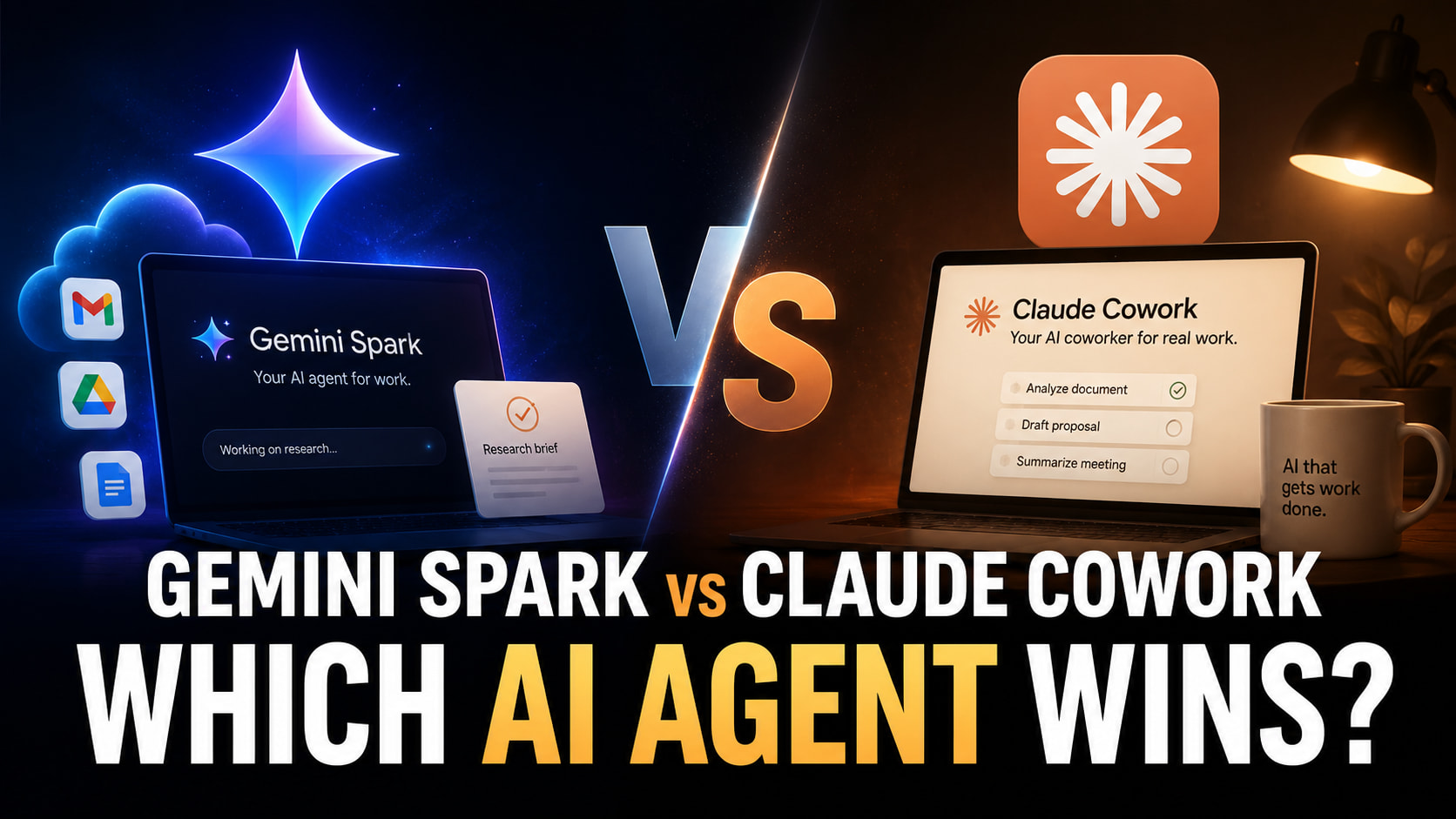
Thumbnail for “Gemini Spark vs Claude Cowork: Which AI Agent Wins?” showing a split-screen AI agent showdown, with Gemini Spark in blue cloud-style lighting on the left and Claude Cowork in warm orange desktop lighting on the right. Large bold text reads “Gemini Spark vs Claude Cowork — Which AI Agent Wins?”

Gemini Spark vs Claude Cowork: Which AI Agent Actually Gets Work Done?

On July 23, 2026, Gemini Spark stopped being a luxury purchase. Google’s 24/7 agent launched at I/O on May 19, 2026 locked behind the $99.99/month Google AI Ultra tier. It now reaches Google AI Pro subscribers at $19.99/month, within pennies of what Claude Cowork costs on Claude Pro. Anthropic shipped Cowork in general availability back on April 9, 2026, so Gemini Spark vs Claude Cowork is the AI-agent comparison most knowledge workers actually need this year. What changed in July is that it is no longer a price question. You came here for a verdict, not a press recap, so this guide does four things. It tells you what each […]

Thumbnail with bold headline “GEMINI PRICING 2026 / COMPLETE GUIDE TO PLANS, API COSTS, VERTEX AI & WORKSPACE” in yellow and white text on a dark blue gradient background, featuring a glowing Gemini logo tile on the right.

Gemini Pricing 2026: Complete Guide to Plans, API Costs, Vertex AI and Workspace

Google now sells Gemini four different ways, and the cheapest entry point just got cheaper again. Gemini 3.6 Flash landed on July 21, 2026 at $1.50 per million input tokens and $7.50 per million output tokens, a 17% output price cut against the 3.5 Flash it replaces. On the consumer side the ladder now runs Google AI Plus at $4.99 per month, Google AI Pro at $19.99 and Google AI Ultra from $99.99. This guide covers every part of Gemini pricing in 2026, fully updated for the I/O 2026 changes. We walk through the restructured consumer plans, the API token rates for Gemini 3.6 Flash, Gemini 3.1 Pro and the […]

Futuristic digital illustration showing a glowing human head with a circuit-like brain illuminated in neon purple and orange, facing a robotic hand reaching toward it, with cosmic clouds, planets, data streams, and a city skyline in the background. Bold headline text reads: “Gemini 3.1 Pro Just Changed the AI Race — And Nobody’s Talking About This.”

Gemini 3.1 Pro Is Here: Benchmarks, Pricing, and How It Stacks Up Against Claude and GPT

Google released Gemini 3.1 Pro on February 19, 2026, and its benchmark numbers are hard to ignore. The model scored 77.1% on ARC-AGI-2, a test specifically designed to prevent AI from relying on memorised answers — it forces genuine reasoning on problems the model has never encountered before. That is more than double the 31.1% scored by Gemini 3 Pro when it launched just three months ago. Google has since launched Gemini 3.5, whose Flash model now beats Gemini 3.1 Pro on coding and agentic benchmarks. This article covers everything you need to know about Gemini 3.1 Pro, including what changed from the previous version, how it performs against Claude […]

Illustration comparing AI models: GPT-5.2 highlighted in the center with icy, warning visuals, flanked by GPT-4 on the left and Claude 4.5 on the right. The image emphasizes controversy around GPT-5.2, with a snowflake icon, warning symbol, and the text “Why Is GPT-5.2 So Controversial?” suggesting strong benchmarks but negative user reception.

GPT-5.2 Is a Monster on Benchmarks – So Why Do Users Hate It?

OpenAI is under real pressure again. In late 2025, Google’s Gemini 3 and Anthropic’s Claude Opus 4.5 closed what used to be a comfortable performance gap. Benchmarks tightened. User sentiment shifted. For the first time in years, OpenAI was no longer the unquestioned leader across reasoning, coding, and everyday usability at the same time. Just weeks after GPT-5.1 — and only a couple of months after GPT-5.0 — OpenAI shipped GPT-5.2. Internally, this followed what multiple reports describe as a “Code Red” moment: a company-wide push to improve ChatGPT’s competitiveness after Gemini 3 began outperforming OpenAI models on several internal and external evaluations. On paper, GPT-5.2 looks like a major […]