
NVIDIA AI Agent Brain cover showing a glowing NVIDIA chip controlling connected AI agent icons, with the title “NVIDIA’s AI Agent Brain” and subtitle “Nemotron 3 Ultra: 550B AI Model.”

NVIDIA Nemotron 3 Ultra With 550B parameters Just Released

On June 4, 2026, NVIDIA released Nemotron 3 Ultra, a fully open 550 billion parameter reasoning model built specifically for long running agents. According to benchmark platform Artificial Analysis, it is now the most capable open model to come out of a US lab, scoring 48 on the Artificial Analysis Intelligence Index. That puts it well ahead of every other open American model and lands it in what Artificial Analysis calls the most attractive quadrant on its chart, combining high intelligence with fast output speed. Microsoft entered the in-house model race days earlier with its MAI lineup at Build. What makes Nemotron 3 Ultra different is the design goal. NVIDIA […]

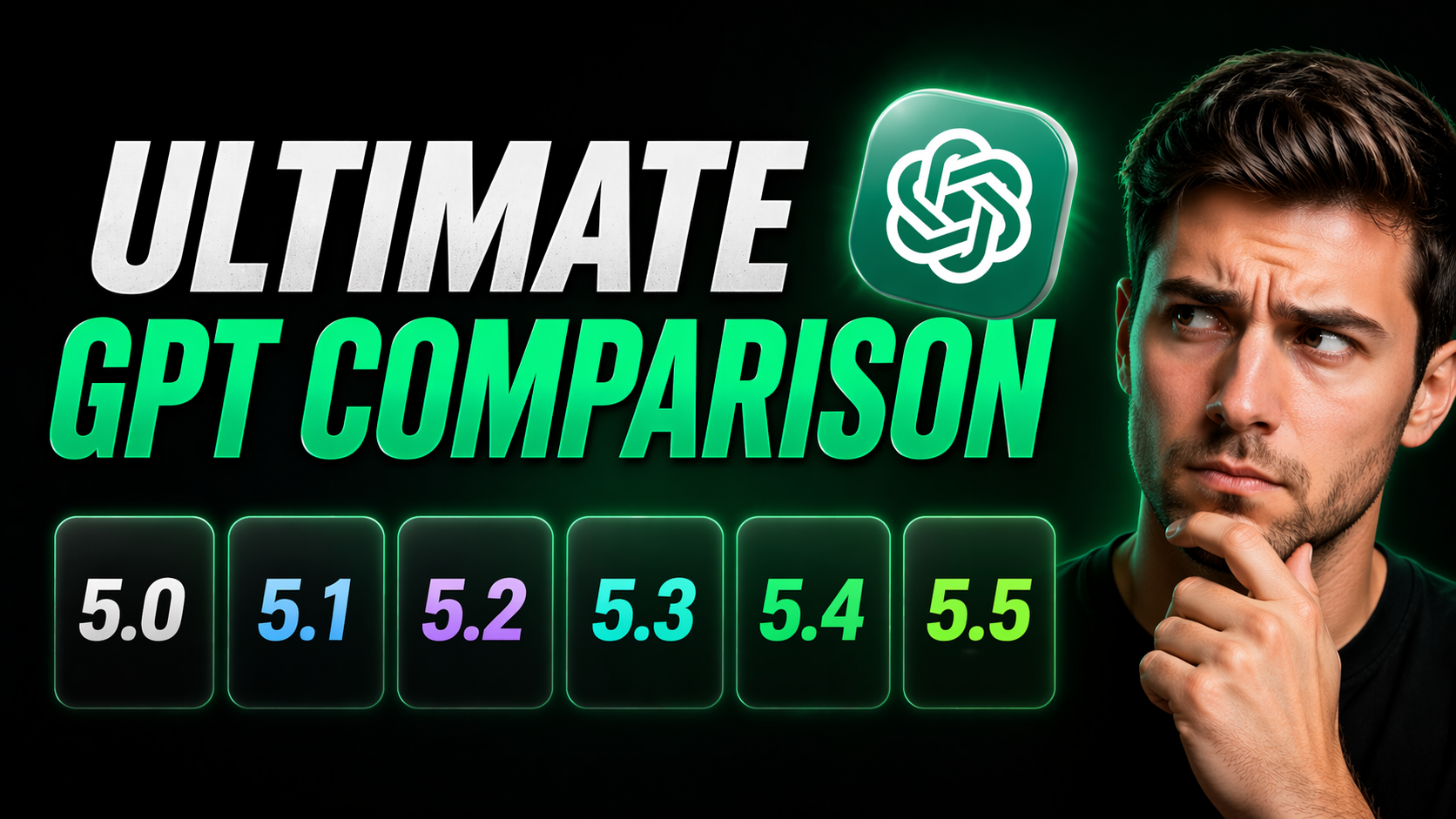
Thumbnail showing large text reading “ULTIMATE GPT COMPARISON” on a black background, with the OpenAI logo glowing green near the top center and six rounded boxes below labeled 5.0, 5.1, 5.2, 5.3, 5.4, and 5.5 in different bright colors. On the right, a man in a black shirt poses thoughtfully with his hand on his chin, looking toward the text.

The Ultimate ChatGPT 5 Model Comparison: GPT-5.0 vs 5.1 vs 5.2 vs 5.3 vs 5.4 vs 5.5

OpenAI dropped GPT-5.5 on April 23, 2026, and it is now the most capable ChatGPT model the company ships. GPT-5.5 scores 93.6% on GPQA Diamond, 82.7% on Terminal-Bench 2.0, and 78.7% on OSWorld-Verified, all ahead of GPT-5.4, while its Pro variant pushes BrowseComp to 90.1% and FrontierMath Tier 4 to 39.6%. In under nine months, OpenAI has shipped six distinct versions of GPT-5, each with its own identity and price point. If you have lost track of what separates GPT-5.0 from GPT-5.5, this guide covers every model in the family, release dates, context windows, benchmarks, pricing, and the key differences that actually matter. We also look ahead at what ChatGPT […]

Soft pastel gradient background with centered white text: “All You Need to Know About GPT-5.5” and OpenAI logo.

GPT-5.5 Released: Everything You Need to Know

On April 23, 2026, OpenAI introduced GPT-5.5, its most capable model to date and the first fully retrained base model since GPT-4.5. The release brings state-of-the-art scores on Terminal-Bench 2.0, OSWorld, and GDPval, a much stronger agentic coding profile in Codex, a new Pro tier, and a pricing step up that reflects the jump in intelligence. GPT-5.5 is rolling out to Plus, Pro, Business, and Enterprise users across ChatGPT and Codex. GPT-5.5 Pro is available to Pro, Business, and Enterprise tiers. For anyone using Fello AI on Mac, iPhone, or iPad, GPT-5.5 will be available in upcoming weeks alongside Claude 4.6, Gemini 3, DeepSeek, Kimi-K2.6, and Perplexity in the same […]

Claude Opus 4.6 brings AI multi-agent coding. Learn what’s new, how it works, key benchmarks, real use cases, and why it matters for developers and teams.

Claude Opus 4.6: Full Breakdown of Anthropic’s New AI Model with 1M Context Window

On February 5, 2026, Anthropic released Claude Opus 4.6 — the latest and most capable model in its Claude lineup. Arriving just three months after Opus 4.5, this release brings a 1-million-token context window to the Opus family for the first time, introduces collaborative agent teams in Claude Code, and delivers benchmark results that put it ahead of GPT-5.2 and Gemini 3 Pro across most evaluations. But the headline number that caught the industry’s attention wasn’t a benchmark score. It was 500 — the number of previously unknown security vulnerabilities Opus 4.6 discovered in open-source code during pre-release testing, with little to no human prompting. This article breaks down everything […]

Comic-style comparison image showing GPT-Image-1.5 vs Nano Banana-Pro, split by a lightning bolt with a bold VS in the center and the headline “Ultimate Comparison.”

Gemini Nano Banana Pro vs GPT-Image-1.5: Ultimate Comparison

The last twelve months have been crazy for AI, and especially for image generation: Midjourney v6, FLUX.2, Seedream 4.5, Nano Banana Pro, and GPT-Image-1.5 have all tried to grab market share. With each new release, the line between synthetic and real continues to blur — and two of the most talked-about contenders in late 2025 are OpenAI’s GPT-Image-1.5 and Google’s Nano Banana Pro. Both aim to make image generation faster, smarter, and more accessible — but they take very different approaches. OpenAI’s GPT Image line replaced DALL·E earlier this year and is now native inside ChatGPT and the API. GPT-Image-1.5, released globally on December 16, 2025, is the latest version […]

A collage of photorealistic AI-generated images including portraits, landscapes, military scenes, and lifestyle photography. In the center, large bold text reads “FLUX.2 Just Dropped! Best Image Generator Now?” The layout suggests a comparison between FLUX.2 and other top image models like Nano Banana Pro, GPT-4o, and Midjourney.

FLUX.2 Arrived — Here’s How It Stacks Up Against Nano Banana, Midjourney & GPT

Today, November 25, 2025, Black Forest Labs released FLUX.2, a new family of image-generation models aimed directly at the high-end creative, marketing, and product-visualization markets. The company, founded in 2024 and known for its open-core approach to multimodal research, positions FLUX.2 as both a frontier-level image generator and a model that can actually hold up in real production workflows—something many AI tools still struggle with. The release comes at a busy time for image-generation models. OpenAI’s GPT-4o tools, Google’s Imagen 4 and Nano Banana Pro, Midjourney v6, and Stability’s SD3 are all fighting for attention. FLUX.2 enters the mix with a clear focus: photorealism, consistent references, reliable text, and practical workflow control. Here’s […]