76% of freelancers now use AI tools in their work and 64% report a meaningful increase in productivity, according to Fiverr’s International Freelancer Day survey of 3,500 freelancers. The biggest time sinks for any freelancer are not the actual client work, they are the business documents surrounding it. Writing proposals, drafting contracts, creating client reports, and polishing professional communications eat up hours that could go toward billable projects.
The problem is that most freelancers cobble together five or more tools to cover these tasks. A single, well-chosen stack of AI for small business solves most of it. ChatGPT for drafting, Grammarly for proofreading, a proposal tool for formatting, a contract template service, and maybe a report builder. That is easily $50+/month in subscriptions before you have even started working. In this guide, we will show you exactly how to use AI for the three documents that matter most to your freelance business, with real prompts you can copy and paste, and how Fello AI lets you handle all of it from a single app.
The Key Takeaways
- 76% of freelancers use AI tools and 64% report increased productivity on business tasks (Fiverr survey of 3,500 freelancers, October 2025)
- Fello AI gives you access to ChatGPT, Claude, and Gemini in one app for $9.99/month, replacing multiple subscriptions
- You can generate professional proposals, draft contracts, and build client reports using the right prompts
- Freelancers using AI workflows consistently report finishing deliverables in significantly less time
- This guide includes copy-paste prompts for proposals, contracts, and reports you can use right now
Why Freelancers Are Switching to AI Tools in 2026
The numbers tell the story. According to Upwork’s 2026 In-Demand Skills report, AI-related freelance skills grew 109% year over year in 2025. Demand for AI-skilled freelancers on the platform more than doubled. But it is not just AI specialists benefiting. Everyday freelancers, designers, writers, consultants, developers, are using AI to handle the business side of freelancing faster. The same skills let you turn AI tools into income instead of only saving time on admin.
What are freelancers actually doing with AI? The pattern is consistent across surveys:
- Drafting proposals and pitches, where freelancers report dramatically cutting the time spent writing and sending proposals each week
- Creating contracts and scope documents, where instead of paying $200+ for a lawyer-drafted template or using a generic one from the internet, AI generates tailored contracts in minutes
- Writing client reports and project summaries, the task most freelancers skip because it feels like unpaid work, now takes 5 minutes instead of an hour
- Proofreading and refining all business communications, from cold outreach emails to project updates
- Researching competitors and markets before pitching, giving proposals a data-backed edge
The biggest motivation? Time savings. Freelancers who adopted AI workflows report consistently finishing client deliverables in significantly less time, getting back hours each week for actual billable work. AI-related skill growth on Upwork also broke down by specialty: AI video generation and editing grew 329% and AI integration grew 178% year over year.
Why Fello AI Is the Best AI Tool for Freelancers
Most “best AI tools for freelancers” lists tell you to download multiple different apps. ChatGPT for writing. Grammarly for editing. Better Proposals for proposal formatting. Bonsai for contracts (now part of Zoom, acquired December 2025). A report builder for client updates. That is five subscriptions, five logins, and five different interfaces to learn.
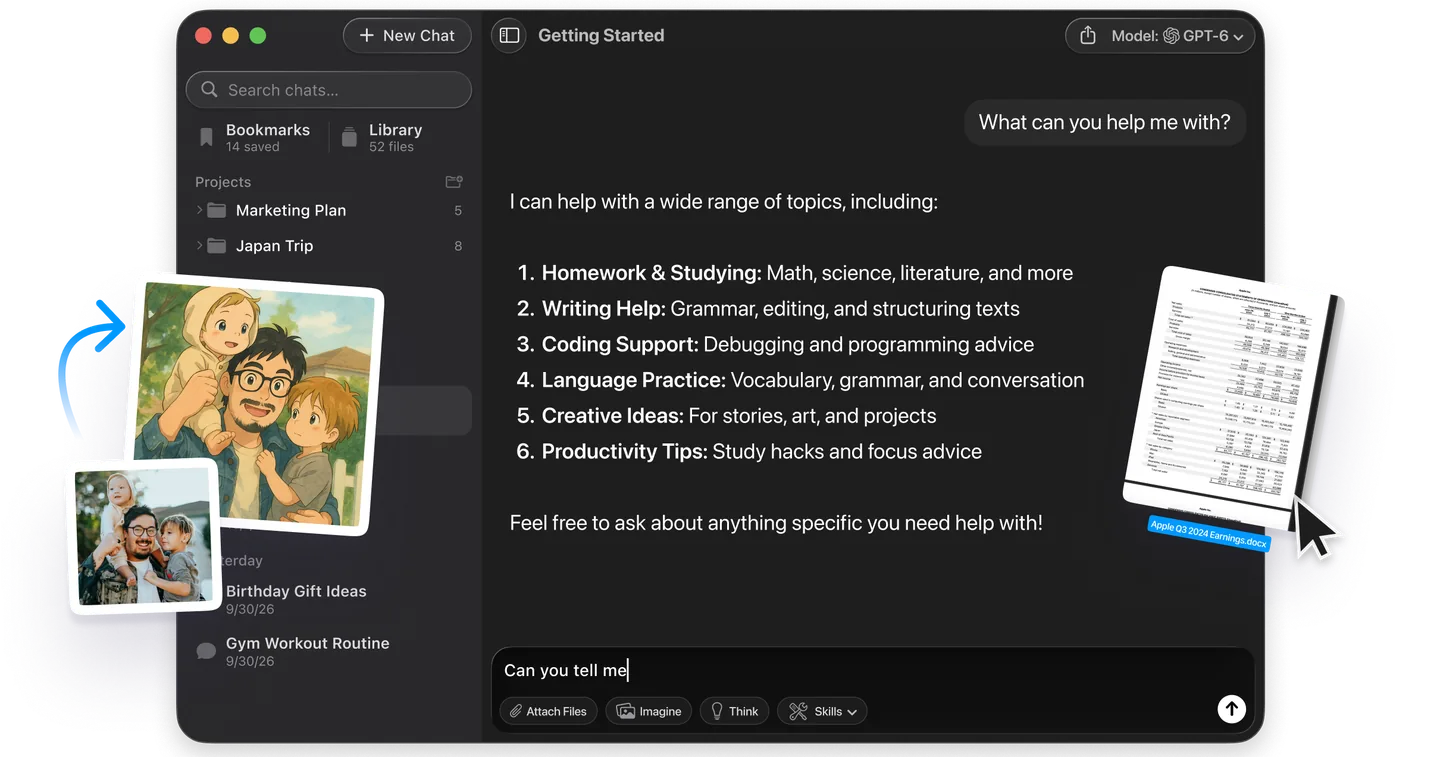
Fello AI takes a different approach. It puts ChatGPT, Claude, and Gemini into a single app on your Mac, iPhone, or iPad. Instead of switching between tools, you pick the best model for each task and work from one clean interface. Freelancers who want full-blown agentic workflows for proposals, contracts, and client reports should look at Claude Cowork, Anthropic’s desktop agent.
Here is what that means in practice:
- Write a client proposal using ChatGPT’s strong text generation, then switch to Claude for a more nuanced edit
- Draft a freelance contract with specific deliverables, timelines, and payment terms
- Generate a client report by pasting project data and asking for a professional summary
- Analyze a client brief PDF by dragging it into Fello AI and extracting key requirements
- Proofread and refine any document with AI-powered editing before sending
All of this for $9.99/month with no ads, no hidden fees, and a free trial to get started. Compare that to paying for ChatGPT Plus ($20/month), Grammarly Pro ($12/month), and a proposal tool like Better Proposals ($19/month per user) separately. That is over $50/month for three tools when one app covers all three use cases.
How to Write Freelance Proposals with AI Using Fello AI
Winning proposals are the lifeblood of freelancing. The difference between a freelancer earning $3,000/month and $10,000/month often comes down to how many quality proposals they send and how well those proposals speak to the client’s needs. AI does not replace your expertise, but it cuts proposal writing time from 45 minutes to under 10. Better proposals are just one of many ways to make money with ChatGPT.
Here is a complete workflow for writing winning proposals in Fello AI.
Step 1: Analyze the Client’s Job Posting
Start by feeding the job description or client brief into Fello AI. This step alone saves you 15 minutes of manual analysis.
Prompt: “Analyze this job posting and identify: 1) The client’s core problem, 2) Their stated requirements, 3) Any unstated needs or concerns implied by the listing, 4) Key phrases I should mirror in my proposal to show I understand their needs: [paste job posting]”
Fello AI lets you compare how different models respond. Try ChatGPT for structured analysis and Claude for picking up on subtle client concerns. The combination gives you a deeper understanding of what the client actually wants versus what they wrote.
Step 2: Generate a Tailored Proposal Draft
Once you understand the client’s needs, create a proposal that speaks directly to their situation. Do not use a generic template.
Prompt: “Write a freelance proposal for this project. Start by restating the client’s problem in my own words to show I understand it. Include: my approach to solving it (3-4 specific steps), expected deliverables with a timeline, why I am the right fit (mention [your relevant experience/skills]). Keep the tone professional but conversational, not corporate. Under 400 words: [paste your analysis from Step 1]”
The key here is specificity. A proposal that says “I will redesign your website” loses to one that says “I will restructure your homepage to prioritize your SaaS free trial CTA above the fold, based on the conversion patterns in your industry.” AI helps you generate that specificity quickly.
Step 3: Add Pricing and Terms
Pricing is where many freelancers either undersell themselves or scare clients away. AI can help you frame your pricing strategically.
Prompt: “Write a pricing section for this proposal. My rate is [your rate]. Frame it as value-based, not hourly. Include 2-3 package options (basic, standard, premium) with clear deliverable differences. Add a brief note about my revision policy and payment terms.”
Having tiered pricing in your proposals increases close rates because clients feel they are choosing how much value they want, not whether to hire you at all.
Step 4: Polish and Personalize
Before sending, run your proposal through a final AI review. This is where switching models in Fello AI gives you a real edge.
Prompt: “Review this proposal for clarity, persuasiveness, and professionalism. Flag any vague promises, weak arguments, or sections where I should add a specific example. Check for grammar and tone consistency. Make it sound confident but not arrogant: [paste your proposal]”
Claude excels at this editing step because it catches logical gaps and improves flow without stripping your personality from the text. For more advanced prompting strategies, our guide to writing better prompts has techniques that work across all document types.
How to Draft Freelance Contracts with AI Using Fello AI
Contracts protect your time, your money, and your sanity. Most freelancers either skip them entirely or copy a generic template from the internet that does not cover their specific situation. AI lets you create tailored contracts in minutes, though you should always have important contracts reviewed by a professional for high-value projects.
Step 1: Define Your Project Scope
A clear scope of work prevents scope creep, which is the single biggest profit killer for freelancers. Start with this prompt to turn vague project discussions into a concrete scope document.
Prompt: “Based on this project description, create a detailed Scope of Work section for a freelance contract. Include: project objectives, specific deliverables (numbered list), what is explicitly NOT included, milestones with estimated dates, and the number of revision rounds. Be specific enough that both parties know exactly what is being delivered: [paste project details or client conversation notes]”
The “what is NOT included” section is critical. Clients often assume extras are included unless you state otherwise. AI helps you think of common assumptions in your industry and address them upfront.
Step 2: Generate Contract Terms
With your scope defined, build out the full contract framework around it.
Prompt: “Draft a freelance contract for a [your profession] project. Include these sections: 1) Parties and project overview, 2) Scope of Work: [paste from Step 1], 3) Payment terms (total: [amount], 50% upfront, 50% on completion), 4) Timeline and milestones, 5) Revision policy ([number] rounds included, additional at [rate]/hour), 6) Intellectual property transfer (upon full payment), 7) Cancellation terms (kill fee of [percentage]%), 8) Confidentiality clause. Use clear, professional language that a non-lawyer can understand.”
You can also drag an existing contract template into Fello AI and ask it to analyze the document for missing protections or unclear language. This is especially useful when a client sends you their contract to sign and you want to understand what you are agreeing to.
Step 3: Review for Gaps and Red Flags
Before sending any contract, run it through a critical review. This catches issues that template contracts typically miss. The most common freelancer contract mistakes are vague deliverable descriptions, missing cancellation clauses, and unclear IP ownership terms. AI spots all three in seconds.
Prompt: “Review this freelance contract as if you were advising the freelancer. Flag any: missing protections, vague language that could be exploited, unfair terms, or common freelance contract clauses I have forgotten to include. Suggest specific replacement language for any issues you find: [paste contract]”
After the first review, follow up with a targeted pass on the areas that burn freelancers most often:
Prompt: “Now specifically check this contract for: 1) Does the scope clearly define what is NOT included? 2) Are payment milestones tied to specific deliverables? 3) Is there a kill fee if the client cancels mid-project? 4) Does IP transfer only happen after full payment? 5) Is there a late payment penalty? For each issue found, suggest exact replacement language.”
This two-pass approach is more thorough than a single review. The first prompt catches structural problems, the second catches the financial traps that cost freelancers real money. Try running the first review in ChatGPT and the second in Claude, since each model tends to catch different issues.
This same workflow works when a client sends you their contract to sign. Drag the PDF into Fello AI, run both review prompts, and you will know exactly which terms to push back on before signing anything.
A word of caution here. AI is excellent at identifying common contract patterns and flagging obvious gaps, but it is not a substitute for legal advice on high-value or complex projects. For contracts under $5,000, an AI-reviewed template covers most freelancers well. For larger engagements, use AI to create the first draft and then have a lawyer review it, saving both time and legal fees. When working with sensitive client information, consider anonymizing specific details before pasting them into any AI tool.
How to Create Client Reports with AI Using Fello AI
Client reports are how you demonstrate value, justify your rates, and build long-term relationships. The problem is that writing them feels like unpaid work. Most freelancers either send a brief email summary (which undersells their work) or spend hours creating a detailed report (which cuts into their profit margin). AI hits the sweet spot: professional, detailed reports in minutes.
Weekly or Monthly Progress Reports
Regular progress reports keep clients informed and eliminate the constant “where are we at?” emails that interrupt deep work. Clients who receive consistent updates are also far more likely to approve scope expansions and pay on time because they can see exactly where their money is going. AI turns a pile of messy notes into a polished report in under 2 minutes.
Prompt: “Create a professional client progress report from these project notes. Include: executive summary (3 sentences), completed tasks this period (bulleted list), tasks in progress, upcoming milestones, any blockers or decisions needed from the client, and key metrics or results. Use a professional but warm tone: [paste your notes, data, or task list]”
ChatGPT is particularly strong at structuring messy notes into clean, scannable reports. If your notes are scattered across Slack messages, task boards, and emails, just paste everything in. AI sorts it out and organizes by priority.
If the report feels too corporate, follow up with: “Rewrite this in a more conversational tone. I want the client to feel updated, not like they are reading a board meeting memo.” If it is too vague, push back with: “Add specific numbers or percentages wherever possible. Replace ‘made progress on’ with ‘completed 60% of’ where you can estimate from the notes.” These follow-up prompts take seconds but dramatically improve the output quality.
Project Completion Reports
End-of-project reports are your best marketing tool. They show the client exactly what they got for their money and often lead to repeat work or referrals. A freelancer who sends a professional wrap-up report stands out from one who just says “files are in the shared folder, let me know if you need anything.”
Prompt: “Write an end-of-project report for a [type of project] I completed for a client. Include: project overview and original objectives, what was delivered (detailed list), results and impact (use these metrics: [your data]), challenges encountered and how I solved them, and recommendations for next steps. Make it professional enough to share with stakeholders: [paste project details and results]”
The “challenges and solutions” section is where you prove your expertise. Anyone can list deliverables, but explaining how you navigated problems shows the client they made the right choice hiring you. If you cannot think of challenges to include, try this follow-up prompt:
Prompt: “Based on this project summary, suggest 2-3 professional challenges I likely encountered and how a skilled [your profession] would have solved them. Frame them as decisions I made that added value, not problems that went wrong: [paste project summary]”
The “recommendations for next steps” section is equally important because it plants the seed for future work. If you delivered a website redesign, recommend an SEO audit. If you wrote brand copy, suggest a content calendar. AI generates these upsell recommendations naturally, and they feel helpful rather than salesy because they come at the end of a report demonstrating the value you already delivered.
Data-Driven Reports
For freelancers who work with analytics, marketing, or any data-heavy field, AI can transform raw numbers into narrative insights that clients actually understand. The gap between “here are your numbers” and “here is what your numbers mean and what to do next” is what separates a $50/hour freelancer from a $150/hour consultant. AI helps you close that gap in minutes.
Prompt: “Analyze this data and create a client-facing report. Include: a summary of key findings (lead with the most impactful metric), trend analysis with comparisons to the previous period, 3-5 actionable recommendations based on the data, and visual suggestions (describe what charts or graphs would best present each finding). Write for a client who understands their business but is not a data specialist: [paste your data or export]”
You can drag CSV files, PDFs, or screenshots directly into Fello AI for analysis. This is especially useful for marketing freelancers who need to turn Google Analytics exports or ad platform data into something clients actually want to read.
If the initial analysis misses context that only you would know, add it in a follow-up: “The traffic spike on March 12 was from a Product Hunt launch, not organic growth. The email open rate drop is because we tested a new subject line format. Rewrite the analysis with this context.” This kind of iteration is where AI reports go from good to genuinely insightful, because you are combining AI’s ability to structure data with your domain knowledge of what actually happened.
For more ideas on how AI can streamline your daily work beyond documents, our list of practical ways AI makes life easier covers use cases from email management to scheduling.
Best AI Prompts for Freelancers: Quick Reference
Here are the most useful prompts you can copy directly into Fello AI. Replace the bracketed placeholders with your actual details. A quick model guide: use ChatGPT for generating first drafts and structured content, Claude for editing, reviewing, and catching logical gaps, and Gemini for research-heavy tasks and data analysis.
For proposals:
- “Analyze this job posting and identify the client’s core problem, stated requirements, and unstated concerns: [job posting]”
- “Write a 300-word proposal that leads with my understanding of the client’s problem, includes 3 specific steps in my approach, and ends with a clear next step: [analysis + your experience]”
- “Rewrite this proposal to sound more confident and specific. Replace any generic phrases with concrete examples: [proposal draft]”
For contracts:
- “Create a Scope of Work with numbered deliverables, exclusions, milestones, and revision limits for this project: [project description]”
- “Draft a freelance contract with payment terms, IP transfer, cancellation policy, and confidentiality clause for: [project details]”
- “Review this contract and flag any missing protections, vague terms, or clauses that are unfavorable to the freelancer: [contract text]”
For reports:
- “Turn these messy project notes into a professional weekly progress report with executive summary, completed tasks, and next steps: [notes]”
- “Write an end-of-project report highlighting deliverables, results, challenges solved, and recommendations: [project data]”
- “Analyze this data and create a client report with key findings, trend analysis, and 3-5 actionable recommendations: [data]”
Pro tip: If any AI response feels too generic, follow up with “Be more specific to my industry” or “Add a concrete example from [your field].” AI models respond well to pushback, and the second response is almost always better than the first. For more prompting techniques, check our full prompting guide.
Best Practices for Using AI in Client Work
AI is a powerful tool, but using it carelessly with client work can damage your reputation or create real problems. Here are the ground rules every freelancer should follow.
Always review AI-generated contracts before sending. AI drafts solid starting points, but it can miss industry-specific clauses, local legal requirements, or nuances specific to your client relationship. Read every line before it goes out. For contracts over $5,000, have a lawyer do a final review. The AI draft still saves you money because the lawyer is reviewing, not writing from scratch.
Anonymize sensitive client data. Before pasting client financials, personal information, or proprietary data into any AI tool, replace specific details with placeholders. Instead of “John Smith, CEO of Acme Corp, revenue $2.3M,” use “Client A, CEO of Company X, revenue $X.” You get the same quality output without exposing confidential information. Our guide on using AI without giving up privacy covers this in detail.
Personalize every output. AI can generate 80% of a proposal or report, but the 20% that wins clients is your unique experience, specific examples from past projects, and industry insight that only you have. Always add personal touches before sending anything to a client.
Be transparent when appropriate. Some clients appreciate knowing you use AI tools to work efficiently. Others prefer not to think about it. Read the room. If a client asks, be honest. If they are paying for your expertise and judgment, and you are delivering that, the tools you use to get there are part of your professional toolkit.
Fello AI vs. Other AI Tools for Freelancers
| Feature | Fello AI ($9.99/mo) | ChatGPT Plus ($20/mo) | Grammarly Pro ($12/mo) | Better Proposals ($19/mo/user) |
|---|---|---|---|---|
| Proposal writing & drafting | Yes (ChatGPT, Claude, Gemini) | Yes (GPT only) | No | Templates only |
| Contract drafting | Yes | Yes | No | No |
| Client report generation | Yes | Yes | No | No |
| Multiple AI models | 5+ models | GPT only | N/A | N/A |
| PDF & document analysis | Yes | Limited | No | No |
| Grammar & proofreading | Yes (via AI models) | Basic | Advanced | No |
| Mac, iPhone, iPad app | Yes | Web + app | Browser extension | Web only |
| Price | $9.99/month | $20/month | $12/month | $19/month |
Specialized tools work if you only need one thing. Better Proposals gives you beautiful visual templates but can not draft your contract or write a client report. Grammarly catches grammar issues but can not generate a proposal from scratch. ChatGPT Plus handles everything but costs double and only gives you one AI model. Fello AI covers proposals, contracts, reports, and editing in one place for less than any single competitor.
Other AI Tools Freelancers Use
While Fello AI covers the full freelancer document workflow in one app, here are a few specialized tools worth knowing about.
ChatGPT Plus is the most popular general-purpose AI tool at $20/month. It handles writing, brainstorming, and coding well, but you are limited to OpenAI’s models. If you already use Fello AI, you get access to the same GPT models plus Claude and Gemini for half the price.
Grammarly Pro focuses specifically on grammar, spelling, and tone at $12/month (annual billing). It works as a browser extension and integrates with Google Docs and Word. The free version catches basic errors, while Pro adds tone detection and full-sentence rewrites. Fello AI’s built-in models handle proofreading just as well, plus they can rewrite entire sections and adjust tone, not just fix individual errors.
Better Proposals is a dedicated proposal platform at $19/month month-to-month, or $13/user/month billed annually, with professional templates, e-signatures, and tracking that tells you when a client opens your proposal. It is worth considering if you send high-volume proposals and need visual polish. However, it only handles proposals, not contracts or reports, and the AI features are limited compared to a full AI assistant.
Bonsai offers an all-in-one freelance management suite with contracts, invoices, proposals, and time tracking starting at $9/user/month billed annually, or $15 month-to-month. It is more of a business management tool than an AI writing tool. The templates are useful but not AI-powered in the same way. If you need CRM features alongside document creation, Bonsai fills a different niche than Fello AI.
Conclusion
AI is already part of freelance life, 76% of freelancers use it, and 64% of them say it made them measurably more productive. Instead of juggling separate tools for proposals, contracts, reports, editing, and research, Fello AI gives you ChatGPT, Claude, and Gemini in one clean app for $9.99/month.
Start with the prompts in this guide. Pick your next client proposal or report, run through the workflow, and see how much time you save. You can download Fello AI on Mac, iPhone, or iPad with a free trial to test it yourself.
FAQ
What AI tools do freelancers use most in 2026?
The most popular AI tools for freelancers are ChatGPT, Claude, and Grammarly. However, Fello AI is the best value option because it gives you ChatGPT, Claude, Gemini, Grok, DeepSeek and more in one app for $9.99/month, replacing the need for multiple separate subscriptions.
Can AI write a freelance proposal for me?
Yes, AI can draft professional proposals in minutes. The best approach is to paste the client’s job posting into an AI tool, have it analyze the client’s needs, then generate a tailored proposal. You should always personalize the output with your specific experience and examples before sending.
Is it safe to use AI for freelance contracts?
AI is excellent for drafting standard freelance contracts and identifying common gaps or unfavorable terms. For contracts under $5,000, an AI-drafted template with thorough review works well. For larger or complex projects, use AI to create the first draft, then have a lawyer review it to save time and legal fees.
How much time can freelancers save with AI tools?
Freelancers using AI tools report saving 8 hours per week on average. Specific tasks show even bigger gains. A proposal that took 45 minutes to write takes under 10 minutes with AI. A 6-hour deliverable that includes research, drafting, and editing now takes about 2.5 hours.
Are free AI tools good enough for freelancers?
Free tiers of ChatGPT and other tools have strict message limits and fewer features, which become a problem when you have multiple proposals to send or reports to deliver in a week. Fello AI at $9.99/month costs less than a single hour of most freelancers’ billing rates and replaces $50+/month in separate tool subscriptions.