You probably have one of the most powerful productivity tools ever created sitting right in your pocket – artificial intelligence. Whether it’s ChatGPT, Google’s Gemini, or any other AI assistant, these tools can handle tasks that would normally take you hours. Yet most people try them once or twice, get disappointing results, and give up thinking AI isn’t worth the hype.
If you’ve asked ChatGPT to “help with work stuff” or “how to make my life easier” and received generic, unhelpful responses, you’re not alone. The reason is that these tools need specific, well-structured instructions to give you genuinely useful results. Ask vaguely, and you’ll get vague answers. Ask specifically, and you’ll get responses that can save you time and effort.
That’s why we’ve compiled 10 practical ways AI can improve your daily life, and on top of that you’ll get copy-paste prompts that actually work. Each prompt includes the specific details and context AI needs to give you actionable results rather than generic fluff. By the end of this article, you’ll know exactly how to get AI to handle everything from meal planning to email writing.
If you’re new to this, start with Getting started with Fello AI and our guide on How to ask ChatGPT.
Before you paste anything personal, it’s also worth knowing how to stop AI from training on your data.
Key Takeaways
- Prompting is key: context + constraints = non-generic output.
- Offload mental load: meal planning, travel logistics, and messy-note summaries are perfect AI tasks.
- Learn faster: AI works well as a tutor when you set your level and ask follow-up questions.
- Pick the right tool: use research-first tools for citations, writing-first tools for drafts, and general assistants for everyday planning.
- Verify important facts: AI can sound confident and still be wrong – double-check anything time-sensitive or high-stakes.
1. Email and Meeting Summaries
You just finished a 90-minute project meeting. Your notebook is a graveyard of scattered bullet points, and now you need to send a summary. Deciphering your own handwriting feels like solving a puzzle, and you’re wasting time trying to remember who promised to do what.
Instead of struggling, feed those raw notes to AI. It creates a professional summary, extracts action items, and assigns owners. It cuts through the noise to find the decisions that matter. You can even chat with PDFs directly if your notes are already digitized.
Summarize these notes into:
1) Main decisions made
2) Tasks assigned (and to whom)
3) Important deadlines
4) Follow-up items needed

Rules:
- Keep it scannable
- If something is unclear, list it under “Needs clarification” instead of guessing
2. Content and Copy Generation
Staring at a blank screen is painful. Whether it’s a LinkedIn post or a product description, finding the right balance between professional and authentic is tough. You know what you want to say, but the words won’t come out.
AI helps you bypass “writer’s block” – see our guide on breaking through writer’s block – by structuring your thoughts. You provide the raw ideas and the target audience; the AI drafts the prose. You can then polish it rather than writing from scratch. Sharp copy like this powers many of the make money with ChatGPT methods, from product listings to client content.
Write a [social media post/blog outline] for [target audience] about [topic].

Tone: [professional/casual]
Length: approximately [word count]
Key points to cover:
- [Point 1]
- [Point 2]
3. Meal Planning
It’s Sunday night. You want to eat healthy and save money, but the mental load of planning a week’s worth of dinners is overwhelming. You usually end up buying random ingredients that go bad or ordering expensive takeout.
AI works best here as a meal-planning assistant: it can generate recipes and a shopping list from your constraints, then you choose what’s realistic (and safe) for you. It even organizes the shopping list by aisle to save you time at the store. For more life hacks, check out 25 ways to use AI to upgrade your life.
Create a [number of days] meal plan for [number of people].

Constraints:
- Dietary preferences: [preferences]
- Cooking time limit: [time]
- Budget: [budget]

Output:
- Meal plan
- Shopping list organized by grocery store section
4. Travel Planning
Planning a trip to Barcelona should be fun, not a second job. Between cross-referencing blogs, checking opening hours, and mapping routes, the logistics can kill the excitement. If airfare is your biggest cost, our guide on using AI to find cheap flights goes deeper on that piece, and our best travel apps round-up covers itinerary, hotels, and local discovery. You can also compare the AI travel itinerary generators head to head.
If your AI can browse the web, it can help validate hours and tickets – remember to stop using AI without web search for time-sensitive info. If it can’t, treat it as a draft itinerary and verify details on official sites. It creates realistic itineraries that account for travel time between spots (so you aren’t sprinting across the city) and suggests backup plans for rainy days.
Plan a [duration] itinerary for [destination] for [number of people].
Interests: [culture/food/adventure]

Include:
- Daily schedule
- Travel time between locations
- 2 backup options for bad weather
5. Translation and Language Correction
Sending a proposal to an international client is stressful. Google Translate often misses the nuance, making you sound robotic or, worse, accidentally rude.
Advanced AI models understand cultural context. They don’t just swap words; they preserve your intent and tone, ensuring your professional emails sound native and respectful. Make sure to learn how to use Gemini anonymous mode for business privacy.
Rewrite this text in [target language] for a [formal business] context.

Goals:
- Maintain original intent
- Ensure it sounds natural to a native speaker
- Point out any cultural nuances I should know
6. Learning Anything (Tutor Style)
Trying to understand cryptocurrency or a new software protocol? Most articles are either too simple or drowning in jargon. You can’t ask a YouTube video a follow-up question.
AI is the ultimate patient tutor. Upload a PDF or paste text using AI chat with PDFs, and ask it to explain concepts at your specific level. It can test your knowledge and explain things using analogies you actually understand.
Explain [topic] to me at a [beginner/intermediate] level.

Format:
- Use analogies and real-world examples
- After the explanation, give me 2 questions to test if I understood correctly
7. Explaining Complex Topics
Whether it’s a medical diagnosis or your teenager’s physics homework, sometimes you need a straight answer without the fluff. Search engines often give you ads or SEO-spam before the actual answer.
AI excels at synthesis. It breaks down the “why” and “how” without making you click through five different websites. (Disclaimer: This is for informational purposes only. Always consult a medical professional for health advice.)
Explain [complex topic] as if I’m a [complete beginner/12-year-old].

Rules:
- Avoid jargon
- Focus on the ‘why’ behind how it works, not just the ‘what’
8. Personal Finance Management
Generic budgeting apps don’t understand freelance income or irregular expenses. They assume a steady paycheck that many of us don’t have.
AI can analyze your specific financial reality. By inputting your erratic income and fixed expenses, it can suggest a flexible budget that adapts to your lifestyle. (Disclaimer: This is for planning assistance only, not professional financial advice.)
Create a monthly budget plan.

Inputs:
- Income: [amount/variable]
- Fixed expenses: [list]
- Goal: [saving for house]

Output:
- Flexible budget breakdown
- 3 specific habits I can change this month to reach my goal faster
9. To-Do List Organization
Your to-do list is a mix of “File taxes,” “Buy milk,” and “Launch website.” It’s chaotic, and you don’t know where to start.
AI acts as an executive assistant. Paste your messy brain-dump, and it will prioritize tasks by urgency and effort, grouping similar tasks (like phone calls or errands) so you can get more done in less time. Mac users can also check AI shortcuts and automations for Mac in 2026.
Organize this list of tasks: [paste list].

Action:
- Group them by context (errands, desk work, calls)
- Suggest a realistic schedule for a 9-5 workday
10. Email Writing
You need to ask for a raise, decline a wedding invitation, or chase a late payment. The anxiety of getting the tone right leads to procrastination.
AI can draft these sensitive emails in seconds. You control the dial – make it firmer, softer, or more formal – until it sounds exactly like the best version of you. See ChatGPT prompts for sales copy for persuasion tips.
Draft a [polite but firm] email to [recipient] about [late invoice].

Goal: [get payment by Friday]
Length: Keep it short
How to Create Your Own Effective Prompts
The “magic” of AI is really just clear communication. Follow this checklist to build your own prompts:
- Be Specific: Don’t just say “Help me.” Say “Write a 200-word email.”
- Set the Persona: Tell the AI who it is (e.g., “Act as a senior travel agent”).
- Provide Context: Who is this for? What is the goal?
- Define Output: Do you want a table, a list, or a paragraph?
For detailed strategies, check out How to ask ChatGPT. You can also look at the Top 10 ChatGPT hacks you need to know in 2026.
Which AI Tools Should You Try?
Different AI tools are good at different tasks, so choosing the right one can make a big difference in your results. Here’s a breakdown of the top options and what they’re best suited for.
- ChatGPT – This is your go-to for general everyday tasks like writing emails, planning trips, getting recommendations, and help with decision-making. ChatGPT handles most common requests reliably and is probably the easiest place to start if you’re new to AI tools. It’s versatile enough to help with almost anything you throw at it.
- Gemini – Consider Gemini as a solid alternative to ChatGPT, especially if you need help with creative writing like essays or storytelling. It also comes with access to Google’s new Nano Banana AI image generator (yes, that’s the real name), which can be really handy for visual projects since its capabilities are genuinely impressive.
- Claude – This is your best choice for in-depth conversations, creative writing projects, and especially coding tasks where it truly excels. Claude tends to provide more thoughtful, detailed responses when you need to work through complex topics or get substantial help with programming challenges.
- Perplexity – The clear winner for web research and current information. While ChatGPT might sometimes give you completely made-up facts with fake links, Perplexity was built specifically to search reliable sources and synthesize accurate information. With 93.9% accuracy, it’s the tool you want when you need trustworthy, up-to-date data.
- Grok – A solid all-rounder that stands out for its witty, conversational style. While it might not match others in coding or creative writing, Grok excels at explaining complex topics in entertaining ways – like breaking down the theory of relativity using Scooby-Doo references (yes, we actually tried this and it worked surprisingly well).
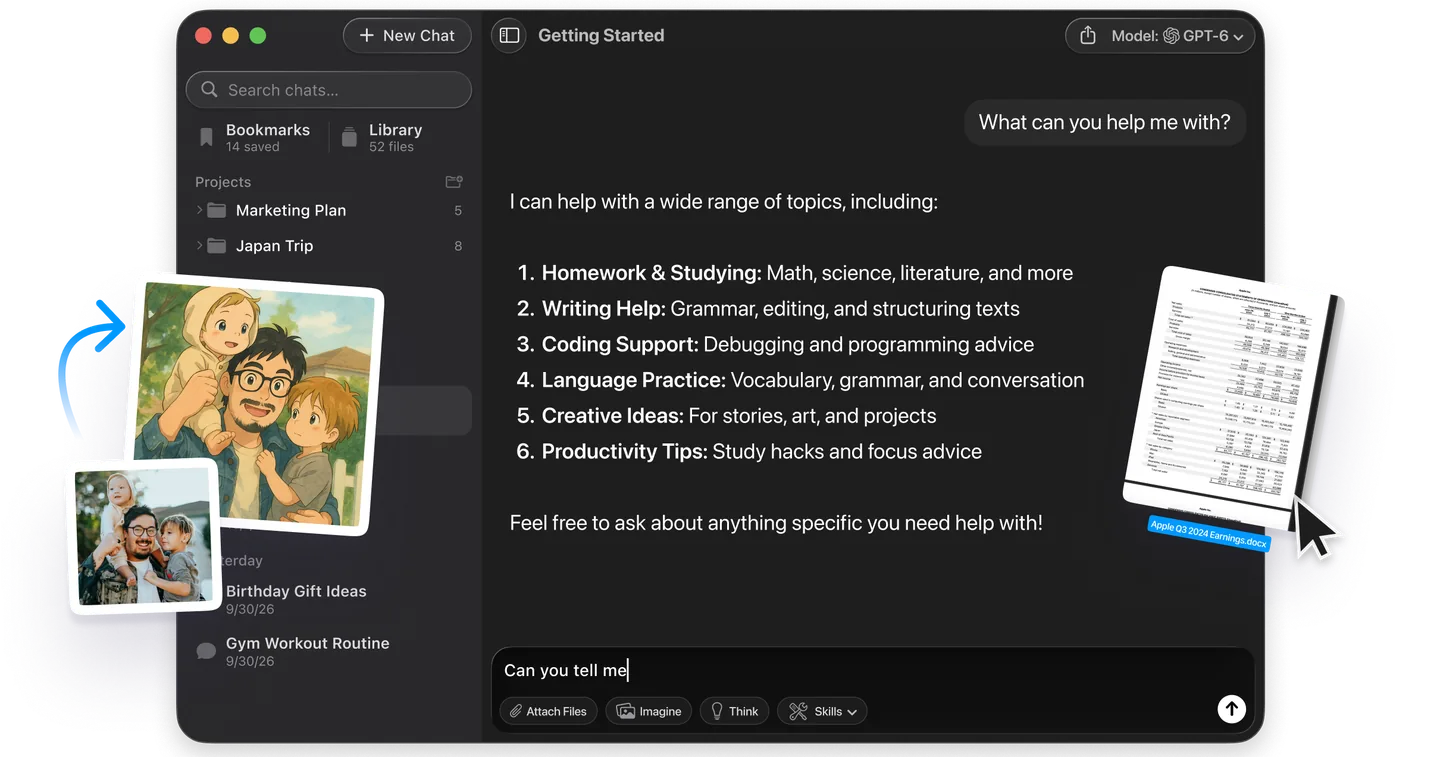
- Fello AI – If you’re not sure which tool to pick, Fello AI brings all these AI models into one interface where you can test them out and switch between them easily. It’s a practical way to figure out which one works best for your specific needs without signing up for multiple services.
Curious how they rank? Read the best AI models right now or find out Which AI sounds most human.
Conclusion
AI isn’t a magic genie, but it is a practical assistant for the annoying parts of life – summaries, planning, drafts, and decision support. The best results come from two habits: give it real constraints and verify anything high-stakes or time-sensitive.
Start small: pick one workflow from this list (meal planning or meeting summaries are great starters), save the prompt, and improve it over a week. That’s how AI becomes genuinely useful – without losing your voice.
FAQ
Is my data safe when using AI for personal tasks?
Most major AI providers offer privacy controls, but details vary by tool and settings. As a rule of thumb, don’t paste sensitive financial account numbers, passwords, or personal health ID numbers into a public AI chat. Use temporary/private chat modes if your tool offers them.
Do I need to pay for these tools?
Free tiers are usually enough for everyday tasks like planning, drafting, and rewriting. Paid tiers typically add faster responses, larger file uploads, and more advanced features. Start free; upgrade only if you hit a limit.
Will AI replace my creativity?
No. AI is an engine; you are the steering wheel. It removes friction at the start, but the final polish, strategy, and emotional connection still come from you.
How do I quickly verify an AI answer?
Ask it to list assumptions, show what it’s uncertain about, and provide sources (or links if it can browse). Then verify anything that affects money, health, or travel bookings.
Can AI browse the web in real time?
Some tools and plans can; others can’t. If it can’t browse, use it for drafts and planning, then verify details on official sites.
What privacy setting should I check first?
Check whether your chats may be used to improve models, and use temporary/private chat modes when available.