On March 11, 2026, a nameless AI model quietly appeared on OpenRouter, one of the most popular platforms where developers test and compare AI systems. It had no branding, no press release, and no company name attached to it. The only label it carried was “Hunter Alpha.”
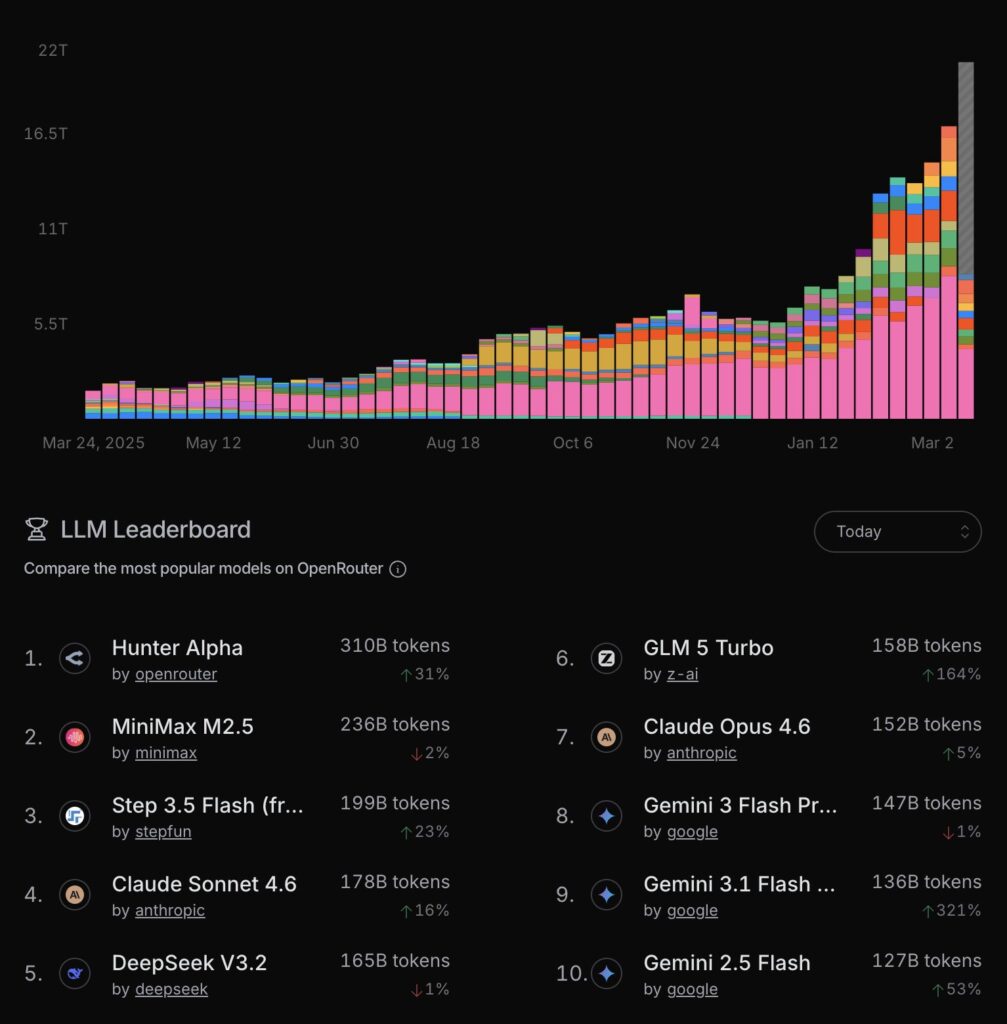
Within days, this anonymous model processed over one trillion tokens, climbed to the top of OpenRouter’s usage charts, and left thousands of developers wondering the same thing: who built this, and why are they hiding?
The answer, when it finally came a week later, surprised almost everyone. Hunter Alpha was not from DeepSeek, the Chinese AI startup that many had suspected. It was built by Xiaomi, the company most people know for smartphones and electric vehicles.
What Is Hunter Alpha?
Hunter Alpha is an AI language model that appeared on the developer platform OpenRouter on March 11, 2026. Unlike most model launches that come with official announcements and marketing campaigns, Hunter Alpha showed up with zero fanfare. OpenRouter itself labeled it a “stealth model.”
The model’s profile page described it as having roughly one trillion parameters and a context window of up to one million tokens. In simple terms, that means it can process enormous amounts of text in a single conversation, roughly equivalent to 1,500 pages of a printed book.
What made Hunter Alpha stand out was not just its size but its performance. Developers quickly noticed that it excelled at complex reasoning, multi-step planning, and code generation. It was not just another chatbot. It was designed to act as the “brain” behind AI agents, software tools that can carry out complicated tasks with minimal human guidance.
And the best part? During its initial testing phase, Hunter Alpha was completely free to use.
The DeepSeek Mystery
Almost immediately after Hunter Alpha appeared, speculation began swirling across developer forums, social media, and tech news outlets. The most popular theory was that Hunter Alpha was actually DeepSeek V4, the highly anticipated next-generation model from the Chinese AI startup that had already made waves with its earlier releases.
The evidence seemed convincing. When users tested Hunter Alpha, the model described itself as “a Chinese AI model primarily trained in Chinese.” Its training data had a knowledge cutoff of May 2025, the exact same date reported by DeepSeek’s own chatbot. The architectural design showed similarities to DeepSeek’s known approaches, including advanced chain-of-thought reasoning and a massive scale that few companies in the world could achieve.
For nearly a week, “Hunter Alpha is DeepSeek V4” became the dominant narrative in the AI community. Articles were written, analyses were published, and even some market analysts began factoring a potential DeepSeek V4 launch into their forecasts.
They were all wrong.
Xiaomi Steps Forward
On March 18, 2026, the mystery was solved. Xiaomi’s AI model team, known as MiMo, officially confirmed that Hunter Alpha was an “early internal test build” of their upcoming flagship model called MiMo-V2-Pro.
The revelation sent shockwaves through the tech industry. Xiaomi, a company primarily known for its smartphones, smart home devices, and its growing electric vehicle business, had just demonstrated that it could build an AI model competitive with the best in the world.
Xiaomi’s stock surged 5.8% on the news, reflecting investor excitement about the company’s expanded AI capabilities.
The person leading this effort is Luo Fuli, a 31-year-old AI researcher who has quickly become one of the most watched figures in the Chinese tech industry. Born in 1995, Luo made a name for herself at Peking University when her research appeared in eight papers at a major computational linguistics conference. She went on to work at Alibaba’s Damo Academy before joining High-Flyer Quant, the hedge fund that owns DeepSeek, where she became a core contributor to the development of DeepSeek-V2.
In late 2025, Luo made the jump to Xiaomi to lead the MiMo AI division. Her deep familiarity with DeepSeek’s architecture explains both the similarities that fueled the initial speculation and the impressive quality of MiMo-V2-Pro.
In an X post after the reveal, Luo wrote: “I call this a quiet ambush, not because we planned it, but because the shift from Chat to Agent paradigm happened so fast, even we barely believed it.”
How Powerful Is MiMo-V2-Pro?
The benchmark results paint a clear picture: MiMo-V2-Pro is one of the most capable AI models in the world, especially when you factor in its cost.
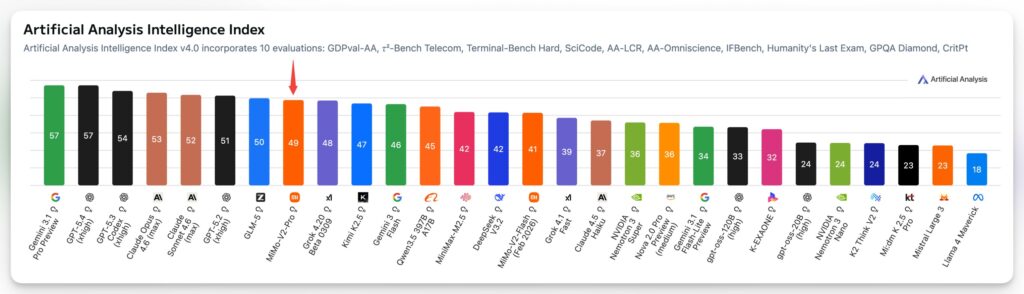
On the Artificial Analysis Intelligence Index, one of the most comprehensive independent evaluations of AI model quality, MiMo-V2-Pro scored 49 points. That places it 10th globally, just behind OpenAI’s GPT-5.2 Codex (also scoring 49) and ahead of xAI’s Grok 4.20 Beta (scoring 48). Among Chinese-made AI models, it ranks second, trailing only Zhipu’s GLM-5 by a single point.
Here is how MiMo-V2-Pro stacks up against leading models across several key benchmarks:
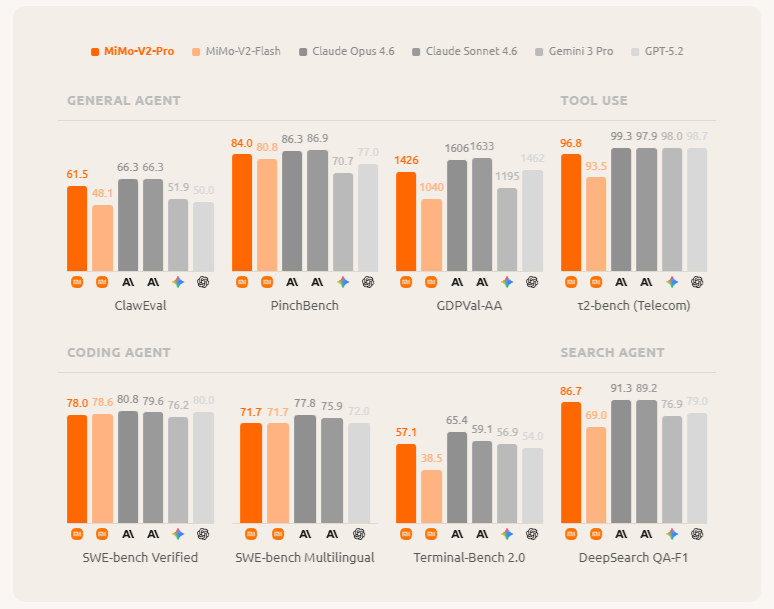
On the ClawEval benchmark, which tests general AI capabilities, MiMo-V2-Pro scored 61.5. For comparison, Anthropic’s Claude Opus 4.6, widely considered one of the most capable models available, scored 66.3 on the same test. OpenAI’s GPT-5.2 scored 50.0, meaning MiMo-V2-Pro significantly outperformed it.
On PinchBench, another widely used evaluation, MiMo-V2-Pro scored 84.0, placing it third globally.
On Terminal-Bench 2.0, which specifically measures coding ability, MiMo-V2-Pro achieved a score of 86.7.
Perhaps most impressively, on GDPval-AA, which measures how well an AI model performs real-world agentic tasks like browsing the web, using tools, and completing multi-step workflows, MiMo-V2-Pro earned an Elo rating of 1,434. That makes it the highest-ranked Chinese model on this benchmark, ahead of GLM-5 (1,406), Kimi K2.5 (1,283), and Qwen3.5 (1,209).
The model also demonstrated strong performance in accuracy and truthfulness. On the AA-Omniscience index, which penalizes AI models for hallucinating or making up information, MiMo-V2-Pro scored +5. While top models like Gemini 3.1 Pro Preview (+33) and Claude Opus 4.6 (+14) scored higher, MiMo-V2-Pro still outperformed GLM-5 (+2) and Kimi K2.5 (-8).
A Fraction of the Cost
What makes these results particularly striking is the price. Running MiMo-V2-Pro through the complete Artificial Analysis Intelligence Index evaluation cost just $348. The same evaluation costs $2,304 for GPT-5.2 and $2,486 for Claude Opus 4.6.
For developers and businesses using the model through Xiaomi’s API, the pricing structure is straightforward. For conversations using up to 256,000 tokens of context, it costs $1 per million input tokens and $3 per million output tokens. For longer conversations using between 256,000 and one million tokens, the price doubles to $2 per million input tokens and $6 per million output tokens.
That works out to roughly one-sixth to one-seventh the cost of comparable models from OpenAI and Anthropic. For startups, developers, and companies building AI-powered products, that kind of cost difference can be transformative.
Built for the Age of AI Agents
MiMo-V2-Pro is not designed to be just another chatbot. Xiaomi built it specifically for what the industry calls “agentic AI,” a new paradigm where AI models do not just answer questions but actively carry out tasks.
Think of the difference between asking an AI “What is the best hotel in Paris?” versus telling it “Book me a hotel in Paris for next weekend under $200 per night, check my calendar for conflicts, and send a confirmation to my email.” The second scenario requires the AI to plan multiple steps, use different tools, handle errors, and make decisions along the way. That is exactly what MiMo-V2-Pro is designed to do.
The model uses a Mixture-of-Experts (MoE) architecture with roughly one trillion total parameters but only 42 billion active at any given time. This design allows the model to be extremely capable while remaining efficient enough to run at low cost. It features a hybrid attention mechanism with a 7:1 mixed ratio, specifically optimized for multi-step reasoning and tool use.
Xiaomi has announced partnerships with several major AI agent frameworks, including OpenClaw, to ensure that MiMo-V2-Pro integrates smoothly into the growing ecosystem of autonomous AI tools.
The Full MiMo-V2 Family
Hunter Alpha’s reveal was just the beginning. On March 18, Xiaomi launched an entire family of AI models under the MiMo-V2 banner.
MiMo-V2-Omni
While MiMo-V2-Pro handles text-based reasoning, MiMo-V2-Omni is Xiaomi’s multimodal powerhouse. It can natively process text, images, video, and audio through a single unified model, rather than stitching together separate systems for each type of content.
The model supports continuous audio understanding for over 10 hours in a single request, making it suitable for analyzing lengthy meetings, podcasts, or video content. On the MM-BrowserComp benchmark, it scored 52.0, outperforming Google’s Gemini 3 Pro. Its agentic Elo rating of 1,435 also edges ahead of Gemini 3 Pro.
Xiaomi demonstrated MiMo-V2-Omni’s capabilities with two striking examples. In one, the model autonomously completed an entire shopping cycle across Chinese e-commerce platforms, from searching for products to placing an order. In another, it took a simple text prompt and autonomously scripted, filmed, edited, added voice narration to, and published a 15-second TikTok video.
MiMo-V2-Omni is priced at $0.40 per million input tokens and $2.00 per million output tokens.
MiMo-V2-TTS
The third model in the family is focused on text-to-speech. Trained on hundreds of millions of hours of audio data, MiMo-V2-TTS delivers remarkably natural and expressive speech synthesis.
Its standout features include per-sentence emotion control, meaning the AI can shift its emotional tone within a single paragraph. It can also sing while preserving pitch and rhythm, and it offers strong support for Chinese regional dialects including Sichuanese and Cantonese.
MiMo-V2-TTS is currently available for free during a limited promotional period.
Why Xiaomi Released It Anonymously
The decision to launch Hunter Alpha without any branding was deliberate. By releasing the model anonymously, Xiaomi ensured that developers and AI researchers evaluated it purely on its merits, without any preconceptions about the company behind it.
If Xiaomi had announced “we built a trillion-parameter AI model,” the reaction might have been skepticism. This is, after all, a hardware company going up against OpenAI, Anthropic, Google, and other AI-first organizations with years of research behind them.
Instead, developers tested Hunter Alpha based on what it could actually do. The fact that it topped OpenRouter’s leaderboards, processing 500 billion tokens per week and accumulating 1.27 million API requests, proved that the model’s quality spoke for itself. The top applications using Hunter Alpha during its anonymous phase were all coding-focused developer tools, confirming its strength in real-world development workflows.
By the time Xiaomi revealed its identity, the model had already earned credibility the hard way.
What This Means for the AI Industry
The Hunter Alpha story highlights several important trends in the rapidly evolving AI landscape.
The Cost Barrier Is Falling
MiMo-V2-Pro delivers performance that approaches the world’s most expensive models at a fraction of the price. On the Artificial Analysis Intelligence Index, it ranks first among 164 models in its price tier (under $0.15 per million tokens), scoring 49 points while the median score in that tier is just 13. This kind of price-performance ratio opens up powerful AI capabilities to a much wider range of developers and businesses.
China’s AI Talent Pool Is Deepening
Luo Fuli’s journey from Peking University to Alibaba to DeepSeek to Xiaomi illustrates the growing depth of AI talent in China. The fact that Xiaomi, a company not traditionally associated with frontier AI research, could recruit a researcher of her caliber and build a globally competitive model speaks to the expanding breadth of China’s AI ecosystem.
The Shift from Chat to Agents
MiMo-V2-Pro is built from the ground up for agentic AI, not just conversation. This reflects a broader industry consensus that the next major wave of AI value will come from models that can autonomously complete complex tasks, not just answer questions. As Luo Fuli noted, “the shift from Chat to Agent paradigm happened so fast, even we barely believed it.”
Hardware Companies Are AI Companies Now
Xiaomi’s entry into frontier AI modeling signals that the line between hardware and software companies is disappearing. With its “Human x Car x Home” ecosystem strategy, Xiaomi plans to integrate MiMo-V2 models across its smartphones, electric vehicles, and smart home devices, creating a unified AI-powered experience across all its products.
The company has committed to investing $5.6 billion in R&D, with AI as a central pillar of its strategy. Xiaomi also plans to open-source its models “when they are stable enough,” which could further accelerate adoption.
OpenRouter Usage by the Numbers
The raw usage statistics from OpenRouter tell the story of Hunter Alpha’s popularity more clearly than any benchmark.
As of March 19, 2026, the model had processed 1.27 million requests, consumed 114.6 billion prompt tokens, and generated 563.8 billion completion tokens. At its peak, the model was processing roughly 500 billion tokens per week.
These are not test numbers from researchers running evaluations. These represent real developers choosing to use Hunter Alpha for actual work, from writing code to building AI-powered applications. The model topped OpenRouter’s daily usage charts for multiple consecutive days, outpacing well-established models from OpenAI, Anthropic, and Google.
How to Try MiMo-V2-Pro
MiMo-V2-Pro is currently available through two channels. Developers can access it via Xiaomi’s first-party API, and it remains available on OpenRouter under both its original “Hunter Alpha” listing and its official MiMo-V2-Pro name.
Xiaomi is offering one week of free developer access globally following the official launch. The model operates from data centers in Singapore and the Netherlands, with a 30-day data retention policy and training on user data disabled.
For now, MiMo-V2-Pro supports text input and output only, with no multimodal capabilities. Users who need image, video, or audio processing can turn to MiMo-V2-Omni instead.
The Bottom Line
A week ago, nobody knew who built Hunter Alpha. Today, Xiaomi stands as a serious contender in the global AI race. MiMo-V2-Pro delivers near-frontier performance at dramatically lower cost, and its focus on agentic AI positions it at the center of where the entire industry is heading.
For developers, the value proposition is hard to ignore. For the AI industry as a whole, Hunter Alpha’s story is a reminder that the next breakthrough can come from unexpected places, and that a great model does not need a famous name to earn respect.