The five open-source AI models worth running on an M5 Mac in April 2026 are Mistral 7B (16 GB), Qwen 3.5 9B (24 GB), DeepSeek R1 Distill Qwen 14B (24 GB), Gemma 4 26B-A4B (32 GB), and Qwen 3.5 35B-A3B (32 GB+). Minimum unified memory is 16 GB, the sweet spot is 24 GB, and anything above 30B parameters needs 32 GB or more. Frontier open-source models like GLM 5.2 or the full DeepSeek R1 need hundreds of GBs of VRAM, so skip those entirely. The five below are what actually fits.
All five picks are examples of open source AI, models whose weights are published openly so you can run them locally instead of through a paid cloud API.
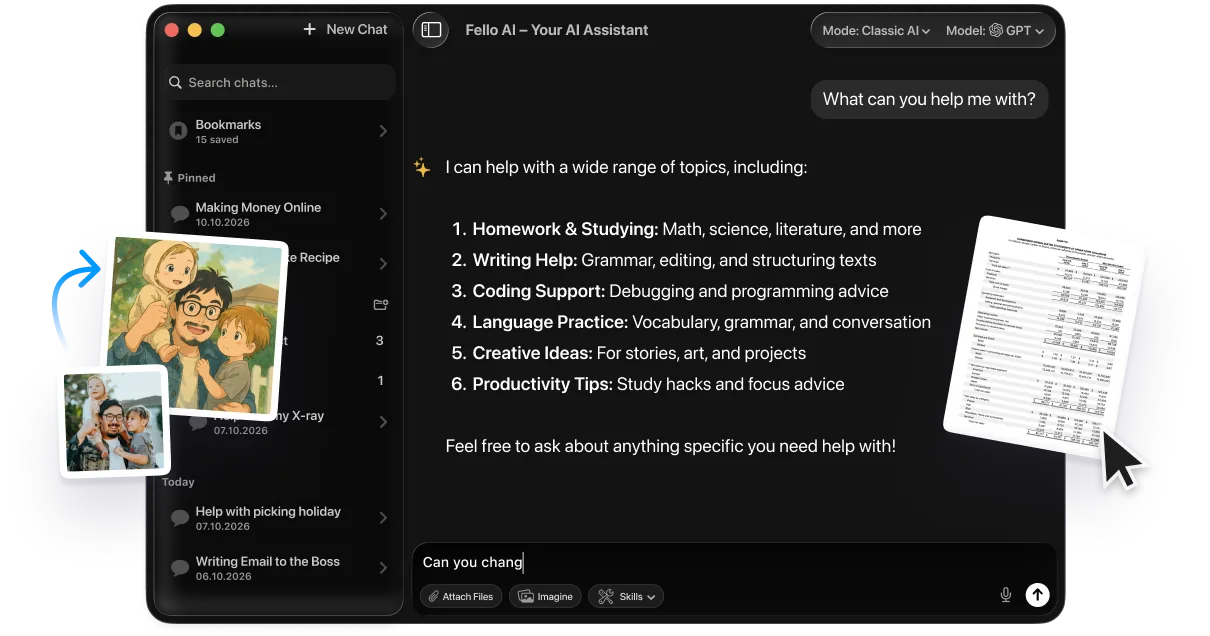
Apple’s own MLX benchmarks show the M5 chip delivering a 3 to 4 times speedup on time-to-first-token compared to the M4, thanks to new Neural Accelerators inside each GPU core. A 20 billion parameter model now produces its first token in under three seconds on a base MacBook Pro, which was unthinkable a year ago. This guide is about running models locally, a different job from what Fello AI does. Fello AI routes to every major cloud chat model — ChatGPT, Claude, Gemini, Grok, DeepSeek, and Perplexity — through one native Mac app on a single $9.99/month subscription (all tracked in our Best AI Models hub). Local models here are the right tool for privacy, offline access, or zero API bills. The realistic 2026 setup is both: a local model for the grunt work, Fello AI open for the hard problems.
For the broader field beyond what fits on a Mac, our guide to the best open source AI models ranks the full open-weight lineup.
The Key Takeaways
Five models worth downloading on an M5 Mac, ranked by hardware fit:
- Mistral 7B for 16 GB Macs that need fast, clean instruction-following
- Qwen 3.5 9B for the 24 GB sweet spot, the best general daily driver
- DeepSeek R1 Distill Qwen 14B for reasoning-heavy work on 24 GB machines
- Gemma 4 26B-A4B for 32 GB Macs that want frontier-adjacent quality
- Qwen 3.5 35B-A3B MoE for 32 GB+ stretch builds and long-context work
Install LM Studio with the MLX backend for most picks. Use Ollama for Gemma 4 specifically (MLX still has bugs with it as of April 2026). Budget 60% of your RAM for the model and leave the rest for macOS and context.
The Comparison Table
| Model | Parameters | Size at Q4 | Min RAM | License | Best For |
|---|---|---|---|---|---|
| Mistral 7B | 7B dense | ~5 GB | 16 GB | Apache 2.0 | Writing, email, drafting |
| Qwen 3.5 9B | 9B dense | ~6 GB | 16–24 GB | Apache 2.0 | General daily driver |
| DeepSeek R1 Distill Qwen 14B | 14B dense | ~9 GB | 24 GB | MIT | Math, logic, code review |
| Gemma 4 26B-A4B | 26B total, 3.8B active (MoE) | ~18 GB | 32 GB | Apache 2.0 | Multimodal, long context |
| Qwen 3.5 35B-A3B | 35B total, 3B active (MoE) | ~22 GB | 32 GB | Apache 2.0 | Long-form coherence |
1. 16 GB Entry: Mistral 7B
If you bought the base M5 MacBook Air with 16 GB of unified memory, this is your starting point. Mistral 7B is a 7 billion parameter dense model from the French lab Mistral AI, released under Apache 2.0. At Q4_K_M quantization it loads in about 5 GB. Plenty of room for macOS and a long context window.
What it’s good at
What makes it worth picking over the crowd of 7B models on Hugging Face is instruction-following discipline. It does what you ask and stops when it’s done. No filler. For drafting emails, rewriting paragraphs, or cleaning up meeting notes, that restraint matters more than benchmark scores.
Quick specs
- Hardware fit: 16 GB M5 MacBook Air comfortably, 24 GB with big context windows.
- License: Apache 2.0 (commercial use allowed).
- Best for: Daily writing assistance, lightweight chat, offline drafting on the go.
- Skip if: You need code generation or multi-step reasoning.
2. 24 GB Daily Driver: Qwen 3.5 9B
When Apple’s Machine Learning Research team published their MLX benchmark for the M5 chip, the reference model they chose was Qwen. That is not random. The Qwen family, from Alibaba, is the one the Apple team ships with MLX LM tutorials because it behaves well on Apple Silicon and the MLX conversion is clean.
Why Qwen 3.5 over Qwen 3
Apple benchmarked Qwen 3. The current generation you actually want to download in April 2026 is Qwen 3.5, which is the version the MLX community has been iterating on since February. The 8B variant at 4-bit quantization loads in under 6 GB and generates at roughly 60–80 tokens per second on an M5 Pro.
What it’s good at
Where it earns its spot is breadth. Qwen 3.5 9B handles coding, long-form writing, summarization, and multilingual tasks. Its Czech and Chinese output are both usable, which is rare at this size. The MLX community builds update weekly, so bug fixes arrive fast.
Quick specs
- Hardware fit: 16 GB tight, 24 GB ideal, 32 GB luxurious.
- License: Apache 2.0.
- Best for: The one local model you keep installed if you only install one.
- Skip if: You want something specialized for a single task.
3. 24 GB Reasoning Pick: DeepSeek R1 Distill Qwen 14B
DeepSeek’s full R1 model is a 671 billion parameter monster that made headlines in early 2025. You cannot run it. What you can run is the distilled version: DeepSeek took R1’s reasoning traces and used them to fine-tune a 14 billion parameter Qwen base. The result is a model that fits in about 9 GB at Q4 but shows its work on math, logic, and multi-step problems the way the big model does.
How the thinking mode works
This is the pick for anyone frustrated by small local models getting confused on anything harder than a FAQ. The distilled R1 thinks before answering, writing a reasoning chain inside <think> tags before the final response. That costs speed. It buys correctness on problems where regular 7B and 8B models guess.
Realistic speed on an M5
A realistic expectation on an M5 Pro with 24 GB: 15 to 25 tokens per second in generation, plus a reasoning pass that takes a few extra seconds on hard prompts. Fast enough to use, slow enough that you notice it thinking.
Quick specs
- Hardware fit: 24 GB M5 Pro is the sweet spot. 16 GB works but leaves no headroom.
- License: MIT.
- Best for: Math, code debugging, logic puzzles, legal reasoning, anything where a confident wrong answer costs you.
- Skip if: You want fast casual chat.
4. 32 GB Power Pick: Gemma 4 26B-A4B
Google DeepMind dropped Gemma 4 on April 2, 2026, and it immediately reshaped the local AI conversation. The 31B Dense flagship ranks #3 on the LMArena open-model leaderboard with a score of 1,452. The version you actually want on a Mac is the 26B-A4B Mixture-of-Experts variant, which activates only 3.8 billion parameters per token while drawing on the full 26 billion for reasoning depth.
Why 32 GB is non-negotiable
At 4-bit quantization it fits in about 18 GB of RAM, which means a 32 GB Mac runs it with real headroom. A 24 GB Mac can load it, but swap pressure is real and inference drops to a crawl. Do not try this on 24 GB. Community testing on an M4 Pro 24 GB machine reported the 26B variant running at around 2 tokens per second due to swap. On a 32 GB or 48 GB machine, it generates cleanly.
Native multimodality and context
The big deal with Gemma 4 is native multimodality. The model takes text, images, and video as input. You can feed it screenshots, architecture diagrams, or PDFs directly. It supports a 256K context window, which is twice what most open models at this tier offer. Apache 2.0 license, commercial use allowed, and Google co-released with day-one support from Hugging Face, llama.cpp, Ollama, LM Studio, MLX, and Unsloth.
Use Ollama, not MLX, for this one
One important caveat for April 2026: MLX has known issues with Gemma 4. The mlx-community 4-bit builds are still fragile, and LM Studio’s MLX backend does not fully support Gemma 4 yet. Use Ollama for this one specifically, even if you use LM Studio for everything else. This is expected to resolve within weeks, but do not fight it today.
Quick specs
- Hardware fit: 32 GB M5 Pro or Max recommended. 48 GB is comfortable.
- License: Apache 2.0.
- Best for: Multimodal work, long-document analysis, anything where you would previously reach for Gemini 2.5 on the API.
- Skip if: You only have 24 GB, or you need fast short-form chat (use Qwen 3.5 9B instead).
Notable mention: OpenAI GPT-OSS 20B
OpenAI quietly released an open-weight model in August 2025 under Apache 2.0, and most people missed it. GPT-OSS 20B is a Mixture-of-Experts build with 21 billion total parameters and 3.6 billion active per token, trained in MXFP4 precision so it fits in roughly 12 GB. It competes with Gemma 4 26B on the same tier but with two differences: it lacks multimodality, and it is now six months old. If Gemma 4’s MLX issues are blocking you, GPT-OSS 20B is a solid stopgap. Otherwise, Gemma 4 is the April 2026 pick.
5. 32 GB+ Max Stretch: Qwen 3.5 35B-A3B
This is the model to download the day you configure an M5 Pro or Max with 48 GB or more. Qwen 3.5 35B-A3B is a 35 billion parameter Mixture-of-Experts build where only 3 billion parameters activate per token. Translation: you get the intelligence of a 30B model at the inference speed of a 3B model, assuming the whole thing fits in memory.
What MoE means in practice
At 4-bit quantization it lives in about 18 GB of RAM. That rules out 16 GB Macs entirely, makes 24 GB workable but cramped, and feels right on 32 GB or 48 GB configurations. Apple’s M5 benchmark included the Qwen 3 version of this architecture and measured first-token latency under three seconds, with generation speeds that outpace most dense 14B models on the same hardware. The 3.5 update improved reasoning and code generation on top of that baseline.
Where it shines
What it enables that smaller models cannot handle is long-form coherence. Tasks like “refactor this 2,000-line file,” “summarize these twenty PDFs,” or “write a 4,000-word article with a specific structure” suddenly work. The 7–8B class gets lost halfway through. Qwen 3.5 35B-A3B stays on task.
Qwen 3.5 35B-A3B vs Gemma 4 26B-A4B: which one?
Where does this sit next to Gemma 4 26B-A4B? Gemma 4 is the better pick for multimodal input and Google ecosystem work. Qwen 3.5 35B-A3B wins on pure text reasoning depth, long-context document work, and has fewer framework issues right now. Install both if you have the disk space.
Quick specs
- Hardware fit: 32 GB minimum, 48 GB recommended, 64 GB+ future-proof.
- License: Apache 2.0.
- Best for: Long-context work, serious coding sessions, replacing Claude Sonnet for routine tasks when you want zero API costs.
- Skip if: You have less than 32 GB of RAM. Pick Qwen 3.5 9B instead.
What You Cannot Run on a Mac (Yet)
A word of honesty, because this matters. The headlines in April 2026 are dominated by models you cannot run locally no matter how much you spent on your MacBook:
- GLM-4.7 and GLM-5 (Zhipu AI): 355–744 billion parameters. The FP8 build needs 8 H200 GPUs. Not happening on a laptop.
- Claude Mythos Preview (Anthropic): Not open weights. Never will be.
- DeepSeek R1 full (not the distill): 671 billion parameters, needs a server rack.
- Llama 4 Maverick and Behemoth: The 400B+ variants need multi-GPU setups.
- Gemma 4 31B Dense: Technically possible on a 48 GB+ Mac, but the 26B-A4B MoE variant is faster and nearly as capable. Skip the dense 31B unless you are fine-tuning.
If a blog post promises these will run on your MacBook with “just a bit of tweaking,” close the tab. The people writing those are reselling API credits with extra steps. The models that actually fit on a Mac are the five above, and the honest truth is that for frontier-level output, you still want cloud access to the real thing.
This is exactly where Fello AI earns its place on an M5 Mac. One native app gives you ChatGPT, Claude, Gemini, Grok, DeepSeek, and Perplexity on a single $9.99/month subscription — including DeepSeek and Grok at no extra cost, which you would otherwise pay separately for. Your local Qwen or Gemma 4 handles offline grunt work, and the frontier cloud models are one keystroke away for anything a 9B or 26B model cannot touch. Which brings us to the practical question.
How to Install Any of These on an M5 Mac
Skip Ollama for now if you are on macOS 26 with an M5 chip and downloading anything except Gemma 4. There is a known Metal 4 shader bug that breaks GPU inference on early Ollama versions, and even the fix routes through the MLX backend. Start with one of these two paths.
Easy path: LM Studio
Download LM Studio, open the app, search for any of the five models above (prefix with mlx-community/ for best speed on Qwen, DeepSeek, and Mistral picks), click Download, click Load. You now have a local ChatGPT clone with an OpenAI-compatible API on localhost:1234.
For Gemma 4 specifically, use Ollama instead. LM Studio’s MLX backend does not fully support Gemma 4 as of April 2026, and the mlx-community 4-bit builds have loading issues. Run ollama pull gemma4:26b-a4b and you’re set.
Nerd path: MLX-LM directly
Open Terminal and run pip install mlx-lm, then python -m mlx_lm.generate --model mlx-community/Qwen3.5-8B-4bit --prompt "hello". The model downloads once to ~/.cache/huggingface/, and every subsequent run is instant.
For most people, LM Studio is the right answer. For developers building apps against a local model, MLX-LM directly is faster to iterate on.
A hardware rule of thumb worth memorizing: keep model weights under 60% of your unified memory. On a 24 GB Mac, that is roughly 12 GB for the model, leaving the rest for macOS, the KV cache, and your browser. Go higher and you will swap, which destroys inference speed.
What Actually Changed With the M5 Chip
One thing almost every other “local LLM on Mac” guide glosses over: the M5 chip is a real architectural shift for AI, not just a spec bump. Apple added dedicated Neural Accelerators inside each GPU core, built specifically for the matrix multiplication operations that dominate transformer inference. That is why Apple’s own benchmark showed up to 4x faster time-to-first-token on the M5 MacBook Pro compared to the M4.
Memory bandwidth also jumped. The base M1 ran at 68 GB/s. The base M5 runs at 154 GB/s. Token generation speed scales almost linearly with memory bandwidth on Apple Silicon, so the practical result is that a 14B model on an M5 Pro feels noticeably snappier than the same model on an equivalent M4 Pro, even without the Neural Accelerator boost.
What this means for a buying decision: if you are choosing between an M4 Pro at a discount and a new M5 Pro at full price for local AI work, the M5 is the better pick by a real margin. If you are choosing between an M5 Pro with 24 GB and an M5 Pro with 48 GB, the memory upgrade matters more than any chip tier change. Memory on Apple Silicon is not upgradeable after purchase. Buy for where you want to be in two years, not today. For a full breakdown of every M5 configuration by RAM tier, see our Best Mac for AI buying guide.
The Honest Verdict
If you are buying one model to install and forget, download Qwen 3.5 9B via LM Studio. It handles 80% of what a normal person wants from a local chatbot and it fits on every M5 Mac sold.
If you upgraded to 32 GB or more, install Gemma 4 26B-A4B via Ollama alongside it. That combination gives you a fast daily driver plus a frontier-adjacent multimodal option with almost no overlap between them. For long-context text work specifically, add Qwen 3.5 35B-A3B as a third option.
Do not build your workflow around local models for frontier-grade work. The gap between a local 9B model and the latest Claude is still large, and anyone telling you otherwise has not run both in production. Local AI is a second tool, not a replacement. Use it for privacy-sensitive work, for offline situations, for unlimited throughput on routine tasks, and for the simple satisfaction of knowing your data never left the machine. For everything else, Fello AI is the cleanest answer: ChatGPT, Claude, Gemini, Grok, DeepSeek, and Perplexity in one native Mac app for $9.99/month — roughly 83% less than stacking ChatGPT Plus, Claude Pro, and Gemini Advanced separately, and with DeepSeek and Grok bundled in at no extra cost.
That is the setup that actually works in April 2026: a local Qwen plus a local Gemma 4 on your Mac for the grunt work, and the frontier stack a click away for the hard problems. Both, not either.
See also a Claude Mythos exploit of Apple’s M5 memory protections.
FAQ
How much RAM do I need to run a local LLM on a Mac?
You need a minimum of 16 GB of unified memory to run anything useful. A 7B or 8B model at 4-bit quantization fits comfortably in 16 GB and leaves room for macOS. The sweet spot is 24 GB, which handles 8B and 14B models with room for long context windows. For 26B-30B models like Gemma 4 or Qwen 3.5 35B-A3B, you need 32 GB or more. Below 16 GB you’re stuck with tiny 1-3B models that exist mainly as proof-of-concept.
Is Ollama or LM Studio better on a Mac?
LM Studio for most April 2026 use cases. It has a clean GUI, native MLX support, and works as a drop-in OpenAI-compatible API server. Use Ollama specifically for Gemma 4, where MLX still has bugs as of April 2026, and for headless server setups. Both are free. Both run the same model files under the hood. Pick LM Studio first, fall back to Ollama for the edge cases.
Can a 16 GB MacBook Air run local AI?
Yes, with caveats. A 16 GB M5 MacBook Air runs Mistral 7B or Qwen 3.5 9B comfortably. You’ll be tight if you also want Chrome with twenty tabs and Slack open. Plan to close memory-hungry apps when running inference, or accept slower generation when macOS starts paging.
M5 Pro vs M5 Max for AI work, which one?
For local AI specifically, more RAM beats more GPU cores every time. An M5 Pro with 48 GB outperforms an M5 Max with 32 GB on this workload because memory capacity determines which models you can load at all. The Max chip’s extra GPU cores help on prompt processing, but token generation is memory-bandwidth-bound and the difference between Pro and Max bandwidth is smaller than the price gap. Buy the Pro with the most RAM you can afford before paying for the Max upgrade.
Can I run DeepSeek R1 on a Mac?
Not the full R1. The flagship DeepSeek R1 has 671 billion parameters and needs roughly 400 GB of memory at 4-bit quantization. That’s a server rack, not a laptop. What you can run is DeepSeek R1 Distill Qwen 14B, which keeps R1’s reasoning behavior in a 9 GB package that fits on any 24 GB Mac. It’s the realistic path to “DeepSeek on Mac” in April 2026.
Are local AI models as good as ChatGPT or Claude?
For routine tasks like drafting, summarizing, and basic coding, the gap has closed enough that local models are competitive. For frontier reasoning, complex multi-step coding, or anything needing the latest training data, cloud models like Claude and ChatGPT still win by a meaningful margin. The honest answer is that local AI is a complement, not a replacement. Use it for privacy, offline work, and unlimited throughput. Use cloud for the hard stuff.
What\u2019s the best setup: local AI or cloud AI on a Mac?
Both, not either. Run Qwen 3.5 9B or Gemma 4 26B-A4B locally via LM Studio or Ollama for privacy-sensitive work, offline sessions, and unlimited throughput. Keep Fello AI open for the hard problems a local model still misses: frontier reasoning in Claude, complex agent work in ChatGPT, long-context document work in Gemini, plus DeepSeek\u2019s math and Grok\u2019s real-time answers — every major cloud chat model bundled into one native Mac app for $9.99/month. Local covers 80% of the volume, cloud covers the 20% that matters most.