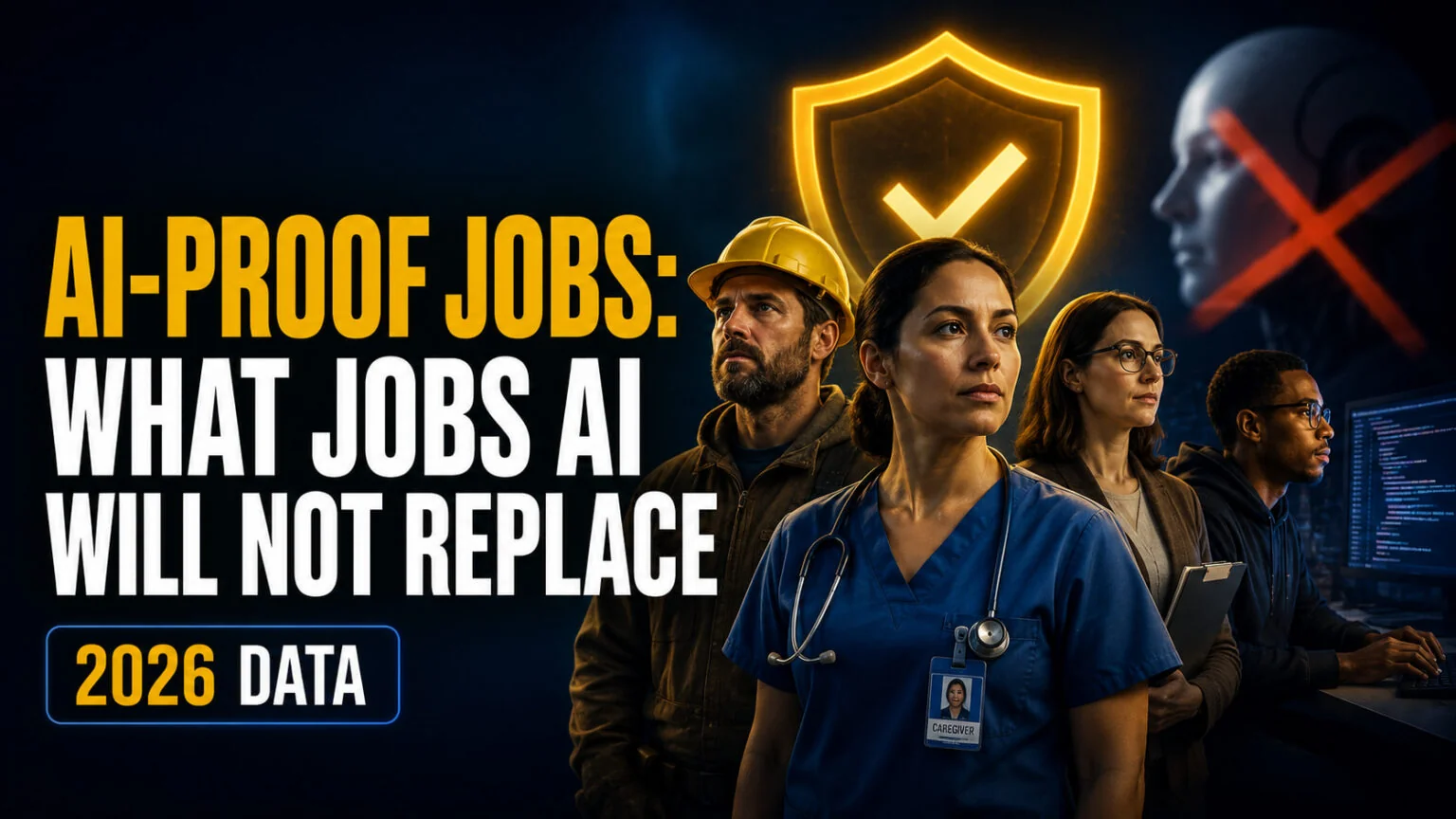
The single most AI-proof job in America is also one of its lowest paid. Home health and personal care aides are projected to add 739,800 jobs by 2034, more than any other occupation in the United States, and Microsoft’s researchers score them among the least AI-exposed roles they measured. Their median wage is $34,900, well under the $49,500 median for all occupations.
That gap is the story most “AI-proof jobs” lists refuse to tell you. We pulled the two best datasets that exist on this question. One is the Bureau of Labor Statistics employment projections for 2024 to 2034; the other is a Microsoft Research study that scored occupations by how much real AI usage overlaps with their work. They were built with completely different methods, and they point at the same answer. Here is what they say, including the parts you will not enjoy.
The Key Takeaways
- No job is 100% AI-proof. The researchers behind the best study on this say predicting displacement from exposure “would be a mistake.”
- The least AI-exposed occupations are hands-on, physical and care roles: forest and conservation workers (0.03), grounds maintenance (0.04), home health aides and nursing assistants (0.04).
- The most AI-exposed are desk roles: media and communication workers (0.38), sales representatives in services (0.35), information and record clerks (0.33).
- Home health and personal care aides add 739,800 jobs by 2034, the largest absolute growth of any occupation, at a $34,900 median wage.
- Clerical work is shrinking for real. Word processors and typists fall 36.1%, data entry keyers 25.9%.
- The best-paid fast-growing jobs are managers, not the least AI-exposed ones. Computer and information systems managers top the list at a $171,200 median.
What Makes a Job AI-Proof?
An AI-proof job is one where the work cannot be reduced to text, code, or images that a model can generate. That sounds obvious, but it has a precise consequence. AI is strongest where the job is information moving between screens, and weakest where the job is a body in an unpredictable physical space, or a person who is legally answerable for the outcome. The mirror image of that question is which jobs AI will replace by 2030, and the same two traits explain both lists.
The pattern that emerges from the data is not about intelligence or skill level. It is about reachability. A model cannot rewire a panel in a cramped attic, reposition a frail patient, or sign its name to a decision that a regulator can prosecute. Four traits keep coming up, and the more of them your role has, the more durable it is.
Physical presence in unpredictable spaces
Every house is wired slightly wrong. Every patient’s body is a different shape. Robotics can handle a controlled factory line, but the economics collapse when every job site is a one-off. This is why grounds maintenance workers and construction workers sit at the bottom of the AI exposure rankings, despite being nobody’s idea of a high-tech career.
Legal and ethical accountability
Someone has to be prosecutable. A physician carries legal responsibility for a treatment decision, and a model cannot hold a license, be sued, or lose one. Accountability is not a technical barrier that better AI will eventually clear; it is a social and legal one, and it is the reason licensed roles cluster on the safe side.
Hands-on human care
Care work is the clearest case, and the data is emphatic. It requires physical contact, real-time judgment about a specific human being, and a kind of presence that is the entire point of the service.
Nobody wants their dying parent comforted by a chatbot.
Building and securing the AI itself
The other durable category is the people making the systems. Data scientists are projected to grow 33.5% and information security analysts 28.5%, roughly ten and nine times the 3.1% average for all occupations. AI creates demand for the humans who build, audit, and defend it.
The Most AI-Proof Jobs, Ranked by Real Data
Below, the two datasets are side by side. The AI applicability score comes from Microsoft Research, which analysed roughly 200,000 anonymised Bing Copilot conversations from January to September 2024 and measured how often AI actually completed work activities tied to each occupation. Lower means less exposed, and because the study is US-only it lines up cleanly with the US labour data. Treat the scores as a ranking rather than as precise values, which is how the authors intend them. Employment change is the BLS projection for 2024 to 2034, while the median wages are actual May 2024 figures, not forecasts.
AI-Proof Jobs Table
| Occupation | AI applicability score | Projected growth 2024-34 | Median wage | Why it resists AI |
|---|---|---|---|---|
| Forest and conservation workers | 0.03 | n/a | n/a | Outdoor, physical, unpredictable |
| Grounds maintenance workers | 0.04 | n/a | n/a | Physical, site-specific |
| Home health and personal care aides | 0.04 | +17.0% | $34,900 | Hands-on care, physical presence |
| Physical therapist assistants | 0.05 | +22.0% | $65,510 | Physical, personalised, licensed |
| Occupational therapy assistants | 0.05 | +19.2% | $68,340 | Physical, personalised, licensed |
| Other construction and related workers | 0.06 | n/a | n/a | Every site is a one-off |
| Legal support workers | 0.06 | n/a | n/a | Lower exposure than expected |
| Agricultural workers | 0.06 | n/a | n/a | Physical, weather-dependent |
| Wind turbine service technicians | n/a | +49.9% | $62,580 | Fastest-growing job in the country |
| Nurse practitioners | n/a | +40.1% | $129,210 | Licensed, accountable, hands-on |
| Data scientists | n/a | +33.5% | $112,590 | Builds the AI |
| Information security analysts | n/a | +28.5% | $124,910 | Defends the AI |
Two cautions on reading this table. Where a cell says n/a, the Microsoft occupation group does not map onto a single BLS occupation, so we have not invented a number for it. And Microsoft scores “home health aides and nursing assistants” together at 0.04, but those are two different BLS occupations with very different outlooks. Home health and personal care aides grow 17.0%; nursing assistants grow only 2.3% at a $39,530 median. Low AI exposure does not automatically mean high growth.
Home health and personal care aides
This is the headline finding, and it is the one the listicles skip. BLS projects this occupation will grow from about 4.35 million to 5.09 million workers, an increase of 739,800 jobs, the largest absolute gain of any occupation in the country. Microsoft independently scores the same work at 0.04, near the floor of AI exposure.
An ageing population needs bodies in rooms, and a model cannot be one.
Skilled trades and construction
Electricians, plumbers, and construction workers keep appearing near the bottom of the exposure rankings, for a reason that has not changed in a decade. AI can now produce a code-compliant estimate in seconds, which does remove some of the paperwork. It cannot crawl under the house.
Industrial machinery mechanics are projected to grow 16.1% at a $63,760 median. The work gets more valuable as more machines exist to break.
The two fastest-growing occupations in the entire BLS dataset are also hands-on trades, which is a detail the listicles somehow never mention. Wind turbine service technicians grow 49.9% at a $62,580 median, and solar photovoltaic installers 42.1% at $51,860. Keep the scale honest, though, because BLS notes the two combined add fewer than 20,000 jobs. Fastest-growing and biggest are not the same thing.
Healthcare practitioners
Nurse practitioners are the standout, projected to grow 40.1% to a $129,210 median wage. Physician assistants follow at 20.4% and a $133,260 median. These roles combine all the durable traits at once, since they are physical, licensed, legally accountable, and dependent on judgment about a specific person in front of you. If you want AI-proof and well paid, this is where the data points.
The people who build the AI
The fastest-growing technical roles are the ones AI itself created demand for. Data scientists grow 33.5%, information security analysts 28.5%, and computer and information research scientists 19.7% at a $140,910 median.
Software development is the interesting case, and it is worth being precise rather than alarmist. Developers grow 15.8%, which is slower in percentage terms, yet they still add 267,700 jobs, more than data scientists and security analysts combined, at a $133,080 median that beats both. The specialist AI roles are growing faster; the developer job is not collapsing. Anyone telling you software is finished is not reading the same table we are.
Mental health and therapy roles
Substance abuse, behavioral disorder, and mental health counselors are projected to grow 16.8%, and speech-language pathologists 15.0% at a $95,410 median. These are trust professions. The value is a human being who is accountable, present, and remembers you, which is precisely the thing a model cannot fake into existence.
Three Kinds of Safety, and Only Two Pay Well
Once you sit with the numbers, the “safe jobs” list splits into three groups, and conflating them is the central error of every article on this topic. Only one of the three is easy to enter, and it is the one that pays worst.
Safe because AI cannot reach it
These are the physical and care roles. They are the most AI-proof jobs by the actual exposure data, and they are largely low-wage. Home health and personal care aides at $34,900 sit well below the $49,500 national median.
This category is safe because the work is stubbornly physical, not because the labour market values it highly. Safety and pay are not the same axis, and pretending otherwise is how career advice goes wrong.
Safe because someone must be accountable
This is the group most lists miss, and it is where the money actually is. The best-paid fast-growing occupations in the BLS data are not clinicians or coders, they are managers. Computer and information systems managers earn a $171,200 median while growing 15.2%, and financial managers earn $161,700 while growing 14.8%. Both out-earn every other occupation on the fastest-growing list.
Licensed clinicians sit here too, including nurse practitioners at $129,210 and physician assistants at $133,260. What links a hospital manager and a nurse practitioner is not the task, it is the liability. A model cannot hold a licence, be sued, be fired, or sign the decision. Someone has to own the outcome, and ownership is not a task you can automate away.
Safe because you build the AI
Data scientists grow 33.5% at $112,590, and information security analysts 28.5% at $124,910. Demand here is created by the technology itself, so the moat lasts exactly as long as the boom does. That is a real caveat, because this is the only one of the three groups whose safety depends on AI spending continuing at its current pace.
The Uncomfortable Part: AI-Proof Does Not Mean Lucrative
Here is the finding that should change how you read every other list on this topic. The occupations with the lowest AI exposure and the largest projected job growth are concentrated in care and physical work, and they pay below the national median. Meanwhile the roles that pay well are protected by licences, management accountability, or the AI boom itself, and every one of those doors takes years to walk through.
The World Economic Forum found the same shape globally in its Future of Jobs Report 2025, published in January 2025. It projects 170 million new jobs created and 92 million displaced by 2030, for a net gain of 78 million. Frontline and essential sectors like care and education lead the growth. The report also notes that graphic designers have newly joined the fastest-declining roles as generative AI reshapes creative work. Treat that as a warning: “creative” is not the safe harbour it was once sold as.
So the honest summary is this. There is plenty of AI-proof work, and whether you want it is a separate question.
Anyone telling you the safe jobs are also the lucrative ones has not looked at the wage column.
What Is Actually Shrinking, and Why It Is Not All AI
Here is where most articles on this topic quietly cheat. The BLS list of fastest-declining occupations is not mostly white-collar jobs being eaten by AI. It is mostly factory and production work. Roof bolters in mining sit at number two on the entire list at -34.2%, alongside foundry mould makers at -25.9%, patternmakers at -24.4%, and engine assemblers at -21.1%.
That decline has very little to do with generative AI. It is decades of robotics, offshoring, and industrial contraction, and it was happening long before ChatGPT existed.
This matters, because it complicates the neat story that “physical work is safe.” The honest version is narrower. Repeatable physical work in a controlled environment, which is what a factory floor is, has been automatable for thirty years. Unpredictable physical work in an uncontrolled environment, which is what a stranger’s attic or a frail patient’s body is, is what actually resists. The trait that protects you is not being physical. It is being physical somewhere a machine cannot be cheaply standardised.
The AI-shaped decline is a smaller and more specific slice, and it is clerical work. Word processors and typists fall 36.1% by 2034, telephone operators 27.5%, switchboard operators 26.3%, data entry keyers 25.9%, telemarketers 22.1%, and order clerks 17.2%. Line those up against Microsoft’s highest-exposure groups, which include information and record clerks at 0.33, and the two datasets agree again. The work that is text in and text out is the work that is going.
So if your job is mostly “receive information, reformat it, pass it on,” the data is not reassuring, and no amount of listicle comfort changes that. Our guide to how AI agents are changing your job covers what that shift looks like day to day.
No Job Is 100% AI-Proof
This needs saying plainly, because the entire genre of AI-proof job lists depends on you not hearing it. The Microsoft researchers who produced the exposure scores explicitly warn against the conclusion everyone draws from them.
“It is tempting to conclude that occupations that have high AI action applicability score will be automated and thus experience job or wage loss … This would be a mistake, as downstream consequences of new technologies are very hard to predict and often counterintuitive.”
Their score measures overlap, meaning how much AI usage already touches an occupation’s work activities. It does not measure displacement. A high score can mean a job gets faster and more valuable rather than deleted, and a low score does not guarantee immunity, it just means AI is not showing up in that work yet. Treat the rankings as a map of where AI is arriving, not a list of death sentences and safe harbours.
How to AI-Proof Your Career
The durable move is not finding a job AI cannot touch. Most people cannot retrain as a nurse practitioner, and the low-exposure jobs that are easy to enter pay poorly. The durable move is becoming the person in your field who uses AI well, because that person absorbs the productivity gain instead of being priced out by it.
Start by separating your role into tasks rather than treating it as one indivisible job. AI does not replace jobs, it replaces tasks, and the honest exercise is asking which of your tasks are text in and text out. Those are the ones to hand over deliberately, on your terms, before someone else automates them around you. What remains is your actual value, and it is usually the judgment, the relationships, and the accountability.
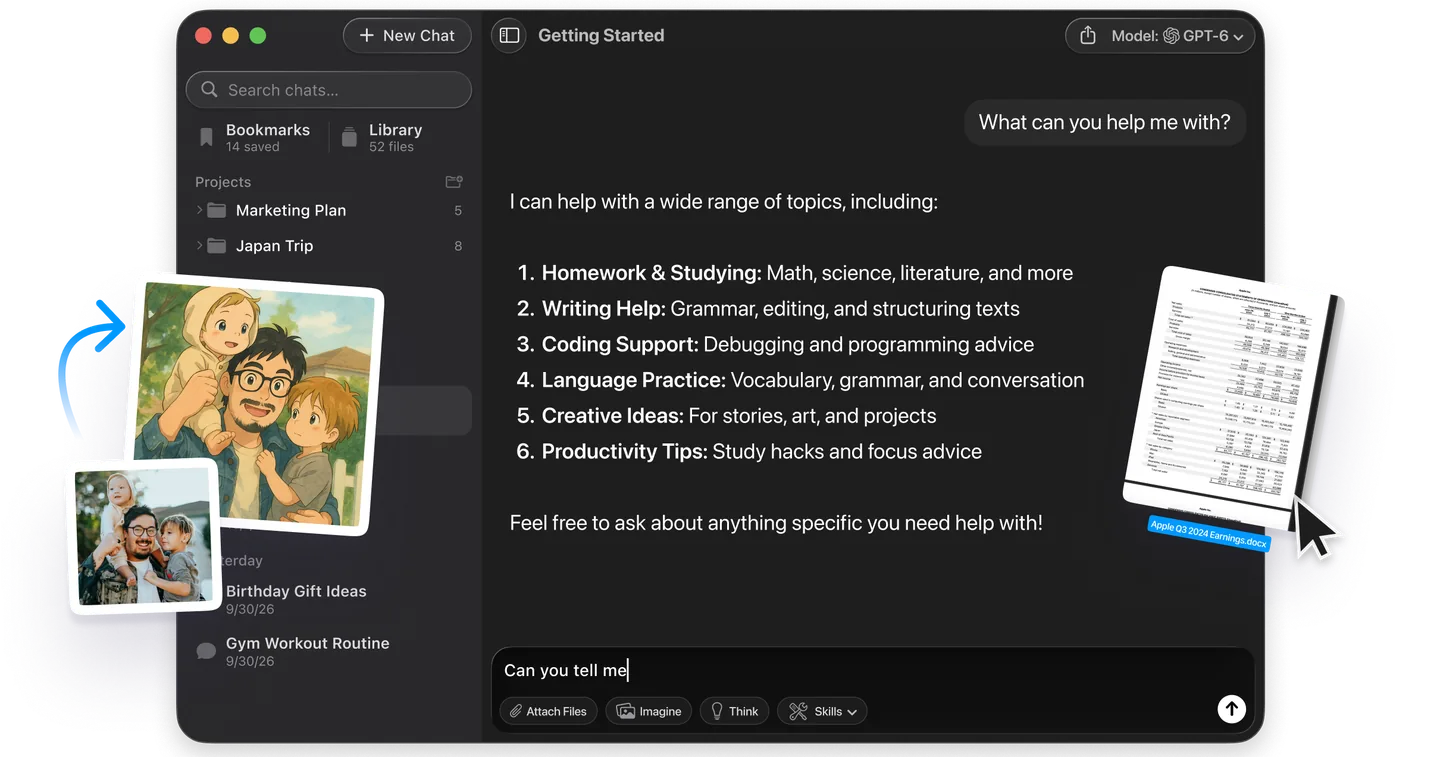
Then get fluent with the tools, not just aware of them. Prompting properly is a real skill with a real learning curve, and our GPT-5.6 prompting guide is a practical starting point. Working across several models rather than defaulting to one is a meaningful edge, because they have different strengths. Apps like Fello AI put multiple models behind a single interface on Mac and iPhone, so you can compare answers without juggling five subscriptions.
Finally, aim at the categories the data actually rewards. The fastest-growing well-paid roles either build AI, sit behind a licence, or carry management accountability.
If you are choosing a direction now, free AI courses are a low-cost way to test whether the technical path suits you. If the move involves applying for anything, pick the right AI for your resume and the best AI for your cover letter first, because the three big chatbots do not handle either equally well. Making money with AI covers the routes that do not require a degree. And understanding what an AI agent actually is is table stakes now, because agents are the form this automation is arriving in.
The Bottom Line
The most AI-proof jobs are hands-on care and unpredictable physical work, and the data on that is unusually strong, because two completely independent methods agree. They are also, on the whole, not well paid. The well-paid safe jobs are protected by a licence, by management accountability, or by the AI boom itself, and every one of those takes real investment to reach.
For everyone else, and that is most people, the realistic answer is not escape but adaptation. The person who knows how to use AI is the one who replaces you, not the AI itself. Pick your tasks, hand over the ones that are pure information shuffling, and get very good at the rest.
FAQ
What are AI-proof jobs?
AI-proof jobs are roles AI cannot easily perform because they depend on physical presence, hands-on care, legal accountability, or unpredictable real-world judgment. Microsoft Research scores home health aides, grounds maintenance workers, and construction workers among the least AI-exposed occupations. No job is completely AI-proof, but these are the most resistant.
What jobs will AI not replace?
AI is least likely to replace hands-on care and physical work, including home health aides, nursing assistants, physical and occupational therapy assistants, electricians, and construction workers. The Bureau of Labor Statistics projects home health and personal care aides will add 739,800 jobs by 2034, more than any other occupation, while clerical roles like data entry keyers shrink 25.9%.
Is any job 100% AI-proof?
No. The Microsoft researchers who produced the most-cited AI exposure scores warn that predicting job loss from exposure “would be a mistake,” because the downstream effects of new technology are hard to predict. Low exposure means AI is not currently showing up in that work, not that it never will.
Do AI-proof jobs pay well?
Often not. The least AI-exposed occupations are concentrated in care and physical work, and home health aides earn a median of $34,900 against a $49,500 median for all occupations. The well-paid safe jobs, such as nurse practitioners at $129,210 and information security analysts at $124,910, are protected by licensure or because they build AI, and both require significant training.
Which jobs are disappearing fastest?
Clerical roles. BLS projects word processors and typists will fall 36.1% by 2034, telephone operators 27.5%, data entry keyers 25.9%, and telemarketers 22.1%. These are jobs built on moving structured information from one place to another, which is exactly what AI does most cheaply.