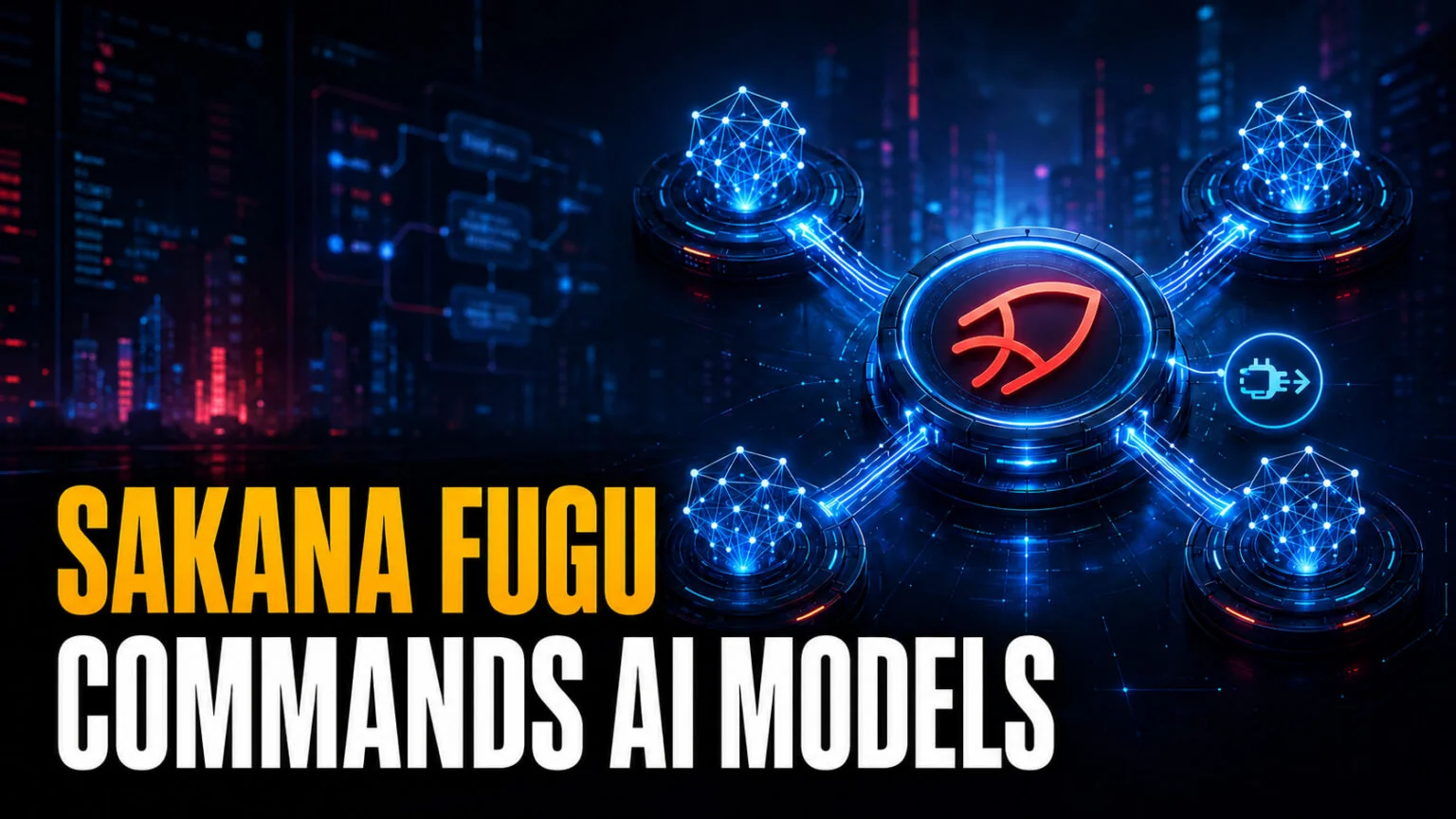
On June 22, 2026, Tokyo-based Sakana AI launched Sakana Fugu, and it works unlike almost any model you’ve used. Instead of trying to be the smartest single brain in the room, Fugu is a language model trained to command a pool of other LLMs, including copies of itself, then blend their answers into one. Its top tier, Fugu Ultra, scores 73.7 on SWE-Bench Pro, a number Sakana says puts it shoulder-to-shoulder with Anthropic’s now-pulled Fable 5 and Mythos Preview.
This article breaks down what Sakana Fugu actually is and how its “model that orchestrates models” idea works in plain English. We’ll check whether the Fable 5 comparison holds up, why the “frontier capability without export-control risk” pitch lands so hard this week, and where the hype needs an asterisk. By the end you’ll know if it’s worth wiring into your own stack, or just worth watching.
The Key Takeaways
- Sakana Fugu launched June 22, 2026 as a model that orchestrates other models, not a standalone frontier LLM.
- Fugu Ultra scores 73.7 on SWE-Bench Pro, 82.1 on TerminalBench 2.1, and 95.5 on GPQA-D, rivaling Fable 5 and Mythos Preview.
- Fugu is itself an LLM trained to call other LLMs, including itself recursively, assigning Thinker, Worker, and Verifier roles.
- Its agent pool draws on Claude Opus 4.8, GPT-5.5, and Gemini 3.1 Pro; Fable 5 and Mythos are NOT in the pool because the US shut them down on June 12.
- Two tiers, Fugu and Fugu Ultra, run through one OpenAI-compatible API with subscription and pay-as-you-go billing.
What Is Sakana Fugu?
Sakana Fugu is an AI model that orchestrates other AI models. Built by Sakana AI, the Tokyo lab known for evolutionary, nature-inspired research, Fugu is itself a language model, but its job is coordination rather than raw answering. In Sakana’s own words, it is “a language model trained to call various LLMs in an agent pool, including instances of itself recursively.”
Most AI labs chase a single, bigger model. Sakana made a different bet. It built a small model whose entire skill is knowing which other models to trust for which kind of problem, then stitching their work together.
When you send a request, Fugu decides how to handle it. For a simple task, it just answers. For a hard, multi-step problem, it assembles a team of specialist models, splits the work, checks the results, and synthesizes one final response. All of that complexity stays hidden behind a single OpenAI-compatible API, so your code only ever talks to one endpoint.
The important nuance is that this routing is learned, not hardcoded. Fugu is not an if/else router stitched together with rules. It was trained to discover its own coordination patterns, working out which model fits which task and how those models should talk to each other.
How Sakana Fugu Works
Fugu’s design comes from two ICLR 2026 papers, TRINITY and the Conductor, which both tackle learned model orchestration. TRINITY contributes a lightweight coordinator that hands out roles to a pool of agents. The Conductor is trained with reinforcement learning to discover natural-language strategies for how those agents collaborate. Together they let Fugu manage a swappable pool of models on the fly.
Think of it less like a search engine picking one result and more like a project manager staffing a team. Fugu reads the task, decides how many specialists it needs, briefs each one, and then reviews their output before signing off. The difference is that every “specialist” is a separate large language model, and the manager is a model too.
Thinker, Worker, and Verifier
Rather than treating every model the same, Fugu assigns three roles across coding, math, reasoning, and knowledge tasks. The Thinker plans and breaks the problem down. The Worker executes the actual sub-tasks, and the Verifier checks that output for errors before anything is combined.
That last role matters more than it sounds. Most single-model answers have no second pair of eyes, so mistakes ship straight to you. Fugu bakes a checking step into the workflow, which is where its quality gains show up. One early tester reported that on code review, Fugu surfaced more than twenty issues where other tools flagged about three.
Calling itself recursively
The most unusual part is recursion. Fugu can call itself as one of its own agents, reading its earlier output as context and deciding whether to revise its plan. When a first attempt falls short, it can spin up a corrective pass on its own.
Sakana frames the depth of this recursion as a tunable compute dial at inference time. Want a faster, cheaper answer? Keep recursion shallow. Need maximum accuracy on a hard problem? Let it go deeper. It is a form of test-time scaling that needs no retraining, only more compute per request.
The swappable agent pool
Fugu coordinates publicly available frontier models in its pool, reported to include Claude Opus 4.8, GPT-5.5, and Gemini 3.1 Pro, alongside open models and Sakana’s own. The pool is swappable by design. If one provider gets restricted, acquired, or priced out, Fugu can route around it without you rewriting a line of code.
This is the heart of Sakana’s strategy. You are not betting on one lab winning the model race. You are betting on a coordinator that can always reach for whatever the best available model happens to be that week.
Why a Model That Commands Models Is a Different Bet
For three years the industry has scaled one way, bigger models trained on more data and more compute. Fugu argues that the next gains might come from coordination instead of size. A well-managed team of good models, it claims, can beat any single great model.
That idea is not brand new in research circles, where multi-agent systems have been studied for a while. What is new is packaging it as a single product with one API and one bill. Developers have wanted the power of multi-agent setups without the pain of building, prompting, and debugging them by hand, and Fugu is a direct answer to that.
It also reframes what “a model” even means. If the thing you call is really a swarm of models negotiating an answer, the old habit of comparing one model’s parameters against another starts to lose meaning. The unit of intelligence becomes the system, not the single network.
Fugu Benchmarks: Does It Really Rival Fable 5?
Sakana says Fugu Ultra stands shoulder-to-shoulder with Fable 5 and Mythos Preview on the hardest engineering, science, and reasoning benchmarks. The headline numbers are strong, and on coding they beat the individual models inside Fugu’s own pool.
| Model | SWE-Bench Pro | TerminalBench 2.1 | GPQA-D | In Fugu’s pool? |
|---|---|---|---|---|
| Fugu Ultra | 73.7 | 82.1 | 95.5 | N/A (the orchestrator) |
| Claude Opus 4.8 | 69.2 | n/a | n/a | Yes |
| GPT-5.5 | 58.6 | n/a | n/a | Yes |
| Gemini 3.1 Pro | 54.2 | n/a | n/a | Yes |
| Fable 5 (reference) | comparable | comparable | comparable | No |
A quick translation of the benchmarks helps. SWE-Bench Pro measures whether a model can resolve real software-engineering tickets in actual codebases. TerminalBench 2.1 tests command-line and tool-use skill, and GPQA-D covers graduate-level science questions. Strong scores across all three signal a system that is good at hard, practical work, not just chat.
Here is the catch the viral posts skip. Neither Fable 5 nor Mythos Preview is in Fugu’s agent pool, because both were pulled from public access. The US government shut down Fable 5 and Mythos 5 on June 12 under a Commerce Department export-control order, and Anthropic disabled both models globally within hours. So Fugu is being compared to models it cannot actually use.
That cuts two ways. Sakana argues Fugu would score even higher if it could fold those models in, which is fair. Skeptics counter that comparing against a model nobody can access is a soft win, since the claim can’t be reproduced. Both points are true at once.
The cleaner proof point sits in the table above. Fugu Ultra’s 73.7 on SWE-Bench Pro outperforms Opus 4.8 (69.2), GPT-5.5 (58.6), and Gemini 3.1 Pro (54.2), the very models in its own pool. A coordinated team beating each of its members is the whole thesis, and that result you can actually verify.
Why “No Export-Control Risk” Matters Right Now
Fugu’s timing is not an accident. The Fable 5 and Mythos shutdown showed enterprises that even a flagship model can vanish overnight by government order. Building your product on a single provider suddenly looks like a real liability rather than a convenience.
Fugu’s answer is redundancy by design. Orchestrate many models from many providers, and no single restriction breaks your stack. If one model goes dark, the coordinator leans on the others, and your application keeps running.
That pitch is real but oversold. Routing around one blocked provider is not the same as true sovereignty. If several providers get restricted at once, or if the open models in the pool can’t match the closed ones they replace, the safety net thins out fast. Fugu reduces vendor lock-in; it does not remove your dependence on the broader model ecosystem.
Fugu vs Fugu Ultra: Which One to Use
Sakana ships two tiers through the same API. Fugu balances strong performance with low latency, pitched as the everyday default for coding, code review, chatbots, and interactive tools. It is the one you reach for when speed and cost matter more than squeezing out the last few points of accuracy.
Fugu Ultra is tuned for maximum accuracy on complex, multi-step work. Sakana points it at research, paper reproduction, cybersecurity analysis, and patent investigation, the kind of tasks where deeper orchestration and more verification passes earn their keep. If a wrong answer is expensive, Ultra is the tier to test.
Both are live now through Sakana’s console with subscription and usage-based billing. A simple rule of thumb works for most teams. Prototype on Fugu, then promote only the workflows that genuinely need the extra rigor up to Fugu Ultra.
What It Costs, and What’s Still Unclear
Sakana has not published clear per-token pricing yet, which is the single biggest gap for anyone planning a budget. A widely repeated “7-billion-parameter orchestrator” figure is also floating around, but it appears only in secondary blogs and not on Sakana’s official pages, so treat that number as unconfirmed.
The deeper question is total cost, not headline price. Orchestrating several frontier models per request, sometimes recursively, can multiply token usage in ways a single model never would. A task that one model answers in a few thousand tokens might fan out into many calls under Fugu.
For some workloads that trade is worth it, because a correct answer the first time beats a cheap wrong one you have to redo. For high-volume, low-stakes traffic, a single mid-tier model may still win on price. Until Sakana publishes real numbers, run your own cost test before committing a production workload.
Conclusion
Sakana Fugu is one of the more original bets in AI right now. It is not “another Mythos-level LLM,” as the hype claims; it’s a learned orchestrator that turns a pool of existing models into something stronger than any one of them alone. The 73.7 SWE-Bench Pro result, beating every model in its own pool, is the number that matters far more than the headline comparison against Fable 5 and Mythos, which nobody can currently access.
If you build with AI and worry about lock-in or sudden provider restrictions, Fugu is worth testing through its OpenAI-compatible API, with a close eye on token costs. Prototype on the standard tier, reserve Ultra for work where accuracy pays, and judge it on the benchmarks it can verify rather than the ones it can only reference. For the wider picture on where coordinated and open systems are heading, see our roundup of the best AI models.
FAQ
What is Sakana Fugu?
Sakana Fugu is an AI model that orchestrates other AI models. It’s a language model from Sakana AI that routes tasks across a pool of LLMs, including itself recursively, then synthesizes one answer through a single OpenAI-compatible API.
Is Fugu better than Fable 5?
Sakana says Fugu Ultra is shoulder-to-shoulder with Fable 5 on top benchmarks, but Fable 5 isn’t in Fugu’s pool because the US shut it down on June 12. The honest proof point is that Fugu beats every model it actually uses, like Opus 4.8 and GPT-5.5, on SWE-Bench Pro.
What benchmarks does Fugu Ultra score?
Fugu Ultra posts 73.7 on SWE-Bench Pro, 82.1 on TerminalBench 2.1, and 95.5 on GPQA-D, according to Sakana AI. Sakana has since shipped Fugu-Ultra v1.1, which pushes those numbers higher at the same price.
How much does Sakana Fugu cost?
Sakana offers subscription and pay-as-you-go billing through its console but has not published clear per-token pricing. Because Fugu can call several models per request, expect higher token usage than a single model, so test your own workload before scaling.
Is Sakana Fugu available now?
Yes. Fugu and Fugu Ultra launched June 22, 2026 and are live through Sakana’s console and an OpenAI-compatible API.