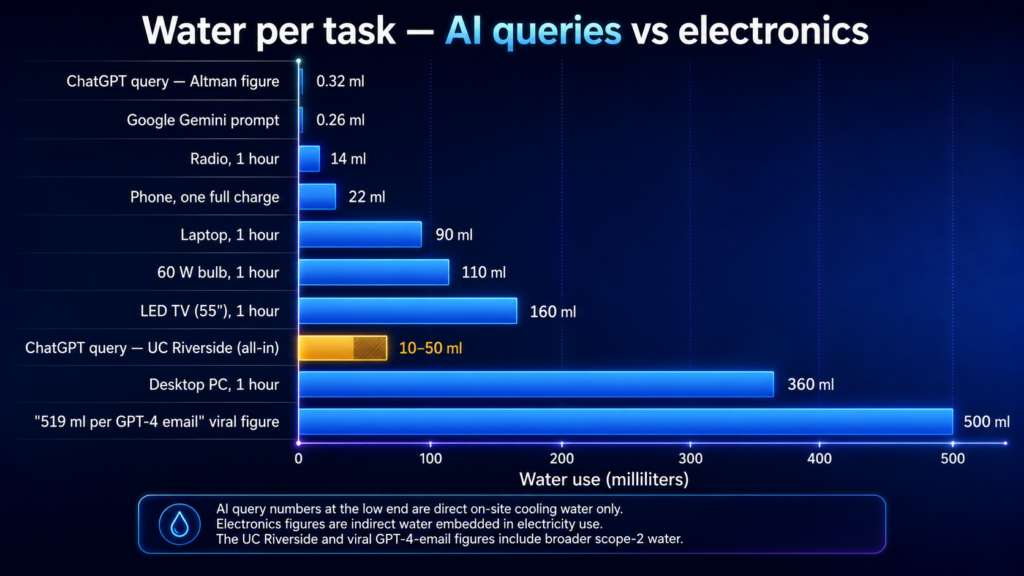
How much water does ChatGPT use? OpenAI’s own figure, stated by CEO Sam Altman, is about 0.000085 gallons per query, roughly 0.32 mL or one fifteenth of a teaspoon, alongside 0.34 watt-hours of electricity. Independent estimates that count only data-center cooling land a little higher, around 1.5 to 4 mL per prompt. The scary viral number, about 519 mL (a full bottle) to write a 100-word email with GPT-4, is not a contradiction. It counts the entire electricity and training supply chain, which is why credible figures span more than 150x.
This guide gives you a dated, sourced answer for every version of the question, so per query, per prompt, per question, per day, and per year. You will see why estimates differ so wildly and why newer GPT-5-class models are thirstier rather than leaner. You will also see how a single prompt compares to a burger or a cotton t-shirt, and the one lever that actually changes your footprint. We lead with the data, not the panic, and we flag what the numbers do not yet show.
The Key Takeaways
- OpenAI’s official figure: ~0.32 mL per query. Sam Altman states an average ChatGPT query uses 0.000085 gallons of water (about one fifteenth of a teaspoon) and 0.34 watt-hours of electricity.
- Independent cooling-only estimates: ~1.5 to 4 mL per query. Only about 15% of the water tied to a request is on-site cooling; the rest is electricity generation and training.
- The viral “bottle per email” number is ~519 mL for a 100-word GPT-4 email, from UC Riverside via the Washington Post. It bundles the full lifecycle, which is why it is over 150x the cooling-only figure.
- GPT-5-class models are thirstier, not leaner. A medium GPT-5 reply is estimated near 18 watt-hours (up to 40), versus about 2 Wh for GPT-4, so water scales up with model weight.
- Per prompt it is negligible; at scale it is not. If one in ten working Americans wrote one ChatGPT email a week for a year, that alone would use about 435 million liters of water.
How Much Water Does ChatGPT Use Per Query, Prompt, or Question?
A single ChatGPT query, prompt, or question uses somewhere between about 0.32 mL and a few milliliters of water for an ordinary text reply, with heavier reasoning answers pushing into the tens of milliliters. The reason there is a range and not one tidy number is that different estimates draw the boundary in different places. The lowest figure is OpenAI’s own, the middle figures count only data-center cooling, and the famous 519 mL “bottle” number counts the electricity and training behind the answer too.
| Estimate | Water per query | Energy per query | What’s counted | Source & year |
|---|---|---|---|---|
| OpenAI official (Altman) | ~0.32 mL (1/15 tsp) | 0.34 Wh | Unspecified “average” | S. Altman, 2025 |
| Independent, cooling only | ~1.5 to 4 mL | ~0.3 Wh (GPT-4o) | On-site data-center cooling | Epoch AI / A. Masley, 2025 |
| GPT-5-class reasoning reply | ~a few to tens of mL | ~18 Wh (up to 40) | On-site cooling estimate | Univ. of Rhode Island, 2025 |
| UC Riverside “bottle” | ~10 to 50 mL per reply | n/a | Cooling + electricity (lifecycle), GPT-3 era | UC Riverside, 2023 |
| Washington Post “email” | ~519 mL per 100-word email | n/a | Full lifecycle, GPT-4 | WaPo / S. Ren, 2024 |
OpenAI’s official figure: about 0.32 mL per ChatGPT query
In his June 2025 essay The Gentle Singularity, Sam Altman wrote that “the average query uses about 0.34 watt-hours” and “about 0.000085 gallons of water; roughly one fifteenth of a teaspoon.” That works out to roughly 0.32 mL per question, the smallest credible figure in circulation and the only one from OpenAI itself. It is a useful anchor because it comes straight from the company, and the energy half lines up with independent work.
The catch is that Altman never defined “average,” never published a methodology, and did not say whether training or electricity generation were included. Independent researchers therefore treat it as a plausible floor for on-site use rather than a full accounting. Epoch AI’s own analysis lands close on energy, estimating a typical GPT-4o query at about 0.3 watt-hours. That is ten times lower than the widely repeated 2023 estimate, so the old “ChatGPT uses ten times a Google search” line is outdated.
The viral “bottle of water per email” claim: about 519 mL
The number behind every alarming headline traces to “Making AI Less Thirsty,” a 2023 study by Pengfei Li, Shaolei Ren and colleagues at UC Riverside. They estimated that GPT-3 “drinks” roughly a 500 mL bottle for every 10 to 50 medium responses, depending on when and where the data center runs. In September 2024 the Washington Post, working with Ren, restated it as about 519 mL of water to write a 100-word email with GPT-4, which is the version that went viral.
That figure is not wrong, it is just wide. It measures cooling water plus the water used to generate the electricity, and in some framings the chip-manufacturing and training water too. The same study estimated that training GPT-3 in Microsoft’s US data centers directly evaporated about 700,000 liters of clean freshwater. You can check the math in the original UC Riverside paper, but the headline takeaway is simpler, so a per-email “bottle” claim is a lifecycle number, not a cooling number.
GPT-5 vs GPT-4o: newer ChatGPT models use more water, not less
A common assumption is that each ChatGPT generation gets more efficient, so water use should fall. Per token it does, but the models also do far more work per answer, and the net direction is up. Epoch AI puts a typical GPT-4o reply near 0.3 watt-hours, while the University of Rhode Island’s AI lab estimates a medium GPT-5 response averages about 18 watt-hours and can reach 40, against roughly 2 watt-hours for GPT-4.
Because cooling water tracks energy closely, an answer that costs eight to nine times the electricity costs roughly that much more water. So the honest framing is that a quick reply from a light model is a few drops, while a long reasoning answer from a frontier model is a meaningful multiple of that. For comparison, Google’s official figure for a median Gemini text prompt is 0.26 mL, in the same ballpark as ChatGPT’s official number. The model and task you pick matter far more than the brand on the logo.
Why Do ChatGPT Water Estimates Vary So Wildly?
Same prompt, two honest answers, a gap of more than 150x. Here is why that happens.
If you have seen “a teaspoon” and “a whole bottle” for the same ChatGPT prompt, neither side is lying. They measure different systems, and once you see the boundary the figures stop fighting each other. On-site water is what a data center evaporates to cool its chips. Indirect water is what power plants consume to generate the electricity those chips run on, which is often larger than the cooling itself.
Analysis by writer Andy Masley, drawing on Ren’s data, estimates that only about 15% of the water attributable to a request is actual on-site cooling, with the other 85% sitting in electricity generation and training. Apply that split and the cooling-only cost of a query falls to roughly 1.5 to 4 mL, which is about 150 to 300 times smaller than the viral 500 mL-per-message version. Neither number is fake; they answer different questions.
The practical rule is to always ask what is being counted, where, and when before repeating a figure. A cooling-only number from a cool, water-rich region in winter and a full-lifecycle number from a hot, fossil-powered grid in summer can differ by an order of magnitude for the exact same prompt. Understanding how AI systems actually work under the hood makes that spread a lot less mysterious.
How Much Water Does ChatGPT Use Per Day and Per Year?
The short version is that nobody has an exact total, and that is the point.
There is no official per-day or per-year water total for ChatGPT alone, and anyone quoting one to the liter is guessing. What we do have is a credible scale projection. The Washington Post and Shaolei Ren estimated that if just one in ten working Americans used ChatGPT once a week to write an email for a year, that single habit would consume about 435 million liters of water, roughly what every household in Rhode Island uses in a day and a half.
Zoom out to AI water use overall and the trajectory is steep. The UC Riverside team projects global AI water withdrawal of 4.2 to 6.6 billion cubic meters by 2027, more than the total annual withdrawal of several small countries. ChatGPT is only part of that, but it is one of the largest single drivers, and inference, the everyday business of answering prompts, is now the dominant and fastest-growing share rather than one-time training. The story is the curve, not any one year’s figure.
Is ChatGPT’s Water Use Actually a Big Deal?
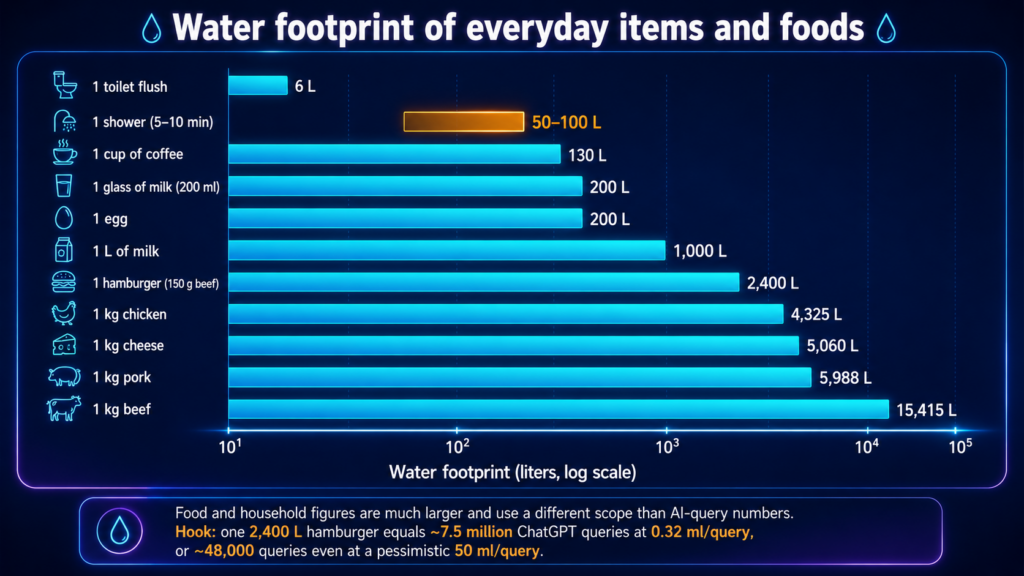
For your personal usage, no. At OpenAI’s official figure, a single beef burger, which takes more than 600 gallons of water to produce, equals well over a million ChatGPT queries, and a cotton t-shirt at more than 700 gallons is in the same territory. By that yardstick, asking a chatbot a question is a rounding error against everyday consumption, and guilt over individual prompts is misplaced.
The legitimate concern is concentration and timing, not the per-prompt cost. Data centers cluster in a handful of regions, often water-stressed ones, and draw heavily at specific hours. A facility pulling millions of gallons a day in Arizona or Texas is a real local problem even while it stays a global rounding error. Both things are true at once, which is why a good answer to “is ChatGPT’s water use bad” is “not for your usage, but yes for where the buildout is concentrated.”
How to Cut Your ChatGPT Water Footprint
The single biggest lever you control is model choice, because the spread between a light model and a frontier reasoning model is enormous. Sending a simple question to a heavyweight model can use close to ten times the energy and water of a lean model that answers it just as well. Matching the model to the task beats any amount of prompt-trimming, and comparisons like DeepSeek vs ChatGPT and our guide to the most capable AI models show how different the efficiency profiles really are. For the greenest tools to switch to, see our guide to the most eco-friendly AI.
In practice that means defaulting to a lighter model for routine questions and reserving GPT-5-class reasoning for problems that genuinely need it. Batch related questions into one session instead of many cold starts, and resist regenerating an answer reflexively, since each retry is a fresh query. Running several models from one place, the way a multi-model setup like the one in our getting started guide works, makes “pick the right tool” a real choice instead of a theoretical one. None of this requires guilt; it just requires using the heavy option on purpose rather than by default.
If you want to go a step further, our EcoGPT review covers a regenerative AI chatbot that runs on energy-efficient Groq LPU chips and funds tree planting at 100 messages per tree, pairing the lighter-model approach with active environmental offsetting. Another lighter-footprint option is covered in our GreenPT review, a privacy-first chatbot that leans on energy-efficient models.
Conclusion
So how much water does ChatGPT use? OpenAI’s official answer is about 0.32 mL per query, independent cooling-only estimates put it near 1.5 to 4 mL, and the viral 519 mL “bottle per email” figure is a full-lifecycle measure rather than a contradiction. Newer GPT-5-class models lift those numbers, not lower them, and the real story is the scale curve, not any single prompt. The most useful next step is not to stop using ChatGPT; it is to be deliberate about which model you reach for, starting with a clear look at how the leading models differ.
FAQ
How much water does one ChatGPT search use?
By OpenAI’s own figure it is about 0.32 mL, roughly one fifteenth of a teaspoon, per query. Independent estimates that count only data-center cooling put it closer to 1.5 to 4 mL, and the viral 500 mL claim only applies if you count the electricity and training behind the answer too.
How much water does ChatGPT use per 100 words?
The widely cited figure is about 519 mL to draft a 100-word email with GPT-4, from UC Riverside via the Washington Post. That is a full-lifecycle number; the on-site cooling cost of the same task is far smaller, on the order of a few milliliters.
Why is ChatGPT’s water usage considered bad?
The per-prompt cost is tiny, but data centers concentrate demand in a few often water-stressed regions and draw heavily at peak times. The concern is local strain and timing where the buildout is happening, not the milliliters behind any one of your questions.
Did Sam Altman say how much water ChatGPT uses?
Yes. In his June 2025 essay The Gentle Singularity he stated an average query uses about 0.000085 gallons of water, roughly one fifteenth of a teaspoon, and 0.34 watt-hours of electricity. He did not publish a methodology, so independent researchers treat it as a plausible floor rather than a full accounting.
How much water does ChatGPT use per day?
There is no official daily total for ChatGPT alone. The useful proxy is scale: the Washington Post estimated that one in ten working Americans writing a single weekly ChatGPT email for a year would use about 435 million liters, which shows the impact is in the aggregate, not the individual prompt.