NotebookLM, now called Gemini Notebook, is Google’s free, source-grounded AI research tool that reads the documents, PDFs, websites, and YouTube videos you upload, then answers your questions, writes summaries, and turns your material into podcasts, videos, mind maps, and study guides. The key difference from ChatGPT or Gemini is that it only uses the sources you give it, and it cites every claim back to the exact passage it came from. That single design choice, source grounding, is why millions of students, researchers, and professionals now trust it with material a general chatbot would happily make up answers about.
This guide explains what NotebookLM is in plain terms, what you can actually use it for, how it works step by step, what it costs, and how it stacks up against ChatGPT and Gemini. It is current as of July 2026, including the Gemini 3.5 upgrade and the secure cloud computer that shipped alongside the rename. By the end you will know whether NotebookLM fits your workflow and exactly where to go next to start using it.
The Audio Overview feature makes NotebookLM one of the best tools for spoken audio, and you can see how it compares in our roundup of the best AI podcast generators.
The Key Takeaways
- Source-grounded: NotebookLM answers only from the files you upload and cites every claim, so it rarely hallucinates the way open chatbots do.
- Free to start: the free Standard tier needs only a Google account, with 100 notebooks, 50 sources per notebook, and daily Audio and Video Overviews.
- More than a chatbot: it generates Audio Overviews (AI podcasts), Video Overviews, mind maps, reports, flashcards, quizzes, and slide decks.
- Runs on Gemini 3.5: the July 2026 rename added a secure cloud computer that writes and runs code for data analysis, on Google AI Ultra and Workspace business plans first.
- Built for your sources: it handles PDFs, Google Docs, websites, and YouTube videos, with up to a 1M-token context window.
What Is NotebookLM?
NotebookLM is an AI research and note-taking tool from Google built by Google Labs and powered by the Gemini model. You upload your own material, then NotebookLM becomes an expert on that material, answering questions, summarizing, and creating new formats from it. Think of it as a personal research assistant that has read everything you gave it and nothing else.
The technical term for this is source grounding, sometimes called retrieval-augmented generation. Every response is tied to the documents in your notebook, and each answer carries inline citations that point to the exact source and passage. If NotebookLM says something, you can click the citation and verify it in seconds, which is the opposite of how a general chatbot works. No source, no answer.
That makes NotebookLM ideal for material you cannot afford to get wrong, like legal contracts, lecture notes, research papers, or company documents. It first went viral in late 2024 for its Audio Overviews, which turn any set of documents into a podcast between two AI hosts. Since then it has grown into a full research workspace used across schools, universities, and businesses.
What Is NotebookLM Used For?
People use NotebookLM whenever they need answers grounded in a specific set of documents rather than the open web. The most common job is studying, where students upload lecture slides and readings, then generate study guides, flashcards, and quizzes to revise faster. The Gemini app’s study notebooks are a separate feature with a different job. It is one reason NotebookLM appears on most lists of the best AI tools for students.
NotebookLM for Students
Students are the biggest group of NotebookLM users, and the appeal is obvious. You upload lecture slides, textbook chapters, and your own notes, then generate study guides, flashcards, and quizzes that pull straight from the material your exam actually covers. The Audio Overview turns a week of readings into a podcast you can listen to on the commute. If you are still in school, it pairs well with the free Google AI Pro plan for students, which unlocks higher NotebookLM limits at no cost.
NotebookLM for Researchers and Writers
Researchers and writers use NotebookLM to interrogate long papers, pull together insights across dozens of sources, and draft reports without losing track of where each fact came from. Because every claim links back to a passage, you can move fast through a literature review and still defend every line. It handles up to 50 sources in a single notebook on the free tier, so an entire reading list fits in one place.
NotebookLM for Professionals
Professionals lean on NotebookLM to summarize contracts, prepare proposals, and brief themselves before meetings. Drop in a stack of reports and ask for the three things that changed since last quarter, or turn a dense policy document into a one-page summary your team will actually read. Anyone sitting on reading they do not have time for can hand it over and get a podcast or a briefing back instead.
The shared thread across all of these is trust. Because every output is backed by your own sources and cited, you can hand NotebookLM material that matters and check its work, which is why it has become a default tool for serious research rather than casual chat.
How Does NotebookLM Work?
NotebookLM works in three simple steps, and you can run the whole flow in a few minutes from a browser or the mobile app.
- Create a notebook and add sources. Upload PDFs, paste Google Docs, drop in website links, or add YouTube videos. A single notebook holds up to 50 sources on the free tier.
- Let it read your material. NotebookLM indexes everything you added so it can ground its answers in your content, with a context window of up to 1M tokens for large libraries.
- Ask questions or generate outputs. Chat with your sources, or create an Audio Overview, Video Overview, mind map, report, or study guide, each one citing the passages it drew from.
If you want the full walkthrough with screenshots and tips, our step-by-step guide to using NotebookLM covers each step in detail. The short version is that the quality of your output depends entirely on the quality of the sources you feed it.
NotebookLM Features
NotebookLM is best known for its Studio outputs, the formats it can generate from your sources. Every one of them stays grounded in the material you uploaded, which is what separates them from generic AI generators.
Audio and Video Overviews
The headline feature is the Audio Overview, an AI-generated podcast where two hosts discuss your material in a natural back-and-forth. The Video Overview does the same as a narrated visual summary, useful for turning dense notes into something you can watch. Both features made NotebookLM go viral, and they remain the fastest way to absorb a pile of documents without reading every page.
Mind Maps, Reports, and Study Tools
Beyond audio and video, NotebookLM builds mind maps that visualize how ideas connect and reports that summarize everything into a clean briefing. For revision it generates flashcards and quizzes, and for presentations it creates slide decks with PPTX export, infographics, and data tables. Every format cites the passages it drew from, so you can trace any point back to its source in one click.
Deep Research and Code Execution
A Deep Research mode hunts down new sources for you and adds them to a notebook automatically, so you can build a library without leaving the app. Alongside the July 2026 rename, Google gave every notebook a secure cloud computer that, in its own words, can “write and execute code natively” to run data analysis grounded in your sources. It reached Google AI Ultra and eligible Workspace business plans at launch, with AI Pro on the web following over the coming weeks. Google has not said it is coming to the free tier.
The list keeps growing, so for the newest additions see our roundup of the latest NotebookLM updates and features. Every one of these outputs stays grounded in your sources, which is what separates them from generic AI generators.
Is NotebookLM Free?
Yes. NotebookLM has a generous free Standard tier that works with any Google account, with no trial period and no credit card required. The free plan includes 100 notebooks, 50 sources per notebook, 50 chat queries a day, plus daily Audio and Video Overviews and Deep Research sessions. Every core feature is available on the free tier, so most people never need to pay. For the full breakdown of what the free plan does and does not cover, see is NotebookLM free.
If you hit those limits, paid tiers raise them sharply. NotebookLM Plus comes bundled inside Google AI Plus at $4.99/month, Pro runs $19.99/month through Google AI Pro, and Ultra reaches the highest limits and earliest feature access. For the full tier-by-tier breakdown, see our NotebookLM pricing guide.
NotebookLM vs ChatGPT vs Gemini
NotebookLM, ChatGPT, and Gemini all run on large language models, but they solve different problems. ChatGPT and Gemini are general assistants that draw on broad training data and the open web, while NotebookLM is built to reason over your sources and cite them. The table below shows where each one wins.
| Feature | NotebookLM | ChatGPT | Google Gemini | Best for |
|---|---|---|---|---|
| Source grounding | Yes, your files only | Optional via uploads | Optional via uploads | NotebookLM |
| Citations | Every answer, inline | Sometimes | Sometimes | NotebookLM |
| Audio/Video Overviews | Yes, built in | No | Limited | NotebookLM |
| Open-web reasoning | Limited | Strong | Strong | ChatGPT / Gemini |
| Free tier | Yes, generous | Yes | Yes | Tie |
| Best use | Research your documents | General chat and writing | Google ecosystem tasks | Depends on task |
NotebookLM vs ChatGPT
ChatGPT is a general assistant that draws on broad training data and the open web, so it shines at brainstorming, writing, and open-ended questions. NotebookLM does the opposite by restricting itself to your uploaded files and citing every answer. Use ChatGPT when you want ideas or text generated from scratch, and NotebookLM when the answer has to come from a document you trust.
NotebookLM vs Gemini
Gemini and NotebookLM both come from Google and share the same underlying model, which causes plenty of confusion. The difference is scope. Gemini is a broad assistant wired into Search, Gmail, and the wider web, while NotebookLM is a focused workspace that only reasons over the sources in your notebook. Many people run both, using Gemini for everyday tasks and NotebookLM for grounded research. In July 2026 Google renamed NotebookLM to Gemini Notebook, though it stays a separate research tool.
The honest takeaway is that these tools complement each other. Use NotebookLM when the answer must come from specific documents, and reach for a general model when you need open-ended reasoning, brainstorming, or web-wide research.
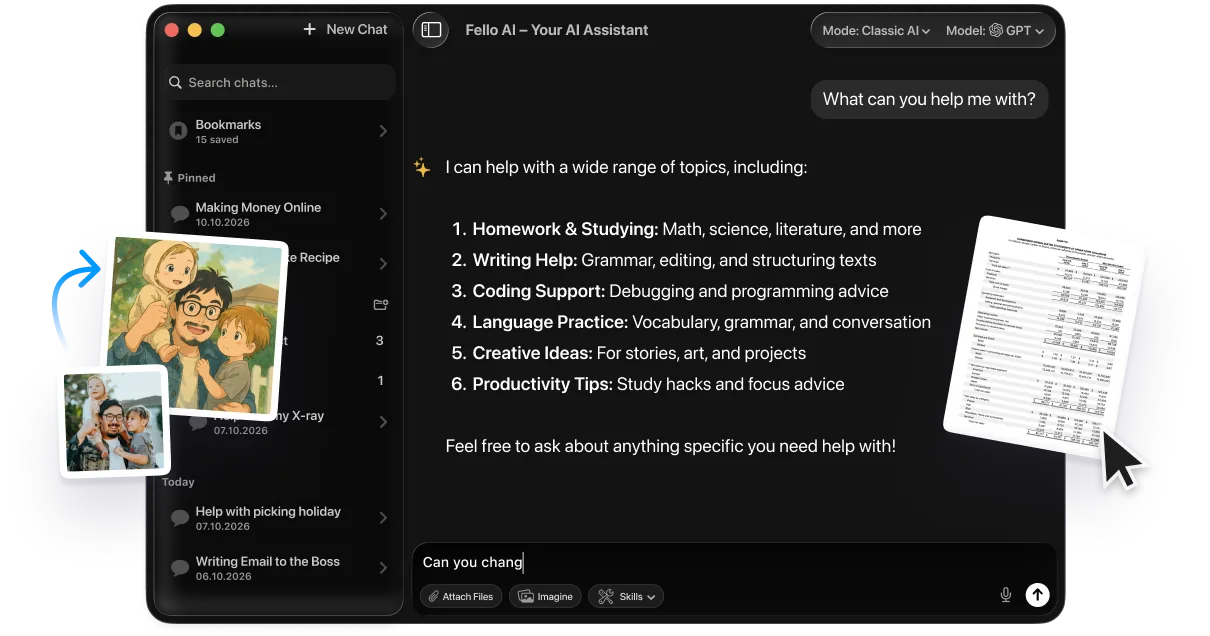
If you would rather not juggle separate apps and subscriptions, Fello AI puts Claude, ChatGPT, Gemini, Grok, and DeepSeek in one Mac app for a single price, so you can do the open-ended reasoning NotebookLM deliberately avoids and switch models whenever one beats the others. It can also turn your own notes, PDFs, or research into a spoken podcast, much like an Audio Overview, alongside images, slides, and documents from the same chat. It is a natural companion to a source-grounded tool, covering everything that lives outside your uploaded documents.
NotebookLM Limitations
NotebookLM is powerful, but it is built for a narrow job and shows its limits outside of it. Knowing where it falls short stops you from expecting it to behave like a general chatbot.
- No open-web knowledge. It only knows what you upload, so it cannot answer general questions or fetch fresh information on its own unless you add a source.
- Source caps on the free tier. You get 50 sources per notebook on Standard, plenty for most projects but tight for very large research libraries.
- Quality depends on your inputs. Feed it messy or low-quality sources and the outputs suffer, because it has nothing else to reason from.
- Limited control over outputs. Audio Overviews, reports, and slides are generated whole, so fine-grained editing of the final wording is still restricted.
None of these are dealbreakers for its core purpose, and pairing NotebookLM with a general assistant covers the gaps. It was never meant to replace ChatGPT or Gemini, only to do one thing they cannot.
Conclusion
NotebookLM is the tool to reach for when accuracy matters and the answer should come from your own material rather than the open internet. It is free to start, it cites everything, and it turns dense documents into podcasts, study guides, and reports in minutes. For most students, researchers, and professionals, that combination is hard to beat.
The best next step is to try NotebookLM on something you are already working through, like a paper or a stack of notes, then read our step-by-step guide if you get stuck. Pair it with a general assistant for everything outside your sources, and you have a research setup that covers both ends.
FAQ
What is NotebookLM in simple terms?
NotebookLM is a research assistant that only reads the sources you give it. You upload documents, PDFs, links or YouTube videos, and it answers questions, writes summaries and makes podcasts from that material, citing the exact passage behind every claim.
Is Gemini Notebook the same as NotebookLM?
Yes. Google renamed NotebookLM to Gemini Notebook on July 16, 2026. It is the same standalone research tool with the same notebooks, the same features and the same free tier, now under the Gemini brand with a new blue-purple logo. Existing notebooks and shared links carried over automatically.
Is NotebookLM free to use?
Yes. The free Standard tier needs only a Google account, with no card and no expiry, and it includes every feature. You pay only to raise the daily caps through a Google AI Plus, Pro or Ultra subscription.
What is the difference between NotebookLM and ChatGPT?
ChatGPT answers from everything it learned in training plus the open web. NotebookLM answers only from the sources in your notebook and cites each one, which makes it far more reliable for research on material you already trust.
Does NotebookLM make things up?
Far less often than an open chatbot, because it is restricted to your uploaded sources and links every claim to the passage it came from. You can click any citation to check it, so errors are easy to catch.
What sources can NotebookLM use?
PDFs, Google Docs and Slides, Microsoft Word files, Google Sheets and CSVs, plain text, web pages, images with OCR, audio files and public YouTube transcripts. Each source can hold up to 500,000 words or 200MB.