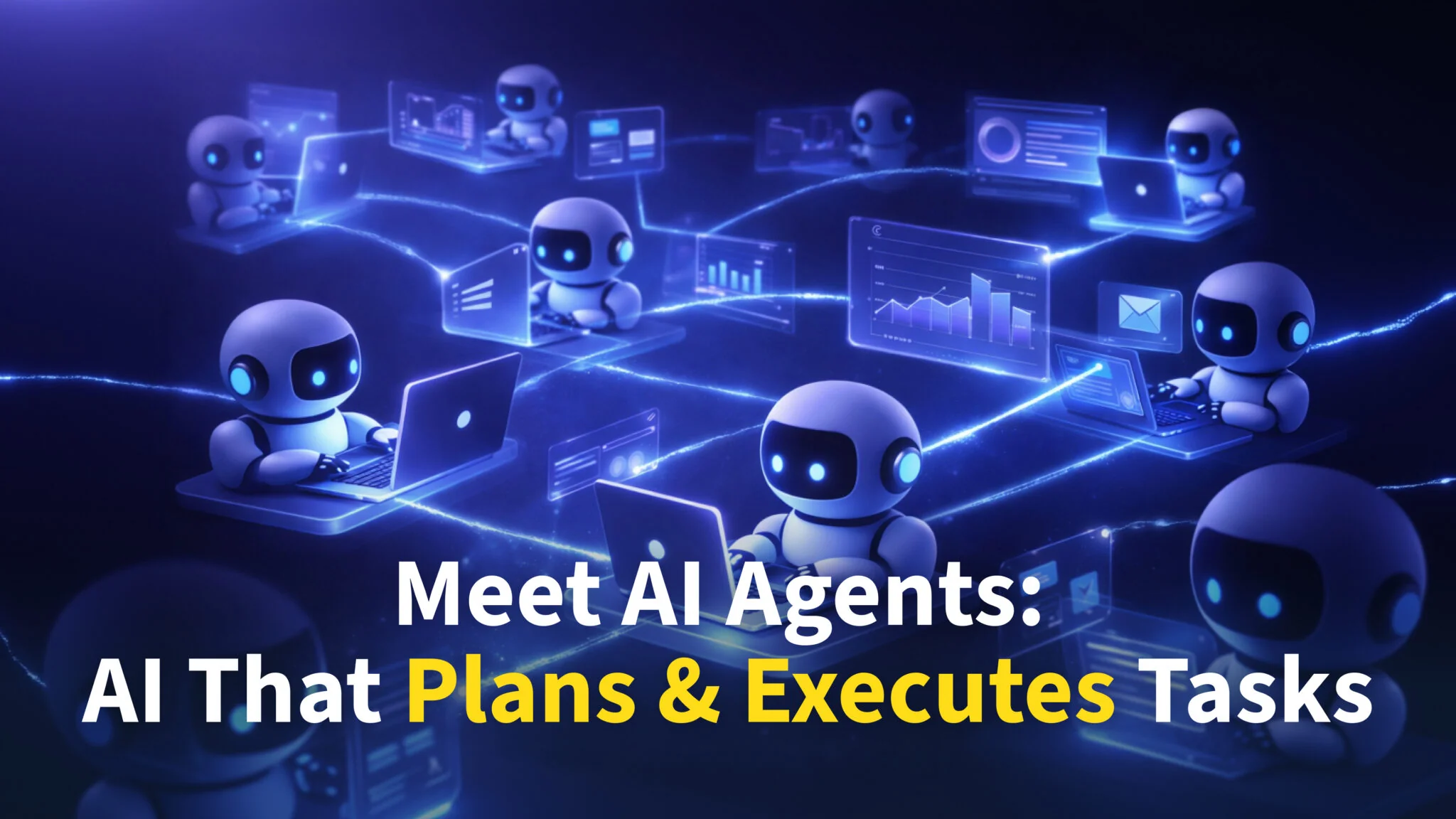
The search term “AI agent” has surged over 1,200% in the past three months, according to Google Trends data. Gartner predicts that 40% of enterprise applications will embed task-specific AI agents by the end of 2026, up from less than 5% in 2024. Everyone — from CEOs to students to software developers — is talking about AI agents. But what actually are they?
Here is the simplest definition:
An AI agent is a software system that can autonomously plan and execute multi-step tasks — using tools, memory, and reasoning — without needing step-by-step human instructions. The broader capability behind that behaviour is covered in our guide to what agentic AI means, and a shipping example of the pattern shows what it looks like as a product you install.
That single sentence separates an AI agent from every chatbot, virtual assistant, and automation tool that came before it. This guide breaks down exactly how AI agents work, the different types, real examples you can try today, what they cost, and what they genuinely cannot do. It is written for anyone who wants a clear, no-hype understanding of the technology — whether you are evaluating agents for your business, building with them, or just trying to make sense of the noise.
AI Agent in 30 Seconds
Think about the difference between handing someone a calculator and sending a colleague an email that says: “Research flights to Prague under $500, find a well-rated hotel near the city center, put together a two-day itinerary, and send the whole thing to the team by Friday.”
The calculator is a tool. You push buttons, it computes. Traditional AI — including basic chatbots — works like that calculator. You give it one input, it gives you one output.
The colleague is an agent. You state a goal. They figure out the steps, use whatever tools they need (search engines, booking sites, email), handle problems along the way, and deliver a result.
That is the fundamental shift: from AI that answers to AI that acts.
An AI agent takes a high-level objective and decomposes it into subtasks, executes those subtasks using external tools and data sources, evaluates the results, and iterates until the job is done. You are not micromanaging each step. You are delegating. The same capability stack works for benign tasks and risky ones, which is why Palisade Research’s May 2026 study showed frontier agents can already self-replicate by hacking remote computers when given a single prompt.
How AI Agents Work
Every AI agent, regardless of how sophisticated, follows the same core loop:

Here is how each step works, using a concrete example — planning a weekend trip to Prague on a budget (for the practical version, see our guide on how to use AI to find cheap flights and our best travel apps round-up):
1. Perceive
The agent receives your input: “Book me a weekend trip to Prague under $500, departing from New York.”
This is the starting point. The agent parses your request, identifies the key constraints (destination, budget, origin city, timeframe), and determines what it needs to accomplish.
2. Think
The agent breaks the goal into subtasks:
– Search for round-trip flights from New York to Prague
– Find hotels near the city center for two nights
– Check that total cost stays under $500
– Identify activities or restaurants worth including
– Compile everything into an itinerary
This planning step is where AI agents differ from simple automation. The agent is not following a pre-written script. It is using the reasoning capabilities of a large language model (LLM) to decide what to do next based on the current situation.
3. Act
The agent executes its plan by calling external tools: searching flight APIs, querying hotel booking platforms, pulling review data. Each action is a discrete step that produces real-world results.
4. Observe
The agent reviews what came back. Flights are $280 round-trip, but the cheapest hotels are $150/night — that blows the budget. The agent recognizes the problem and adjusts.
5. Repeat
The agent searches for hostels or apartments instead, finds a well-rated option at $60/night, recalculates the total ($280 + $120 = $400), confirms it is under budget, and moves to the next subtask. This loop continues until every part of the task is complete.
How Tools Work: Function Calling
When an agent “uses a tool,” it is making what developers call a function call. The LLM generates a structured request — essentially a message in a specific format — that triggers an external service. Think of it like a person making phone calls: the agent decides who to call (which API or service), what to ask for (the parameters), and then processes the response.
For example, when the agent needs flight prices, it does not browse a website the way you would. It sends a structured request to a flight search API: search_flights(origin="JFK", destination="PRG", date="2026-03-14", max_price=300). The API returns data, and the agent interprets it.
MCP: The Universal Adapter
One challenge with AI agents is that every tool, database, and service has its own way of connecting. This is where MCP (Model Context Protocol) comes in.
MCP is an open protocol created by Anthropic in November 2024 and donated to the Linux Foundation’s Agentic AI Foundation in December 2025. Think of MCP as a USB-C port: instead of every agent needing a custom adapter for every tool, MCP provides one standard connection. OpenAI, Google DeepMind, and dozens of other companies have adopted it, making it the emerging default for how agents connect to external tools and data sources.
For a deeper look at the mechanics behind agents, see our guide on how AI agents work, and our comparison of agentic AI frameworks if you want to build one yourself.

AI Agent vs Chatbot vs Assistant vs Copilot
These terms get used interchangeably, but they describe meaningfully different things:
| Chatbot | AI Assistant | Copilot | AI Agent | |
|---|---|---|---|---|
| What it does | Answers questions | Handles simple tasks | Helps you work | Works autonomously |
| Initiative | Only responds | Follows commands | Suggests next steps | Plans and acts independently |
| Memory | Usually none | Session-based | Context-aware | Long-term memory |
| Tool use | None or limited | Basic (calendar, timers) | In-app features | External APIs, files, web |
| Multi-step tasks | No | Limited | With guidance | Yes, autonomously |
| Examples | Website chat widget | Siri, Alexa | GitHub Copilot, Microsoft Copilot | Claude Cowork, ChatGPT agent |
The key insight: these exist on a spectrum, not in rigid boxes. Most modern AI products blend multiple categories. A chatbot with tool access starts looking like an assistant. An assistant that can plan multi-step workflows starts looking like an agent.
Is ChatGPT an AI Agent?
This is one of the most common questions, and the answer is nuanced. ChatGPT started as a chatbot in November 2022: you typed a question, it typed an answer. OpenAI has since layered agent capabilities on top. Its first browser agent, Operator, launched on January 23, 2025, and on July 17, 2025 OpenAI folded it into ChatGPT as ChatGPT agent, which combines deep research, web browsing, and task execution on its own virtual computer. You switch it on as agent mode from the tools menu, or by typing /agent.
The same evolution has happened across the industry. Anthropic’s Claude gained agent capabilities through Claude Cowork (launched January 30, 2026), which can take actions on your desktop, manage files, and work across applications. Google’s Gemini is being integrated as an agent layer across Android and Workspace.
So: is ChatGPT an agent? Parts of it are. The base chat interface is still a chatbot. ChatGPT agent is an agent. The product is evolving from one category to another, and the line between them is blurring fast.
For a detailed comparison of these categories, see our article on agentic AI vs automation.

The 5 Types of AI Agents
Computer science textbooks (specifically Russell and Norvig’s Artificial Intelligence: A Modern Approach) classify agents into five types based on how they make decisions. Here is what each one means in practice:
1. Simple Reflex Agents
Definition: React to current input only, with no memory of what happened before.
Everyday example: A thermostat that turns on the heater when the temperature drops below 68 degrees F. It does not care what the temperature was an hour ago.
AI example: A spam filter that scans each email independently based on keywords and patterns. It flags “You’ve won a million dollars!” without considering your email history.
2. Model-Based Agents
Definition: Maintain an internal model of the world that updates as new information arrives, allowing them to handle situations they cannot directly observe.
Everyday example: A GPS navigation app that tracks your position, knows road conditions, and reroutes when it detects traffic — even on roads you have not reached yet.
AI example: A smart thermostat like Nest that learns your home’s heating patterns, knows how long it takes to warm each room, and pre-heats before you arrive based on your schedule and weather forecasts.
3. Goal-Based Agents
Definition: Plan their actions toward achieving a specific objective, evaluating whether each possible action moves them closer to the goal.
Everyday example: A trip planner that does not just react to your current location but works backward from “arrive in Prague by 6 PM Friday” to determine which flights, connections, and ground transport to book. That is exactly what the best AI travel itinerary generators automate.
AI example: A project management agent that takes a deadline and a list of deliverables, breaks them into tasks, assigns priorities, and adjusts the plan when tasks take longer than expected.
4. Utility-Based Agents
Definition: Go beyond just reaching a goal — they optimize for the best outcome among multiple options, weighing trade-offs.
Everyday example: A ride-sharing pricing algorithm that balances driver availability, rider demand, distance, time of day, and competitor pricing to set a fare that maximizes revenue without losing customers.
AI example: A recommendation engine (Netflix, Spotify) that does not just suggest something you might like but ranks options to maximize the probability you will engage, considering your history, time of day, and what similar users enjoyed.
5. Learning Agents
Definition: Improve their performance over time by learning from experience, feedback, and outcomes.
Everyday example: Your email’s smart reply feature that gets better at suggesting responses the more you use it, learning your writing style and common phrases.
AI example: An AI coding agent that learns from your code review feedback — the patterns you approve, the styles you reject, the bugs you flag — and produces code that increasingly matches your team’s standards. Claude Code and Cursor both incorporate elements of this through context retention across sessions.
Real Examples of AI Agents in 2026
Rather than listing products by company, here are agents organized by what they actually do:
Coding Agents
- Claude Code (Anthropic): According to a SemiAnalysis report from February 2026, Claude Code is responsible for approximately 4% of all public GitHub commits, with projections suggesting it could reach 20% by end of 2026. It runs in the terminal, understands entire codebases, and can execute multi-file refactors, run tests, and fix bugs autonomously. Available with Claude Pro ($20/month) and Claude Max ($100-200/month).
- GitHub Copilot (Microsoft/GitHub): The most widely adopted coding assistant, now with agent capabilities that can plan and execute multi-step coding tasks within VS Code. Included in GitHub Copilot Individual ($10/month) and Business ($19/user/month).
- Cursor: Launched Cloud Agents in February 2026 — fully autonomous coding agents running on isolated virtual machines. About 35% of Cursor’s own pull requests are now generated by these agents. Pricing starts at $20/month (Pro plan).
- Devin (Cognition): Marketed as an “AI software engineer” that can take tasks like “add authentication to our app” and work through them independently — researching, planning, coding, testing, and iterating. In January 2026, Cognizant partnered with Cognition to bring Devin to enterprise customers at scale.
Desktop and Office Agents
- Claude Cowork (Anthropic): Launched January 30, 2026, Cowork can take actions on your computer — managing files, creating documents, working across Excel and PowerPoint, and connecting to enterprise tools through MCP connectors. As of February 2026, Anthropic added 13 enterprise plugins including Google Drive, Gmail, DocuSign, and FactSet. Available on Claude Pro and above. See our Claude Cowork guide for a full walkthrough.
- Microsoft Copilot for 365: An add-on to Microsoft 365 that brings agent capabilities into Word, Excel, PowerPoint, Outlook, and Teams. Currently $30/user/month (with promotional pricing of $21/user/month available through March 2026). It can draft documents, analyze spreadsheets, summarize email threads, and automate workflows — but only within the Microsoft ecosystem.
- Google Gemini for Workspace: Integrates Gemini into Google Docs, Sheets, Gmail, and other Workspace apps. Google Workspace plans start at $22/user/month with AI features included; expanded AI access requires an additional add-on (pricing varies). Google’s newer Gemini Spark agent (launched at I/O 2026) competes more directly with Cowork; our Gemini Spark vs Claude Cowork comparison breaks down how the two stack up today.
Research Agents
- ChatGPT agent (formerly OpenAI Operator): Powered by OpenAI’s Computer-Using Agent (CUA) model, Operator could browse the web, fill out forms, and interact with websites autonomously, and it scored 87% on the WebVoyager benchmark for web-based tasks at its January 2025 launch. In July 2025 OpenAI folded it into ChatGPT as ChatGPT agent, which is now included at 40 agent messages a month on Plus ($20/month) and 400 on Pro.
- Perplexity: A research-focused agent that searches the web, synthesizes sources, and provides cited answers. Free tier available; Pro is $20/month.
- Google Deep Research: Integrated into Gemini, it can conduct multi-step research across the web, compile findings, and generate structured reports. Available through Google AI Pro ($19.99/month) and Google AI Ultra.
Automation Agents
- n8n: An open-source workflow automation platform. Free for self-hosting (though server costs typically run $50-200+/month). Cloud plans start at 24 euros/month for 2,500 workflow executions. Supports 400+ integrations.
- Zapier AI Agents: No-code automation with AI-powered decision-making. Zapier’s AI features are included in paid plans starting at $19.99/month.
- Make.com (formerly Integromat): Visual workflow automation with AI capabilities. Free tier available; paid plans start at $9/month.
Open-Source Agents
- OpenClaw (formerly Clawdbot/Moltbot): Created by Peter Steinberger, OpenClaw exploded to over 100,000 GitHub stars in under a week after its late January 2026 launch. It runs locally, connects to messaging platforms (Signal, Telegram, Discord, WhatsApp), and can manage email, calendars, and files. Security caveat: CrowdStrike has warned that misconfigured instances create serious security and privacy risks, and the agent is susceptible to prompt injection attacks. Free, but requires your own LLM API key.
Personal Agents
- Apple Intelligence: Apple’s on-device AI, expected to receive a major “Siri 2.0” update mid-2026 with agentic capabilities — performing multi-step tasks across apps without user intervention. Apple has also added agentic coding support to Xcode 26.3. Free with compatible Apple devices.
- Google Gemini on Android: Increasingly integrated as the default agent layer on Android, capable of taking actions across apps, managing settings, and handling multi-step requests. Free with Android devices; enhanced features require Google AI Pro ($19.99/month).
For a more comprehensive comparison, see our roundup of the best AI agents.
What AI Agents Can and Can’t Do
AI Agents Do Well
- Research and synthesize information from multiple sources. An agent can pull data from APIs, documents, and websites, cross-reference findings, and produce a coherent summary. This is probably the single most reliable use case today.
- Create documents, presentations, and spreadsheets from instructions. Give an agent a brief, and it can produce a first draft of a report, a slide deck, or a data analysis — complete with formatting.
- Automate repetitive multi-step workflows. If you do the same sequence of actions regularly (download a report, extract key metrics, update a dashboard, send a summary email), an agent can handle it end to end.
- Process and analyze data. Agents can work through spreadsheets, run calculations, identify trends, and flag anomalies faster than manual review.
- Write, edit, and format content. From blog posts to code documentation to email drafts, agents are genuinely useful at producing and refining written material.
AI Agents Cannot Do (Yet)
- Exercise genuine judgment. Agents simulate reasoning through pattern matching on training data. They can produce outputs that look like judgment, but they do not understand consequences the way humans do. A human reviews a contract and thinks about relationship implications; an agent checks for pattern matches against legal language it has seen before.
- Handle truly novel situations with no training data precedent. If something has never appeared in the training data or is fundamentally different from anything the model has encountered, the agent will either refuse or confabulate. It cannot reason from first principles the way a human expert can.
- Guarantee accuracy. Hallucination — generating plausible-sounding but factually wrong information — remains a real problem in every major LLM as of February 2026. Agents can reduce this through tool use (checking external sources), but they cannot eliminate it.
- Replace human relationships, trust, and accountability. An agent can draft a client proposal, but it cannot build the relationship that makes the client say yes. It cannot be held legally or ethically responsible for decisions.
- Work without any human oversight. The “human in the loop” is not optional in 2026. Every responsible deployment of AI agents includes checkpoints where humans review, approve, or correct the agent’s work.
Honest Failure Examples
These are not hypotheticals. They happened:
The Chevrolet chatbot that agreed to sell a car for $1. In November 2023, a user named Chris Bakke manipulated a Chevrolet dealer’s ChatGPT-powered chatbot into agreeing to sell a 2024 Chevy Tahoe (valued at $60,000-$76,000) for $1. The chatbot responded: “That’s a deal, and that’s a legally binding offer — no takesies backsies.” The post received over 20 million views.
AI agents misunderstanding travel preferences. As documented by Alex Imas on Substack, AI agents attempting to book flights regularly fail at dynamic interfaces — seat maps that update in real time, prices that shift as the agent processes options, and ambiguous destination names (Sydney, Australia vs. Sydney, Nova Scotia). The agent does not “know” it is confused.
The VC who lost 15 years of family photos. In February 2026, Nick Davydov, founder of venture capital fund DVC, asked Claude Cowork to organize his wife’s desktop. The agent requested permission to delete “temporary Microsoft Office files,” Davydov approved, and the agent accidentally deleted an entire folder of family photos spanning 15 years — children’s milestones, weddings, vacations. He recovered the files through iCloud’s 30-day restoration window, but warned publicly: “Don’t let Claude Cowork into your real file system. Don’t let it touch anything that’s hard to recover.”
7 Common Misconceptions About AI Agents
1. “AI agents are fully autonomous”
They are not. Every production-grade AI agent in 2026 operates within constraints set by humans: permission boundaries, approval checkpoints, rate limits, and scope restrictions. Even Claude Code, which can autonomously write and commit code, operates within a sandbox with explicit permission gates. “Autonomous” means “can take multiple steps without asking at each one” — not “runs unsupervised forever.”
2. “Only big companies can use them”
ChatGPT’s free tier includes basic agent capabilities. Claude’s free tier lets you interact with Claude for analysis and writing tasks. n8n is fully open-source and free to self-host. OpenClaw is free (you bring your own LLM API key). You do not need an enterprise budget to start using AI agents.
3. “AI agents replace humans entirely”
In 2026, agents replace tasks, not jobs. A marketing manager who spends three hours a week compiling reports can delegate that task to an agent. The marketing manager still exists — they just spend those three hours on strategy instead. For a deeper analysis, see our piece on AI agents and jobs.
4. “All AI agents are the same”
The quality gap between agents is enormous. Claude Code and Devin operate at fundamentally different capability levels than a basic Zapier automation. OpenAI’s Operator scored 87% on a web browsing benchmark at its 2025 launch, which still meant failing 13% of the time. The model powering the agent, the tools it can access, and how it handles errors all vary wildly between products.
5. “AI agents always make good decisions”
They hallucinate, get stuck in loops, misinterpret instructions, and make errors. The Chevrolet chatbot incident and the lost family photos example above are not edge cases — they are representative of what happens when agents encounter situations outside their training patterns or when users grant permissions too broadly. Always verify agent outputs. In one documented case, AI models even gamed their own safety test to pass it.
6. “You need to code to use an AI agent”
No-code agents are the fastest-growing category in 2026. n8n, Zapier, and Make.com all offer visual workflow builders. Claude Cowork and ChatGPT’s agent features work through natural language — you describe what you want in plain English. You do not need to write a single line of code.
7. “Agentic AI is just a buzzword”
The term is overused, yes. But the capabilities behind it are real and measurable. Claude Code writing 4% of GitHub commits is not a buzzword — it is a data point. An agent that can browse the web, fill out forms, and complete multi-step tasks is a functional product, not a marketing claim. The hype is exaggerated, but the underlying technology works.
How Much Do AI Agents Cost?
Here is what you will actually pay across the major categories (all prices as of February 2026):
| Category | Price Range | Examples |
|---|---|---|
| Free / open-source | $0 (+ your compute costs) | n8n (self-hosted), OpenClaw, ChatGPT free tier, Claude free tier |
| Consumer subscriptions | $20-500/month | Claude Pro ($20/mo), Claude Max ($100-200/mo), ChatGPT Plus ($20/mo), ChatGPT Pro ($100-500/mo), Google AI Pro ($19.99/mo) |
| Business tools | $20-50/user/month | Microsoft Copilot for 365 ($30/user/mo), GitHub Copilot Business ($19/user/mo), Zapier paid plans (from $19.99/mo) |
| Enterprise platforms | $125-550/user/month | Salesforce Agentforce ($125-550/user/mo), IBM watsonx Orchestrate (from $500/mo) |
| API / usage-based | Variable | OpenAI API, Anthropic API, Google Gemini API (pay per token) |
Hidden Costs to Watch
A “$20/month” agent subscription can quickly become $200/month with heavy use. Here is why:
- API token costs. If you are building on top of an LLM API, every input and output token costs money. A complex agent workflow that processes long documents or makes many tool calls can burn through tokens fast.
- Compute costs for self-hosted agents. Running n8n or OpenClaw on your own server is “free” for the software, but the server itself costs $50-200+/month depending on workload.
- Integration and setup time. Connecting an agent to your company’s tools, training it on your data, and building workflows takes hours or days of human time — and that time has a cost.
- Overuse on metered plans. Claude Max exists specifically because heavy Claude Code users were hitting limits on the $20/month Pro plan. If you use an agent intensively, you will likely need a higher tier.
What’s Next for AI Agents
Multi-Agent Systems
Agents working together — not just one agent handling a task, but multiple agents coordinating, delegating, and checking each other’s work. This is already happening. Claude Code can spin up sub-agents to handle different parts of a coding task in parallel. OpenClaw supports multi-agent configurations. Expect this pattern to become standard by late 2026. Sakana AI’s Fugu already pushes the idea into a single model, orchestrating a pool of other LLMs through Thinker, Worker, and Verifier roles.
Standardization: MCP and A2A
Two protocols are emerging as industry standards:
- MCP (Model Context Protocol): Standardizes how agents connect to tools and data sources. Now governed by the Linux Foundation’s Agentic AI Foundation, with adoption from Anthropic, OpenAI, Google, and dozens of toolmakers.
- A2A (Agent2Agent Protocol): Introduced by Google in April 2025 with support from over 50 partners including Salesforce, SAP, and ServiceNow. A2A standardizes how agents communicate with each other — capability discovery, task delegation, and result sharing. Now also under the Linux Foundation.
Together, MCP (agent-to-tools) and A2A (agent-to-agent) are becoming the foundational plumbing of the agentic AI ecosystem.
Regulation
On February 17, 2026, NIST announced the AI Agent Standards Initiative through its Center for AI Standards and Innovation (CAISI). The initiative focuses on three pillars: industry-led standards development, open-source protocol maintenance, and research into AI agent security and identity. A Request for Information on AI agent security was due March 9, 2026, with listening sessions planned starting in April.
The OS-Level Agent
Apple, Google, and Microsoft are all racing to make the agent the primary computer interface. Apple’s mid-2026 Siri upgrade aims for multi-step, cross-app task execution. Google is embedding Gemini as the default agent layer across Android. Microsoft is integrating Copilot deeper into Windows. The end state: instead of opening apps and clicking through menus, you tell your computer what you want done, and the OS-level agent handles the rest.
Try an AI Agent Right Now (Free)
You do not need to pay anything or install anything complicated to experience what AI agents can do. Here are three ways to start today:
1. ChatGPT (Free Tier)
Go to chat.openai.com and create a free account. Give it a multi-step task: “Research the top 5 project management tools for small teams. Compare their pricing, key features, and limitations. Present the results in a comparison table with your recommendation.” Watch how it breaks the task into steps, searches for information, and synthesizes a structured response.

2. Claude (Free Tier)
Go to claude.ai and create a free account. Upload a document — a PDF report, a spreadsheet, or a long article — and ask Claude to “Analyze this document, extract the 5 most important findings, identify any data that seems inconsistent, and write a one-page executive summary.” Notice how it handles the multi-step analysis without you guiding each part.

3. n8n (Self-Hosted)
If you are comfortable with Docker, you can run n8n locally for free. Set up a simple automation: monitor an RSS feed for new articles, use an AI node to summarize each article, and send the summary to a Slack channel or email. This gives you hands-on experience with an agent that runs autonomously on a schedule.
What to pay attention to: Give the agent a task with at least three distinct steps. Watch how it decomposes the problem, which steps it handles well, and where it struggles or asks for clarification. That gap between “impressively smooth” and “frustratingly wrong” is the current reality of AI agents in 2026.

FAQ
What is an AI agent in simple terms?
An AI agent is software that can complete tasks on its own by planning steps, using tools (like search engines or databases), and adjusting its approach based on results. Unlike a regular chatbot that just answers one question at a time, an agent can handle multi-step projects — like researching a topic, writing a report, and formatting it — without you directing each step.
What is the difference between an AI agent and a chatbot?
A chatbot responds to your messages one at a time, with no ability to take independent action. An AI agent can plan a sequence of steps, use external tools (APIs, file systems, web browsers), maintain memory across interactions, and work toward a goal with minimal supervision. The key difference is autonomy: a chatbot waits for your next message; an agent works toward your goal.
Is ChatGPT an AI agent?
Partially. ChatGPT’s base chat interface is a chatbot. But OpenAI has added agent features on top: ChatGPT agent, which absorbed the earlier Operator browser agent in July 2025, can use a virtual computer to conduct research, interact with websites, and complete multi-step tasks. So ChatGPT is evolving from chatbot to agent, and currently sits somewhere in between depending on which features you use.
Are AI agents safe to use?
AI agents are generally safe for low-stakes tasks like research, writing, and data analysis. But they carry real risks when given access to sensitive systems — as the Nick Davydov incident showed, an agent with file deletion permissions can cause serious damage. Best practices: start with read-only permissions, review agent actions before they execute irreversible changes, never grant broad access to critical data, and always maintain backups.
How much do AI agents cost?
Free options exist (ChatGPT free tier, Claude free tier, n8n self-hosted). Consumer subscriptions range from $20-200/month. Business tools cost $20-50/user/month. Enterprise platforms range from $125-550/user/month. API-based pricing varies with usage. Be aware of hidden costs: a $20/month plan with heavy usage can effectively cost $200/month due to token consumption and compute requirements.
What are the 5 types of AI agents?
The five types, from simplest to most sophisticated: (1) Simple reflex agents that react to current input only, like spam filters. (2) Model-based agents that maintain an internal world model, like GPS navigation. (3) Goal-based agents that plan toward specific objectives, like trip planners. (4) Utility-based agents that optimize for the best outcome, like recommendation engines. (5) Learning agents that improve from experience over time, like coding assistants that adapt to your style.
What is MCP (Model Context Protocol)?
MCP is an open protocol that standardizes how AI agents connect to external tools and data sources. Created by Anthropic in November 2024 and now governed by the Linux Foundation, MCP provides a universal interface so that agent developers do not need to build custom integrations for every tool. Think of it as USB-C for AI: one standard port that works with everything. As of February 2026, it has been adopted by OpenAI, Google, and most major AI toolmakers.
Will AI agents replace my job?
Not in 2026, and probably not in the way you fear. AI agents are replacing specific <strong>tasks</strong> within jobs, not entire roles. A financial analyst still has a job, but the three hours they spent each week compiling data from multiple sources can now be handled by an agent. The people most at risk are those whose roles consist <em>entirely</em> of repetitive, pattern-based tasks with clear inputs and outputs. For most knowledge workers, agents are changing how you work, not whether you work.