Claude AI is the family of large language models built by Anthropic, and in 2026 it is one of the two or three most capable AI systems you can actually use. The flagship of the main lineup is Claude Opus 5.5, released September 22, 2026, which Anthropic calls the first model in a new Claude 5.5 family and which leads the Artificial Analysis Intelligence Index at 57.6 on v4.3.2, ahead of Anthropic’s own Claude Fable 5.1 on 53.4, and the value tier, Claude Sonnet 5, brings near-flagship quality down to $2 per million input tokens. Claude is known for careful reasoning, strong coding, a huge 1 million token context window, and a safety-first design its maker calls Constitutional AI.
This guide is the plain-English tour of everything that matters about Claude AI: who makes it, the full 2026 model lineup and what each tier is for, what Claude can and cannot do, how it compares to ChatGPT and Gemini, what it costs, and how to run it on a Mac or iPhone. Whether you are picking your first AI assistant or deciding which Claude model to build on, this is the map. For the head-to-head, see Claude against Gemini.

The Key Takeaways
- Claude is made by Anthropic, a US AI-safety company founded in 2020 by ex-OpenAI siblings Dario and Daniela Amodei.
- The 2026 lineup spans four tiers: Haiku 4.5 (cheap and fast), Sonnet 5 (value and agents), Opus 5.5 (flagship reasoning), and the Mythos class (long autonomous work).
- Claude Opus 5.5 is the flagship of the main lineup, released September 22, 2026 at $4/$20 per million tokens with a 1M-token context window, and it is first on the Artificial Analysis Intelligence Index at 57.6, ahead of every model from every lab.
- Claude Fable 5.1 (September 1, 2026) costs more than Opus at $10/$50 and now sits second among Claude models on 53.4, with an invitation-only twin, Mythos 5.1, that relaxes the biology and cybersecurity safeguards.
- Claude Sonnet 5 (June 30, 2026) is the most agentic Sonnet yet, at $2/$10 and near-Opus quality.
- Claude can now search the web, write and run code, use tools autonomously, and read images, and it builds diagrams and charts as custom visuals, but it still does not generate photos or illustrations.
What Is Claude AI?
Claude AI is a large language model assistant, the same broad category as ChatGPT and Gemini, that you reach through the Claude.ai website, the Claude apps, the developer API, or coding tools like Claude Code. You type or speak a request, and Claude generates text, writes and debugs code, analyzes documents and images, and increasingly plans and carries out multi-step tasks on its own. How much you get out of it depends heavily on how you ask, and prompts that work best on Claude look different from ChatGPT prompts.
It is built by Anthropic, a company founded in 2020 by Dario Amodei (CEO) and Daniela Amodei (President), both former OpenAI research leaders, along with a group of colleagues who left to build AI with safety at the center. That focus shows up in the training method Anthropic calls Constitutional AI, where the model is trained against an explicit written set of principles rather than relying only on human feedback, which is a big part of why Claude tends to be careful, transparent about uncertainty, and hard to push into harmful output. The training pipeline behind it has a less comfortable side: Anthropic bought and destroyed millions of print books to build Claude’s training set.
The name is a nod to Claude Shannon, a founding figure of information theory. Since the first release in 2023, Claude has gone from a capable chatbot to a frontier system that many developers consider the best model in the world for real coding work.
The Current Claude Lineup (September 2026)
Anthropic no longer ships one “Claude” model. It versions four separate tiers, each tuned for a different balance of intelligence, speed, and cost. Here is the current lineup, from the budget tier up to the frontier; everything below it, Opus 5 included, is still served but sits on Anthropic’s published legacy list. Anthropic said on 22 September that Claude Sonnet 5.5 and Claude Haiku 5.5 would follow in the coming weeks, so this table will move again.
| Model | Released | Price (in/out per M) | Context | Best for |
|---|---|---|---|---|
| Haiku 4.5 | Oct 2025 | $1 / $5 | 200K | High-volume, fast, simple tasks |
| Sonnet 5 | Jun 30, 2026 | $2 / $10* | 1M | Agents, everyday coding, long context |
| Opus 5.5 | Sep 22, 2026 | $4 / $20 | 1M | The hardest reasoning and coding |
| Fable 5.1 / Mythos 5.1 | Sep 1, 2026 | $10 / $50 | 1M | Long autonomous work, security research |
*Sonnet 5 launched on introductory pricing due to move to $3/$15 on September 1, 2026; Anthropic cancelled that increase on August 10, 2026, so $2/$10 is permanent. Claude Opus 5 (July 24, 2026) is now the previous flagship and stays available in the API at the same $5/$25, on Anthropic’s published legacy list alongside Claude Opus 4.8 and the rest of the Opus 4.x line. The full Claude pricing breakdown covers subscription plans as well as these API rates.
Claude Haiku 4.5
Haiku is the smallest and cheapest tier, built for speed and scale. If you are classifying thousands of emails, moderating content, triaging support chats, or doing anything high-volume where a wrong answer is cheap, Haiku 4.5 does the job in a fraction of the time and cost of the bigger models. Using Opus for that kind of work would just be burning money.
Claude Sonnet 5
Claude Sonnet 5, released June 30, 2026, is the new default for most people. Its calling card is agentic work: planning a sequence of steps, calling tools, reading the result, and continuing without a human nudging it along. It ships with a 1M-token context window and lands close to flagship quality for roughly a quarter of the price, which is also why it is what a free Claude account runs on: claude.com’s plan comparison marks Sonnet and Haiku yes on Free and the Opus tier no.
Claude Opus 5.5
Claude Opus 5.5 is the flagship, released September 22, 2026 under the API id claude-opus-5-5. When a task is genuinely hard, deep debugging, subtle judgment calls, or research where a wrong answer is expensive, Opus is the model to reach for. It carries a 1M-token context window, a 128K maximum output, and a reliable knowledge cutoff of June 2026, at $4/$20 per million tokens, 20% below the $5/$25 that Claude Opus 5 charged.
Two features carry the tier. A Fast mode runs at up to 2.5 times the default speed for twice the base price, $8/$40, and an effort setting lets you trade tokens against depth of reasoning, defaulting to medium on Opus 5.5. On Artificial Analysis it now ranks first overall, at 57.6 on the Intelligence Index at v4.3.2, ahead of Anthropic’s own Claude Fable 5.1 on 53.4 and of GPT-6 Astra on 52.7. Anthropic says it costs 40% less to run than Opus 5 on typical workloads, and it is the strongest model included in Claude Pro, where the Fable tier still costs extra usage credits on top of the subscription.
The Mythos Class (Fable 5.1 and Mythos 5.1)
In June 2026 Anthropic opened a fourth tier above Opus, the Mythos class. Its public model, Claude Fable 5, launched June 9 at $10/$50, built for long-running autonomous work, and led most benchmarks at the time. Its unrestricted sibling, Mythos 5, keeps the same capability with the safety layer removed and stays gated to vetted partners. Both were briefly pulled offline by a US export-control order in June and returned on July 1 after the controls were lifted. Opus 5 overtook Fable 5 on the public leaderboards at half the price, and then Anthropic refreshed the tier on September 1, 2026 with Claude Fable 5.1 and Mythos 5.1, which took the Intelligence Index back. That lead lasted three weeks: Opus 5.5 passed it on September 22 at less than half the price, and Anthropic says the two perform at the same level on most work. Fable 5.1 held its $10/$50 price and its cache reads sit at 2.5% of the input rate, $0.25 per million tokens, but it reasons for longer, so Artificial Analysis measured it at roughly 20% more per completed task than Fable 5, not less. Mythos 5.1 stays invitation only, handed out through Anthropic’s trusted access programs.
What Claude AI Can Do
Claude has grown well past text chat. These are the capabilities that matter most in day-to-day use.
Coding. This is Claude’s standout strength. It writes, explains, refactors, and debugs code across every major language, and through Claude Code it can work as an autonomous agent in your terminal, editing files and running commands. Many developers rate it the best coding model available.
Long context. The Sonnet, Opus, and Mythos tiers all carry a 1 million token context window, which Anthropic puts at roughly 555,000 words on the tokenizer it introduced with Opus 4.7. You can drop an entire codebase, a book, or a stack of contracts into a single conversation and have Claude reason across all of it at once.
Web search and tools. Unlike the 2024 version, Claude can now search the web for current information, and through the Model Context Protocol (MCP) and Skills it connects to your own data, apps, and tools, then uses them to complete tasks.
Vision and documents. Claude reads images, screenshots, charts, and PDFs, so you can hand it a diagram or a scanned form and ask it to explain, extract, or act on what it sees. It does not, however, generate photos or illustrations the way an image model does. What it makes instead are custom visuals, diagrams and interactive charts built as HTML and SVG, which Anthropic ships in beta to every plan.
Artifacts and Projects. Artifacts open generated documents, code, or diagrams in a side workspace you can edit and reuse, and Projects let you give Claude persistent context and files for ongoing work rather than starting cold each time.
Slack. Claude also works where colleagues already talk. Anthropic put a shared @Claude inside Slack channels in June 2026, and it replaced the older Claude in Slack app on 3 August. Our Claude Tag guide covers what the shared version does and why only Team and Enterprise plans can switch it on.
Claude AI vs ChatGPT and Gemini
All three are frontier assistants, and the honest answer is that the best one depends on the task. The rough shape of the 2026 field looks like this.
| Strength | Claude (Anthropic) | ChatGPT (OpenAI) | Gemini (Google) |
|---|---|---|---|
| Coding and agents | Class-leading | Very strong | Strong |
| Careful reasoning and honesty | Class-leading | Strong | Strong |
| Image generation | Diagrams and charts only | Yes | Yes |
| Ecosystem integration | API, Claude Code, MCP | Broad consumer apps | Google Workspace, Android |
In short, reach for Claude when you want the strongest coding partner and the most careful reasoning, ChatGPT when you want the broadest all-round toolkit including image generation, and Gemini when you live inside Google’s ecosystem. For a fuller side-by-side across every current model, see our guide to the best AI models right now.
How Much Does Claude AI Cost?
You can use Claude for free on Claude.ai, and Anthropic publishes no message count for any plan. Limits reset on a rolling five-hour session window, and how much you get through depends on the length and complexity of your conversations, the model you pick, and the features you use. Free covers everyday questions on Sonnet and Haiku. Paid plans lift the limits and add the Opus tier.
Claude Pro is $17 per month on an annual subscription, $200 billed up front, or $20 billed monthly, and it is the right tier for most individuals, because it opens the Opus family and its current model is Opus 5.5. The Max plans start from $100 and buy 5x or 20x more usage per five-hour session than Pro. Fable 5.1 is reachable on Pro only as pay-as-you-go usage credits, and Max includes it up to half of your weekly limits. Team and Enterprise cover organizations. Developers pay per token at the API rates in the table above. The full Claude pricing breakdown lays out every plan and rate in detail.
How to Use Claude AI on Mac and iPhone
Claude runs in any browser at Claude.ai, and Anthropic ships native desktop and mobile apps. On a Mac, the desktop app adds handy extras like a global shortcut and the ability to see your screen for context.
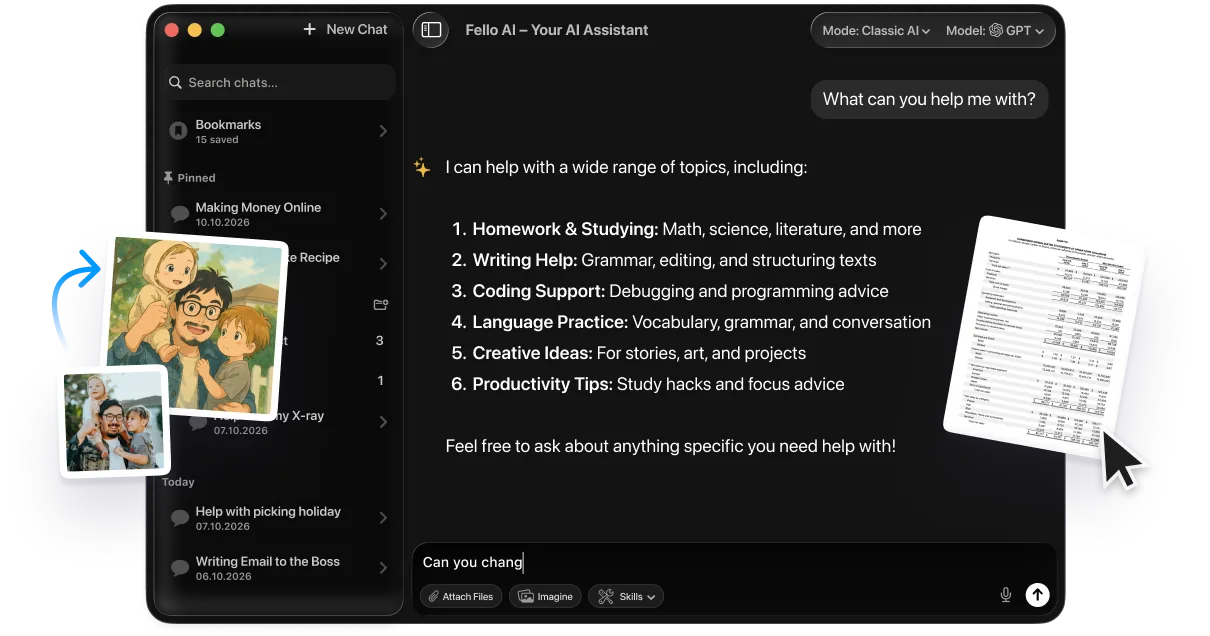
If you would rather not lock into one provider, Fello AI puts every Claude tier alongside ChatGPT, Gemini, Grok, and DeepSeek in a single native app for Mac, iPhone, and iPad. You can switch models mid-conversation, so you get Claude for coding and reasoning, another model for image generation, and no separate subscriptions to juggle. It is the simplest way to keep Claude and its rivals one tap apart. Our full DeepSeek vs Claude comparison puts the two side by side.
Conclusion
Claude AI has become one of the most capable and trustworthy assistants available, with a four-tier lineup that covers everything from cheap high-volume work to frontier autonomous coding. For most people the move is simple: use Claude Sonnet 5 as your daily driver and step up to Claude Opus 5.5 when a problem is genuinely hard. If you want Claude alongside every other top model in one place, start with Fello AI, and to see exactly where Claude sits against the rest of the field, read our roundup of the best AI models right now.
FAQ
What is the newest Claude AI model?
Claude Opus 5.5, released September 22, 2026, is the newest model and the first in what Anthropic calls the Claude 5.5 family. It leads the Artificial Analysis Intelligence Index at 57.6 on v4.3.2, ahead of Claude Fable 5.1 (September 1, 2026) on 53.4, and it costs less than half as much at $4/$20. Anthropic has said Claude Sonnet 5.5 and Claude Haiku 5.5 will follow.
Does Claude AI have internet access?
Yes. Modern Claude models can search the web for current information, which is a change from the 2024 version that was limited to its training data. It can also connect to your own tools and data through the Model Context Protocol.
Can Claude AI generate images?
No, not photos or illustrations. Claude reads and analyzes images, screenshots, and PDFs, and it builds diagrams and interactive charts as custom visuals, but it does not generate pictures. For image creation you would use a model like those in ChatGPT or Gemini, or an app like Fello AI that bundles image models alongside Claude.
Is Claude AI free?
There is a free tier on Claude.ai that runs on Sonnet and Haiku, with no Opus and no fixed message count: limits reset on a rolling five-hour session window. Claude Pro costs $17 a month on an annual subscription or $20 monthly for higher limits and the Opus tier, with Max, Team, and Enterprise plans above it.
Who owns Claude AI and where is Anthropic from?
Claude is developed and owned by Anthropic, a US AI-safety company based in San Francisco. It was founded in 2020 by former OpenAI leaders Dario Amodei (CEO) and Daniela Amodei (President).