Viro AI is a free AI chat app from Viro Climate Action, Inc. that puts ChatGPT, Claude, Gemini and Viro’s own model, also called Viro AI, in one app, and says it funds clean energy for every message. It holds 4.9 stars from 319 ratings on the US App Store and 4.9 stars from 1,160 reviews on Google Play as of November 2026, and it runs on the web, iPhone, Android and Mac. So the short answer to “is Viro AI legit” is yes: it is a real app from a named company, and you can use it without a card.
Whether Viro AI is actually eco-friendly depends on which model you pick. Viro says its own model runs in renewable-powered data centers in Iceland, Norway, Ireland and Finland. ChatGPT, Claude and Gemini inside Viro still run in their makers’ own data centers, and for those Viro funds new renewable generation to match the estimated electricity. Every green claim in this review is Viro’s own, and we say so each time. This review covers what Viro AI is, how it works, what it costs, what it does for the environment, and how it compares with ChatGPT and an all-in-one app.
The Key Takeaways
- Viro AI is legit: it is made by Viro Climate Action, Inc., founded by Nick Arbuckle, with a 4.9-star rating on both app stores.
- Chat is free and unlimited with no card. Ad-free costs $4.99/month and Supercharged costs $12.99/month (US prices, November 2026).
- Viro labels its own model “100% clean energy” and ChatGPT, Claude and Gemini “Energy matched”. Viro says it buys no carbon offsets.
- Published water estimates per AI reply run from about 0.26ml (Google’s own figure) to roughly 50ml (a UC Riverside estimate for GPT-3 that also counts power-plant water).
- App Store reviewers like the mission but report bugs, from dead send buttons to replies that cut off.
What Is Viro AI?
Viro AI is an AI chat app that sells itself as a free, eco-friendly alternative to ChatGPT. It includes five models: Viro AI (Viro’s own, and the default), ChatGPT, Gemini, Claude, and Apple Intelligence, which runs on your own device on recent iPhones, iPads and Macs. You can switch models in the middle of a conversation, and every model is on every plan, including Free.
Viro AI is built by Viro Climate Action, Inc., an independent company founded by Nick Arbuckle. Its pitch is that ads and subscriptions pay for clean energy and climate projects. Think of it as Ecosia’s idea of turning searches into planted trees, applied to AI chat. Beyond chat, Viro offers web search, Research reports, image creation, voice, file uploads, Projects, Notebook, a Write editor, Design, and connections to apps such as Gmail, Google Calendar, Google Drive, Outlook, Slack, Notion and GitHub. It also runs a Shop of climate-conscious products from other retailers.
How Does Viro AI Work?
Viro AI works like any chatbot on the surface, with three layers underneath that the big providers do not offer in their own apps. The first is model routing. The second is Viro’s own data centers. The third is a clean-energy funding loop tied to every message. Here is how Viro describes each one.
Adaptive model routing
When you choose the Viro AI model, Viro sends simple questions to small, efficient models and saves larger models for complex tasks. A quick fact goes to a light model; a detailed physics explanation gets a bigger one. Viro says its own usage data shows this cuts estimated energy use by roughly 14x compared with sending every request to the most capable model. That figure comes from Viro alone and is not independently audited, so treat it as Viro’s claim. Viro’s help pages do not name the underlying models that Viro AI routes between.
Viro’s own data centers
Viro says its own model runs on 100% clean energy in data centers at Akureyri, Blönduós and Keflavík in Iceland, Glomfjord in Norway, Dublin in Ireland, and the Helsinki area in Finland. Viro lists their power as hydro, geothermal and wind, and their power usage effectiveness (PUE) as 1.03 to 1.31. Viro calls this “clean by geography, not by certificates.” The sites belong to hosting providers, not to Viro: its data policy says messages to Viro AI go to “the providers that run Viro AI.” These are Viro’s descriptions of the sites; we have not checked them against the operators.
Clean energy matching
For ChatGPT, Gemini and Claude, which run in their providers’ data centers, Viro estimates the electricity of each message from the tokens it used and funds new renewable generation to cover it. Viro labels these models “Energy matched” and names solar, wind, hydro and battery storage projects. Each reply shows its estimate, for example “⚡ +.3 Wh”, and an impact screen adds up kilowatt-hours of clean energy added, CO₂e avoided and homes powered. Viro states that it does not use carbon offsets or carbon credits.
Climate restoration on top
Viro says its remaining profits from ads, subscriptions and the Shop go to climate restoration. Its first restoration partner, according to Viro, is The Ocean Cleanup, and it plans to add biodiversity, reforestation and carbon removal projects as it grows. On the Supercharged plan, each message funds 10 times the clean energy it needs. Viro’s current pages no longer use the word “climate-positive”, and the Viro pages we read cite no third-party audit of the energy matching or the restoration funding.
Is Viro AI Legit and Safe?
Yes, Viro AI is legit. It is published by a named company, Viro Climate Action, Inc., which is the developer on the official Viro app on the App Store and on Google Play. As of November 2026 it has 4.9 stars from 319 ratings on the US App Store and 4.9 stars from 1,160 reviews and 50,000+ downloads on Google Play. Viro says more than 100,000 people have signed up. Viro also says it never sells your data, builds no ad profile, and does not use your chats to train AI models. You can use it without handing over payment details.
Being legit is not the same as being polished. The most detailed App Store reviews complain about stability, not trust. One reviewer in February 2026 listed a send button that often fails, random “no connection” errors on strong internet, one photo per message, and no way to edit messages. Another said replies sometimes cut off mid-answer, and a July review said the app made images it was not asked for. Viro ships updates every week or two, up to version 7.0 in November 2026, so some of these may be fixed. Reviewers back the environmental mission but get frustrated when basic chat actions break.
Does Viro AI Use Water? Is It Actually Eco-Friendly?
Viro AI uses water and energy, and how much depends on the model you pick. ChatGPT, Claude and Gemini inside Viro run in their providers’ data centers, so their water and electricity use is the same as anywhere else. For those three, Viro funds clean energy elsewhere; it does not reduce what the query consumes. For its own model, Viro says its data centers are cooled by cold outside air and closed-loop liquid systems, so they consume “only a small fraction” of the roughly 1.8 liters per kilowatt-hour that Viro attributes to evaporative cooling. Viro’s per-message estimate does not include water yet.
The water reality
AI water figures depend on what you count. Google said in August 2025 that a median Gemini Apps text prompt consumes 0.26ml of water, based on its data centers’ cooling water. OpenAI’s Sam Altman wrote in June 2025 that an average ChatGPT query uses about 0.000085 gallons, roughly 0.32ml, without saying what that covers. The UC Riverside paper “Making AI Less Thirsty” also counts the water used to generate the electricity. It estimated that GPT-3 consumes a 500ml bottle for roughly 10 to 50 medium-length responses, depending on when and where it runs. Our guide to how much water AI uses explains why these numbers differ so much.
Matching versus reducing
Viro AI does two different things, and they should not be confused. For partner models, Viro pays for renewable generation elsewhere to match the electricity: the water still evaporates and the electrons still flow in the provider’s data center. Viro rejects the word “offsets” for this, but the logic is the same ledger idea. For its own model, the claim is a real reduction: cleaner power, low-water cooling and smaller models for simple questions. Viro’s strongest point is transparency, since it shows an energy estimate on every reply. Its weakest point is that the numbers rest on its own accounting.
So is Viro AI good for the environment? Compared with using ChatGPT with no matching at all, funding clean energy is a net plus, and the default Viro AI model is the greener choice inside the app, if Viro’s data center claims hold. Just do not read “eco-friendly” as “uses no water.” For the bigger picture, our guide to which AI is actually green ranks the options side by side. The most sustainable AI query is still the one you do not send.
Is Viro AI Free? Pricing and Plans
Yes, Viro AI is free. The Free plan includes unlimited chat with all four cloud models and every feature, supported by small sponsored cards that Viro matches to the topic of your conversation, not to your identity. Heavier features have fair-use limits that are the same on every plan: 5 Research reports a day, 20 images a week, and a cap of 15 messages a minute and 150 an hour. The two paid plans remove ads. They do not unlock better models or higher limits.
| Plan | Monthly | Annual | What you get |
|---|---|---|---|
| Free | $0 | $0 | All models and features, with ads |
| Ad-free | $4.99 | $49.99 | No ads; called “Viro AI” in the app |
| Supercharged | $12.99 | $129.99 | No ads, 10x clean energy per message |
These are Viro’s US prices as of November 2026, and the US App Store lists the same amounts. App Store and Google Play prices vary by country. People who subscribed before May 2026 keep their original price, which is why the App Store still shows older items such as a $0.99 Premium plan and a $9.99 Supercharged plan. For most people the Free plan is enough. The paid tiers buy a cleaner screen and a bigger climate contribution, not extra capability.
Viro AI vs ChatGPT
Viro AI includes ChatGPT, so the real comparison is the Viro app against the ChatGPT app. Here is how the two stack up on the points that matter for everyday use.
| Feature | Viro AI | ChatGPT |
|---|---|---|
| Cost to start | Free, no card | Free tier, card for Plus |
| Models available | Viro AI, ChatGPT, Gemini, Claude, Apple Intelligence | OpenAI models only |
| Eco model | Own model on renewable power (Viro’s claim); others energy matched | OpenAI does not advertise clean-energy matching for consumers |
| Transparency | Energy estimate under every reply | OpenAI does not show a per-reply energy figure |
| Reliability | Bugs reported in app reviews | Generally stable |
| Best for | Eco-conscious casual users | Power users who want stability |
If your priority is a lighter conscience and several models in one free app, Viro AI is compelling. If you need a tool that never drops a message during deep work, ChatGPT or another mature app is the safer pick right now.
How to Sign In to Viro AI
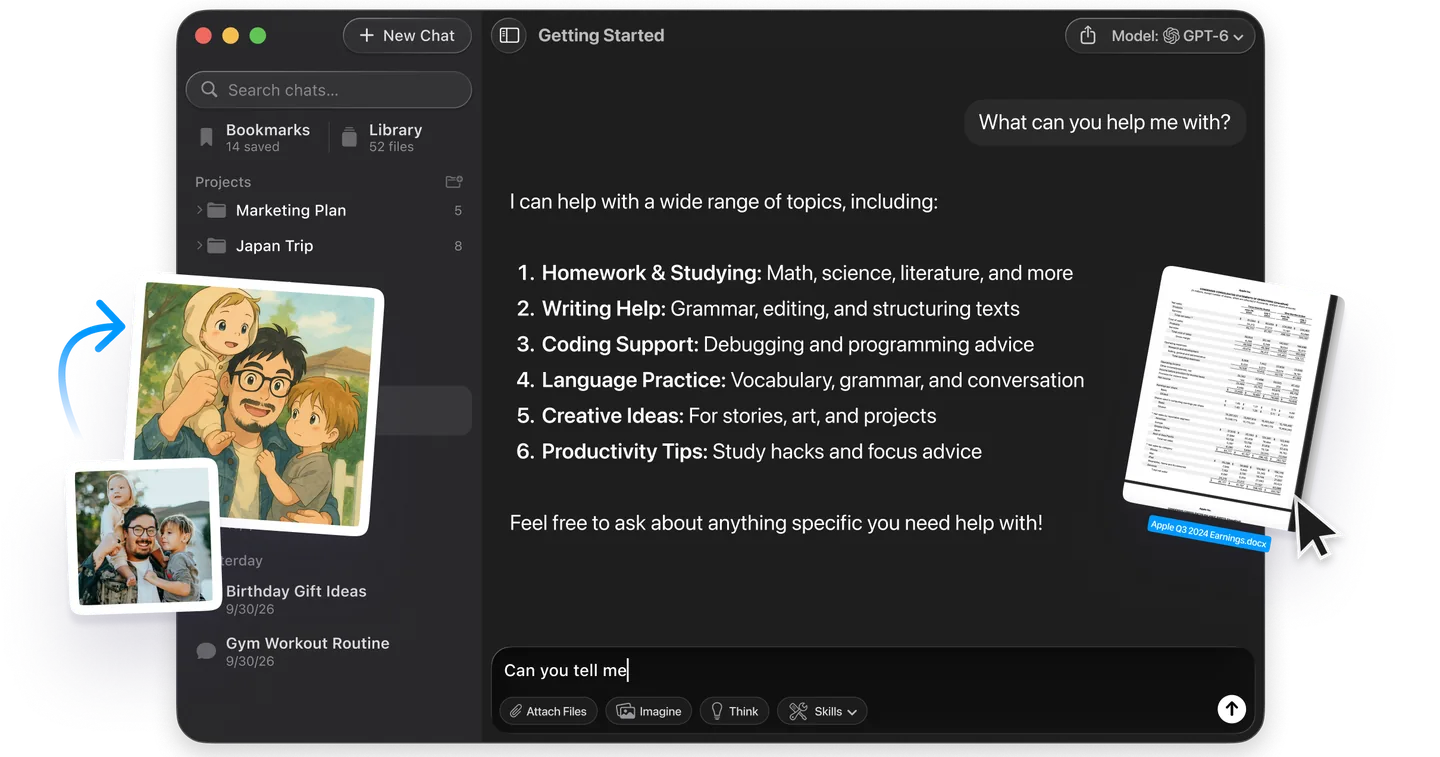
Getting started takes under a minute. Go to the Viro AI web app, or download the app from the App Store or Google Play. On a Mac, Viro offers its own app at ai.viro.app/mac for macOS 12 or later, on Apple silicon and Intel; on Windows, Viro installs from the browser for now. Sign up with email, Apple, Google or Microsoft, and you can start chatting without entering any card details. You can also text Viro from iMessage, WhatsApp, Telegram and Discord. Your chats, memory and impact total follow your account across web, desktop and mobile.
Want Every Model in One App? Try Fello
Viro’s best idea is that you should not have to pick one AI. If that is the part you care about most, you can take it further. When one answer looks off, ask Grok, DeepSeek or Perplexity the same question in the same window, without a second account or a second bill. Fello AI puts GPT, Claude, Gemini, Grok, DeepSeek, Perplexity and more behind one subscription on Mac, iPhone and iPad, with a free tier to start.
Fello AI also hands back the finished thing: ask for a deck and get a PowerPoint file, ask for a budget and get an Excel sheet, or drop in a PDF and get the answer. Fello and Viro answer different priorities. Viro leads with its climate funding, and Fello with model choice and finished files. You can compare the underlying systems in our best AI models guide to decide which fits your needs.
The Verdict on Viro AI
Viro AI is a legit, free and well-intentioned way to use AI with a lighter footprint. Five models in one app, an energy estimate on every reply, a default model that Viro says runs on renewable power, and unlimited free chat are real strengths. The two honest caveats are stability, since app reviewers report bugs, and expectations: ChatGPT, Claude and Gemini inside Viro use the same water and energy as anywhere else, and Viro’s green figures are its own, not audited.
If you want a greener conscience for everyday questions and can tolerate the occasional glitch, Viro AI is worth a try, and it costs nothing to test. Keep it on the default Viro AI model for the lowest footprint Viro claims. If you need a rock-solid, do-everything AI app, compare it against alternatives first. Either way, the smartest eco move is using AI deliberately rather than assuming any label makes it free of impact.
Frequently Asked Questions
Is Viro AI legit?
Yes. Viro AI is a real app from Viro Climate Action, Inc., founded by Nick Arbuckle. It is on the App Store and Google Play with a 4.9-star rating on both as of November 2026. It lets you chat with Viro’s own model, ChatGPT, Gemini and Claude while funding renewable energy. It is legitimate and safe to use, though app reviewers report bugs.
Does Viro AI use water?
Yes, like every AI app. ChatGPT, Claude and Gemini inside Viro run in their providers’ data centers and use the same water there as anywhere else. Viro says its own model runs in data centers cooled by outside air and closed-loop systems that consume only a small fraction of the water that evaporative cooling does. Viro’s energy estimate does not count water yet.
Is Viro AI free?
Yes. Viro AI’s Free plan includes unlimited chat with all four cloud models and every feature, with no payment details, supported by small ads. Ad-free costs $4.99 a month or $49.99 a year, and Supercharged costs $12.99 a month or $129.99 a year, which also funds 10 times more clean energy (US prices, November 2026). Paid plans do not add models or raise limits.
Is Viro AI actually eco-friendly?
Partly. Viro says its own model, the default, runs on 100% clean energy in data centers in Iceland, Norway, Ireland and Finland. ChatGPT, Claude and Gemini inside Viro run in their providers’ data centers, and Viro funds new renewable generation to match their estimated electricity. Viro buys no carbon offsets, by its own account, and shows an energy estimate on every reply. These figures are Viro’s own and are not independently audited.
What models does Viro AI use?
Viro AI offers five models: Viro’s own model, called Viro AI, plus ChatGPT, Gemini, Claude and Apple Intelligence, which runs on your own device. The Viro AI model routes simple questions to small models and complex ones to larger models, but Viro does not name which underlying models it uses. Every model is available on every plan.
Does Viro AI have a Mac app?
Yes. Viro AI offers a Mac app as a download from ai.viro.app/mac, for macOS 12 or later on Apple silicon and Intel Macs. It shows the same live Viro as the web app and signs in to the same account. Viro’s App Store listing, by contrast, says “Designed for iPad. Not verified for macOS.”
Úvodní obrázek k tomuto článku vznikl s pomocí AI.