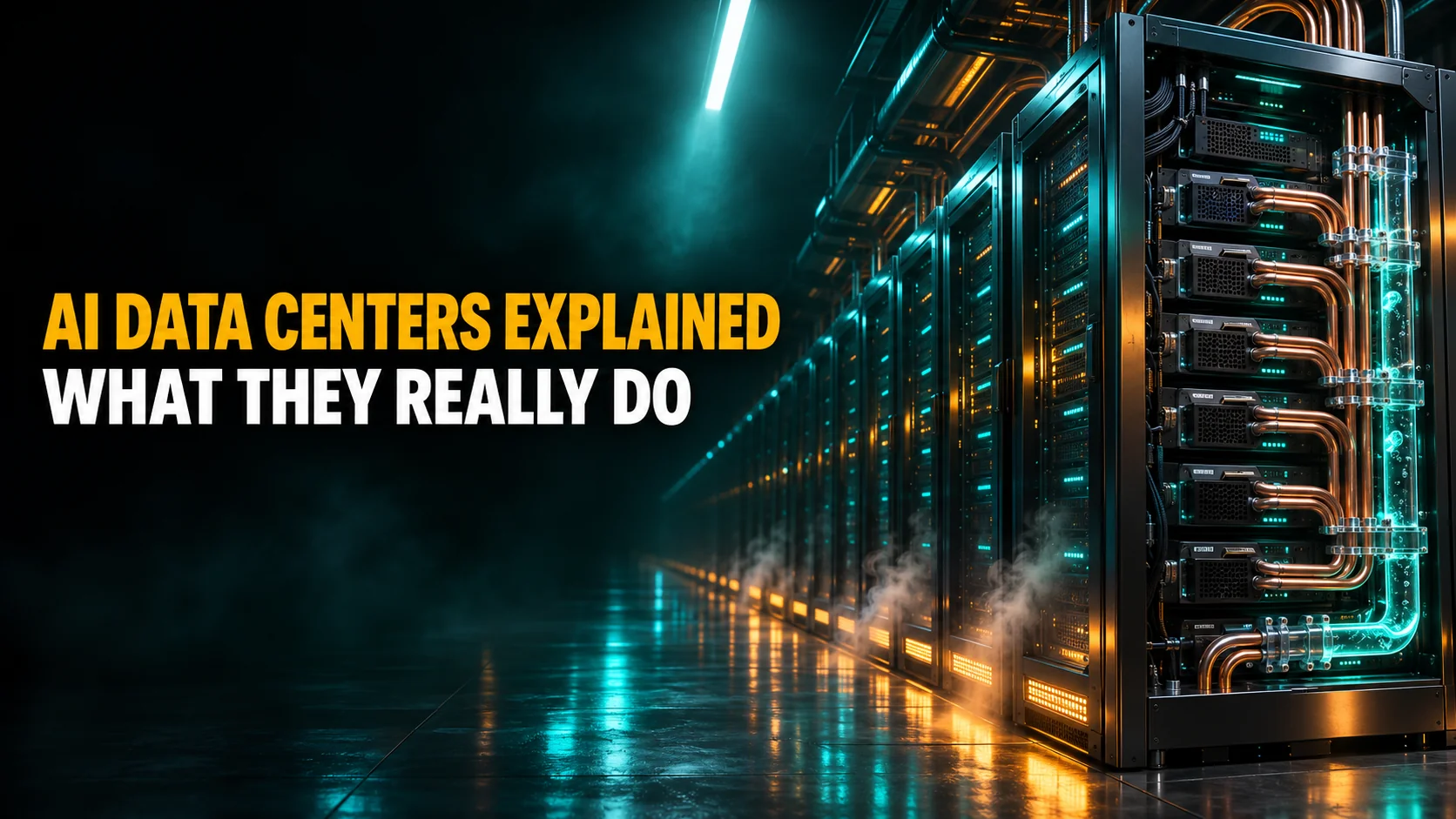
What are AI data centers? They are large buildings packed with AI chips, mostly Nvidia GPUs and Google TPUs, that train AI models and then run them every time you send a prompt to ChatGPT, Claude or Gemini. What sets them apart from ordinary data centers is electricity. One modern AI server rack draws more than 100 kilowatts, roughly ten times a regular rack. The International Energy Agency expects data center electricity use to roughly double from 485 TWh in 2025 to 950 TWh by 2030.
That is why AI data centers keep turning up in the news: in local zoning fights, in arguments about electricity bills and in announcements like Meta's 5-gigawatt Hyperion campus in Louisiana. This guide explains what AI data centers are actually for, what is inside one and how many the US has. The counts disagree wildly, and we show why. Then we cover where the biggest ones are and why so many people say they are bad for the environment. Every number is dated and attributed.
The Key Takeaways
- What they are: buildings full of GPUs and TPUs that train and run AI models. An AI rack uses 100+ kW, against about 10 kW for a regular one.
- What they are for: training new models and answering prompts. Electricity use by AI-focused data centers grew 50% in 2025, according to the IEA.
- How many: US trackers count anywhere from 57 to 1,267 AI data centers, depending on what they count. The US has 5,159 data centers of all kinds.
- The biggest: Amazon's New Carlisle campus in Indiana (about 1,037 MW), xAI's Colossus 2 in Memphis (946 MW) and OpenAI's Stargate Abilene in Texas (824 MW), per Epoch AI in November 2026.
- The downside: US data centers used 4.4% of US electricity in 2023 and could reach 11.8% by 2030. Local opposition blocked or delayed about $130 billion of projects in early 2026.
What Are AI Data Centers?
AI data centers are data centers built around chips made for AI, such as Nvidia GPUs, Google TPUs and Amazon's Trainium. The research group Epoch AI defines one as one or more nearby buildings with a shared owner or operator that run hardware specialized for AI. They are used to experiment on, train and deploy AI models.
The chips are only half of the story. Because AI chips have to swap data with each other constantly, they are packed tightly into server racks. Epoch AI notes that Nvidia's standard GB200 NVL72 rack holds 72 GPUs in a cabinet a little over 2 meters tall and draws over 100 kW, enough to power about 100 American homes. That density forces everything else in the building to change: the power lines, the cooling and the backup systems.
How AI Data Centers Differ From Traditional Data Centers
AI data centers differ from traditional data centers mainly in power density and cooling. A traditional data center runs websites, email, storage and business software on CPU servers. An AI data center runs model training and AI inference on accelerators.
| Feature | Traditional data center | AI data center |
|---|---|---|
| Main chips | CPUs | GPUs, TPUs and other AI chips |
| Power per rack | About 10 kW | Over 100 kW (Nvidia NVL72) |
| Cooling | Fans and air conditioning | Mostly liquid cooling through plates on the chips |
| Power pattern | Fairly steady | Large, rapid swings during training |
| Main jobs | Websites, email, storage, cloud apps | Training models and answering AI requests |
Sources: Epoch AI for rack power and cooling (November 2025), IEA for power swings (April 2026).
What Are AI Data Centers Called?
AI data centers are also called AI factories, AI superclusters or training clusters. The IEA calls the most advanced ones AI factories, cutting-edge data centers designed specifically for AI. Companies often say AI supercluster or training cluster: Meta describes Hyperion as its largest AI training cluster. Very large sites run by Amazon, Microsoft, Google and Meta are also called hyperscale data centers, a term that predates the AI boom.
What Are AI Data Centers Used For?
AI data centers are used for two jobs: training new AI models and running them for users, which the industry calls inference. Everything else, from AI images to company chatbots, is a version of those two.
Training new models. A frontier model learns from its data over weeks or months on a huge cluster in one place. Epoch AI estimates GPT-4 was likely trained on about 25,000 Nvidia A100 GPUs. OpenAI's Stargate Abilene campus is estimated to have over 250 times that compute.
Answering prompts. Every ChatGPT reply, Claude answer or Gemini summary is computed on chips in a data center, not on your phone. As user numbers grow, so does this share of the work.
Making images and video. Image and video generation use far more computing per request than a short text answer. In tests reported by MIT Technology Review, one 5-second clip from an open-source video model took about 3.4 million joules, more than 700 times a high-quality image. That is why AI video has a bigger environmental footprint than chat.
Renting AI power to other companies. Amazon Web Services, Microsoft Azure, Google Cloud and CoreWeave rent GPU time to startups, banks and labs that do not own chips.
What Are Data Centers Used For Besides AI?
Besides AI, data centers run ordinary computing: streaming, storage, email, websites and business software. AI is the fastest-growing part. In its 2025 Energy and AI report, the IEA projected that AI-oriented accelerated servers would drive almost half of the growth in data center electricity use to 2030. Conventional servers would drive about 20%.
Why Are So Many AI Data Centers Being Built?
So many AI data centers are being built because demand for AI is growing faster than the chips to serve it. The IEA's April 2026 update says major model providers reported a threefold increase in active users and a fivefold increase in revenue over the past year. The capital expenditure of five large technology companies passed $400 billion in 2025 and is expected to rise by another 75% in 2026. The IEA's satellite tracking shows that AI factories more than tripled in capacity in 18 months. Whether that spending pays off is a separate debate, covered in our piece on whether the AI bubble is about to pop.
What Do AI Data Centers Look Like Inside?
AI data centers look like huge, low warehouses surrounded by rows of cooling machines and a power substation. Inside are long halls of refrigerator-sized server racks fed by thick power cables and coolant pipes.
From the Outside
The cooling equipment is the giveaway. Epoch AI notes that if you see a building with a bunch of giant chillers next to it, there is a good chance it is a data center. The sites are enormous. Epoch AI puts OpenAI's Stargate campus in Abilene, Texas, on an 875-acre site, about 3.5 square kilometers. Meta says its Richland Parish campus in Louisiana, home to Hyperion, will cover nearly 10 million square feet of buildings.
Inside the Server Halls
Inside an AI data center, the racks are the heart of the building. The IEA describes a single advanced rack as the size of a large refrigerator that could, by 2027, have peak power demand equal to 65 households. The power density of AI servers rose 11 times between 2020 and 2025, according to the IEA, and is set to rise another fourfold by 2027.
Air struggles to carry that much heat away, so most new GPU data centers use liquid cooling. Coolant flows through metal plates mounted on the chips, carries the heat out of the rack and passes it to a water loop. Many sites then reject the heat outdoors with evaporative cooling towers, which is where much of the water use comes from. Not every site works this way. Epoch AI says Amazon's New Carlisle campus, the largest by power, runs on Amazon's own Trainium2 chips and uses direct air-based cooling instead.
Power and Backup
AI data centers need their own heavy power infrastructure. AI training causes large, rapid swings in demand, so the IEA expects 20 to 25 GW of battery storage to be installed in data centers worldwide by 2030. Grid connections are slow, so US developers are also building gas generators on site. The IEA estimates 15 to 27 GW of onsite natural gas could power data centers by 2030, mostly in the United States.
How Many AI Data Centers Are in the US?
Nobody has one agreed count of AI data centers in the US. Depending on the tracker, the answer in November 2026 ranges from 57 to 1,267, because each one defines "AI data center" differently.
We call our comparison below the Fello AI data center count check: on 27 November 2026 we read each tracker's own page and recorded what it counts. That shows why the numbers disagree.
| Tracker | US count | What it counts | As of |
|---|---|---|---|
| Data Center Index | 1,267 AI campuses | Every tracked AI campus: 675 operating, 176 under construction, 416 announced or permitted | 27 Nov 2026 |
| AI Data Center Index | 84 facilities | Source-backed AI facilities: 45 operational, 39 in the pipeline, 43.6 GW | Checked 27 Nov 2026 |
| LLMpulse | 57 projects | Major projects only, running, under construction, approved or announced with a site, in 24 states | 15 Nov 2026 |
| Statista | 5,159 data centers | All data centers, AI or not | Nov 2026 |
The honest answer: the US has roughly 675 operating AI data center campuses by the broadest count, but only a few dozen giant ones that drive the headlines. Epoch AI, which tracks the largest sites by satellite, only includes facilities of roughly 100 MW or more at full buildout. The US also leads the world in data centers of every kind: Statista counts 5,159, against 606 in the UK and 583 in Germany.
Where Are AI Data Centers Located?
AI data centers are located mostly in the United States, and within it wherever large amounts of electricity are available. Texas leads every tracker we checked. Data Center Index lists a 43.4 GW pipeline in Texas, followed by Virginia (18.5 GW), Utah (13.8 GW), Ohio (11.8 GW) and Georgia (11.4 GW). Epoch AI's list of large sites is also led by Texas (14 sites), then Ohio and Virginia (7 each).
These are the largest AI data centers by power they can already draw, according to Epoch AI's satellite-based estimates updated on 23 November 2026:
| Campus | Owner | Location | Current IT power |
|---|---|---|---|
| New Carlisle (Project Rainier) | Amazon, used by Anthropic | New Carlisle, Indiana | About 1,037 MW |
| Colossus 2 | xAI | Memphis, Tennessee | About 946 MW |
| Stargate Abilene | Oracle, for OpenAI | Abilene, Texas | About 824 MW |
| Fairwater Atlanta | Microsoft | Atlanta, Georgia | About 636 MW |
| DayOne Nusajaya | DayOne | Johor, Malaysia | About 473 MW |
For scale, Epoch AI notes the city of San Diego draws about 800 MW on average. The next wave is bigger still. Epoch AI expects Microsoft's Fairwater Wisconsin to reach about 2,263 MW by mid-2028, the largest planned site it tracks. Meta has announced 5 GW of IT capacity for its Louisiana campus once complete. Epoch AI counts only what it can confirm, and projects the first phase of Hyperion at about 1,632 MW by 2028. OpenAI's sites are part of Project Stargate, and the hunt for power has even led SpaceX and Google to plan AI data centers in space.
Why Are AI Data Centers Bad for the Environment?
AI data centers are bad for the environment mainly because they use huge amounts of electricity, much of it from natural gas, and because many evaporate water to cool their chips. Locally, they also bring noise, land use and worries about power bills. Their global climate effect, though, is still small.
1. Electricity
Electricity is the biggest environmental cost of AI data centers. US data centers used 176 TWh in 2023, or 4.4% of all US electricity, according to the Lawrence Berkeley National Laboratory (LBNL). The lab's 2025 update estimates that share could reach 11.8% by 2030, within a range of 9.5% to 15.3%. Worldwide, the IEA's April 2026 update sees data center use roughly doubling to 950 TWh by 2030. Our guide to how much energy AI uses breaks this down per prompt.
2. Fossil Fuel Power
Much of the new power for AI data centers comes from natural gas. The IEA expects data center emissions to double to about 350 million tonnes by 2035. Meta's agreement with Entergy Louisiana for its Hyperion campus funds seven new natural gas plants, alongside batteries and nuclear upgrades, according to Louisiana Economic Development.
3. Water
AI data centers use water mainly in evaporative cooling. LBNL estimates US data centers consumed about 66 billion liters (about 17 billion gallons) of water directly in 2023. It expects hyperscale sites alone to use 60 to 124 billion liters in 2028. Our guide to how much water AI uses has per-prompt and per-company numbers, and the story of the Memphis water fight over xAI's Colossus.
4. Local Impact and Opposition
Local opposition to AI data centers is growing fast. The research group Data Center Watch found that at least 75 projects worth about $130 billion were blocked or delayed in the first quarter of 2026, as reported by Newsweek. Its second-quarter report counted another 45 projects worth about $68 billion. The complaints center on electricity demand, water use, noise and whether the sites bring enough local benefit. On bills, the IEA says data centers do not necessarily raise electricity prices, but can in some places if grid costs are not shared fairly.
What Is Overstated
The global climate damage from AI data centers is often overstated today. In November 2025, Epoch AI estimated that AI data centers used about 1% of US power, against 12% for air conditioning. The IEA says the energy used per AI task has fallen by at least ten times a year recently. It adds that a simple text query now typically uses less electricity than running a TV for the same time. The problem is the pace of growth and where it lands: a few counties carry most of the strain. For the full argument, see is AI bad for the environment.
Do AI Data Centers Have Benefits?
AI data centers do bring benefits, mainly construction jobs, contracts for local companies and money for the power grid. Meta says its Louisiana campus will support 7,500 construction jobs at peak and about 1,000 operational jobs, and that it has already contracted more than $1.6 billion with local companies.
The grid can gain too. The IEA reports that the tech sector signed around 40% of all corporate renewable power deals in 2025. Deals between data center operators and planned small nuclear reactors grew from 25 GW at the end of 2024 to 45 GW by April 2026. And with the right incentives, the IEA says, the batteries inside data centers could turn them from a strain on the grid into a help.
What AI Data Centers Mean for You
AI data centers are the factories behind every AI answer you get, and your share of their footprint depends on what you ask for. A short text question is cheap. Long reasoning, image generation and video are far heavier, so using the biggest model for everything costs the most electricity. You also do not have to pick one AI company and use its largest model for every task. In Fello AI you can switch between lighter and frontier models from OpenAI, Anthropic and Google in one app.
Our verdict: AI data centers are neither a scam nor a climate catastrophe yet. They are real infrastructure with real local costs, and the fights that matter are about who pays for the power, where the water comes from and which towns host them. Expect those fights to grow as the planned gigawatt campuses come online in 2027 and 2028.
FAQ
What percentage of data centers are used for AI?
There is no official percentage, but AI is the fastest-growing share. The IEA says electricity use by AI-focused data centers grew 50% in 2025 and will triple by 2030, while total data center use roughly doubles. Of the 1,513 US campuses Data Center Index tracks, 1,267 (about 84%) are AI campuses, though that tracker focuses on new large builds.
Do AI data centers raise electricity bills?
AI data centers can raise electricity bills in some places, but not necessarily. The IEA says the risk comes from new grid and power plant costs that get passed on to all customers if they are not allocated fairly. Some utilities now make large customers pay their full cost of service, which Louisiana Economic Development says Entergy's pledge covers for Meta's campus.
Do AI data centers use a lot of water?
Yes, many AI data centers use a lot of water for cooling. US data centers directly consumed about 66 billion liters (17 billion gallons) in 2023, according to LBNL. Use depends heavily on the cooling design: sites with evaporative towers use far more than closed-loop or air-cooled ones.
Which companies are building the most AI data centers?
Meta, Amazon and Microsoft lead by tracked US capacity. The AI Data Center Index lists Meta at 14.7 GW, Amazon Web Services at 9.0 GW and Microsoft at 5.5 GW. OpenAI builds through partners such as Oracle under Project Stargate, and xAI runs its own Colossus sites in Memphis.
Are AI data centers being banned?
A few places have paused them, but there is no US ban. Data Center Watch counted statewide moratorium proposals in 14 states in early 2026, and local groups blocked or delayed dozens of projects. Most fights happen at the county or town level, over zoning, power and water.