Every "best AI storyboard generator" list on the first page of Google is written by a company that sells one. Boords' own list puts Boords first. Wireflow's list puts Wireflow first. The lists also get each other wrong: Boords tells readers that Storyboarder.ai "only accepts scripts from PDFs", while Storyboarder.ai's own page lists PDF, FDX, Fountain, Word and plain text.
This guide does the comparison without a horse in the race. We took six dedicated tools and read each one's own pricing and feature pages in full on 30 September 2026. Then we sorted them by the job you actually have: a screenplay to board, a client to win over, a YouTube video to plan, or no budget at all. The free route through ChatGPT and Gemini gets its own step-by-step section with copy-paste prompts, because no storyboard vendor will tell you about it.
The Key Takeaways
- Screenplay to board: Storyboarder.ai imports PDF, FDX, Fountain, Word and TXT and includes unlimited image generation on every paid plan, from $69 a month.
- Client sign-off: Boords is built for agency approvals, with frame-level comments and MP4 animatics, from $39 a month for 250 AI images.
- Cheapest paid entry: Adobe Firefly Boards starts free with an Adobe account, and Firefly Standard costs $9.99 a month.
- Free and good enough for most videos: Google says Nano Banana 2 keeps up to five characters consistent in one workflow "allowing you to storyboard", and ChatGPT Images 2.5 is on every ChatGPT tier.
- Vendors contradict themselves: two of the six tools state different free-tier terms on two of their own pages. The pricing page is the one to trust.
What an AI Storyboard Generator Does
An AI storyboard generator turns a script or a scene description into a sequence of storyboard frames. Most attach a shot list and camera notes, so you can plan a video without drawing. Dedicated tools add four things on top of the pictures: script import, a saved cast, animatic export and frame-by-frame client comments.
A general image model such as ChatGPT or Gemini produces the frames and nothing else. You write the shot list, you keep the character consistent, and you lay the board out yourself. For a solo creator planning a two-minute video, that trade is usually fine. For an agency sending boards to a client, the missing approval layer is the whole point of paying.
The hardest problem in both cases is the same one: keeping the same person looking like the same person across eight or twelve frames. Every tool below describes its own answer to it, under a different name.
The Best AI Storyboard Generator for Each Job
The best AI storyboard generator depends on what you start with and who sees the result. The table sorts the six dedicated tools and the free route by that job, using figures from each vendor's own pages as of 30 September 2026. Prices are monthly billing unless stated.
| Tool | Best for | Free option, per the vendor's pages | Paid from | Script import | Motion output |
|---|---|---|---|---|---|
| Storyboarder.ai | Filmmakers with a finished screenplay | 2 projects, 6 shots each, 30 images, watermarked, no commercial use | $69 (Starter) | PDF, FDX, Fountain, Word, TXT | MP4 animatic, image-to-video |
| Boords | Agencies that need client sign-off | Pricing page: free trial only. Product page FAQ: a free version | $39 (Solo, 250 AI images) | Paste a script, treatment or brief | MP4 animatic |
| Adobe Firefly Boards | Creative Cloud users | Free Adobe account, free daily generations | $9.99 (Firefly Standard) | Text or script-based prompts | JPEG, PNG or MP4 export |
| LTX Studio | Going from board to finished AI video in one app | 800 one-time credits, blank storyboards only, personal use | $35 (Standard) | Upload a script | AI video generation |
| StoryboardHero | Teams who want a human artist as a fallback | 7-day free trial, no card | $19 (Solo) | Generates a structured script | MP4 export |
| Higgsfield Popcorn | Quick 8-shot sequences | Free daily credits | Credit-based | Prompt per scene | Page still points to Sora 2 (shut down) |
| ChatGPT or Gemini | Solo creators, YouTubers, zero budget | ChatGPT Images 2.5 on all tiers; Nano Banana 2 free in the Gemini app | $0 | Paste the script into the chat | None, assemble it yourself |
Two verdicts fall straight out of the table. For a screenplay, Storyboarder.ai is the only one of the six whose own pages name Final Draft (FDX) and Fountain files, the two formats screenwriters actually save in. For a YouTube video or a short ad with one or two characters, the free route covers the job before any subscription does.
The Six Dedicated Tools, From Their Own Pages
Each tool below is described from its own product and pricing pages, not from a rival's list. Where a vendor's two pages disagree, both versions are given.
Storyboarder.ai: Best for a Screenplay
Storyboarder.ai turns an uploaded script into a scene breakdown, a shot list, a storyboard and an animatic in one pass. The company behind it is The FilmAI GmbH in Dortmund, Germany. It accepts PDF, FDX, Fountain, Word and TXT scripts, and offers a 3D camera tool that lets you orbit and reframe a generated frame instead of regenerating it.
The paid plans list at $69 (Starter), $149 (Pro Unlimited) and $399 (Production Unlimited) a month on monthly billing, with lower rates for paying yearly. The pricing page ran sale prices of $45, $99 and $295 until 30 September, so check the page on the day you buy. Every paid plan includes unlimited image generation. Starter caps you at 5 projects a month and 80 shots per project; Pro Unlimited allows 250 shots.
The free plan is small. The pricing page gives 2 projects, 6 shots per project and 30 image generations, with watermarked exports and no commercial use. The home page FAQ describes the same free plan with 50 image generations. The pricing page is the operative one. Storyboarder.ai also states that it does not use your scripts or storyboards to train AI models.
Pick Storyboarder.ai if your script already lives in Final Draft.
Boords: Best for Client Approval
Boords is pre-production software for video agencies, and its AI storyboard generator is one part of a review workflow. You save a cast of characters, locations and props once, then type @ to put them into any frame. Clients leave comments on individual frames without signing up, and boards export as PDFs, images, shot lists, voiceover-ready scripts and MP4 animatics.
Boords starts at $39 a month for Solo, with 1 user and 250 AI images. Pro costs $75 for up to 5 users and 1,000 images, and Team $125 for up to 10 users and 2,000 images. Agency costs $250 for up to 30 users and 3,000 images. Yearly billing drops those to $26, $50, $85 and $165 a month.
Boords is inconsistent on the free tier. The pricing page lists no free plan and offers a free trial on every paid tier. The product page FAQ says "Boords offers a free version" with no credit card required. Sign up and check what your account shows before you plan around a free allowance.
Pick Boords when a client, not you, decides whether the frames are right.
Adobe Firefly Boards: Best Low-Cost Entry
Adobe Firefly Boards is a free canvas for storyboards inside Firefly, usable with a free Adobe account and a daily allowance of free generations. Adobe says Boards keeps characters, products and environments consistent across frames, and exports single frames or the full board as JPEG, PNG or MP4.
Paid Firefly plans start at $9.99 a month for Firefly Standard with 2,000 generative credits, and every paid plan includes unlimited standard image generation. Frames made with partner models from Google or OpenAI inside Firefly use credits. Adobe calls output from its own Firefly models safe for commercial use, and says you are responsible for checking output from partner models yourself.
LTX Studio: Best for Board-to-Video
LTX Studio is an AI video platform with a storyboard stage built in. You upload a script, LTX generates scenes and a storyboard, and a feature called Elements keeps characters, objects and locations consistent before you turn frames into clips. The AI Storyboards feature and Elements start on the Standard plan at $35 a month, or $28 a month billed yearly.
The free plan gives 800 one-time credits, blank storyboards only, and a personal-use licence that rules out business or paid work. The LTX pricing page still carried "Save 50% for Cyber Monday" labels next to current prices on 30 September, so confirm the price at checkout.
Pick LTX Studio if the storyboard is a step toward an AI-generated video rather than a live shoot.
StoryboardHero: Best With a Human Backup
StoryboardHero generates a structured script, with voiceover, camera angle and transition notes, and then the frames. Its unusual extra is a team of human sketch artists: when an AI frame will not come right, you pay credits for a hand-drawn one, at 10 credits for $99.
Plans cost $19 (Solo, 1 seat), $59 (Starter, 5 seats) and $199 (Advanced, 10 seats) a month. Each includes unlimited standard AI images plus 100, 350 or 1,200 premium images a month, MP4 export and commercial use. The trial runs 7 days with no card. For a pitch where a wrong frame costs the job, the human fallback is the reason to choose StoryboardHero.
Higgsfield Popcorn: Best for a Quick Sequence
Higgsfield Popcorn generates up to 8 matching images in one sequence from a reference image and a prompt per scene. To go past eight, you feed the last frame back in as the new reference. New users get free daily credits.
The Popcorn page still promotes a one-click export of the finished board "directly into Sora 2". OpenAI closed the Sora app on 26 April 2026 and the Sora API on 24 September 2026, so treat that part of the page as out of date.
Why the Vendor Best-Of Lists Disagree
The vendor lists disagree because each one grades rivals against its own feature names. Boords' list, last updated 19 December 2025, marks Storyboarder.ai, Krock.io, Elai.io, StoryboardHero and Voxxio down for lacking Character Guidelines, which is a Boords feature name. Storyboarder.ai's own page describes its character consistency at length under a different name. Neither page is lying about its own product. Each is simply the wrong source for the other's.
The same problem shows up inside single vendors. Boords and Storyboarder.ai both state different free-tier terms on two of their own pages, and Higgsfield still advertises an export to a product that no longer exists. That is why this guide uses the Fello AI pricing-page rule. Every figure comes from the vendor's own pricing or feature page. When a vendor's marketing copy and its pricing page disagree, the pricing page wins.
How to Make an AI Storyboard for Free in ChatGPT or Gemini
You can make a usable storyboard for free with ChatGPT or Gemini in four steps: a shot list, a character sheet, one frame per shot, and a layout. It takes longer than a dedicated tool, but it costs nothing. The method works because both models now accept a reference image and hold a character's look across a run of edits.
Google says Nano Banana 2 can "maintain character resemblance of up to five characters and the fidelity of up to 14 objects in a single workflow, allowing you to storyboard and build narratives". OpenAI says ChatGPT Images 2.5 is better at preserving the subjects in your reference photos and follows editing instructions more reliably across multiple turns. Both are free to try. Our guide to how much Nano Banana you get free has the daily limits.
Step 1: Turn the Script Into a Shot List
Start in any chat model and get a shot list before you make a single image. A shot list forces decisions about framing and camera movement that an image prompt alone never asks for. Paste your script where the brackets are:
You are a storyboard artist. Turn the script below into a shot list of 8 shots.
For each shot give: shot number, shot size (wide, medium or close-up), camera angle,
camera movement, what happens on screen, dialogue or voiceover, and length in seconds.
One line per field. Do not add shots the script does not need.

Script:
[paste your script here]
Step 2: Make a Character Sheet First
A character sheet is the single reference image every frame points back to, and it is the step that holds the rest of the board together. Generate it once, save it, and attach it to every frame prompt after this:
Create a character reference sheet for [name]: [age, build, hair, clothing,
one distinctive detail such as a red scarf]. Show front, three-quarter and side
views on a plain white background, in a clean pencil storyboard style.
Label each view. No other characters.
Step 3: Generate One Frame per Shot
Generate the frames one at a time, each with the character sheet attached. Google's own Nano Banana 2 example prompt asks for exactly this: "Generate 6 images one at a time. Each image should be a separate output in 16:9 format." Asking for all eight frames in one image is faster, but every panel shrinks to an eighth of the picture.
Using the attached character sheet, draw shot [number] of my storyboard in the
same pencil storyboard style, 16:9. Shot: [paste the shot line from the list].
Keep the character's face, hair and clothing identical to the sheet.
Generate one image only.
If you already know the composition, sketch it. ChatGPT's Sketch tool, opened by typing @Sketch in the chat, lets you draw a rough layout and turns it into a finished image.
Step 4: Lay Out the Board on Your Mac
Put the frames on a board with the tools already on your Mac. Freeform, Apple's free canvas app, lets frames sit side by side with a note under each one. Keynote gives you one frame per slide, the shot line in the presenter notes, and a PDF export for anyone who needs a copy. Once the board is approved, the frames become the reference images for your clips. Our round-up of free AI video generators covers where to animate them. When Google launched Nano Banana 2 in February 2026, it made it the default image model in Google Flow, at zero credits.
Make Storyboard Frames in Fello AI
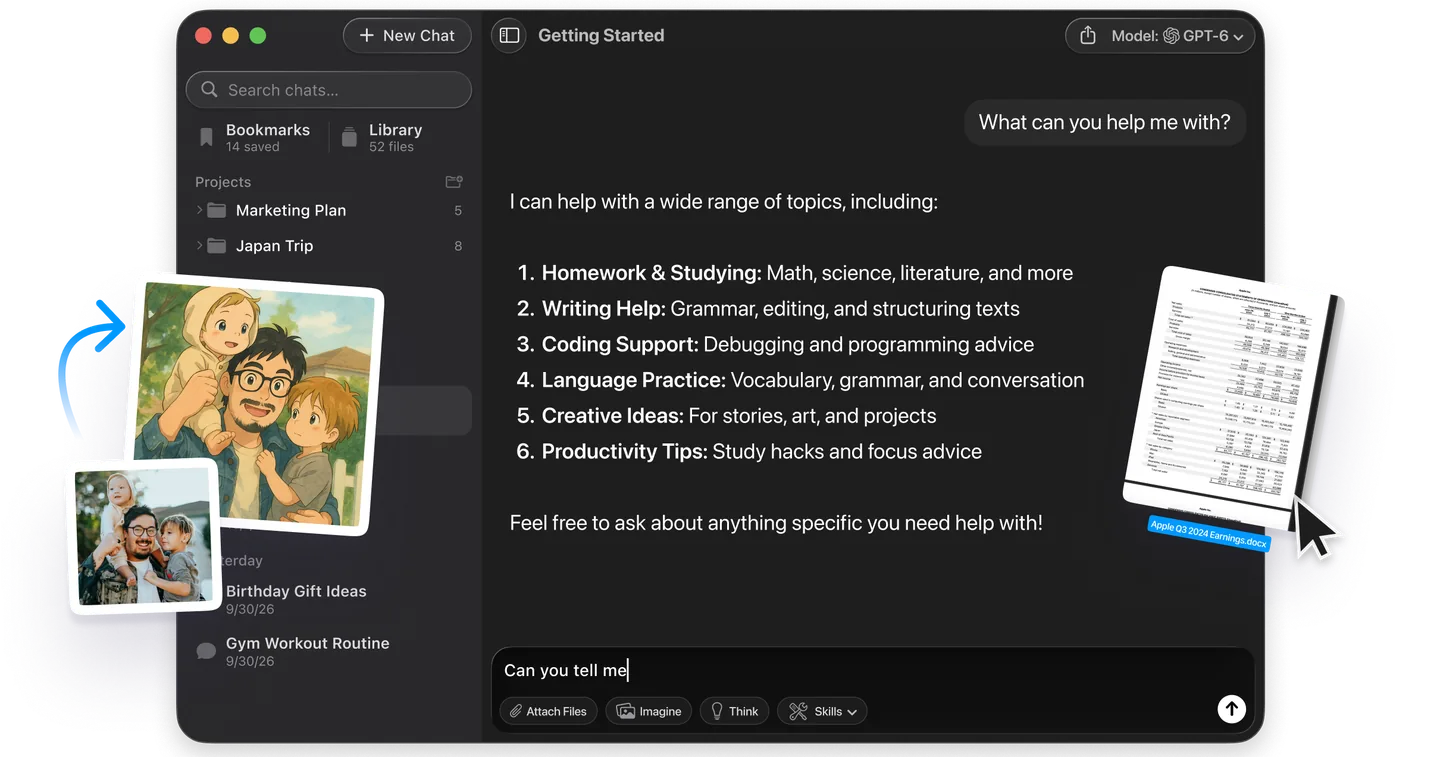
If you are going the free route, Fello AI puts both halves of it in one Mac app. Write the shot list with GPT, Claude or Gemini, then generate the frames with GPT Image in the same window, without switching between browser tabs and accounts.
That matters most in Step 1. Running the same script through Claude and GPT side by side gives you two readings of it to choose from before you commit to one. Fello AI runs on Mac, iPhone and iPad and has a free tier, so the whole four-step method stays free to try.
Which AI Storyboard Generator Should You Use?
Use the free ChatGPT or Gemini method first, and pay only when a specific missing feature costs you time. For most YouTube videos, explainers and short ads with one or two characters, a character sheet and eight well-prompted frames are enough. The five-character limit on Nano Banana 2 is more than a short video needs.
Pay when the job changes. A screenwriter with an FDX file should pay for Storyboarder.ai, the only tool here whose pages name the format. An agency sending boards to clients should pay for Boords, because frame-level comments and version history are what the client relationship runs on. And if the board is only a step on the way to AI video, LTX Studio puts both stages in one place. Before you choose, compare where your frames will end up with our tested ranking of the best AI video generators.
Frequently Asked Questions
Is there a free AI storyboard generator?
Yes. Adobe Firefly Boards is free with an Adobe account and a daily allowance of generations. Storyboarder.ai has a small free plan of 2 projects and 30 images with watermarks and no commercial use. ChatGPT and the Gemini app both generate storyboard frames free, though you lay out the board yourself.
Can ChatGPT make a storyboard?
Yes. ChatGPT writes the shot list and generates the frames with ChatGPT Images 2.5, which is available on every ChatGPT tier. Attach a character sheet to every frame prompt to keep the character consistent, and generate one frame at a time rather than a whole grid in one image.
How do I keep characters consistent across storyboard frames?
Make a character reference sheet first and attach it to every frame. In dedicated tools, use the saved-cast feature: Boords lets you @mention a saved character, and LTX Studio calls them Elements. Google says Nano Banana 2 holds up to five characters consistent in one workflow.
Can I use AI storyboards commercially?
On paid plans, usually yes. Storyboarder.ai grants commercial rights on paid plans but not on its free plan. LTX Studio's free plan is personal use only. Adobe calls its own Firefly model output safe for commercial use but leaves partner-model output to you to check.
Which AI storyboard generator imports Final Draft scripts?
Storyboarder.ai names it. It lists PDF, FDX (Final Draft), Fountain, Word and plain text as accepted script formats. Boords takes a pasted script, treatment or brief, and LTX Studio takes an uploaded script without naming the formats on its home page.