AI training jobs pay people to write prompts, rate chatbot answers and check code. In November 2026 the published rates run from $7 an hour on one Outlier listing in the Philippines to $150+ an hour for DataAnnotation coding work. The work is remote, flexible and real. It is also unstable, mostly gated behind a degree, and full of unpaid minutes that no landing page mentions.
Every platform in this guide promises "no AI experience required". That line is true, and it misleads. This guide sets out the pay each platform publishes itself, checked on 10 November 2026. It also covers the requirements behind that pay, the time you will not be paid for, and the scams that copy the format.
The Key Takeaways
- Legit, with friction: Outlier, DataAnnotation, Mercor, Handshake AI, Alignerr, Mindrift and Prolific are real companies that pay, and most publish a fixed weekly or twice-monthly payout schedule.
- Generalist pay is modest: Outlier lists general work at up to $18 an hour and Handshake AI lists evaluation work at up to $17. DataAnnotation's FAQ now lists $25 to $50, though reviews from mid-2026 put its base nearer $20.
- "No experience" still means a degree: Outlier requires at least an associate degree, DataAnnotation a bachelor's or equivalent experience. Prolific is the main door with no credential check.
- Unpaid time is built in: DataAnnotation's Starter Assessment takes about an hour and you get one attempt. Handshake AI does not pay for onboarding unless the Project Terms say so.
- The scam test is simple: a real platform never asks you for money. A message on WhatsApp or Telegram offering "tasks" is the FTC's textbook task scam.
What Are AI Training Jobs?
AI training jobs are remote contract gigs where people write difficult prompts, rate chatbot answers, build grading rubrics, check code or maths, and label images, audio and video. AI companies use that work to improve their models. Platforms such as Outlier, DataAnnotation, Mercor and Handshake AI sit between the workers and the AI labs. They pay by the hour or by the task, and they treat everyone as an independent contractor.
The industry behind AI training jobs is large. An Oxford Economics report estimated that data annotation supported nearly 200,000 flexible earning opportunities in the US in 2024 and contributed $5.7 billion to US GDP. The platforms publish their own scale too: Outlier claims 900,000+ experts and $600M+ paid out, and Handshake AI claims $500M+ in payouts to 188,000+ fellows. Those are company figures, not audited ones.
What the work looks like day to day
Outlier names three core tasks on its own homepage: write a challenging prompt, create grading rubrics, and rate and rank answers. A typical prompt task asks you to think of a question in your field that would trick a model into a wrong answer, then write the correct answer yourself. A rating task shows you two or more chatbot responses and asks which one is better and why, in writing.
That written "why" is the job.
DataAnnotation describes its general projects as evaluating chatbot responses, comparing AI outputs and testing image generation, and it stresses that the work needs critical thinking and fact-checking, not clicking. If you have ever noticed that the same prompt gets different answers from different models and wondered which one was right, you have done the unpaid version of this work.
Are AI Training Jobs Legit?
Yes, the established AI training platforms are legitimate businesses that pay their contractors, but the work is not stable employment. Outlier pays weekly on Tuesdays through PayPal, Airtm or ACH bank transfer. DataAnnotation pays through PayPal within a few days of a request. Mercor pays every Wednesday through Stripe or Wise. None of them guarantees hours, and every one of them can stop offering you tasks.
The complaints that show up in worker reviews are about reliability, not fraud. Independent review sites such as Breaking Even describe empty task queues, removal from projects without explanation, and unpaid assessments that never turn into paid work. Treat any single AI training platform as a side income that can disappear next week, and you will judge it correctly.
How to spot a fake AI training job
A fake AI training job asks you for money, and a real one never does. DataAnnotation's trust page says it plainly: "We will never ask you for money or any other form of payment. We pay you, not the other way around." The only way to apply is through its official sign-up flow. Anyone who contacts you directly outside its recruitment team should be ignored.
The scam version copies the format almost exactly. The FTC's alert on task scams describes an unexpected message on WhatsApp, Telegram, text or social media offering quick money for online "tasks" such as "optimization" or "product boosting". You watch fake earnings pile up in an app. Then you are told to deposit your own money, usually in crypto, to unlock the next tasks or withdraw what you earned.
That deposit is the scam. The earnings never existed.
Three checks catch nearly all of it. You found the platform yourself rather than being messaged. You applied on the platform's own website. You never paid anything, for a starter kit, a training course or a verification fee. Real platforms do ask for ID verification and tax forms, but only inside their logged-in dashboard.
The Best AI Training Jobs Platforms Compared
The best AI training jobs platform depends on what you can prove: a degree, a profession, a language, or nothing yet. This table uses only the pay each platform publishes itself, as listed on 10 November 2026. Listings change weekly, and "up to" means the top of a range, not what most people earn.
| Platform | Run by | Published pay (Nov 2026) | Minimum requirement | How you are paid |
|---|---|---|---|---|
| Outlier | Scale AI | General up to $18/hr, coding up to $30/hr; one Philippines listing up to $7/hr | Associate degree | Weekly, Tuesdays: PayPal, Airtm or ACH |
| DataAnnotation | DataAnnotation | General $25 to $50/hr; coding $40 to $150+/hr | Bachelor's or equivalent experience | PayPal, on request |
| Mercor | Mercor | Set per contract; $85+/hr average claimed in Oct 2025 | Professional or domain expertise | Weekly, Wednesdays: Stripe or Wise |
| Handshake AI | Handshake | Evaluation up to $17/hr; specialist roles up to $80 to $150/hr | US-based with work authorization; degree tags on listings | Weekly: Stripe |
| Alignerr | Labelbox | $80/hr "average pay" claimed; one legal role listed at $75 to $95/hr | PhDs, researchers, professionals | Weekly, one provider per country |
| Mindrift | Toloka | Entry $15 to $30/hr; experts $60 to $100+/hr | Domain expertise (70% hold a Master's or PhD) | 5th and 20th: Payoneer or PayPal |
| Prolific | Prolific | Studies must pay at least $8/hr | None beyond identity check | Per study |
Outlier and DataAnnotation: the generalist platforms
Outlier is run by Scale AI and claims more than 900,000 experts. Onboarding takes 30 to 90 minutes and needs a valid ID, a phone from your country, a resume and a LinkedIn profile. Pay depends on location as well as skill. In the same week, Outlier listed generalist roles at up to $18 an hour and an English-speaking image and video evaluator role in the Philippines at up to $7.
DataAnnotation publishes the highest generalist floor of any platform here: its FAQ lists general projects starting at $25 to $50 an hour. Independent reviews from May and July 2026 put the standard base rate nearer $20, so check the current rate when you apply.
The catch is DataAnnotation's Starter Assessment. It takes about an hour and you get one attempt. DataAnnotation says it cannot reply to every applicant, so if you are not accepted, you may never hear back.
Mercor, Handshake AI and Alignerr: the expert platforms
Mercor recruits domain experts such as scientists, doctors and lawyers and matches them to AI labs on contracts. In October 2025 it told TechCrunch it had 30,000+ experts earning over $85 an hour on average and paid out more than $1.5 million a day. Its first Stripe payout has a 7-day hold, which is Stripe's rule, not Mercor's.
Handshake AI runs the Handshake AI Fellowship, open to generalists as well as experts. Its AI Evaluation Specialist role tops out at $17 an hour, while specialist roles in energy, finance, game development and software engineering go up to $80 to $150. The Fellowship is US-only: Handshake says you must be based in the US and have valid work authorization. Alignerr, powered by Labelbox, claims 100,000+ experts and pays only for tasks that pass quality review on its pay-per-accepted-task projects.
Mindrift and Prolific: the alternatives
Mindrift is built by Toloka and shows the price of each task before you start it. It states openly that it is not a job: there is no employment contract and no fixed hours. Prolific is a research platform, not an AI training platform first, but some of its studies ask participants to evaluate AI models. Researchers must pay at least £6 or $8 an hour, and Prolific recommends £9 or $12.
Remote AI Training Jobs With No Experience: What It Really Takes
Remote AI training jobs with no experience exist, but "no experience" means no AI experience, not no qualifications. Asked whether you need a degree, Outlier's FAQ answers: "Yes, you need at least an associate degree". DataAnnotation's baseline is "a bachelor's degree or equivalent real-world experience". Handshake AI's sign-up page says "no AI experience required" directly above listings tagged Bachelor's, Master's and PhD.
DataAnnotation is the most flexible of the degree-gated platforms. It says someone with a bachelor's degree and no work history could qualify for its general projects, and that real-world experience counts as much as formal education. Its general track tests written English, research and fact-checking. Practise explaining in a clear paragraph why an answer is wrong, because that is what gets graded.
Without any degree, Prolific is the realistic starting point. Its participant sign-up is a waitlist, an invite and a 15-minute identity check, with no credential check. The pay is lower and the studies are short, but some of them are AI evaluation tasks, which gives you something real to point to when you apply elsewhere. Outlier also accepts students of legal working age for part-time work.
The Unpaid Time in AI Training Jobs
The hourly rate on an AI training job listing covers task time, not all the time you spend. Handshake AI's own help centre lists what it does not pay for. Onboarding is unpaid unless the Project Terms say otherwise, and so is the account setup checklist. Optional meetings, time in Slack, messages about instructions and time lost to internet or login problems are unpaid too. Some tasks carry a time cap, and pay stops at the cap even if the task takes longer.
Other platforms build the same gap into their payment rules. Alignerr's pay-per-accepted-task projects pay only for tasks marked "Accepted" after review. Mindrift pays only for tasks that are completed and accepted as meeting the project's quality standards. DataAnnotation's one-hour Starter Assessment is unpaid. Outlier adds project-specific onboarding and assessment tasks after its general sign-up, and its FAQ does not say whether those are paid.
None of this makes the platforms illegitimate. It does mean your real hourly rate is lower than the listed one.
Track every hour you spend for your first month, including onboarding and rejected tasks. Divide what you were paid by that total, and you will know whether a platform is worth your evening.
How to Get Accepted for AI Training Jobs
The fastest way into AI training jobs is to treat the assessment as the job interview it is. DataAnnotation says successful applicants "spend more time crafting thorough answers rather than rushing through responses", and its assessment cannot be retaken. Read every instruction twice, fact-check every claim you make, and explain your reasoning in full sentences rather than one-word ratings.
Apply to several platforms at once. Outlier's FAQ explicitly allows work alongside other jobs, and Mindrift says most contributors work alongside a primary career. The empty-queue weeks that workers report are much easier to absorb across three dashboards than one.
Pick the track where your strongest skill sits: a second native language, a coding language, or a professional field all unlock higher rates than general evaluation. If you are still building the basics, learning how prompting works makes the tasks that ask you to trip up the model far easier.
Practise by comparing AI answers side by side
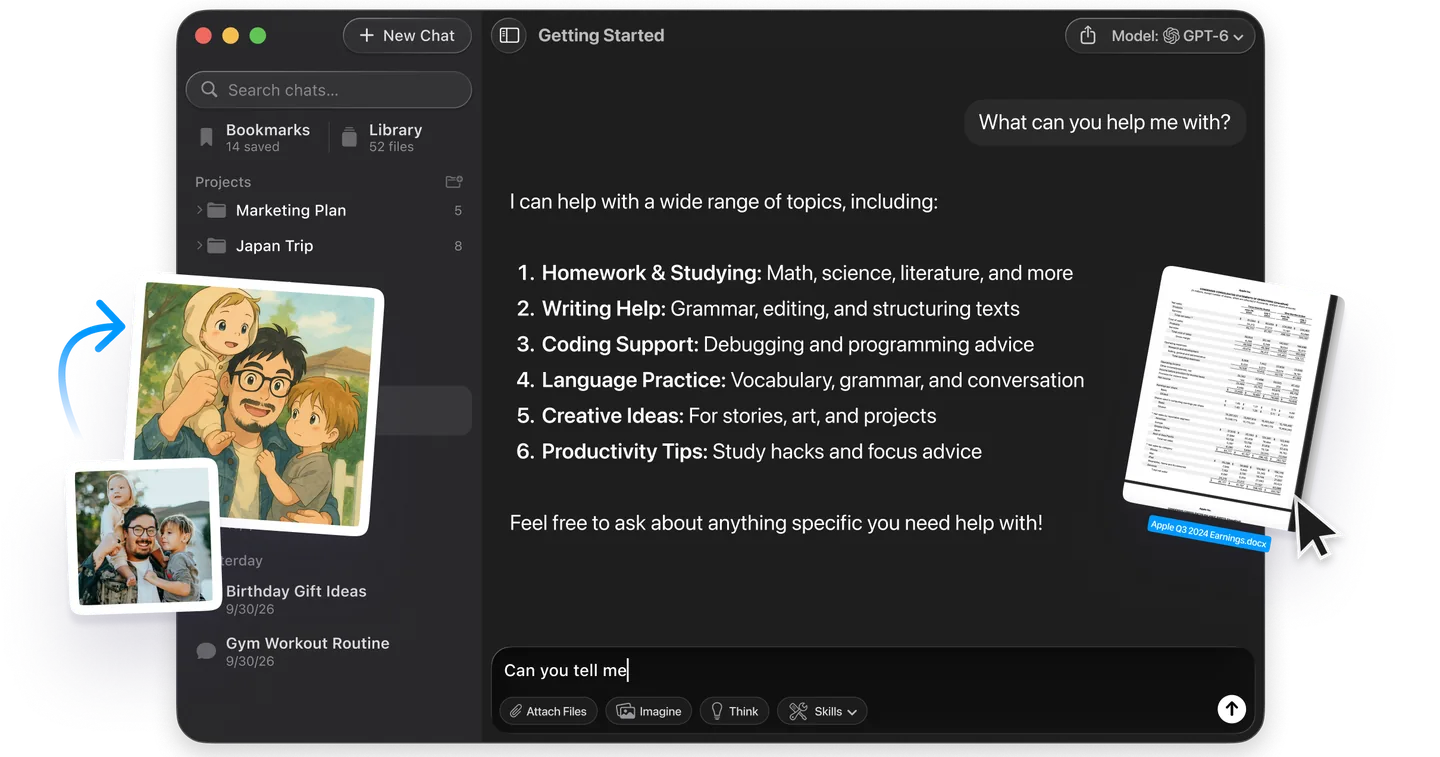
Most AI training assessments test one skill: look at two answers to the same question and explain, precisely, which is better. You can practise that before you apply without paying for three chatbot subscriptions. Fello AI lets you ask ChatGPT, Claude and Gemini the same question from one app on your Mac, iPhone or iPad. Read the answers next to each other and write down where each one went wrong.
Use questions from your own field, the way Outlier's prompt tasks do. When one model gets a fact wrong and another gets it right, write the two-sentence justification an AI training job would pay for.
Ten of those, and you have practised the exact skill the platforms screen for.
Can You Do AI Training Jobs Outside the US?
Yes, most AI training platforms in this guide hire outside the US. The big exception is the Handshake AI Fellowship, which requires you to be based in the US with valid work authorization. Elsewhere, pay and payout methods change with your country. Outlier lists opportunities in 52 countries and pays through PayPal, Airtm or ACH. Mercor contracts are in US dollars, paid through Stripe Connect where Stripe supports payouts and through Wise elsewhere. Alignerr enables only one payment provider per country for compliance reasons.
Location also moves the rate. Outlier states that pay varies "by expertise, project complexity, and location", and its own listings show it. General work is listed at up to $18 an hour in most markets and an evaluator role in the Philippines at up to $7. Native French, German and Korean writers are listed at up to $25 to $31 an hour.
Outlier does not sponsor work visas and says your visa must permit work in your country of residence.
Are AI Training Jobs Worth It?
AI training jobs are worth it if you have a skill the platforms pay a premium for, and a disappointment if you expect a steady income from general rating work. Coding, STEM and professional tracks start at $40 an hour on DataAnnotation, and Mindrift lists domain experts at $60 to $100+. A generalist starting on Outlier at up to $18 an hour, with unpaid assessments and gaps between projects, will earn less than the headline suggests.
Start with two platforms that match your strongest credential, track your real hourly rate for a month, and keep the one that pays. If the numbers do not work, the same skills transfer to other ways to make money with AI, from freelance writing to building AI-assisted freelance services. And if you are weighing this against a career change, judging which work holds up best starts with the jobs AI is least likely to replace.
FAQ
How much do AI training jobs pay?
AI training jobs pay roughly $15 to $50 an hour for general work and $40 to $150+ for coding and professional expertise. Those are the ranges the platforms published in November 2026. Outlier lists general work at up to $18 an hour, DataAnnotation at $25 to $50, and Mindrift's entry level at $15 to $30.
Do you need a degree for AI training jobs?
Most AI training platforms need a degree or equivalent experience. Outlier requires at least an associate degree, and DataAnnotation asks for a bachelor's degree or equivalent real-world experience. Prolific is the main platform with no credential check, only an identity check.
Is Outlier AI legit?
Yes, Outlier is a legitimate platform operated by Scale AI. It pays weekly on Tuesdays through PayPal, Airtm or ACH, and it says it has paid out more than $600 million. The common complaints are about task availability and removal from projects, not about missing payments.
Do AI training platforms pay for onboarding?
Usually not. DataAnnotation's Starter Assessment is unpaid, and Handshake AI pays for onboarding only when a project's Project Terms say so. Check the terms of each project before you start, and count onboarding time when you work out your real hourly rate.
Can you work on more than one AI training platform?
Yes. AI training platforms hire independent contractors, not employees, so you can work on several at once. Outlier's FAQ says you can contribute alongside other part-time or full-time work, and working on two or three platforms smooths out the weeks when one has no tasks.