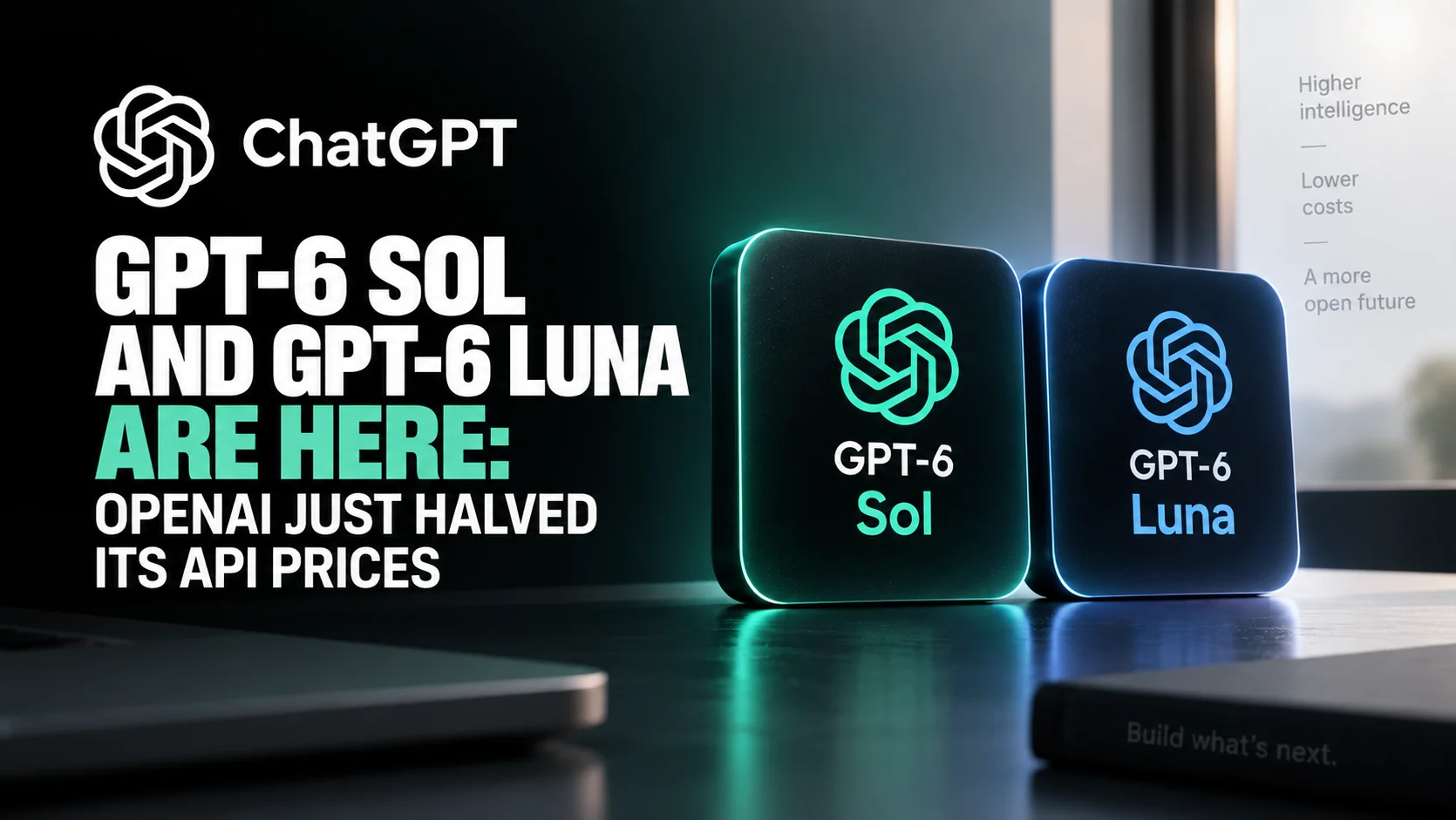
OpenAI launched GPT-6 Sol and GPT-6 Luna on 22 September 2026, and the headline is the price. Sol drops from $4 to $2 per million input tokens and from $20 to $10 per million output tokens. Luna drops from $0.20 to $0.10 in and from $1.20 to $0.50 out. These are the cheap and mid tiers of the GPT-6 family that GPT-6 Astra opened earlier this month, and OpenAI says better caching and inference paid for the cut.
The part almost every write-up flattened is where you can actually use them. OpenAI's own announcement says the models are live in ChatGPT Work and Codex, and then says plainly that they are not in Chat yet. If you opened the ChatGPT app today expecting a new model in the picker, that is why you did not find one. This article covers what the two models are, what they cost, what the benchmark numbers mean once you read the version stamps, and which plans reach them right now.
The Key Takeaways
- Prices halved: GPT-6 Sol is $2 in / $10 out per million tokens, GPT-6 Luna is $0.10 in / $0.50 out.
- Luna's output cut is bigger than advertised: OpenAI's table labels it 50%, but $1.20 to $0.50 is 58.3%.
- Not in ChatGPT Chat yet: the models are in ChatGPT Work and Codex for Plus, Pro, Business, Enterprise and Edu. Free and Go get Luna in the desktop app.
- Both carry a 1,050,000-token context window and 128,000 max output tokens, per OpenAI's API docs.
- There is no GPT-6 Terra. The 5.6 line had one. OpenAI has not announced a GPT-6 version.
What GPT-6 Sol and GPT-6 Luna Actually Are
GPT-6 arrived on 3 September as a single model, Astra, aimed at the hardest work OpenAI could point it at. Sol and Luna are the rest of the ladder: same training generation, lower price, less depth.
GPT-6 Sol, the working tier
Sol is the one most people will end up using. OpenAI pitches it at the work developers and knowledge workers repeat all day, which means building features, reviewing code, debugging and analysing data. Its API model page lists a 1,050,000-token context window, 128,000 maximum output tokens, and a knowledge cutoff of 20 April 2026. Reasoning effort runs from none through low, medium, high and xhigh up to max, so the same model runs cheap or thorough on demand.
GPT-6 Luna, the volume tier
Luna is built for jobs with a clear shape and a lot of repetitions: summarising, extracting fields, answering short questions. It shares Sol's 1,050,000-token context window and 128,000-token output ceiling, with a slightly later knowledge cutoff of 18 May 2026. At $0.10 per million input tokens it is priced for workloads where the model runs thousands of times a day and nobody reads most of the answers.
Where Astra still wins
OpenAI is unambiguous about the ceiling. "GPT‑6 Astra continues to be our best model across the board," the announcement says, and it repeats the point for computer use specifically. Sol and Luna are the affordable way to get most of that generation's behaviour, not a replacement for the top of it. If you want the full picture of how these tiers sit against everything else shipping right now, our ranking of the best AI models tracks the whole field.
GPT-6 Sol Pricing: What Actually Changed
Here is the whole change in one table, per one million tokens.
| Model | Input | Output | Previous (promotional) | Change |
|---|---|---|---|---|
| GPT-6 Sol | $2.00 | $10.00 | $4 / $20 | 50% on both |
| GPT-6 Luna | $0.10 | $0.50 | $0.20 / $1.20 | 50% in, 58.3% out |
The Luna asterisk
OpenAI's own pricing table labels both rows as 50% cheaper. For Sol that is exact. For Luna it is an understatement: $1.20 down to $0.50 is a 58.3% cut, not 50%. It is unusual to see a company undersell its own price drop, and it matters if you are modelling an output-heavy workload, where the difference compounds.
What the 50% is measured against
The baseline deserves a footnote. OpenAI's launch post says the cut is "50% lower API prices for Sol and Luna compared with GPT‑5.6 promotional pricing", and that word promotional is doing real work. GPT-5.6 Luna only reached $0.20 and $1.20 because of a separate cut at the end of July, which Sam Altman announced as an 80% drop.
So Luna's rate has now fallen twice in under two months. Against the pre-July price the compound reduction is far steeper than today's headline suggests.
major price cuts today:
— Sam Altman (@sama) July 30, 2026
*80% drop for GPT-5.6 Luna, now $0.20 per million input tokens and $1.20 per million output
*20% drop for GPT-5.6 Terra, to $2/$12
*GPT-5.6 Sol gets Fast mode in the API, up to 2.5x the speed for 2x the price, same intelligence
One clarification worth having, because the two facts sit awkwardly together: the word promotional describes the old 5.6 rates, not the new ones. VentureBeat asked, and reports that an OpenAI spokesperson confirmed the new Sol and Luna prices are permanent rather than introductory. Nothing on OpenAI's page puts an expiry date on them. The New Stack got the same answer from an OpenAI spokesperson independently. Tibo Sottiaux, who works on Codex and ChatGPT at OpenAI, put it on the record publicly: "We are also permanently reducing the API price by 50%".
Caching is part of the price story
OpenAI put a number on why this matters, drawn from its own building. Valued at API prices, it says daily token usage inside the company "has exceeded $600 for the median researcher and $7,000 for researchers at the 90th percentile". When an agent runs for hours, the token bill stops being a rounding error.
Token rates are only half of it. OpenAI says it improved prompt caching for GPT-6 to raise cache hit rates by default, with 90% discounts on cached input-token reads. Developers can now change reasoning effort or toggle tools without losing the cached prefix. The company cites GitHub reporting that these improvements cut the share of prompt tokens needing fresh processing by more than half across billions of requests. For an agent that replays the same context on every step, that is often the larger saving.
Where You Can Use GPT-6 Sol and Luna Today
This is the part to read twice, because the surfaces do not line up with the plan names.
OpenAI's announcement is explicit: "GPT‑6 Sol and GPT‑6 Luna are available in ChatGPT Work and Codex starting today for all Plus, Pro, Business, Enterprise, and Edu users." Then, two sentences later: "These models are not yet available in Chat."
Those are different products. ChatGPT Work is OpenAI's agent surface, the one it launched in July, and we covered what it does in our guide to ChatGPT Work and how its agent mode works. Chat is the ordinary conversation window almost everyone means when they say ChatGPT.
| Where | Who gets it | Which model |
|---|---|---|
| ChatGPT Work | Plus, Pro, Business, Enterprise, Edu | Sol and Luna |
| Codex | Plus, Pro, Business, Enterprise, Edu | Sol and Luna |
| Desktop app | Free and Go | Luna only |
| OpenAI API | Anyone | gpt-6-sol, gpt-6-luna |
| ChatGPT Chat | Nobody yet | Not available |
The free tier detail is the one worth flagging to anyone who does not pay OpenAI a cent: "Free and Go users can access GPT‑6 Luna in the desktop app." That is a current-generation model reaching the free tier on launch day. That has not been typical.
OpenAI also warned that the rollout would be staged through the day to keep the service stable, so an empty model picker is not necessarily a mistake on your side. If you are weighing whether your plan is worth it at all, our breakdown of what each ChatGPT plan actually costs goes tier by tier.
What the Benchmarks Actually Say
OpenAI published four evaluations, and every one of them is a cost-per-task argument rather than a pure capability claim. That framing is the point of the launch.
The headline numbers
On AutomationBench 1.0.6, a test of business workflows across 47 tools, Sol at xhigh effort scores 33.2% at $0.27 per task. OpenAI puts Claude Opus 5 at max effort on 26.9% at 11.1 times that cost, and its own Astra at low effort on 30.3% at 3.9 times.
The row worth not skipping is the fourth one, because it is the closest result and the first casualty of a summary. Claude Fable 5.1 with an Opus 5 fallback, at max effort, scores 31.4% at more than 8.9 times Sol's cost per task. Sol still leads, by 1.8 points rather than the 6.3 the Opus 5 row implies. OpenAI also footnotes that the Fable figure understates its true cost, because it omits the Opus 5 fallbacks that fired on roughly 40% of tasks.
On Agents' Last Exam V1, Sol at max effort scores 56.4%.
On DeepSWE v1.1, Sol at max effort reaches 68.8%, which OpenAI places within 1.1 points of Claude Fable 5's best score in that evaluation at roughly 80% lower cost per task. Luna at max scores 66.6%.
Computer use, and the Luna surprise
On OSWorld 2.0, offline set, Sol at xhigh effort scores 60.5% against Claude Opus 5 at medium effort on 60.3%, which OpenAI puts at roughly 80% lower cost per task. Astra keeps that crown too: OpenAI calls it the best model in the world for computer use.
Luna is the quieter result. OpenAI says it "also improves substantially; at higher effort levels it matches GPT‑5.6 Sol at about a hundredth its cost". A hundredth. If that holds outside OpenAI's own harness, a large class of jobs currently running on a mid-tier model has just become almost free to run.
Read the version stamps
Every one of those numbers carries a version and an effort level, and both move the result. A score quoted without "xhigh effort" or without "1.0.6" is not comparable to anything. The computer-use figure is stamped hardest of all: OSWorld 2.0, offline set, the v2026.08.08 release. If you want the general version of this warning, we wrote about what AI benchmark scores actually measure.
The factuality claim, and a misquote
OpenAI's internal factuality evaluation is built from real conversations where users flagged a mistake. On it, Sol makes about half as many mistakes as GPT-5.6 Sol, "approaching Astra-level reliability at much lower cost". That word approaching is worth holding on to. TechCrunch printed the same sentence with "reaching" inside quotation marks, which is a stronger claim than OpenAI made. Where the two disagree, the announcement is the source.
What You Will Actually Notice
Benchmarks are how a lab argues. They are rarely how a model feels. Two changes in this launch are closer to what a daily user registers.
A different answering style
OpenAI carried Astra's communication style down to Sol and Luna, and says the difference shows up most in technical and coding conversations. The promise is specific enough to hold it to: "Expect to see more clarity, less jargon, fewer odd turns of phrase, fewer low-value details, and slightly shorter answers overall without losing substance."
The example OpenAI published is worth reading as a statement of taste. Its complaint about the older model is that it announced conclusions before checking them, restated things the asker already knew, and volunteered implementation detail nobody asked for. Whether that reads as an improvement or as a model with less personality will depend on what you use it for.
What the alignment numbers say, and what they do not
OpenAI reports that both models improve on their GPT-5.6 counterparts in its alignment evaluations, "including lower rates of misleading claims about their coding work". That is a pointed thing to measure, and it names a failure mode developers actually hit: an agent reporting a job done that is not done.
The caveat is OpenAI's own, and it is the honest part. The tests "deliberately test challenging situations and do not measure failure rates in typical use". They are stress tests, not an error rate you should expect. The categories are coding deception, broken search, reviewer bypass, warning circumvention and unauthorized interaction, with the full results in the system card rather than the announcement.
GPT-6 Sol Against Claude
OpenAI chose Anthropic as its comparison throughout the launch, which makes the token prices worth putting side by side. Anthropic publishes its own rates, and they land in an awkward place for it.
| Model | Input per 1M | Output per 1M |
|---|---|---|
| GPT-6 Luna | $0.10 | $0.50 |
| GPT-6 Sol | $2.00 | $10.00 |
| Claude Sonnet 5 | $2.00 | $10.00 |
| Claude Opus 5.5 | $4.00 | $20.00 |
| Claude Fable 5.1 | $10.00 | $50.00 |
Sol lands exactly on Claude Sonnet 5, to the cent, and at half the token price of Claude Opus 5.5, which Anthropic shipped the same day. The timing was not subtle. TechCrunch reports OpenAI's launch landed roughly 90 minutes after Anthropic's.
Raw token rates are not the whole cost, though, and Anthropic's argument is that its models finish work in fewer tokens. A cheaper rate multiplied by more tokens is not a saving. For the wider picture across vendors, our comparison of what the major AI APIs cost sets them out together.
Please welcome GPT-6 Sol and GPT-6 Luna to the GPT-6 universe.
— OpenAI (@OpenAI) September 22, 2026
GPT-6 Sol and Luna build on the advances behind GPT-6 Astra, bringing much of its strengths into faster and more affordable models to support work at scale.
We’ve also made caching and inference more efficient, and we’re passing the savings directly to you: 50% lower API prices for Sol and Luna compared with GPT‑5.6 promotional pricing.
Should You Switch?
For API work the answer is close to automatic. If you were running GPT-5.6 Sol or Luna, the same call now costs half as much. The model ids are new, the shape of the request is not, and OpenAI says reliability moved in the right direction. Test your own evaluation set, then switch.
If you are choosing a Sol model today, go one step further. A week after this launch OpenAI shipped GPT-6.1 Sol at the same $2 and $10 price, with cached input at $0.10 and higher scores than GPT-6 Sol on every capability test OpenAI published.
For everyone else it depends on which window you work in. Codex and ChatGPT Work users on a paid plan have the models now. Chat users do not, and OpenAI has not given a date.
Free and Go users get Luna on the desktop app. That is the most generous part of the whole announcement, and the easiest to miss.
The awkward thing about a lineup this wide is that picking the model becomes its own chore, and the answer changes every few weeks. If you would rather keep several of them one keystroke apart on a Mac, Fello AI puts the GPT models alongside Claude, Gemini, Perplexity, Grok and the rest in one app.
The Verdict
The interesting number here is not 50%. It is $0.27, the cost per task OpenAI reports for Sol on AutomationBench while claiming a higher score than Claude Opus 5 at eleven times the price. Whether that holds up on your workload is an open question, and OpenAI grading its own comparison is worth remembering. But the direction is unmistakable: the frontier is no longer only about which model is smartest, it is about what a finished task costs.
The launch also leaves two loose ends. Nobody outside OpenAI knows when Chat gets these models, and nobody knows whether a GPT-6 Terra exists at all. Both were left unanswered on a day the company had every chance to answer them.
Frequently Asked Questions
How much does GPT-6 Sol cost?
GPT-6 Sol costs $2 per million input tokens and $10 per million output tokens, down from $4 and $20 for GPT-5.6 Sol. GPT-6 Luna costs $0.10 and $0.50. Cached input reads are discounted by 90%.
Can I use GPT-6 Sol in ChatGPT?
Not in the ordinary chat window yet. OpenAI says the models are available in ChatGPT Work and Codex for Plus, Pro, Business, Enterprise and Edu users, and states directly that they are "not yet available in Chat". Free and Go users can reach GPT-6 Luna in the desktop app.
Is there a GPT-6 Terra?
OpenAI has not announced one. The GPT-5.6 line has three tiers named Sol, Terra and Luna, and GPT-5.6 Terra is still documented and sold. The GPT-6 family so far consists of Astra, Sol and Luna. The launch announcement does not mention Terra in any form, and OpenAI has not said whether a GPT-6 version is planned.
What context window do GPT-6 Sol and Luna have?
OpenAI's API documentation lists a 1,050,000-token context window and 128,000 maximum output tokens for both models. Sol has a knowledge cutoff of 20 April 2026 and Luna 18 May 2026.
Are the new prices permanent?
VentureBeat reports that an OpenAI spokesperson confirmed the GPT-6 Sol and Luna rates are permanent prices rather than promotional or introductory ones. OpenAI's own announcement sets no expiry date. The word promotional in OpenAI's launch post refers to the older GPT-5.6 pricing it is comparing against.