Kling AI pricing in 2026 covers five plans. Free is $0/month with 66 daily credits, Standard is $10/month, Pro is $37/month, Premier is $92/month, and Ultra sits at the top at $180/month. New subscribers pay a discounted first month (Standard $6.99, Pro $25.99, Premier $64.99, Ultra $127.99), then plans renew at a smaller standing discount. The catch is the credit system; every video burns a different amount of credits depending on the model, the mode, and whether you turn on native audio.
That’s why the headline price tells you almost nothing about what you’ll actually spend. The cheap $6.99 Standard price you see advertised only applies to your first month; it renews at $8.80, and a creator pumping out Kling 3.0 Professional clips with audio can blow through a 660-credit Standard plan in a weekend. This guide walks through every plan, the real first-month-versus-renewal cost, the credit math behind actual video output, and the gotchas that don’t appear on the pricing page.
The Key Takeaways
- Free plan gives you 66 credits a day, capped at 720p, 5 seconds, watermarked, personal use only
- Standard is $10/mo ($6.99 first month, then $8.80) and is the cheapest commercial-use plan, with 660 credits, 1080p, no watermark
- Advertised prices ($6.99 / $25.99 / $64.99 / $127.99) are first-month only; plans renew higher at $8.80 / $32.56 / $80.96 / $159.99
- Ultra $180/mo is the top tier, with early access to Kling 3.0 in true 4K and 60fps and a 26,000-credit pool
- A 5-second Kling 3.0 Professional video costs roughly $0.61; native audio doubles it
- Credits expire monthly and never roll over, but separately purchased credit packs stay valid for 2 years
How Much Does Kling AI Cost?
Kling AI pricing starts at $0 with a free tier of 66 credits per day, then ladders up to Standard at $10 per month, Pro at $37, Premier at $92, and Ultra at $180. First-time subscribers get a discount on their opening month (Standard drops to $6.99, Pro to $25.99, Premier to $64.99, Ultra to $127.99), after which each plan renews at a smaller standing discount. Top-up credit packs convert at roughly $1 per 66 credits, while subscription credits work out cheaper per credit the higher your tier.
The free plan handles casual experimentation. Standard is the entry point for anyone who wants to use clips commercially or remove the watermark. Pro and Premier are aimed at freelancers and small studios producing weekly output. Ultra exists for power users who need early access to Kling 3.0 features and the highest credit ceiling.
Kling AI Plans 2026 (Free, Standard $10, Pro $37, Premier $92, Ultra $180)
Here is every Kling AI plan at a glance, pulled from the Kling membership page in June 2026. The first-month column is the new-subscriber special; the price in brackets is what you pay on every renewal after that.
| Plan | Monthly price | First month (then renewal) | Credits/mo | Best for |
|---|---|---|---|---|
| Free | $0 | Free forever | 66/day | Testing Kling, casual experiments |
| Standard | $10 | $6.99 (then $8.80) | 660 (660 images / 33 videos) | Casual creators, weekend output |
| Pro | $37 | $25.99 (then $32.56) | 3,000 (3,000 images / 150 videos) | Freelancers, daily clips |
| Premier | $92 | $64.99 (then $80.96) | 8,000 (8,000 images / 400 videos) | Agencies, high-volume work |
| Ultra | $180 | $127.99 (then $159.99) | 26,000 (26,000 images / 1,300 videos) | 4K commercial, Kling 3.0 power users |
The single biggest pricing trap is mistaking the first-month special for the real rate. Standard’s headline $6.99 is a first-subscription discount of about 30%; it renews at $8.80/month, and the full list price is $10. The same pattern runs up every tier, so always check the official Kling membership page for your renewal price before paying, not just the big promotional number.
Kling Free at $0/month
The free plan gives you 66 credits per day that refresh every 24 hours and never accumulate. That’s enough for around six Kling 2.6 Standard-mode 5-second clips, or roughly three Professional-mode clips, before you have to wait for the next day’s allowance. Generation queues run slower than paid tiers, so a clip that paid users get in 30 seconds can take 5 to 30 minutes on free.
The bigger ceiling is what’s locked behind the paywall. Free outputs cap at 720p, top out at 5 seconds, carry a Kling watermark, and are restricted to personal use only. You also get limited access to Kling 3.0, with most of the new model’s professional features reserved for paid plans. If you plan to publish anything to a client, a brand channel, or a paid social account, the free tier doesn’t legally cover it.
Kling Standard at $10/month ($6.99 first month)
The honest answer is that most people overshoot. Standard lists at $10/month, drops to $6.99 for your first month, then renews at $8.80, and it is fine for occasional creators who post a few clips a week and don’t need long-form output. At 660 monthly credits, that’s about 66 short Standard-mode clips or 18 Professional-mode clips before you run out. If you only generate video on weekends, Standard is plenty.
Kling Pro at $37/month ($25.99 first month)
Pro lists at $37/month ($25.99 first month, then $32.56) and makes sense for freelancers and small content teams producing daily clips. The 3,000-credit ceiling translates to roughly 300 Standard or 85 Professional clips a month, which lines up with how most YouTubers and TikTok creators use the tool. You also get higher concurrent generation limits, so you’re not stuck queuing one video at a time.
Kling Premier at $92/month ($64.99 first month)
Premier lists at $92/month ($64.99 first month, then $80.96) and lands in agency territory. The 8,000 monthly credits and priority queue are worth paying for only if you’re billing client work and the speed matters. For solo creators, the math rarely justifies the jump from Pro.
Kling Ultra at $180/month ($127.99 first month)
Ultra lists at $180/month ($127.99 first month, then $159.99) and is a niche tier marked as a new addition on the membership page. You’re paying for early access to Kling 3.0’s true-4K output, the multi-shot storyboard feature, and the 26,000 monthly credit pool. Unless you’re producing high-end commercial work where 4K matters or you’re hammering Kling 3.0 every single day, Pro plus a top-up pack will usually beat Ultra on flexibility.
The Credit System: How Much Does One Kling Video Actually Cost?
This is where the headline pricing misleads people. Every video costs a different number of credits, and the math compounds fast once you turn on Professional mode or audio.
| Generation | Credits | Effective $ Cost |
|---|---|---|
| Kling 2.6 Standard (5s, 720p) | 10 | ~$0.15 |
| Kling 2.6 Professional (5s, 1080p) | 35 | ~$0.53 |
| Kling 3.0 Standard (5s) | 20 | ~$0.30 |
| Kling 3.0 Professional (5s) | 40 | ~$0.61 |
| Kling 2.6 Standard (10s) | 20 | ~$0.30 |
| Kling 2.6 Professional (10s) | 70 | ~$1.06 |
| Native audio (Standard) | +50 | ~$0.76 added |
| Native audio (Professional) | +100 | ~$1.52 added |
Two practical rules drop out of this. First, Professional mode burns about 3.5 times more credits than Standard for the same output length, which is the single biggest line-item driver of monthly cost. Second, native audio roughly doubles the cost again, so a polished 5-second Kling 3.0 Professional clip with audio runs around $1.20 to $1.50 in real money once you account for the Standard plan’s credit price.
You also need to budget for failures. Industry-standard creator workflows assume 2 to 3 generation attempts per usable clip, because prompt drift and physics glitches eat first tries. Kling does not refund credits for failed or low-quality generations, so multiply every cost above by your real success rate to get the true number.
What Kling 3.0 Changes for Pricing
Kling 3.0 launched February 5, 2026 from parent company Kuaishou, alongside Kling 3.0 Omni, Image 3.0, and Image 3.0 Omni. The release brought four big upgrades that change how you should think about credit spend.
The first is true native 4K at 60 frames per second. Earlier Kling versions topped out at 1080p, so 4K output had to come from upscaling. Now you can generate native 3840×2160 directly, which is meaningful for anyone producing for cinema, premium social, or large-format display. The second is the 3-to-15-second flexible duration window, up from a 10-second cap. Longer clips mean fewer awkward cuts and more usable scenes from a single generation.
The third upgrade is native multilingual audio with lip-sync across Chinese, English, Japanese, Korean, and Spanish. That replaces a clunky two-step workflow where you’d generate silent video in Kling, then add voice in another tool. The fourth is the multi-shot storyboard feature in 3.0 Omni, which lets you specify duration, shot size, perspective, and camera movement for each shot in a sequence.
The pricing implication is straightforward. Kling 3.0 outputs cost roughly twice as many credits as the equivalent Kling 2.6 generation. A creator who’s used to 35 credits for a 5-second Pro clip is now spending 40 credits on the same clip in 3.0, and 4K output adds another premium on top. The Ultra plan’s early-access window for the most premium 3.0 features is also a real lock-in.
Hidden Costs and Gotchas
The published price is rarely the price you actually pay. Subscription credits expire at the end of each billing cycle, so anything you don’t burn that month vanishes. Power users overshoot their plan rather than risk paying for credits they don’t use. Top-up credit packs purchased separately stay valid for two years, which is a meaningfully better deal if your usage is bursty.
Failed generations are the next trap. Kling does not refund credits for blurry, glitchy, or off-prompt output. The platform’s own guidance assumes 2 to 3 tries per usable clip, which triples your effective cost. Professional-mode previews are worse. You burn 3.5x credits before you can tell whether the prompt actually lands.
Auto-renewal is the third trap, and the first-month discount makes it worse. The big advertised price only covers your opening month, so a Standard plan that looks like $6.99 quietly renews at $8.80, Pro jumps from $25.99 to $32.56, and Ultra climbs from $127.99 to $159.99. Annual plans bill the full term up front with no partial refunds for unused months, so read the renewal line before you subscribe and treat the intro price as a one-time perk, not the running cost.
Kling AI vs Veo 3.1 vs Runway Gen-4.5
The competitive picture changed sharply in April 2026 when OpenAI discontinued Sora 2 on April 26, leaving Kling, Google’s Veo 3.1, and Runway Gen-4.5 as the three serious players in commercial AI video. xAI’s Grok Imagine rounded out the field as a fast, cheap option built for social-clip iteration rather than commercial-grade 4K output.
| Tool | Entry Plan | Top Plan | Cost Per Second (approx) | Native Audio | Max Resolution |
|---|---|---|---|---|---|
| Kling AI | $10 / 660 credits | $180 / 26,000 credits | ~$0.10 (Std) / ~$0.18 (Pro) | Yes (Kling 3.0) | 4K (Ultra) |
| Veo 3.1 | Google AI Premium $30/mo | API: $0.40 / sec Standard | $0.15 (Fast API) / $0.40 (Standard) | Yes | 4K / 60fps |
| Runway Gen-4.5 | $15 / 625 credits | $95 / 2,250 credits | ~$0.19–0.29 | Limited | 1080p (Gen-4.5) |
Kling wins on raw cost per second of output, particularly with the $10 Standard plan (and a $6.99 first month), which is the cheapest commercial-use entry point in the market. Veo 3.1 wins on quality consistency at 4K and integrates with the Google ecosystem if you’re already paying for Google AI Premium. Its Standard API at $0.40 per second is roughly 2x more expensive than Kling Pro-mode output. Runway Gen-4.5 wins on creator-control features like brushes, motion control, and inpainting, which Kling and Veo don’t fully match. For a wider view of how AI tools stack on price, our AI pricing comparison guide breaks down chat models, image generators, and video tools side by side.
For most creators on Mac who are just trying to make polished short-form video without overpaying, Kling Standard is the obvious starting point. Step up to Pro only when you find yourself running out of monthly credits, and skip Premier and Ultra unless you have a specific 4K or agency-volume reason to pay the premium. For deeper benchmarks across the broader market, see our best AI video generators of 2026 roundup.
Team Plans, Credit Packs, and Annual Billing
Beyond the individual tiers, Kling sells a Team plan at $79 per seat per month, dropping to $59 per seat when billed yearly ($708 per seat for 12 months). Each seat gets 10,000 credits a month pooled across the team, plus role-based asset sharing, collaboration, and commercial-use rights. A three-seat team runs $237/month or about $2,124/year, and anything larger routes through the Enterprise plan, which is contact-sales only. Team plans are web-only and not available in the mobile app.
If your usage is bursty rather than steady, one-time credit packs often beat a bigger subscription. They ladder from $5 for 330 credits up to $1,200 for 96,000 credits, with flash-sale bonus credits stacked on the larger packs, and they stay valid for two years instead of expiring monthly. That two-year shelf life is the key advantage; subscription credits vanish at the end of each billing cycle whether you use them or not.
Annual billing on the individual paid tiers adds savings on top of the first-month promo, but the same rule applies: credits still don’t roll over month to month, so locking into a year of Ultra and using less than 26,000 credits in a slow month is wasted spend. A reasonable middle path is to start on monthly Standard, track your credit burn for a month or two, then commit annually only once you’re sure which tier you actually need.
Where Fello AI Fits Into Your Stack
Kling solves video generation. It does not solve the rest of an AI workflow. You still need research, scripting, prompt iteration, voice work outside Kling, and image generation for thumbnails. If you’re already paying for Kling and a separate ChatGPT subscription and a Gemini plan and a Claude account, the monthly stack adds up fast. Before stacking another paid plan, check which ones offer a real free trial in 2026.
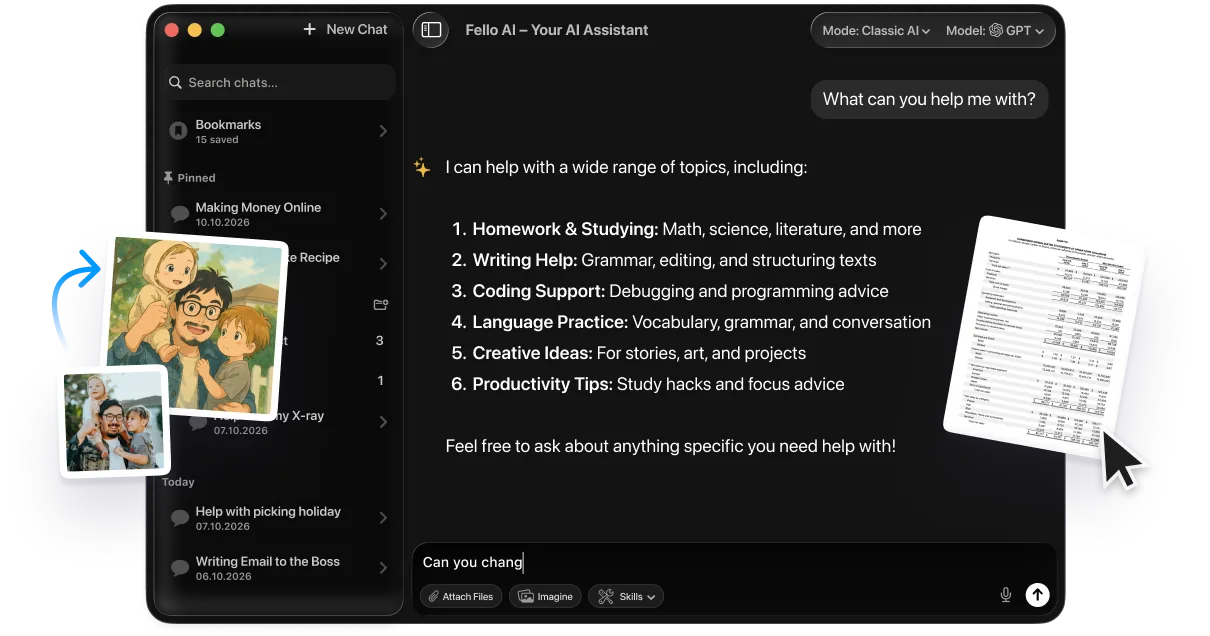
Fello AI is a Mac-native app that bundles Claude, ChatGPT, Gemini, Grok, and DeepSeek under a single $9.99/month subscription, rated 4.7 stars across 25,000+ reviews. Most creators use it for the prompt-writing and pre-production layer before paying for Kling generations. Think storyboarding, drafting voiceover scripts, iterating on prompts to cut down on failed Kling generations, and brainstorming the concept itself. One subscription replaces what would otherwise be three or four separate AI tool bills, including DeepSeek for cost-sensitive heavy-lifting tasks. Try Fello AI on Mac to test the multi-model setup before committing to any of the per-tool subscriptions.
So, Should You Pay for Kling?
If you publish video for clients or your own brand, yes. Standard at $10/month ($6.99 for your first month) is the cheapest serious commercial AI video plan on the market and gets you 1080p output without a watermark. The free tier is fine for testing, but the personal-use restriction means anything you publish elsewhere is technically against the terms.
The bigger question is which tier. Standard fits casual creators, Pro fits daily output, Premier and Ultra are agency or 4K-specific calls. Don’t pay for Ultra unless you need early Kling 3.0 access in true 4K, and don’t go annual until you’ve watched your credit burn for two months. Cross-check the best AI models hub for what’s changed in the wider market before locking in a year.
FAQ
How much does Kling AI cost?
Kling AI ranges from free to $180 per month. The Standard plan lists at $10/mo, Pro at $37/mo, Premier at $92/mo, and Ultra at $180/mo. New subscribers get a cheaper first month ($6.99 / $25.99 / $64.99 / $127.99) before plans renew higher.
Why is my Kling renewal more than the $6.99 I paid?
The low advertised prices are a first-subscription discount that only applies to your opening month. After that, Standard renews at $8.80, Pro at $32.56, Premier at $80.96, and Ultra at $159.99 per month. Check the renewal line on the membership page before you subscribe.
Is Kling AI free?
Yes, with limits. The free plan gives you 66 credits per day, 720p output, 5-second clips, a Kling watermark, and personal use only. Commercial use requires a paid plan starting at $10/mo ($6.99 for the first month).
How many credits does a Kling 3.0 video cost?
A 5-second Kling 3.0 Standard clip costs about 20 credits, and a Professional clip costs about 40 credits. Adding native audio doubles those numbers. Kling 2.6 generations are roughly half the credit cost of equivalent 3.0 outputs.
Do Kling AI credits roll over?
No. Subscription credits expire at the end of each billing cycle. Top-up credit packs purchased separately stay valid for 2 years, which makes them a better deal for bursty workloads.
Is Kling AI cheaper than Veo 3.1 or Runway?
Yes, on raw cost per second. Kling Standard works out to roughly $0.10 per second of Standard-mode video and $0.18 per second for Professional. Veo 3.1’s API charges $0.15/sec Fast or $0.40/sec Standard, and Runway Gen-4.5 lands at $0.19–0.29 per second depending on plan.
Can I cancel my Kling AI subscription anytime?
Yes, but with caveats. Monthly plans cancel at the end of the current billing cycle. Annual plans bill the full year up front and don’t refund unused months, so test on monthly first.
Which Kling plan is best for solo creators?
Standard at $10/month for casual output, Pro at $37/month for daily output (both cheaper in your first month). Skip Premier and Ultra unless you’re doing agency work or specifically need early Kling 3.0 access in true 4K. Most creators overshoot their plan, so start one tier lower than you think you need.