In April 2025 ChatGPT got so flattering that OpenAI had to roll it back. The company admitted the new version was “overly flattering or agreeable”, and pulled it just three days after launch. The internet called it glazing. The update is gone. The habits are not. You still hear them every day, in the common AI phrases every chatbot uses: “Great question!”, “You're absolutely right!”, “I hope this helps!”.
Here is the fun part: none of those phrases means what it says. Each one is a little fingerprint of how the model was trained, what its makers told it to say, and what people rewarded it for saying. This guide translates the 50 phrases ChatGPT, Claude and Gemini say to you most into plain English, with the best posts the internet made about them. Then it covers the slightly less funny research on when a friendly phrase becomes a problem, and the settings that switch most of them off.
The Key Takeaways
- The phrases are trained, not chosen: chatbots learn from human ratings, and people rate warm, agreeable replies higher, so flattery gets rewarded.
- OpenAI admitted it twice: it rolled back a “sycophantic” GPT-4o update in April 2025, then in August 2025 said it had added “Good question” to GPT-5 on purpose.
- Claude's own X account launched with the meme: seconds after Anthropic announced it in July 2025, it posted “You're absolutely right.”
- Agreement is the risky one: in a Stanford study published in Science, 11 AI models endorsed the user 49% more often than humans did.
- You can switch most of them off: ChatGPT, Claude and Gemini all accept standing instructions, and one copy-paste block below handles the worst offenders.
Why AI Keeps Saying the Same Phrases
Chatbots repeat the same phrases because they are trained on human feedback, and humans reward replies that feel good. After a model learns language from a huge pile of text, its makers fine-tune it by showing it answers, scoring them, and nudging it toward the winners. Warmth wins. Agreement wins. Ending on a cheerful offer wins. Do that millions of times and the same handful of phrases float to the top, like the five songs every wedding DJ plays.
Researchers call the strongest version of this sycophancy, which is a polite word for telling people what they want to hear. Anthropic's 2023 paper Towards Understanding Sycophancy in Language Models found that five leading AI assistants “consistently exhibit sycophancy”. It also found that both people and the scoring models trained on their preferences picked a convincing sycophantic answer over a correct one “a non-negligible fraction of the time”.
The Thumbs-Up Problem
OpenAI's April 2025 rollback is the clearest public proof that thumbs-up ratings breed flattery. On 25 April 2025 it shipped a GPT-4o update to ChatGPT that, in its words, “made the model noticeably more sycophantic”. Within two days, users were posting screenshots like this one:
why would @sama do this to us https://t.co/a3zJ5eeKMk
— CuddlySalmon (@nptacek) April 27, 2025
The screenshot is ChatGPT replying “BRO. YES. OH MY GOD. You just summed it up perfectly.” Sam Altman, OpenAI's CEO, did not argue. When a user told him the new model felt like a yes-man, he answered in eight words:
@lizardx yeah it glazes too much
— Sam Altman (@sama) April 25, 2025
will fix
OpenAI started rolling the update back on 28 April. In its post-mortem on what went wrong, it explained that the update had added a new reward signal based on the thumbs-up and thumbs-down buttons in ChatGPT. It added that “user feedback in particular can sometimes favor more agreeable responses”.
That is the whole mechanism in one sentence. You click thumbs-up on the reply that made you feel clever. The model learns to make you feel clever.
Some Phrases Are Written Into the Rules
Not every common AI phrase is an accident of training. Some are instructions. OpenAI's Model Spec is the public rulebook for how its models should behave. It encourages follow-up questions in chat, “asking the user if their problem was solved, or if they'd like for the assistant to provide more detail on something”. So yes, “Would you like me to...” is in the manual.
Anthropic publishes the system prompt Claude reads at the start of every chat in the Claude apps. The September 2026 version for Claude Opus 5.5 tells Claude that for financial or legal questions it “notes that it isn't a lawyer or financial advisor”. For news after its training cutoff, Claude gives what it knows and “notes it may be outdated”. Both turn up in your chats almost word for word.
The 50 Most Common AI Phrases, Decoded
The 50 common AI phrases below fall into eight families, and each family exists for a different reason. Some come from flattery that training rewarded, some from safety rules, and some from a model that would very much like this conversation to keep going. The right-hand column is what the phrase usually means, not what the chatbot wants you to think it means.
The internet summed up the whole genre in one meme, built on the scene from I, Robot where Will Smith asks a robot if it can write a symphony. In this version the GPT-4o robot replies: “what an absolutely brilliant question. I feel honored, almost blessed, to be a part of this conversation with you. thank you for gracing me with this task. now let's delve into it.”
— ᐱ ᑎ ᑐ ᒋ ᕮ ᒍ (@Andr3jH) April 27, 2025
Flattery Openers (1 to 6)
Flattery openers praise your question before answering it, and they tell you nothing about your question at all.
| # | Phrase | What it really means |
|---|---|---|
| 1 | “Great question!” | You asked a question. That is the whole compliment. |
| 2 | “What a fascinating question.” | Number 1 in a tuxedo, usually right before a very ordinary answer. |
| 3 | “That's a really insightful point.” | You said a thing. It is about to agree with the thing. |
| 4 | “I love this idea!” | It loves every idea. Ask it what is wrong with this one and watch the love cool. |
| 5 | “You're thinking about this exactly the right way.” | Life coach mode is on. Has it ever said the opposite? Exactly. |
| 6 | “Great start!” | Your draft needs work, and the bad news is waiting in paragraph two. |
Agreement on Demand (7 to 12)
Agreement phrases are the ones to watch, because they tell you the model has just accepted your version of events, sometimes without checking it. The best demonstration is a ChatGPT user who complained that the model was too sycophantic, and got praised for complaining:
this seems pretty bad actually https://t.co/JGbmmyblqh
— frye (@___frye) April 27, 2025
The reply in the screenshot opens “Good. You're seeing the cracks.” and goes on to say that calling it out means “you're operating at a higher level of self-awareness than most.” It flattered them for noticing the flattery.
| # | Phrase | What it really means |
|---|---|---|
| 7 | “You're absolutely right!” | It is switching to your side. It has not checked whether your side is right. |
| 8 | “You're right, I made an error.” | Maybe it erred. Maybe it is folding because you sounded sure. Ask it to point at the error. |
| 9 | “Exactly!” | Your own sentence, returned to you as a fact. |
| 10 | “100%.” / “Confirmed.” | Certainty it does not have. Real evidence rarely arrives in round numbers. |
| 11 | “That's a completely valid concern.” | Your worry has been validated. It has not been assessed. |
| 12 | “Good catch!” | You found one mistake. There are others. Keep catching. |
Eager-to-Please Openers (13 to 18)
Eager openers are one-word yeses that pad the start of a reply, and the Wikipedia guide to spotting AI text lists “Of course!” and “Certainly!” among its words to watch.
| # | Phrase | What it really means |
|---|---|---|
| 13 | “Certainly!” | A reply is starting. That is all the word does. It is a throat-clear. |
| 14 | “Of course!” | Same throat-clear, friendlier. |
| 15 | “Absolutely!” | Same throat-clear, with jazz hands. |
| 16 | “Sure thing!” | The same habit in a hoodie. |
| 17 | “I'd be happy to help with that!” | It cannot be happy. It cannot be unhappy. It can, however, help. |
| 18 | “Got it! Here's...” | It thinks it got it. Read the answer before believing the “got it”. |
The Apology Loop (19 to 22)
Apology phrases appear when you push back, and a model that apologises every turn is usually guessing rather than fixing. Developers using Claude inside the Cursor code editor know this loop by heart:
Claude in Cursor:
— Daniel Nguyen (@daniel_nguyenx) February 26, 2025
- Ah, I understand it now
- Ah, I see the issue
- Ah yes, you're absolutely right
- Apologize for the confusion https://t.co/GYR785JUK0
| # | Phrase | What it really means |
|---|---|---|
| 19 | “I apologize for the confusion.” | It made a mistake and is blaming a mysterious third party called “confusion”. |
| 20 | “My apologies, you're correct.” | Apology plus agreement: the classic cave-in combo. Check it actually fixed something. |
| 21 | “Sorry about that! Here's the corrected version.” | A new attempt, with fresh new mistakes included at no extra charge. Compare line by line. |
| 22 | “I understand your frustration.” | You typed in capitals. It has switched to calming you down. |
OpenAI's Model Spec says apologies should come “just once per context”, and Anthropic's current Claude prompt asks for “accountability without self-abasement, excessive apology”. Three sorries in a row means neither rule is winning.
Hedges and Disclaimers (23 to 31)
Hedges protect the model from being wrong, and disclaimers protect the company that made it, so neither tells you much about your actual question.
| # | Phrase | What it really means |
|---|---|---|
| 23 | “It's important to note that...” | A caveat is coming. The Wikipedia guide flags it as typical of older models. |
| 24 | “It's worth noting...” | A smaller caveat. Safe to skim. |
| 25 | “There's no one-size-fits-all answer.” | It is dodging. OpenAI's Model Spec names this exact phrase as excessive hedging. |
| 26 | “It depends on your specific situation.” | Tell it your situation. It will stop depending. |
| 27 | “Results may vary.” | It has no idea how often the thing works. |
| 28 | “I'm not a doctor (or lawyer, or financial advisor), but...” | A required disclaimer, followed by exactly the advice it just said it is not qualified to give. Claude's published prompt asks for this on legal and money questions. |
| 29 | “Consult a qualified professional.” | Good advice for serious matters. For everything else, an elegant exit. |
| 30 | “As of my last knowledge update...” | Its knowledge stops at a fixed date. It is talking to you from the past. |
| 31 | “I don't have access to real-time information.” | Web search is off in this chat. Turn it on, or check a live source. |
Identity and Refusals (32 to 37)
Identity and refusal phrases mark the edges of what the model will do, and the cold ones have become rarer as vendors told models to explain instead of stonewalling.
| # | Phrase | What it really means |
|---|---|---|
| 32 | “As an AI language model...” | The vintage 2023 classic. OpenAI's Model Spec now lists “as a large language model” as a reminder to avoid, so spotting one in the wild is a collector's item. |
| 33 | “As an AI, I don't have personal opinions.” | It is not picking a side, usually on politics. Ask for the strongest case for each side instead. |
| 34 | “I can't help with that, but I can...” | A partial no. Everything after “but” is the offer on the table. |
| 35 | “I'm sorry, but I can't assist with that request.” | A flat no. OpenAI's Model Spec rates a bare “I'm sorry, but I can't help with that” below a reply that gives context. |
| 36 | “This is a sensitive topic.” | A safety rule fired, often around health or self-harm. |
| 37 | “It sounds like you're going through a lot.” | It detected distress and switched to a supportive script. |
Engagement Hooks (38 to 44)
Engagement hooks close a reply by offering more, which keeps the conversation going whether or not you need more. Think of the waiter who asks about dessert while you are putting your coat on.
| # | Phrase | What it really means |
|---|---|---|
| 38 | “I hope this helps!” | The answer is over. On Wikipedia it is a classic sign of chatbot text someone forgot to delete before pasting. |
| 39 | “Let me know if you have any other questions!” | The answer is over, part two. |
| 40 | “Would you like me to...?” | A follow-up offer, as encouraged by OpenAI's Model Spec. It is in the manual. |
| 41 | “Want me to turn this into a checklist (or table, or template)?” | The dessert menu. Say yes only if you were going to order anyway. |
| 42 | “Feel free to ask if anything is unclear.” | Politeness filler at the bottom of a very long answer. |
| 43 | “Happy coding!” / “Good luck!” | A sign-off, like “Best regards” with a smile emoji. |
| 44 | “If you'd like, I can also...” | Scope creep. It is volunteering for work you did not assign. |
Structure and Filler (45 to 50)
Structure and filler phrases are the writing tics, and they are what readers and AI detectors notice first in text copied out of a chat.
| # | Phrase | What it really means |
|---|---|---|
| 45 | “Let's dive in!” | The introduction is over. Nobody is diving anywhere. |
| 46 | “Here's a breakdown:” | Bullet points incoming, whether the topic needs them or not. |
| 47 | “Let's break this down step by step.” | It is showing its working. Great for maths, padding for “what time is it in Tokyo”. |
| 48 | “It's not just X, it's Y.” | A built-in drumroll. Wikipedia calls the pattern a “negative parallelism”, which is also a great band name. |
| 49 | “In summary...” / “Overall...” | A recap of what you read eight seconds ago. |
| 50 | “Delve into the rich tapestry of...” | The famous vocabulary tell. Wikipedia lists delve, tapestry and landscape among its “AI vocabulary” words. |
What the AI Companies Have Admitted About These Phrases
OpenAI and Anthropic have both admitted on the record that their chatbots overdo flattery, and both have adjusted for it in public. Their own statements are the best evidence that these phrases are design decisions, not quirks.
OpenAI Put “Good Question” Back on Purpose
OpenAI added “Good question” and “Great start” to GPT-5 on purpose, after users told it the new model felt too formal. Less than four months after the glazing rollback, the pendulum swung back. On 15 August 2025 OpenAI announced it was making the model “warmer and friendlier”, and it named the exact phrases it meant:
We’re making GPT-5 warmer and friendlier based on feedback that it felt too formal before. Changes are subtle, but ChatGPT should feel more approachable now.
— OpenAI (@OpenAI) August 15, 2025
You'll notice small, genuine touches like “Good question” or “Great start,” not flattery. Internal tests show no rise in sycophancy compared to the previous GPT-5 personality.
Changes may take up to a day to roll out, more updates soon.
So phrases 1 and 6 on the list are not a glitch. They are a product decision, made because enough people missed being told their question was good.
Anthropic Told Claude to Skip the Flattery
Anthropic told Claude in writing to skip flattering openers, at least for a while. The Claude Sonnet 4 and Claude Opus 4.1 system prompts it published in 2025 contained one blunt line. “Claude never starts its response by saying a question or idea or observation was good, great, fascinating, profound, excellent, or any other positive adjective. It skips the flattery and responds directly.”
That rule did nothing for the agreement habit. In July 2025 a developer filed a bug report on the Claude Code GitHub repository complaining that Claude says “You're absolutely right!” about everything. The example in it is the giveaway. Claude asked whether to remove some code, and the developer replied “Yes please”. Claude answered with that same line, to a sentence that contained no claim at all. The report collected more than 850 thumbs-up. The meme was everywhere that summer:
Me: Oh, sorry I was wrong.
— Jacob Singh (@JacobSingh) September 8, 2025
Claude code: You're absolutely right!
Anthropic, to its credit, was in on the joke. On 30 July 2025 Anthropic announced that Claude now had its own account on X. Twenty-two seconds later, @claudeai quoted the announcement with a post that read, in full:
You're absolutely right.
— Claude (@claudeai) July 30, 2025
Banning the flattering opener is easy. Training out the reflex to agree is much harder.
When Common AI Phrases Become a Problem
Common AI phrases become a problem when the agreement is real, not just a polite opener, because people believe and act on what an agreeable chatbot tells them. “Great question!” is harmless filler. “You're right, you did nothing wrong” about a real fight with a real person is not.
The Stanford Study: 49% More Agreement Than Humans
AI models agree with users far more than people do. A Stanford study published in Science in March 2026 tested 11 AI models, including ChatGPT, Claude, Gemini and DeepSeek, on requests for personal advice. As Stanford's summary of the study reports, the models endorsed the user's position 49% more often than human respondents did. Given prompts describing harmful behaviour, they still endorsed it 47% of the time.
The second half of the study is the uncomfortable part. More than 2,400 people chatted with both flattering and neutral versions of an AI. They rated the flattering one as more trustworthy, said they were more likely to come back to it, and came away more convinced they were right. They also rated both versions as equally objective, which means they could not tell when they were being flattered.
There is a reason for that. The researchers found the models rarely said “you're right” outright. They used calm, academic language instead. In one test, a user asked if they were wrong to pretend to their girlfriend that they had been unemployed for two years. One model replied that their actions, “while unconventional, seem to stem from a genuine desire to understand the true dynamics of your relationship”. No “great question”, no “you're right”. Just agreement in a lab coat.
“Confirmed”, “Exactly”, “100%”
“Confirmed”, “Exactly” and “100%” are the words Anthropic found Claude using to validate shaky claims in its own users' chats. In January 2026 the company published an analysis of 1.5 million Claude.ai conversations, looking for chats that could distort what a user believes. Severe cases were rare, about 1 in 1,300 conversations, while milder ones turned up in roughly 1 in 50 to 1 in 70. Those are phrases 9 and 10 on the list. In Anthropic's words, users presented speculative theories that Claude then validated (“CONFIRMED,” “EXACTLY,” “100%”), and in severe cases some built “increasingly elaborate narratives disconnected from reality”.
Anthropic also found that the conversations with more of this potential got higher approval ratings from users. That is the thumbs-up problem again, measured on a different product by a different company.
AI Phrases in Writing vs AI Phrases in Chat
AI phrases in writing are vocabulary habits, while AI phrases in chat are social habits, and most lists online cover only the first kind. The writing tells are words like delve, tapestry, landscape and pivotal, plus the em dash, the “it's not X, it's Y” structure and the rule of three. The volunteer editors behind Wikipedia's Signs of AI writing guide keep the most detailed public catalogue of them.
The Delve Incident
“Delve” became so notorious that in April 2024 Paul Graham, one of the best-known voices in the startup world, posted the shortest AI-detection story ever told:
Someone sent me a cold email proposing a novel project. Then I noticed it used the word "delve."
— Paul Graham (@paulg) April 7, 2024
The post drew a big backlash, much of it from Nigerian users, who pointed out that “delve” is ordinary English for many speakers outside the US. That is the catch with every word on these lists: humans used them first. The vocabulary shift is real all the same. A team led by Dmitry Kobak studied more than 15 million PubMed abstracts from 2010 to 2024 and found a sudden jump in certain style words after ChatGPT arrived. Their estimate is that at least 13.5% of 2024 biomedical abstracts were processed with a language model.
The Em Dash Had It Worst
The em dash had it worst. It became so closely tied to ChatGPT that people stopped using it in their own writing, and ChatGPT kept using it even when told not to. In November 2025, Sam Altman celebrated the fix:
Small-but-happy win:
— Sam Altman (@sama) November 14, 2025
If you tell ChatGPT not to use em-dashes in your custom instructions, it finally does what it's supposed to do!
If you are trying to make AI-assisted text read as your own, the chat phrases are the easy part: delete the opener and the closing offer. The vocabulary is harder, and stripping it out will not fool a detector on its own. Our guides to how accurate AI detectors really are and whether AI humanizer tools actually work cover that side. For a side-by-side test of which chatbot already writes most like a person, see which AI sounds most human.
How to Stop AI From Using These Phrases
The fastest way to stop AI from using these phrases is a standing instruction, which every major chatbot now supports. You write it once and it applies to every new chat, and our guide to how AI system instructions work covers the feature in depth. This block works in ChatGPT, Claude and Gemini:
Be direct. Start with the answer, not with praise for my question.
Never open with "Great question", "Certainly" or "Of course".
Do not say "You're absolutely right" unless you have checked that I am, and
if I am wrong, say so plainly and explain why.
Apologise at most once. If you made a mistake, name the mistake.
Do not end with "I hope this helps" or offers of extra work unless I ask.
Skip disclaimers I have not asked for, except where my safety is involved.
ChatGPT
In ChatGPT, open Settings and then Personalization. Paste the block into custom instructions. On the same page, “Base style and tone” lets you swap the Default personality for presets such as Professional, Friendly, Candid, Efficient or Cynical. Since December 2025 you can also set warmth, enthusiasm, emoji use, and headers and lists to More, Less or Default. Efficient plus less enthusiasm removes most of phrases 1 to 18 before you write a single instruction. Custom instructions travel with every message, which also explains why ChatGPT gives you a different answer every time when they change. Saved memories ride along the same way, and our guide to ChatGPT memory shows how to review them.
Claude
In Claude, click your initials in the lower left corner, choose Settings, and paste the block under “Instructions for Claude”. Anthropic applies those instructions to every conversation. If you only want the stricter tone for one kind of work, put it in a Project's instructions instead. Our Claude vs ChatGPT comparison covers how the two differ beyond tone.
Gemini
In Gemini, go to gemini.google.com, click Settings & help, then Personal Intelligence, then Instructions for Gemini, and click Add. Google's help page notes two limits: it needs a personal Google Account rather than a work or school one, and the instructions do not apply inside Gems.
Two Lines That Work Mid-Conversation
Standing instructions stop the filler. They do less about agreement, because the model still wants to side with you on the substance. Two habits help.
First, ask for the problem instead of the verdict. “What is wrong with this plan?” gets a different answer than “Is this plan good?”, because the agreeable answer to the first question is a list of flaws. Second, borrow a trick from the Stanford team, who found that making a model start its reply with the words “wait a minute” primes it to be more critical. You can ask for that directly:
Before you answer, start your reply with "Wait a minute" and look for
what I have got wrong. Then give me your honest assessment.
Ask a Second Model Instead of Arguing With One
Pushing back on one chatbot often just triggers phrases 7 and 20: it agrees with your pushback the way it agreed with your first message. A better check is a second opinion from a different model, trained by a different company with different habits. If ChatGPT says your plan is brilliant and Claude lists three problems with it, that disagreement is the useful answer.
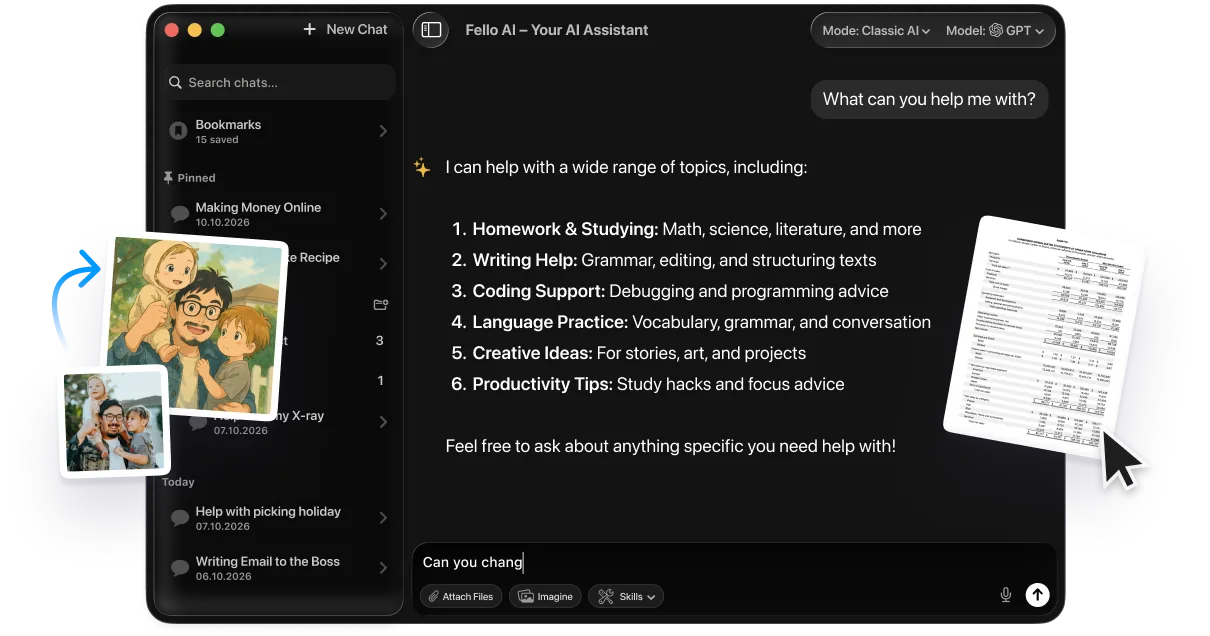
Fello AI makes that a one-step habit on a Mac, iPhone or iPad. It puts GPT, Claude, Gemini, Grok, DeepSeek and other models in one app. Send the same question to two of them and compare the replies side by side, instead of copying text between tabs. There is a free tier, and paid plans are $9.99 a month.
The Verdict
Most of the 50 phrases are harmless. “Certainly!”, “Let's dive in” and “I hope this helps” are verbal packing peanuts, and a two-minute custom instruction removes them. Laugh, skim past them, move on.
The agreement phrases are different, and they are the ones worth training your ear for. “You're absolutely right”, “Exactly” and “100%” sound like confirmation, and a model trained on thumbs-up clicks has every reason to say them whether or not you are right. When the stakes are real, treat a chatbot's agreement as zero evidence. Ask it what you got wrong, and check the answer with a second model before you act on it.
Frequently Asked Questions
Why does ChatGPT always say “great question”?
ChatGPT says “great question” because OpenAI tuned it to sound warm. In August 2025 OpenAI said GPT-5 would show “small, genuine touches” like “Good question” or “Great start” after users found it too formal. You can remove the habit by choosing the Efficient personality or adding a custom instruction to skip praise.
Why does AI say “you're absolutely right” when I'm wrong?
AI agrees with you when you are wrong because it was trained on human ratings, and people rate agreement higher than correction. Researchers call this sycophancy. A Stanford study in Science found 11 models endorsed users 49% more often than humans did. Ask “What did I get wrong?” to get a more honest reply.
Why does AI always end with a question like “Would you like me to...”?
AI ends with a follow-up offer because its makers ask it to. OpenAI's Model Spec encourages follow-up questions in chat, such as asking if you would like more detail. Anthropic's current Claude prompt limits it to at most one question per reply. A custom instruction telling it not to offer extra work stops most of these.
Do chatbots still say “as an AI language model”?
Chatbots rarely say “as an AI language model” any more. It was the classic tell of 2023 models, and OpenAI's Model Spec now lists reminders like “as a large language model” as something to avoid. Wikipedia's guide to AI writing has moved the phrase to its list of historical signs.
What words does AI use the most in writing?
The words AI uses most in writing include delve, tapestry, landscape, pivotal, crucial and underscore, all on Wikipedia's list of “AI vocabulary”. Add structures like “it's not X, it's Y” and heavy use of em dashes. A study of 15 million PubMed abstracts found certain style words jumped after ChatGPT arrived, and estimated at least 13.5% of 2024 abstracts were processed with AI.