Every price an AI company has ever quoted you is measured in tokens. Claude Opus 5.5 costs $4 per million tokens in and $20 per million out. GPT-6 Astra costs $10 and $50. Gemini 3.8 Flash costs $0.75 and $3.75. Those numbers are published on the vendors' own pricing pages. So what are AI tokens? They are the unit behind every one of those prices, and most people using AI every day have never had them explained.
A token is not a word, not a message, and not a credit. It is the small piece of text an AI model actually reads and writes. It quietly decides three things you feel every day: what you pay, how fast an answer arrives, and how much of a long conversation the model can still see. This guide explains what AI tokens are, how they are counted, what a million of them really buys, and why the same question costs more in some languages than in others.
The Key Takeaways
- A token is a fragment of text, not a word. OpenAI puts it at roughly 4 characters, or three-quarters of a word in English, and calls those figures estimates rather than exact counts.
- Output costs about five times more than input. Measured across the current OpenAI, Anthropic and Google price lists, the multiplier is 5x on almost every flagship model and above 8x on some cheap ones.
- A million tokens is roughly 750,000 words, or about eight novels. Getting a million tokens back out of a model costs between $0.50 and $50 depending on which one you pick.
- Your language changes the price. The same text translated into different languages can differ in token length by up to 15 times, according to published tokenizer research.
- Tokens are not credits and not context. Tokens are the unit you are billed in, credits are what an app meters, and the context window is the ceiling on how many tokens fit in one conversation.
What Are AI Tokens?
A token is the smallest piece of text a language model reads or writes. It is usually not a whole word. Common short words are one token each, and longer or rarer words get split into pieces, so the word "encoding" becomes encod plus ing rather than one unit.
In OpenAI's own words, "a token can represent a character, part of a word, a whole word, or punctuation." Its help documentation on counting tokens gives two rules of thumb for English. One token is approximately four characters. One token is approximately three-quarters of a word. The same page adds a warning most write-ups drop: "These are estimates, not exact counts."
The ratio also shifts between vendors, because each one ships its own tokenizer. Google's documentation lands in the same place, stating that white space is excluded and the result is "approximately 4 characters per token". Anthropic is more conservative, putting a Claude token at "approximately 3.5 English characters". Nobody is wrong; they are simply counting with different vocabularies.
That caveat matters more than it looks. Tokenization is sensitive to things you would never think about. OpenAI's documentation points out that "red", "Red" and " red" are three different pieces of text, because the last one carries a leading space, and an encoding can represent all three differently. Capital letters, spacing and punctuation all move the count.
Three Different Things Called "AI Tokens"
Search for this term and you will get three unrelated answers, which is exactly why the phrase is so confusing. It is worth clearing up before going further.
1. Text tokens, the subject of this article
The fragments a language model reads and writes, and the unit AI companies bill in. This is what "per million tokens" means on every pricing page.
2. Crypto tokens with "AI" in the name
A category of cryptocurrency traded on exchanges. These have nothing to do with how a chatbot processes your sentence. If a page about AI tokens starts talking about market capitalisation, you are on the wrong page.
3. In-app currency on companion and roleplay sites
Several character-chat services sell "tokens" as a prepaid balance you spend on messages or images. That is a payment product with a borrowed name, not a technical unit. The same word, three meanings, no connection between them.
How AI Tokens Work, Step by Step
The process is short and worth understanding, because every cost and every limit falls out of it.
Your text gets split
Before the model sees anything, your text is broken into tokens by a tokenizer. OpenAI's is called tiktoken, described in the project's own words as "a fast BPE tokeniser for use with OpenAI's models." BPE stands for byte pair encoding. The documentation calls it "reversible and lossless", says it works on arbitrary text, and puts each token at about four bytes on average.
The splitting is not random. BPE keeps common fragments intact so the model can recognise a pattern like "ing" wherever it appears. That is why "encoding" splits as encod and ing instead of enc and oding. You can read the mechanism in OpenAI's open-source tiktoken repository.
Each token becomes a number
The model does not work with letters. Every token maps to an ID in a fixed vocabulary, and that list of numbers is what actually enters the model.
The reply is produced one token at a time
This is the part that explains your bill. The model does not compose a whole answer and hand it over. It predicts one token, appends it, then predicts the next one with everything so far as input, over and over until it stops. That is why replies stream onto your screen word by word instead of appearing at once, and it is also why longer answers take proportionally longer to arrive.
How Many Tokens Is a Word?
Using OpenAI's published ratio of one token to roughly three-quarters of a word, here is what the round numbers actually represent. Treat every row as an approximation, because the real count depends on your exact wording.
| Tokens | Roughly in words | What that looks like | Cost to generate |
|---|---|---|---|
| 1 | About 3/4 of a word | Four characters | A tiny fraction of a cent |
| 100 | About 75 words | A short paragraph | Under a cent on every model |
| 1,000 | About 750 words | A long email or a blog section | Under 6 cents even on the priciest model |
| 100,000 | About 75,000 words | A full novel | $0.05 to $5.00 |
| 1,000,000 | About 750,000 words | Roughly eight novels | $0.50 to $50.00 |
The cost column uses the cheapest and dearest output rates in the next section. Nothing here is exotic: a normal back-and-forth chat message is usually a few hundred tokens, and a long document you paste in runs to tens of thousands before the model writes a single word back.
How Much Do AI Tokens Cost?
Every major vendor publishes a rate per million tokens, split into input, meaning what you send, and output, meaning what the model writes. These are the published figures at the time of writing, taken from each company's own pricing documentation: Anthropic's model pricing page, plus the equivalent developer pricing pages at OpenAI and Google.
| Model | Input per 1M tokens | Output per 1M tokens | Output multiplier |
|---|---|---|---|
| Claude Haiku 5.5 | $0.10 | $0.50 | 5x |
| Gemini 3.8 Flash | $0.75 | $3.75 | 5x |
| Claude Sonnet 5.5 | $2.00 | $10.00 | 5x |
| Claude Opus 5.5 | $4.00 | $20.00 | 5x |
| GPT-6 Astra | $10.00 | $50.00 | 5x |
| Gemini 3.5 Flash-Lite | $0.30 | $2.50 | 8.3x |
Claude Haiku 5.5, which replaced Haiku 4.5 on 7 October 2026, is the cheapest row, but its rate holds only for prompts up to 100,000 tokens; above that Anthropic charges $0.50 in and $2.50 out. One scheduled change is worth knowing about if you are budgeting: Google's introductory rate on Gemini 3.8 Flash runs to 31 December 2026, and from 1 January 2027 it doubles to $1.50 in and $7.50 out. For a fuller picture across vendors, our comparison of what every major AI model costs tracks the whole field.
What a $20 chat habit actually costs
Take a fairly typical exchange: you send about 500 tokens of question and context, and the model writes about 700 tokens back. At Claude Sonnet 5.5 rates that exchange costs about eight tenths of a cent, so $20 of tokens would cover roughly 2,500 of them. On Claude Opus 5.5 the same exchange costs about 1.6 cents, or around 1,250 exchanges. On GPT-6 Astra it is about four cents, or around 500. On Gemini 3.8 Flash it is about three tenths of a cent, which is more than 6,000 exchanges.
That arithmetic is the API price of the tokens, not what a consumer subscription meters, and the two are deliberately not the same. Subscriptions bundle usage into message and rate caps instead, which is a separate system with its own rules. Ours are set out in the guide to ChatGPT's usage limits and the equivalent for Claude.
Why Output Tokens Cost Five Times More
Look down the multiplier column above and the pattern is hard to miss. Output is not slightly dearer than input, it is about five times dearer, on model after model, across three competing companies. On some of Google's cheaper models the gap is wider still.
The reason is the generation step. Your prompt, however long, is read in a single pass, which is comparatively cheap. The reply is built one token at a time, and every new token requires another pass over everything written so far. Reading your message is one job. Writing the answer is thousands of small ones, each slightly more expensive than the last as the text grows.
This has a practical consequence. Pasting a large document into a chat is cheaper than most people assume, because it is all input. Asking for a very long written answer is what actually costs money. If you want to spend less, ask for shorter output rather than sending shorter prompts.
There is a discount worth knowing about in the other direction. OpenAI states that cached input tokens are discounted 90% across all its models, which is why sending the same long context repeatedly is far cheaper than sending it cold each time.
Why Your Language Changes The Price
Tokenizers were built on text that is overwhelmingly English, so English packs efficiently and other languages do not. OpenAI acknowledges this plainly, noting that other languages can have different relationships between characters, words and tokens.
Researchers have measured how large the gap gets. The paper Language Model Tokenizers Introduce Unfairness Between Languages reports that the same text translated into different languages can have "drastically different tokenization lengths, with differences up to 15 times in some cases". The disparity, it adds, "persists even for tokenizers that are intentionally trained for multilingual support." A companion study analysing 22 languages concluded that "speakers of a large number of the supported languages are overcharged while obtaining poorer results."
For anyone working outside English, that is not a footnote. The same question, with the same meaning, can consume several times the tokens, cost several times as much, and fill a context window several times faster. Code behaves similarly, splitting into smaller fragments than prose does.
Tokens, Context Windows And Credits Are Three Different Things
These get used interchangeably and they are not the same, which causes a lot of confusion when someone tries to work out why they have run out of something.
| Term | What it is | Who sets it |
|---|---|---|
| Token | The unit of text, and the unit you are billed in | The model's tokenizer |
| Context window | The maximum number of tokens the model can hold in one conversation | The model's architecture |
| Credit | A prepaid allowance an app deducts as you use features | The app or service you are paying |
The distinction is not academic. OpenAI's own pricing page states that "credit-based pricing and token-based pricing are available for Enterprise plans", which is a vendor saying outright that these are two different billing systems sitting side by side. When an app tells you that you have run out of credits, that is the app's meter. When a model says your conversation is too long, that is the context window. Tokens are underneath both.
What Are AI Tokens Costing You Day To Day?
Three things you feel in normal use are all token effects, and recognising them makes the behaviour a lot less mysterious.
Long conversations get slower and dearer. Every reply re-reads the whole thread, so a chat that has been running for an hour is doing far more work per answer than it was at the start. Starting a fresh conversation for a new subject is not tidiness, it is cheaper and faster.
The same task costs very differently by model. The table above spans a hundredfold difference between the cheapest and priciest output rates. Routine summarising and reformatting do not need a frontier model, and choosing by task rather than by brand is the single biggest lever on cost. Our rundown of the best AI models available right now covers where each one is ahead, and the guide to what AI benchmarks actually measure explains how those rankings are produced.
Identical prompts can still produce different answers. Because output is generated token by token with an element of sampling at each step, running the same prompt twice is not guaranteed to give the same result. We covered the mechanics in the explanation of why AI gives different answers to the same question.
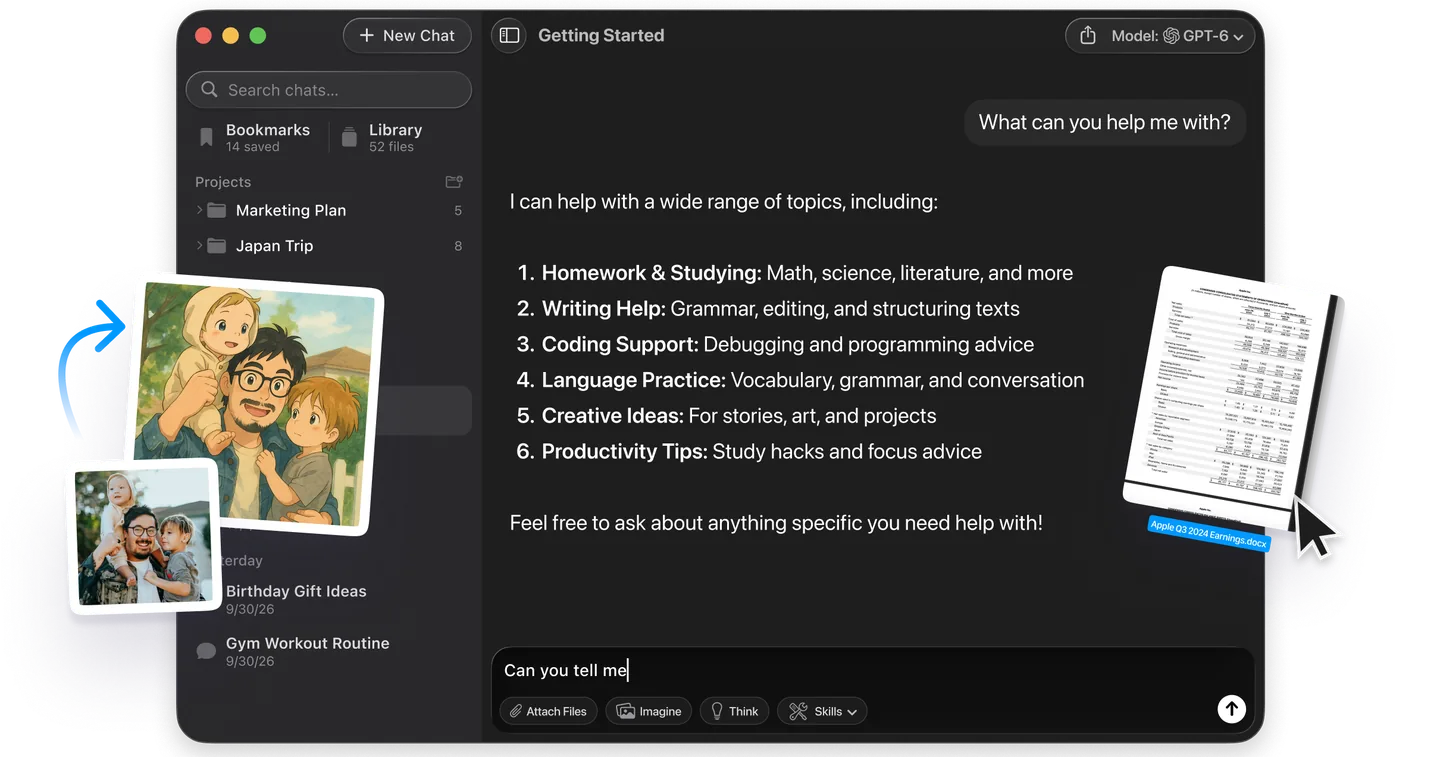
Switching between models to match the task only works if switching is easy. A Mac app that puts several models behind one keyboard shortcut turns model choice into a per-question decision rather than a monthly subscription commitment, which is exactly the decision token pricing rewards.
The Verdict
Tokens are the honest unit of AI. Messages, credits and plan tiers are packaging that sits on top, but underneath all of it a model is reading fragments and writing fragments, and somebody is counting them. One token is about four characters. Output costs roughly five times input. Your language and your conversation length both move the number. Once you know those three things, most of what looks arbitrary about AI pricing turns out to be arithmetic.
The practical version is short. Ask for shorter answers rather than sending shorter prompts. Start a new conversation when the subject changes. Match the model to the job instead of running everything through the most expensive one you have access to. Those three habits will do more for your costs than any prompt trick.
Frequently Asked Questions
What are AI tokens in simple terms?
An AI token is the smallest piece of text a model reads or writes. It is usually not a whole word: common words are one token, longer ones split into pieces, so "encoding" becomes "encod" plus "ing". OpenAI puts one token at roughly four characters, or about three-quarters of a word in English, while noting those are estimates rather than exact counts.
How many tokens is 1,000 words?
Using OpenAI's published ratio of about three-quarters of a word per token, 1,000 English words works out at roughly 1,300 tokens. The real figure moves with your wording, punctuation and capitalisation, and it rises considerably in languages other than English.
Why are output tokens more expensive than input tokens?
Because reading and writing are different amounts of work. Your prompt is read in a single pass, but the reply is generated one token at a time, with each new token requiring another pass over everything written so far. Across the current OpenAI, Anthropic and Google price lists, output costs about five times input, and more than eight times on some cheaper models.
Are AI tokens the same as credits?
No. Tokens are the unit of text a model processes and the unit vendors bill in. Credits are a prepaid allowance an app or service deducts as you use features, and each app decides its own conversion rate. OpenAI's pricing page treats them as two separate systems, offering credit-based and token-based pricing side by side.
Is there such a thing as unlimited AI tokens?
Not really. Plans advertised as unlimited still carry a rate cap, a message cap or a fair-use policy somewhere, because every token costs the provider real compute. What changes between plans is where the ceiling sits and how it is described, not whether one exists.