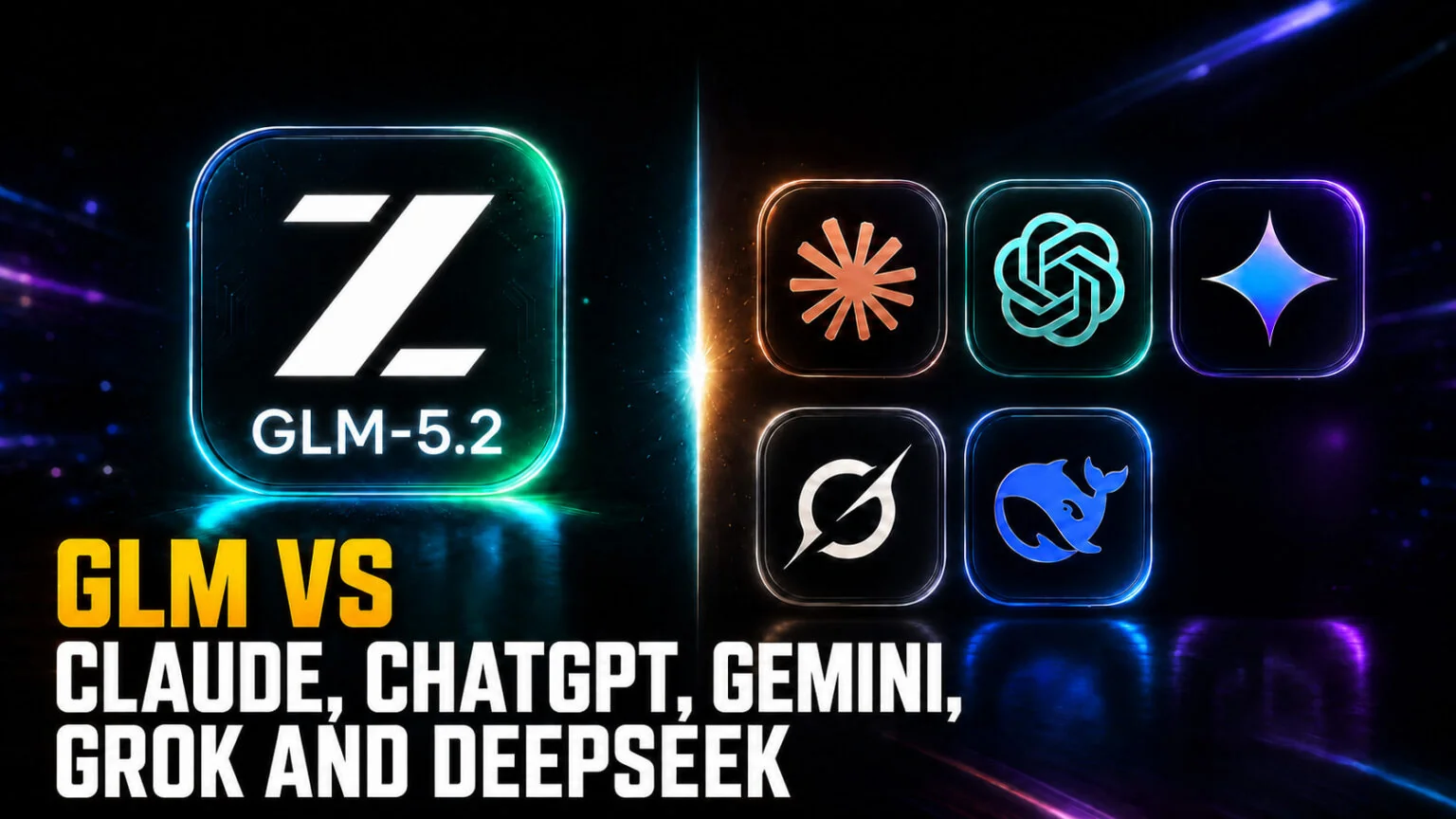
GLM-5.2 is the top open-weight model on the Artificial Analysis Intelligence Index, scoring 51 while costing a fraction of the closed flagships, and that gap is why the GLM vs Claude question has spread into a much bigger fight. Zhipu AI’s open-weight model costs $1.40 input / $4.40 output per million tokens against Claude Opus 5 at $5 / $25, ships under a permissive MIT license, and now trades benchmark wins with models from OpenAI, Google, xAI and DeepSeek.
So the real question is not just GLM vs Claude. It is whether an open-weight model at a fraction of the cost can stand in for any of the big paid flagships. This guide compares GLM-5.2 head-to-head with Claude, GPT-5.6, Gemini, Grok and DeepSeek V4 on price, benchmarks, context and coding, then tells you exactly which model to pick for which job. All numbers were re-checked against vendor pricing pages and the live Artificial Analysis boards on July 25, 2026. Every matchup below uses GLM-5.2, which is still the newest GLM you can download: GLM 5.3, released on August 14, 2026, leads on agentic coding and security by Z.ai’s own figures, but it shipped without open weights and is reachable only through the GLM Coding Plan and ZCode.
The Key Takeaways
- GLM-5.2 is the price-to-performance leader, at $1.40 / $4.40 per million tokens versus $5 / $25 for Claude Opus 5, roughly 3.6x cheaper input and 5.7x cheaper output.
- Claude still wins the hardest agentic work. Opus 5 tops the Artificial Analysis Agentic Index at 55.3 against GLM-5.2’s 43.1, and Opus 4.8 already led GLM on SWE-bench Pro at 69.2 to 62.1.
- GLM tops open weights on intelligence, ranking #1 among open-weight models on the Artificial Analysis Intelligence Index, ahead of DeepSeek V4 Pro and MiniMax-M3 (51 vs 44 for both).
- DeepSeek V4 Pro is cheaper still, at $0.435 / $0.87 per million tokens, and dominates competitive-programming benchmarks.
- GLM and DeepSeek are MIT-licensed and self-hostable; Claude, GPT, Gemini and Grok are closed, API-only models.
- GLM 5.3 is not part of these comparisons. It is the newer model, but it has no open weights and no published per-token price, so GLM-5.2 remains the one you can download, self-host and cost out.
GLM vs Claude, GPT, Gemini, Grok and DeepSeek at a glance
Here is the whole field on one screen. Prices are list API rates per million tokens; context is the maximum input window. GLM-5.2 and DeepSeek V4 are the only open-weight models in the group here, and DeepSeek is the cheapest of all six. Moonshot’s newer Kimi K3 belongs in the same open-weight camp, though its weights are only expected to drop in late July 2026.
| Model | Maker | License | Price (in / out per 1M) | Context | Best at |
|---|---|---|---|---|---|
| GLM-5.2 | Zhipu / Z.ai | Open, MIT | $1.40 / $4.40 | 1M | Price-to-performance, math, open weights |
| Claude Opus 5 | Anthropic | Closed | $5 / $25 | 1M | Long-horizon coding, tool use, writing |
| GPT-5.6 Sol | OpenAI | Closed | $4 / $20 | 1M | Balanced all-rounder, ecosystem |
| Gemini 3.1 Pro | Closed | $2 / $12 | 1M | Multimodal, coding-arena play | |
| Grok 4.6 | xAI | Closed | $2 / $6 | 500k | Real-time X data, strongest Grok |
| DeepSeek V4 Pro | DeepSeek | Open, MIT | $0.435 / $0.87 | 1M | Lowest cost, competitive coding |
If you want the full definition and version history behind these numbers, our explainer on what GLM is and how the family evolved covers every release from 4.5 to 5.2. The rest of this article is the head-to-head verdict.
GLM vs each rival, head to head
The at-a-glance table sets the scene, but the real decision happens one matchup at a time. Here is how GLM-5.2 stacks up against each of the five big flagships in turn, with the specific benchmark and price gaps that should drive your choice.
GLM vs Claude
This is the matchup everyone searches, and the honest answer is that Claude is still the better model where it matters most, meaning multi-hour software engineering, tool orchestration and polished writing. Anthropic’s current flagship is Claude Opus 5, released July 24, 2026, which tops the Artificial Analysis Intelligence Index at 61 and its Agentic Index at 55.3 against GLM-5.2’s 51 and 43.1. On llm-stats’ head-to-head the previous flagship, Opus 4.8, already led GLM-5.2 on SWE-bench Pro (69.2 vs 62.1), Tool-Decathlon (59.9 vs 48.2) and NL2Repo by a wide margin. If your work depends on an agent staying coherent across a long, messy task, Claude is worth the premium.
GLM-5.2 closes the gap in surprising places, though. It nearly saturates olympiad math, scoring 99.2 on AIME 2026 and 91.0 on IMO-AnswerBench, benchmarks where it sits at or near the very top of the whole field, and it lands within a point of Opus on several agentic evals. The price story is the clincher: GLM costs 3.6x less on input and 5.7x less on output. For workflows that run thousands of agent turns a day, that difference compounds into real money.
| Metric | GLM-5.2 | Claude (Opus 4.8 / Opus 5) |
|---|---|---|
| SWE-bench Pro (Opus 4.8) | 62.1 | 69.2 |
| GPQA Diamond (Opus 4.8) | 91.2 | 93.6 |
| AA Agentic Index (Opus 5) | 43.1 | 55.3 |
| AIME 2026 (math) | 99.2 | Not published |
| Price (out per 1M) | $4.40 | $25 |
| Weights | Open, MIT | Closed |
Verdict: pick Claude Opus 5 for premium, high-stakes coding and customer-facing output; pick GLM for high-volume, cost-sensitive pipelines where frontier-class quality at one-sixth the output price is an easy trade. For the deeper spec, see our breakdown of GLM-5.2’s architecture and capabilities.
GLM vs GPT-5.6
GPT-5.6 Sol is OpenAI’s flagship, in broad release since July 9, 2026. It is the safe default for people who want one model that does a bit of everything well inside a mature ecosystem. It matches GLM on general reasoning and pulls ahead on breadth of tooling, plugins and third-party support. What it does not do is compete on price.
At $4 input / $20 output per million tokens, cut from $5 / $30 on August 21, 2026, Sol is no longer the dearest output in this table, that is Claude Opus 5 at $25, and it runs about 4.5x GLM-5.2’s rate. OpenAI does sell cheaper tiers of the same generation, and it cut them hard on July 30, 2026, taking Terra to $2 / $12 and Luna to $0.20 / $1.20, so the comparison now depends entirely on which one you actually call. Against Sol, GLM is dramatically cheaper. Against Luna it is not: Luna undercuts GLM-5.2 by 7x on input and roughly 3.7x on output. What GLM still gives you that no GPT tier does is open weights and self-hosting.
Verdict: choose GPT-5.6 for ecosystem depth, for a dependable all-rounder, and now for the cheapest tokens of the two if Luna is enough model for the job; choose GLM when you need open weights, self-hosting, or frontier-class quality well under Sol’s price.
GLM vs Gemini
Google’s shipping Pro flagship is Gemini 3.1 Pro at $2 / $12 per million tokens. One thing is worth stating plainly, because it circulates constantly. There is no Gemini 3.5 Pro and no Gemini 3.6 Pro. Google’s published catalog lists 3.1 Pro as its newest Pro model, still labelled preview, and Gemini 3.6 Flash as its newest stable Flash model. Gemini’s edge is multimodal understanding and strong coding-arena performance, plus tight integration with Google Workspace and Search. It also sits closer to GLM on price than the other closed flagships.
GLM-5.2 counters with higher raw intelligence scores among open-weight models and far cheaper output. Gemini is the better pick if your work is image, video or document heavy, or if you live inside Google’s tools. For text-first, high-volume or self-hosted workloads, GLM’s cost advantage and MIT license carry more weight.
Verdict: choose Gemini for multimodal and Google-ecosystem work; choose GLM for text-heavy pipelines and open deployment.
GLM vs Grok
xAI now ships two models worth comparing. Grok 4.6, released August 12, 2026, is the flagship, publicly listed in xAI’s API catalog at $2 / $6 per million tokens below 200k and $4 / $12 above it, with a 500k context window. Grok 4.3 stays available at $1.25 / $2.50 with a 1M window, which makes it the cheap option rather than the strong one. Grok’s standout feature is real-time access to X (Twitter) data, which no other model here offers natively.
The price comparison depends entirely on which Grok you mean. Grok 4.3 undercuts GLM-5.2 on output at $2.50 against $4.40, but Grok 4.6 costs more than GLM on both sides of the meter. Grok 4.6 buys you considerably more capability for that than Grok 4.5 did, scoring 61 on the Artificial Analysis Intelligence Index against GLM-5.2’s 51 — a gap that widened from three points to ten when Grok 4.6 landed in August without a price change. If real-time X data is core to your use case, Grok wins. If open weights, self-hosting or the lowest bill matter more, GLM does.
Verdict: choose Grok 4.6 for real-time X data and the strongest closed model in xAI’s line-up; choose GLM for open weights, self-hosting, and the lower bill.
GLM vs DeepSeek
This is the true open-weight showdown, because GLM-5.2 and DeepSeek V4 are both MIT-licensed, both Chinese, both 1M-context and both built for developers who want frontier coding without lock-in. DeepSeek V4 Pro is the cheaper of the two at $0.435 / $0.87 per million tokens, and it dominates competitive-programming evals like LiveCodeBench (93.5%) and Codeforces (3206 rating). Alibaba’s Qwen 3.8 is the newest heavyweight in that Chinese open-weight race.
GLM-5.2 wins on broad intelligence and long-horizon coding, leading DeepSeek on SWE-bench Pro (62.1 vs 55.4) and ranking higher on the Artificial Analysis Intelligence Index (51 vs 44). So the split is clean: DeepSeek for rock-bottom cost and contest-style coding, GLM for higher overall reasoning and agentic software work. Both are genuine open-weight leaders, which our roundup of the best open-source AI models covers in full.
Verdict: choose DeepSeek for the lowest possible cost and competitive coding; choose GLM for stronger all-round intelligence. See our full DeepSeek V4 breakdown for the details.
Benchmarks: where GLM actually wins and loses
Benchmarks tell a consistent story once you sort them into three buckets. GLM-5.2 is competitive at the frontier on reasoning and math, competitive-but-behind on the hardest agentic coding, and clearly ahead on value. The newer GLM 5.3 benchmarks narrow the agentic coding gap sharply, though only on Z.ai's own figures. Here is how each bucket breaks down.
Reasoning and math: GLM is frontier-class
On pure reasoning and math, GLM-5.2 runs with the frontier. It tops the open-weight field on GPQA Diamond (91.2%) and nearly saturates olympiad math, scoring 99.2 on AIME 2026 and 91.0 on IMO-AnswerBench, where it ranks at or near the top of every model tested. This is the category where an open-weight model most convincingly matches the paid flagships.
Coding and agents: the closed models still lead
On long-horizon software engineering, the closed frontier models still lead. Claude Opus 4.8 was out in front on SWE-bench Pro (69.2 vs 62.1) and on tool-use marathons like the Tool-Decathlon (59.9 vs 48.2). Its successor Opus 5 has since taken the top of the Artificial Analysis Agentic Index at 55.3. That is the multi-hour agentic work where staying coherent across a messy task is what you are paying for. GLM trails by a handful of points rather than a chasm, which is the whole reason the value argument holds. Newer entrants keep pushing at that frontier. Meta’s Muse Spark 1.1 wins several agentic tool-use rows on Meta’s own benchmark chart. Artificial Analysis scores it well behind GLM on its independent Agentic Index, though, 37.5 against 43.1.
Security: GLM edges Claude Code
The most talked-about result comes from security research firm Semgrep. In its prompt-only IDOR vulnerability-detection test, GLM-5.2 scored 39% F1 with no scaffolding at all and edged out Claude Code, a result Semgrep headlined as a seven-point win. An open-weight model running a bare prompt matching a frontier coding agent on a reasoning-heavy security task is exactly the kind of result that makes teams reconsider paying premium prices.
The takeaway is nuance, not a clean sweep. You can verify the live rankings yourself on the Artificial Analysis Intelligence Index and read Semgrep’s methodology in its GLM-5.2 cyber benchmark writeup.
Pricing: the reason this comparison exists
Every verdict above bends around one fact: GLM is far cheaper than the closed flagships. At $1.40 / $4.40 per million tokens, GLM-5.2 undercuts Claude Opus 5 by 3.6x to 5.7x, GPT-5.6 Sol by even more on output, and sits below Gemini 3.1 Pro. The cheap tiers are a different story since July 30, 2026. DeepSeek V4 Pro and the older Grok 4.3 still come in under GLM, and GPT-5.6 Luna now joins them at $0.20 / $1.20. All three give up ground to GLM somewhere, on general intelligence or on open weights, so cheapest-per-token and best-per-dollar are no longer the same question.
Zhipu also offers subscription coding plans and higher rate limits than most rivals, which matters for teams running continuous agents. For the full plan-by-plan breakdown, including the coding tiers and free models, see our dedicated GLM pricing guide, and compare it against the wider market in our AI pricing comparison.
Which model should you actually pick?
The five-way answer comes down to what you optimise for. For premium coding and long agentic tasks, Claude Opus 5 is the pick, with GLM-5.2 as the budget runner-up. For the best value at scale, go with GLM-5.2, or drop to DeepSeek V4 Pro if you want the absolute cheapest option.
The specialist jobs sort out cleanly too. Multimodal and Google-ecosystem work belongs to Gemini 3.1 Pro, real-time information and X data go to Grok 4.6, and anything that needs open weights or self-hosting means GLM-5.2 or DeepSeek V4, the only MIT-licensed options in this group.
Notice that no single model wins every job. That is the real lesson of any GLM vs Claude vs everyone comparison: the “best” model depends entirely on the task in front of you, and the smartest teams route different jobs to different models.
Conclusion: you don’t have to pick just one
GLM-5.2 has turned the GLM vs Claude question into a genuine contest. It offers frontier-class reasoning at open-weight prices, tops the field on math while edging Claude Code on one security benchmark, and only falls behind on the hardest long-horizon coding. Against GPT, Gemini and Grok it wins on openness, and on cost against everything except DeepSeek and the older Grok 4.3, while trading blows on capability.
Since the winner changes with every task, the practical move is to keep several models on hand. Fello AI gives you Claude, ChatGPT, Gemini, Grok, DeepSeek and open models like GLM in one app on a single flat subscription, so you can send each job to the model that wins it without juggling five separate bills. That is how you get the best of this whole comparison instead of committing to one side of it. On a Mac it all runs through one native GLM desktop client, next to every other model in this comparison.
Frequently Asked Questions
Is GLM better than Claude?
Not overall, but it depends on the task. Claude Opus 5 leads GLM-5.2 on long-horizon software engineering and tool use, topping the Artificial Analysis Agentic Index at 55.3 against 43.1, while GLM wins on math benchmarks and costs roughly 3.6x to 5.7x less. For high-volume or cost-sensitive work, GLM is often the smarter pick.
Is GLM cheaper than Claude and GPT?
Yes, significantly. GLM-5.2 costs $1.40 input / $4.40 output per million tokens, versus $5 / $25 for Claude Opus 5 and $4 / $20 for GPT-5.6 Sol. That is about a fifth of Sol’s output rate and a sixth of Claude Opus 5’s.
Is GLM open source?
GLM-5.2 is released with open weights under the permissive MIT license, so you can self-host and fine-tune it. Alongside DeepSeek V4, it is one of the only open-weight models in this comparison; Claude, GPT, Gemini and Grok are all closed and API-only.
GLM vs DeepSeek, which is better?
GLM-5.2 leads on overall intelligence and long-horizon coding, while DeepSeek V4 Pro is cheaper ($0.435 / $0.87) and dominates competitive-programming benchmarks like LiveCodeBench. Both are MIT-licensed, 1M-context open-weight models, so the choice comes down to cost versus all-round capability.
Can GLM replace Claude for coding?
For many coding tasks, yes, especially at scale where cost matters. GLM-5.2 stays within a few points of Claude on most coding evals and even beat Claude Code on one security benchmark. For the very hardest multi-hour agentic work, Claude Opus 5 still has the edge.