GLM vs Claude is the question people search, and the 2026 answer starts with a correction: the GLM worth comparing is no longer GLM-5.2. Z.ai now sells three of them, and on the Artificial Analysis Intelligence Index v4.3.2, read on September 24, 2026, the flagship GLM-5.3 scores 44.8 and GLM-5.3 Flash scores 41.8, while the older GLM-5.2 scores 33.7 on an identical $1.40 / $4.40 rate card. Against Claude Opus 5.5 at $4 / $20, GLM-5.3 is 2.9x cheaper on input and 4.5x on output, and that gap is what this whole comparison turns on.
So the real question is not just GLM vs Claude. It is whether an open-weight model at a fraction of the cost can stand in for any of the big paid flagships. This guide compares GLM-5.3 and the far cheaper GLM-5.3 Flash head-to-head with Claude, GPT-6, Gemini, Grok and DeepSeek on price, benchmarks, context and coding, then tells you which model to pick for which job. Every price and score below was re-read from the vendors’ own pricing pages and the Artificial Analysis model pages on September 24, 2026. One thing to settle first, because the licences differ inside the family: GLM-5.2 and GLM-5.3 Flash ship under MIT, while GLM-5.3’s weights are public under Z.ai’s own GLM-5.3 License, permissive except for cloud operators above $10 billion in revenue.
The Key Takeaways
- GLM-5.3 Flash is the value pick, not GLM-5.2. At $0.15 / $0.50 per million tokens it costs $0.25 per Artificial Analysis Intelligence Index task, against $2.01 for GLM-5.3 and $0.96 for GLM-5.2, and it outscores GLM-5.2 by eight points.
- Claude still wins the hardest agentic work. Claude Opus 5.5 scores 57.6 on the Artificial Analysis Intelligence Index v4.3.2 and Claude Fable 5.1 scores 53.4, against GLM-5.3’s 44.8. That is a gap of nearly 13 points to the model Anthropic calls its daily driver.
- GLM no longer tops the open-weight field. On the same v4.3.2 board, Xiaomi’s MiMo-V2.6-Pro scores 46.3 and Alibaba’s Qwen3.8 Max (0902) 45.4, both above GLM-5.3’s 44.8, with Moonshot’s Kimi K3 just behind at 43.6.
- DeepSeek is no longer the automatic cheap pick. Since it moved to time-of-day billing, DeepSeek V4.1 Flash runs $0.15 / $0.60 off-peak and $0.30 / $1.20 at peak, so GLM-5.3 Flash matches it on input and beats it on output at a flat rate, all day.
- Every GLM and every DeepSeek model here is downloadable. GLM-5.2, GLM-5.3 Flash and both DeepSeek builds are MIT-licensed, and GLM-5.3 publishes weights under Z.ai’s own licence; Claude, GPT, Gemini and Grok are closed, API-only models.
- There is no reason left to call GLM-5.2. Z.ai prices it at exactly the same $1.40 / $4.40 as GLM-5.3, which is built on the same base model and scores eleven points higher. If your code still names the older model, that is the one-line change worth making today.
GLM vs Claude, GPT, Gemini, Grok and DeepSeek at a glance
Here is the whole field on one screen. Prices are list API rates per million tokens, context is the maximum input window, and the index column is the Artificial Analysis Intelligence Index v4.3.2 as read on September 24, 2026. Version-stamp matters here: Artificial Analysis rescaled the index twice in September, so a bare number from an older version is not comparable to these. Three of the seven models below publish downloadable weights, which is more than a year ago.
| Model | Maker | License | Price (in / out per 1M) | Context | AA Index v4.3.2 | Best at |
|---|---|---|---|---|---|---|
| GLM-5.3 | Zhipu / Z.ai | Open weights, GLM-5.3 License | $1.40 / $4.40 | 1M | 44.8 | Flagship GLM, agentic coding |
| GLM-5.3 Flash | Zhipu / Z.ai | Open, MIT | $0.15 / $0.50 | 1M | 41.8 | Price-to-performance, image and video input |
| Claude Opus 5.5 | Anthropic | Closed | $4 / $20 | 1M | 57.6 | Long-horizon coding, tool use, writing |
| GPT-6.1 Sol | OpenAI | Closed | $2 / $10 | 1M | 51.8 | Balanced all-rounder, ecosystem |
| Gemini 4 Argon | Closed | $2 / $10 (to Nov 30), then $4 / $20 | 1M | 52.6 | Legal, finance, long agentic work | |
| Gemini 3.1 Pro | Closed | $2 / $12 | 1M | 29.7 | Multimodal, Google ecosystem | |
| Grok 4.7 | xAI | Closed | $2 / $6 | 500k | 46.4 | Real-time X data |
| DeepSeek V4.1 Flash | DeepSeek | Open, MIT | $0.15 / $0.60 off-peak, $0.30 / $1.20 peak | 1M | 39.5 | Lowest off-peak rates, image input |
If you want the full definition and version history behind these numbers, our explainer on what GLM is and how the family evolved covers every release from 4.5 onward. The rest of this article is the head-to-head verdict.
GLM vs each rival, head to head
The at-a-glance table sets the scene, but the real decision happens one matchup at a time. Here is how GLM stacks up against each of the five big flagships in turn, with the specific benchmark and price gaps that should drive your choice.
GLM vs Claude
This is the matchup everyone searches, and the honest answer is that Claude is still the better model where it matters most, meaning multi-hour software engineering, tool orchestration and polished writing. Anthropic’s daily driver is now Claude Opus 5.5 at $4 / $20, with Claude Fable 5.1 at $10 / $50 for long-running agents, and Opus 5 has moved to Anthropic’s legacy list. On the Artificial Analysis Intelligence Index v4.3.2 those three read 57.6, 53.4 and 50.8, against GLM-5.3’s 44.8. If your work depends on an agent staying coherent across a long, messy task, Claude is worth the premium.
GLM closes the gap in two places. The first is math: on Z.ai’s July 2026 figures GLM-5.2 scored 99.2 on AIME 2026 and 91.0 on IMO-AnswerBench, at or near the top of the whole field at the time. The second is the bill. Opus 5.5 is cheaper than the Opus 5 it replaced, so the gap has narrowed, but GLM-5.3 still costs 2.9x less on input and 4.5x less on output. For workflows that run thousands of agent turns a day, that difference compounds into real money.
| Metric | GLM-5.3 | Claude Opus 5.5 |
|---|---|---|
| AA Intelligence Index v4.3.2 | 44.8 | 57.6 |
| AA cost per Index task | $2.01 | $5.98 |
| Price (in / out per 1M) | $1.40 / $4.40 | $4 / $20 |
| SWE-bench Pro, July 2026 (GLM-5.2 vs Opus 4.8) | 62.1 | 69.2 |
| Context | 1M | 1M |
| Weights | Public, GLM-5.3 License | Closed |
Verdict: pick Claude Opus 5.5 for premium, high-stakes coding and customer-facing output; pick GLM-5.3 for high-volume, cost-sensitive pipelines where near-frontier quality at under a quarter of the output price is an easy trade. For the deeper spec, see our breakdown of the architecture GLM-5.2 introduced, which GLM-5.3 still runs on.
GLM vs GPT-6
GPT-6.1 Sol is OpenAI’s working flagship, with GPT-6 Luna beneath it and GPT-6 Astra above it at $10 / $50. GPT-6.1 Sol succeeded GPT-6 Sol on September 29, 2026 at the same price. Sol is the safe default for people who want one model that does a bit of everything well inside a mature ecosystem. It leads GLM on general reasoning and on breadth of tooling, plugins and third-party support. On the v4.3.2 index GPT-6.1 Sol scores 51.8 against GLM-5.3’s 44.8, a seven-point gap, so GLM now has to win on price and open weights rather than on a near-tie.
At $2 input / $10 output per million tokens, GPT-6.1 Sol costs half what GPT-5.6 Sol did, so the old line about GLM being several times cheaper than OpenAI is dead. GLM-5.3 is now 1.4x cheaper on input and 2.3x on output, a real saving but no longer a rout. The budget tier inverts it: GPT-6 Luna at $0.10 / $0.50 undercuts GLM-5.3 Flash on input and matches it on output, though Flash answers with a higher index score, 41.8 against 37.3. GPT-5.6 Sol is still purchasable at $4 / $20, with OpenAI committing to that promotional rate at least through November 21, 2026, but it is no longer the model to compare against.
Verdict: choose GPT-6 for ecosystem depth and a dependable all-rounder, and Luna when raw cost per token is the only axis that matters; choose GLM when you need downloadable weights, self-hosting, or the better score per dollar in the budget tier.
GLM vs Gemini
Google’s Pro-tier model is Gemini 3.1 Pro at $2 / $12 per million tokens below 200k, rising to $4 / $18 above it. One thing is worth stating plainly, because it circulates constantly. There is no Gemini 3.5 Pro and no Gemini 3.6 Pro. Google’s published catalog still lists 3.1 Pro as its newest Pro model, labelled preview, while the Flash line has moved several releases ahead to Gemini 3.8 Flash. Google also announced Gemini 4 Argon on September 30, 2026, a new flagship above the Pro line, and opened it to Google AI Pro and Ultra subscribers and the paid API on October 13, at $2 / $10 until November 30, then $4 / $20. Gemini’s edge is multimodal understanding and tight integration with Google Workspace and Search.
Below Gemini 4 Argon, GLM wins this one outright on the measured board. Artificial Analysis puts GLM-5.3 at 44.8 on v4.3.2, above Gemini 3.8 Flash at 40.9 and far above Gemini 3.1 Pro at 29.7, the lowest score of any flagship in this comparison. Gemini 4 Argon, at 52.6, beats GLM-5.3, and since October 13 anyone on Google AI Pro, Ultra or the paid API can use it, though it costs more than GLM-5.3 on both input and output. Gemini is still the better pick if your work is image, video or document heavy, or if you live inside Google’s tools, and Google prices 3.8 Flash at $0.75 / $3.75 through December 31, 2026. For text-first, high-volume or self-hosted workloads, GLM’s cost advantage and public weights carry more weight.
Verdict: choose Gemini for multimodal and Google-ecosystem work; choose GLM for text-heavy pipelines, open deployment and the higher measured score.
GLM vs Grok
xAI now ships three models worth comparing. Grok 4.7 is the flagship, listed in xAI’s API catalog at $2 / $6 per million tokens below 200k and $4 / $12 above it, with a 500k context window. Grok 4.6 sits at exactly the same price, and Grok 4.3 stays available at $1.25 / $2.50 with a 1M window, which makes it the cheap option rather than the strong one. Grok’s standout feature is real-time access to X (Twitter) data, which no other model here offers natively.
The price comparison depends entirely on which Grok you mean. Grok 4.3 undercuts GLM-5.3 on output at $2.50 against $4.40, while Grok 4.7 costs more than GLM on both sides of the meter. What that buys is the narrowest capability gap of any closed model here: 46.4 against GLM-5.3’s 44.8 on the v4.3.2 index, with Grok 4.6 at 44.3 now effectively level with GLM. Since 4.7 and 4.6 carry the same rate card, there is no reason to stay on the older one. If real-time X data is core to your use case, Grok wins. If downloadable weights, self-hosting or the lowest bill matter more, GLM does.
Verdict: choose Grok 4.7 for real-time X data and the strongest closed model in xAI’s line-up; choose GLM for open weights, self-hosting, and the lower bill.
GLM vs DeepSeek
This is the true open-weight showdown, because GLM and DeepSeek both publish downloadable weights, both come from Chinese labs, both run 1M context and both target developers who want frontier coding without lock-in. DeepSeek’s own lineup has flipped since this comparison was first written: its cheap model is now its strong one. DeepSeek V4.1 Flash costs $0.15 / $0.60 off-peak and $0.30 / $1.20 at peak (01:00-04:00 and 06:00-10:00 UTC, Monday to Friday) and scores 39.5 on the v4.3.2 index, while the dearer DeepSeek V4 Pro at $0.66 / $1.98 off-peak scores 36.0 and takes no image input at all. Alibaba’s Qwen 3.8 and Xiaomi’s MiMo-V2.6-Pro are the newest heavyweights in that race, and both now outscore every GLM.
GLM leads on measured intelligence, with GLM-5.3 at 44.8 against DeepSeek V4.1 Flash’s 39.5, and GLM-5.3 Flash at 41.8 clears both DeepSeek builds as well. On price the two are now level at the bottom: GLM-5.3 Flash is a flat $0.15 / $0.50 with no peak surcharge, against DeepSeek Flash’s $0.15 / $0.60 off-peak that doubles during the working window. So the split is no longer cost against capability. It is DeepSeek’s image input against GLM’s flat bill and higher score. Both are genuine open-weight leaders, which our roundup of the best open-source AI models covers in full.
Verdict: choose DeepSeek when you need image input in the budget tier or run mostly outside peak hours; choose GLM for stronger all-round intelligence at a price that does not move with the clock. See our full DeepSeek V4 breakdown for the details.
Benchmarks: where GLM actually wins and loses
Benchmarks tell a consistent story once you sort them into three buckets. GLM is competitive at the frontier on reasoning and math, competitive-but-behind on the hardest agentic coding, and strong but no longer alone on value. One caveat before the numbers: Artificial Analysis retired its separate Agentic Index and Coding Index during 2026 and folded them into the single Intelligence Index, so any agentic-index pair you find quoted for these models cannot be refreshed, only replaced. Here is how each bucket breaks down.
Reasoning and math: GLM is frontier-class
On pure reasoning and math, GLM’s published record is its strongest, with the caveat that the headline numbers are its own lab’s. Z.ai’s July 2026 figures had GLM-5.2 topping the open-weight field on GPQA Diamond (91.2%) and nearly saturating olympiad math at 99.2 on AIME 2026 and 91.0 on IMO-AnswerBench. Those results have aged in an unusual way: Artificial Analysis dropped GPQA Diamond from its index entirely, on the grounds that the field had saturated it. This is still the category where an open-weight model most convincingly matches the paid flagships, and also the one the benchmark makers have stopped treating as a discriminator.
Coding and agents: the closed models still lead
On long-horizon software engineering, the closed frontier models still lead. Anthropic’s Opus 4.8 was out in front of GLM-5.2 on SWE-bench Pro (69.2 vs 62.1) and on tool-use marathons like the Tool-Decathlon (59.9 vs 48.2) when llm-stats ran that pair in July, and both sides have shipped a successor since. Today the cleanest comparison is the single index: Claude Opus 5.5 at 57.6 against GLM-5.3 at 44.8. That is the multi-hour agentic work where staying coherent across a messy task is what you are paying for. Z.ai’s own pitch for 5.3 is a 50% coding gain over 5.2 on its internal Code Bench plus state-of-the-art open-source results on Terminal Bench 3.0, which are vendor figures and should be read as such. Newer entrants keep pushing at that frontier, and Meta’s Muse Spark 1.3 and Moonshot’s Kimi K3 both land in the same band.
Security: where GLM beat Claude Code
The most talked-about result came from security research firm Semgrep. In its prompt-only IDOR vulnerability-detection test, GLM-5.2 scored 39% F1 with no scaffolding at all and edged out Claude Code, a result Semgrep headlined as a seven-point win. That was a July 2026 run against models both sides have since replaced, so read it as a snapshot rather than a current ranking. It still made the point that mattered: an open-weight model running a bare prompt can match a frontier coding agent on a reasoning-heavy security task. Z.ai has leaned into that since, claiming GLM-5.3 more than doubles GLM-5.2’s scores on the CyberGym vulnerability-exploitation benchmark.
The takeaway is nuance, not a clean sweep. You can verify the live rankings yourself on the Artificial Analysis Intelligence Index, checking the version stamp printed on each model page, and read Semgrep’s methodology in its GLM-5.2 cyber benchmark writeup.
Pricing: the reason this comparison exists
Every verdict above bends around one fact, and it has weakened this year: GLM is cheaper than the closed flagships, but by less than it was. At $1.40 / $4.40, GLM-5.3 undercuts Claude Opus 5.5 by 2.9x to 4.5x and GPT-6.1 Sol by 1.4x to 2.3x, and sits below Gemini 3.1 Pro on both halves. The budget tier is where it gets interesting. GLM-5.3 Flash sits at a flat $0.15 / $0.50 that never moves with the clock, which DeepSeek Flash matches only outside peak hours. GPT-6 Luna is flat too and cheaper still on input at $0.10, but it scores 37.3 against Flash’s 41.8. On Artificial Analysis’s own cost-per-index-task figure, Flash runs $0.25 against $0.72 for GPT-6.1 Sol and $5.98 for Opus 5.5, though Xiaomi’s MiMo-V2.6-Pro beats all of them at $0.13.
Zhipu also offers subscription coding plans and higher rate limits than most rivals, which matters for teams running continuous agents; the GLM Coding Plan starts at $18 a month and now covers both 5.3 and 5.3 Flash. For the full plan-by-plan breakdown, including the coding tiers and free models, see our dedicated GLM pricing guide, and compare it against the wider market in our AI pricing comparison.
Which model should you actually pick?
The five-way answer comes down to what you optimise for. For premium coding and long agentic tasks, Claude Opus 5.5 is the pick, with GLM-5.3 as the budget runner-up. For the best value at scale, go with GLM-5.3 Flash, then check MiMo-V2.6-Pro and GPT-6 Luna against it, because each beats it on one axis.
The specialist jobs sort out cleanly too. Multimodal and Google-ecosystem work belongs to Gemini, real-time information and X data go to Grok 4.7, and anything that needs downloadable weights or self-hosting means GLM or DeepSeek, the only models in this group you can run on your own hardware. Inside GLM the MIT-licensed options are 5.2 and 5.3 Flash, while 5.3 ships under Z.ai’s own terms, and at 753 billion parameters it needs a multi-GPU server rather than a workstation.
Notice that no single model wins every job. That is the real lesson of any GLM vs Claude vs everyone comparison: the “best” model depends entirely on the task in front of you, and the smartest teams route different jobs to different models.
Conclusion: you don’t have to pick just one
GLM has turned the GLM vs Claude question into a genuine contest, and then quietly moved the goalposts inside its own family. GLM-5.3 offers near-frontier reasoning at a fraction of Claude’s price, GLM-5.3 Flash offers most of that again for a tenth of 5.3’s rate, and GLM-5.2, the model this comparison used to be built on, is the one to stop calling. Against GPT, Gemini and Grok, GLM wins on openness and on score per dollar in the budget tier. It loses the outright capability crown to Claude, and the outright open-weight crown to Xiaomi and Alibaba.
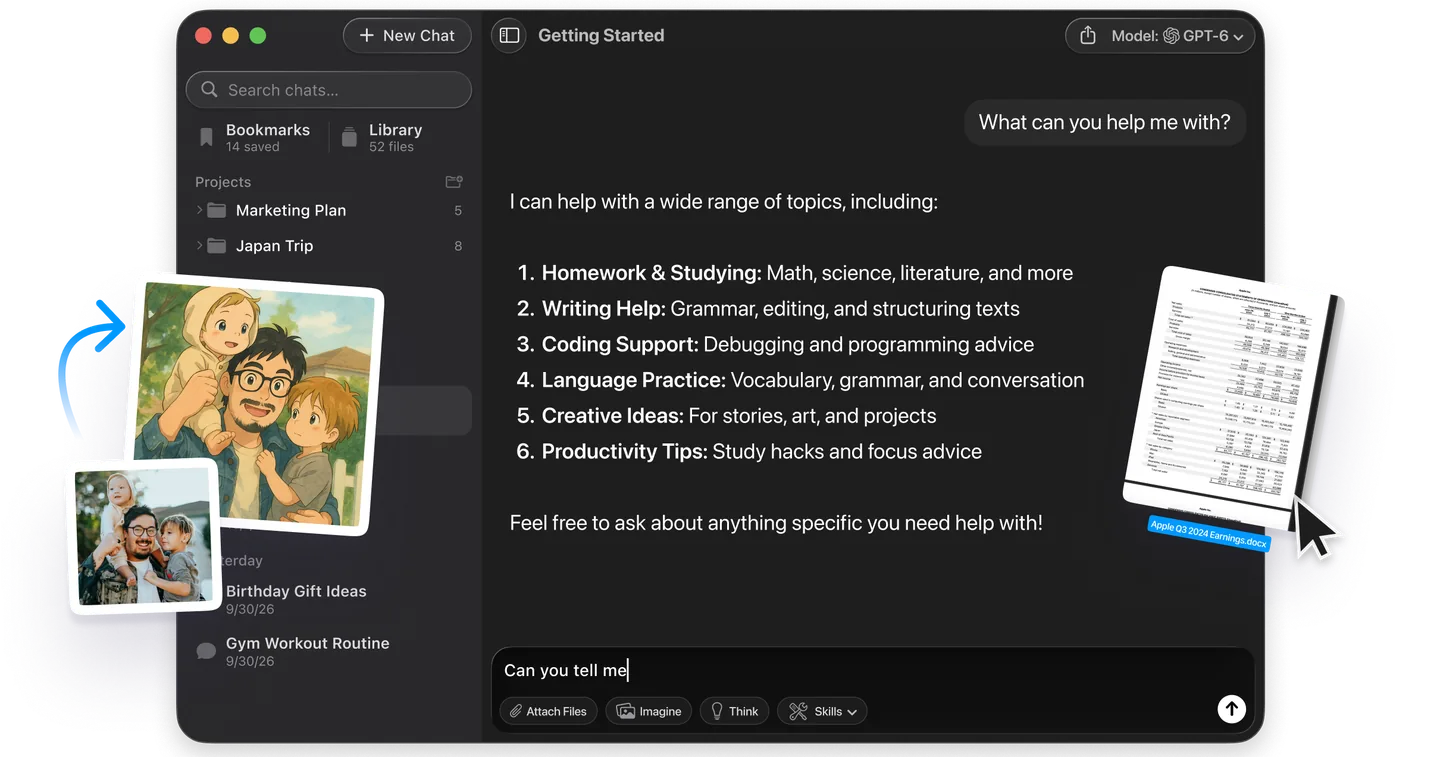
Since the winner changes with every task, the practical move is to keep several models on hand. Fello AI is a native Mac, iPhone and iPad app that puts Claude, ChatGPT, Gemini, Grok, DeepSeek and open models like GLM behind one subscription, along with Perplexity, Kimi and Qwen. It starts at $9.99 a month, with a free tier to try first and a 4.7-star rating across 27,000+ reviews, so you can send each job to the model that wins it without juggling five separate bills. That is how you get the best of this whole comparison instead of committing to one side of it. On a Mac it all runs through one native GLM desktop client, next to every other model in this comparison.
Frequently Asked Questions
Is GLM better than Claude?
Not overall, but it depends on the task. Claude Opus 5.5 leads GLM-5.3 on the Artificial Analysis Intelligence Index v4.3.2, 57.6 to 44.8, and on long-horizon software engineering and tool use, while GLM costs 2.9x less on input and 4.5x less on output. For high-volume or cost-sensitive work, GLM is often the smarter pick.
Is GLM cheaper than Claude and GPT?
Yes, though by less than it used to be. GLM-5.3 costs $1.40 input / $4.40 output per million tokens, against $4 / $20 for Claude Opus 5.5 and $2 / $10 for GPT-6.1 Sol. That is under a quarter of Claude’s output rate but only 2.3x below OpenAI’s, because GPT-6 Sol halved the price GPT-5.6 Sol charged. GLM-5.3 Flash at $0.15 / $0.50 goes much lower still.
Is GLM open source?
Partly, and the licence differs by model. GLM-5.2 and GLM-5.3 Flash are released under the permissive MIT license. GLM-5.3, the current flagship, publishes its weights too, but under Z.ai’s own GLM-5.3 License, which allows commercial use and self-hosting and only adds a security-review requirement for cloud operators above $10 billion in revenue. Either way you can download and fine-tune them; Claude, GPT, Gemini and Grok are all closed and API-only.
GLM vs DeepSeek, which is better?
GLM leads on measured intelligence: GLM-5.3 scores 44.8 and GLM-5.3 Flash 41.8 on the Artificial Analysis Intelligence Index v4.3.2, against 39.5 for DeepSeek V4.1 Flash and 36.0 for DeepSeek V4 Pro. DeepSeek answers with image input on its Flash model and an off-peak rate of $0.15 / $0.60 that doubles during peak hours, while GLM-5.3 Flash charges a flat $0.15 / $0.50. Both publish downloadable weights, so the choice comes down to vision against a predictable bill.
Can GLM replace Claude for coding?
For many coding tasks, yes, especially at scale where cost matters. Z.ai claims GLM-5.3 is 50% better at coding than GLM-5.2 on its own Code Bench, and GLM-5.2 beat Claude Code on one Semgrep security benchmark in July 2026. For the very hardest multi-hour agentic work, Claude Opus 5.5 still has the edge, and the 13-point index gap is the size of it.