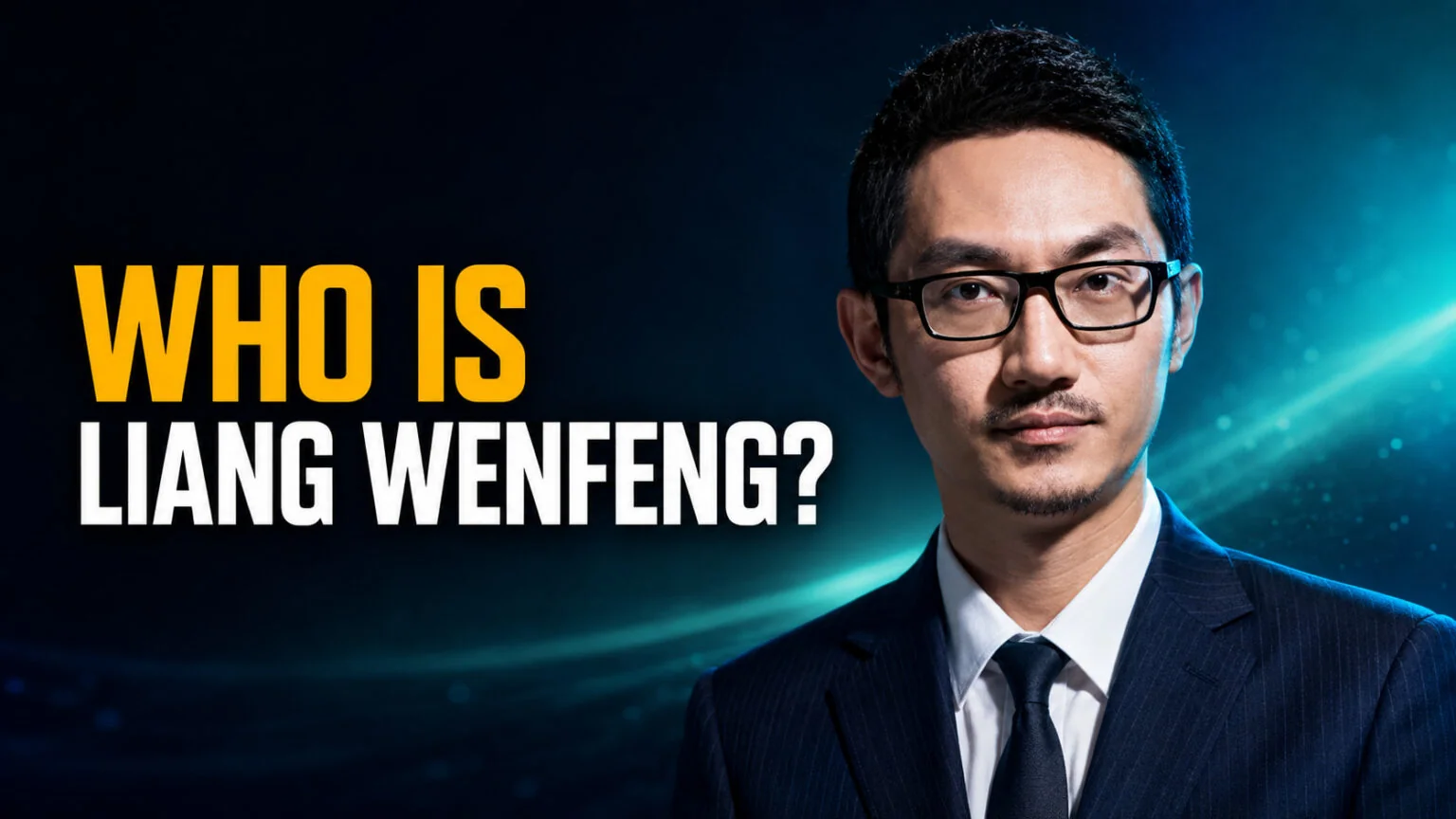
In January 2025, a single AI model from a little-known Chinese startup erased more than $1 trillion in market value from US tech stocks in one trading day. The model was DeepSeek-R1, and the man behind it is Liang Wenfeng, a former quant trader who built a frontier-grade AI lab on a fraction of the budget his American rivals spend. He rarely gives interviews, holds no flashy executive title beyond founder and CEO, and reportedly still reads research papers and writes code himself.
So who is Liang Wenfeng, and how did a kid from a rural village in southern China end up reshaping the global AI race? This guide covers his early life and education, the quant hedge fund that funded his ambitions, the founding of DeepSeek, the models that made him famous, his net worth, and his contrarian vision for building AI cheaply and in the open. The facts here are current to June 2026.
Liang built DeepSeek around open source AI, releasing model weights publicly rather than locking them behind a closed API, a contrarian bet that reshaped the whole industry.
The Key Takeaways
- Liang Wenfeng (born 1985) is the founder and CEO of DeepSeek and its parent hedge fund, High-Flyer.
- His reasoning model DeepSeek-R1 launched on January 20, 2025 and helped wipe more than $1 trillion off US tech stocks within a week.
- DeepSeek-V3 was reportedly trained for around $5.6 million, a tiny fraction of what comparable Western models cost.
- His net worth is hard to pin down; the most-cited 2025 estimate is roughly $11 billion, though figures range from about $1 billion to over $100 billion because DeepSeek takes no outside funding.
- DeepSeek’s current flagship, DeepSeek V4, shipped in April 2026 with open weights and a 1-million-token context window.
Who Is Liang Wenfeng?
Liang Wenfeng is a Chinese entrepreneur and AI researcher, born in 1985 in Guangdong Province. He is the founder and chief executive of DeepSeek, the Hangzhou-based lab whose open-weight models rattled Silicon Valley in early 2025, and of High-Flyer, the quantitative hedge fund whose profits and computing hardware bankrolled that AI work.
Three things set him apart from his peers. He came from modest roots rather than an elite tech pedigree. He built a frontier AI lab on a shoestring by obsessing over engineering efficiency, and he insists on releasing his best models as open weights instead of locking them behind a paywall. That combination turned a quiet quant trader into one of the most influential figures in artificial intelligence. Here are the essentials at a glance.
| Detail | Information |
| Full name | Liang Wenfeng (梁文锋) |
| Born | 1985, Mililing village, Wuchuan, Guangdong, China |
| Age | 40 (as of 2026) |
| Nationality | Chinese |
| Education | Zhejiang University (BEng 2007, MEng 2010) |
| Known for | Founder & CEO of DeepSeek |
| Other company | High-Flyer (quantitative hedge fund) |
| Estimated net worth | ~$11 billion (2025 estimate; figures vary widely) |
Early Life and Education
Liang was born in 1985 in Mililing, a small village in the Wuchuan area of Guangdong Province. Both of his parents worked as primary school teachers, so education was prized at home even though the family was far from wealthy. His talent for mathematics showed early, and he reportedly helped classmates with university-level problems while still in high school.
At just 17 he enrolled at Zhejiang University, one of China’s most respected institutions, in 2002, according to his public biography. He earned a bachelor’s degree in electronic information engineering in 2007 and stayed on for a master’s in information and communication engineering, finishing in 2010. His master’s thesis focused on a low-cost object-tracking algorithm using inexpensive PTZ cameras, an early sign of the cost-conscious, problem-solving mindset that would later define DeepSeek.
Those university years also shaped his approach to talent. Years later he would staff DeepSeek mostly with young graduates from top Chinese universities rather than poaching expensive veterans from big tech, betting that raw curiosity and fresh thinking matter more than a polished résumé.
From Quant Trading to High-Flyer
Rather than join a large corporation after graduation, Liang became convinced that machine learning could crack the patterns hidden in financial markets. He spent the early 2010s experimenting with algorithmic trading strategies alongside a small group of like-minded classmates. By 2015 those experiments had matured into a business, and that year he co-founded the quantitative hedge fund High-Flyer, formally registered as Ningbo High-Flyer Quantitative Investment Management the following year.
High-Flyer grew fast. By relying almost entirely on AI-driven models to make trades, the fund swelled to manage tens of billions of yuan, making it one of China’s largest quant shops. Crucially, Liang reinvested those profits into computing power. His team built large GPU clusters nicknamed “Fire-Flyer,” and the firm reportedly stockpiled around 10,000 Nvidia A100 GPUs before US export controls cut China off from the most advanced chips. That hardware war chest is what later made an independent AI lab possible.
The Birth of DeepSeek
In 2023, Liang spun a dedicated AI lab out of High-Flyer and called it DeepSeek. His goal was no longer just beating the market; it was building artificial general intelligence, the kind of broadly capable AI that the biggest US labs were chasing with multibillion-dollar budgets. He took a deliberately different route, wagering that smart engineering could close the gap without matching that spending.
Because High-Flyer funded everything, DeepSeek never had to raise venture money or answer to outside investors, which freed Liang to pursue research over quick revenue. The team leaned on techniques like a mixture-of-experts architecture and efficient mixed-precision training to get frontier-level results from far less compute. You can read the fuller company story in our explainer on DeepSeek and how it challenged the industry giants.
That open, research-first philosophy became DeepSeek’s signature. Instead of guarding its best work, the lab published papers and released model weights openly, letting developers worldwide run, study, and build on its systems. The strategy made DeepSeek a darling of the open-source community long before it became a household name.
DeepSeek Models: A Quick Timeline
Liang’s lab has shipped a steady run of models, each pushing the same theme of strong performance at low cost. The table below traces the releases that built DeepSeek’s reputation.
| Model | Released | Size (total / active) | Type | Why it mattered |
|---|---|---|---|---|
| DeepSeek-V2 | May 2024 | 236B / 21B | MoE language model | Slashed inference costs and triggered a China AI price war |
| DeepSeek-V3 | Dec 2024 | 671B / 37B | MoE language model | Rivaled GPT-4-class models for about $5.6M in training cost |
| DeepSeek-R1 | Jan 2025 | 671B / 37B | Reasoning model | Open, free, and tied to the $1 trillion market sell-off |
| DeepSeek-V3.2 | 2025 | 671B MoE | Agentic + reasoning | Its Speciale variant reportedly reached gold-medal scores at IMO and IOI 2025 |
| DeepSeek V4 | Apr 2026 | 1.6T / 49B (Pro) | MoE, 1M context | Current flagship, open weights, Thinking and Non-Thinking modes |
DeepSeek-R1 and the $1 Trillion Shock
DeepSeek had been gaining respect among researchers through 2024, especially after DeepSeek-V3 arrived in December 2024 and reportedly cost only about $5.6 million to train on roughly 2,000 Nvidia H800 chips. The moment that changed everything came on January 20, 2025, when the lab released its reasoning model, DeepSeek-R1. Attention has since shifted to his long-rumoured DeepSeek R2.
R1 matched the performance of leading US reasoning models on many math and coding benchmarks, yet it was free to use and open to download. Within a week it became the most downloaded free app on the US App Store, overtaking ChatGPT. Then the markets reacted. Investors panicked at the idea that cutting-edge AI no longer required astronomical budgets. On January 27, 2025 US tech stocks shed more than $1 trillion in combined market value, and chipmaker Nvidia suffered the largest single-day loss in market history at the time.
The shock turned Liang into a national figure overnight. He was invited to a high-profile symposium led by Premier Li Qiang and joined a meeting of private-sector leaders with Xi Jinping in February 2025, a clear signal that Beijing saw DeepSeek as proof of China’s AI ambitions. Western commentators, meanwhile, debated whether the “DeepSeek moment” marked a permanent shift in how AI gets built.
DeepSeek Today: V4 and the Wait for R2
DeepSeek’s current flagship is DeepSeek V4, released on April 24, 2026. It ships as a family, with a 1.6-trillion-parameter V4-Pro and a lighter V4-Flash, both offering a 1-million-token context window and switchable Thinking and Non-Thinking modes. As ever, the weights are open, keeping Liang’s open-source promise intact even as the models grow far larger. Our breakdown of what is new in DeepSeek V4 goes deeper on the specs and benchmarks.
The model the internet keeps waiting for is DeepSeek-R2, the next dedicated reasoning release. As of 22 October 2026 it has not launched, and DeepSeek has not ruled it out. Reuters reported that Liang held R2 back because he was not satisfied with its performance, a decision that fits his reputation for valuing quality over hype. We track the rumors and timeline in our DeepSeek R2 release tracker.
Liang Wenfeng’s Net Worth
Liang Wenfeng’s net worth is hard to estimate, and you should treat every figure as an approximation. The core problem is that DeepSeek takes no outside funding, so there is no investor-set valuation to anchor the math. Analysts instead guess what the company might be worth and multiply by Liang’s stake, which Forbes has put at roughly 84% of DeepSeek and at least 76% of High-Flyer.
That guesswork produces a huge spread. A 2025 Bloomberg survey of founders and AI experts valued DeepSeek anywhere from $1 billion to $150 billion, which on paper could make Liang worth over $100 billion under the rosiest assumptions. The most frequently cited recent figure is more grounded, putting his fortune near $11 billion in late 2025, when he joined lists of China’s richest people. Whatever the true number, his wealth is unusual in that it sits inside a company he deliberately refuses to sell shares in.
Leadership Style and Vision
For someone at the center of a geopolitical AI story, Liang keeps an extraordinarily low profile. He gives few interviews, avoids the celebrity-CEO circuit, and is described by colleagues as a hands-on “tech idealist” who still digs into research papers and code. He has said he prizes original thinking over imitation, which is partly why he hires curious young researchers and gives them room to experiment.
His broader bet is that efficiency and openness, not raw spending, will decide the AI race. By proving a small team could reach the frontier on a modest budget, Liang reframed the global conversation that founders like Sam Altman at OpenAI and Dario Amodei at Anthropic had dominated. He has also navigated real constraints, from US chip export controls to questions about data privacy, while insisting that open research is the fastest path to better AI. His personal life stays mostly private, and he rarely discusses anything beyond his work.
Try DeepSeek and Other Top Models in One App
Liang Wenfeng’s biggest gift to everyday users is choice, because DeepSeek’s open models pushed the whole industry toward cheaper, more accessible AI. If you want to see how DeepSeek stacks up against the rest, Fello AI lets you run DeepSeek alongside Claude, ChatGPT, Gemini, and Grok from a single Mac app, so you can compare answers on the same prompt without juggling subscriptions. It is one price for many models, which fits Liang’s own efficiency-first spirit.
You can get started with Fello AI here, and if you want the bigger picture, our regularly updated guide to the best AI models ranks where DeepSeek lands against every major competitor right now.
Conclusion
Liang Wenfeng’s story runs from a rural village in Guangdong to the eye of a $1 trillion market storm, and it is far from over. By funding AI with hedge-fund profits, obsessing over efficiency, and giving his best models away for free, he proved that the frontier is not reserved for the richest labs. Whether DeepSeek-R2 lives up to its hype or a rival borrows his playbook, the cheap-and-open approach he championed is now permanent in the AI landscape. The fastest way to judge his work is to try DeepSeek yourself and compare it directly with the models it set out to challenge.
FAQ
How old is Liang Wenfeng?
Liang Wenfeng was born in 1985, which makes him 40 years old as of 2026. Exact day-and-month birth details are not publicly confirmed.
Which university did Liang Wenfeng attend?
He studied at Zhejiang University, earning a bachelor’s degree in electronic information engineering in 2007 and a master’s in information and communication engineering in 2010.
What is Liang Wenfeng’s net worth?
Estimates vary widely because DeepSeek takes no outside funding. The most-cited 2025 figure is around $11 billion, though valuations of the company range from roughly $1 billion to over $100 billion, so treat any number as an estimate.
What inspired Liang Wenfeng to create DeepSeek?
After using AI to run his hedge fund High-Flyer, he became convinced that smart engineering could reach artificial general intelligence without the enormous budgets of US labs. High-Flyer’s profits and its stockpile of around 10,000 Nvidia GPUs let him fund that research independently.
Is Liang Wenfeng married?
Liang keeps his personal life private, and there are no reliably confirmed public details about his marriage or family. Most reporting focuses on his work rather than his private life.