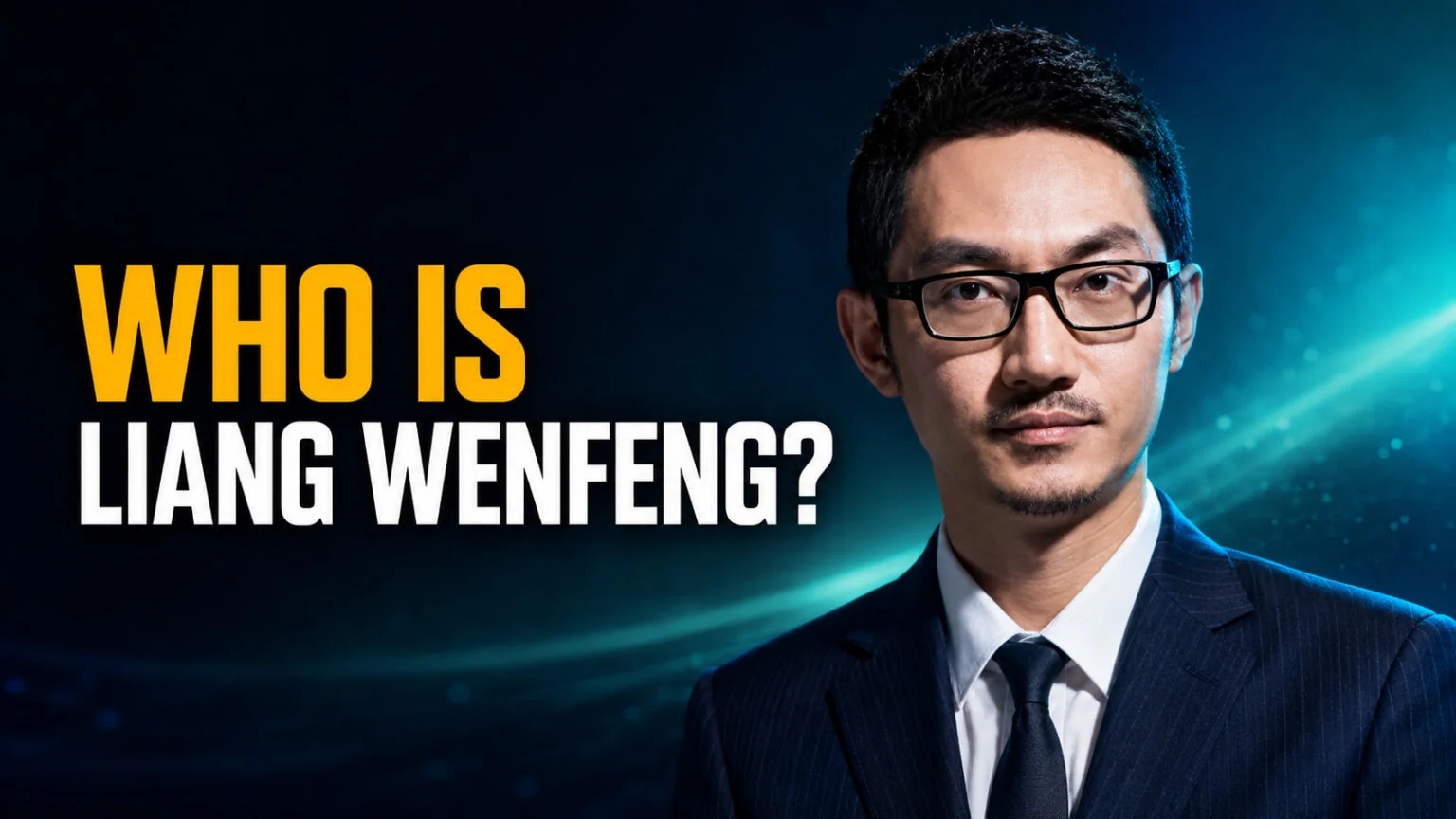
In January 2025, a single AI model from a little-known Chinese startup knocked $593 billion off Nvidia’s market value in one trading day, the largest one-day loss for any company on Wall Street. The model was DeepSeek-R1, and the man behind it is Liang Wenfeng, a former quant trader who built a frontier-grade AI lab on a fraction of the budget his American rivals spend. He rarely gives interviews and holds no flashy title beyond founder and CEO.
So who is Liang Wenfeng, and how did a kid from a rural village in southern China end up reshaping the global AI race? This guide covers his early life and education, the quant hedge fund that funded his ambitions, the founding of DeepSeek, the models that made him famous, his net worth, and his contrarian vision for building AI cheaply and in the open. The facts here are current to 22 November 2026.
Liang built DeepSeek around open source AI, releasing model weights publicly rather than locking them behind a closed API, a contrarian bet that reshaped the whole industry.
The Key Takeaways
- Liang Wenfeng (born 1985, age 41 per Forbes) is the founder and CEO of DeepSeek and a co-founder of the hedge fund High-Flyer.
- His reasoning model DeepSeek-R1 launched on January 20, 2025. On January 27, Nvidia lost $593 billion in market value, a record one-day loss.
- DeepSeek put the final training run of DeepSeek-V3 at about $5.6 million in rented GPU time, a figure that excludes its earlier research.
- Forbes put his net worth at $59.3 billion on 22 November 2026, after two 2026 funding rounds valued DeepSeek at $92.3 billion.
- DeepSeek’s current models are DeepSeek V4-Pro (open weights, 1-million-token context) and DeepSeek-V4.1-Flash-1017, released in October 2026. R2 has still not launched.
Who Is Liang Wenfeng?
Liang Wenfeng is a Chinese entrepreneur and AI researcher, born in 1985 in Guangdong Province. He is the founder and chief executive of DeepSeek, the Hangzhou-based lab whose open-weight models rattled Silicon Valley in early 2025, and a co-founder of High-Flyer, the quantitative hedge fund whose profits and computing hardware bankrolled that AI work.
Three things set him apart from his peers. He came from modest roots rather than an elite tech pedigree. He built a frontier AI lab on a shoestring by obsessing over engineering efficiency, and he insists on releasing his best models as open weights instead of locking them behind a paywall. That combination turned a quiet quant trader into one of the most influential figures in artificial intelligence. Here are the essentials at a glance.
| Detail | Information |
| Full name | Liang Wenfeng (梁文锋) |
| Born | 1985, Mililing village, Wuchuan, Guangdong, China |
| Age | 41 (Forbes, November 2026) |
| Nationality | Chinese |
| Education | Zhejiang University (BEng, MEng 2010) |
| Known for | Founder & CEO of DeepSeek |
| Other company | High-Flyer (quantitative hedge fund) |
| Estimated net worth | $59.3 billion (Forbes real-time estimate, 22 November 2026) |
| Recognition | Nature’s 10, people who shaped science in 2025 |
Early Life and Education
Liang was born in 1985 in Mililing, a small village in the Wuchuan area of Guangdong Province. He was born to a primary school teacher, so education was prized at home even though the family was far from wealthy. His talent for mathematics showed early, and reporting on his school years describes him as a gifted student.
At just 17 he enrolled at Zhejiang University, one of China’s most respected institutions, in 2002, according to his public biography. He earned a bachelor’s degree in electronic information engineering and stayed on for a master’s in information and communication engineering, finishing in 2010. His master’s research was in machine vision under his supervisor Xiang Zhiyu: tracking moving objects in real time with pan-tilt-zoom (PTZ) cameras, work the two published together in Zhejiang University’s engineering journal in 2011.
Those university years also shaped his approach to talent. Years later he would staff DeepSeek mostly with young graduates from top Chinese universities rather than poaching expensive veterans from big tech. In a 2023 interview he said High-Flyer’s core technical roles were “mainly filled by fresh graduates and those who have graduated for one or two years,” betting that raw curiosity and fresh thinking matter more than a polished résumé.
From Quant Trading to High-Flyer
Rather than join a large corporation after graduation, Liang became convinced that machine learning could crack the patterns hidden in financial markets. He spent the early 2010s experimenting with algorithmic trading strategies alongside a small group of like-minded classmates. By 2015 those experiments had matured into a business, and that year he co-founded the quantitative hedge fund High-Flyer, formally registered as Ningbo High-Flyer Quantitative Investment Management the following year.
High-Flyer grew fast. By relying almost entirely on AI-driven models to make trades, the fund at its peak managed more than 100 billion yuan, making it one of China’s largest quant shops. Crucially, Liang reinvested those profits into computing power. His team built GPU clusters nicknamed “Fire-Flyer,” and the second one, a 1-billion-yuan build finished in 2021, carried about 10,000 Nvidia A100 GPUs, before US export controls cut China off from the most advanced chips. That hardware war chest is what later made an independent AI lab possible.
The Birth of DeepSeek
In 2023, Liang spun a dedicated AI lab out of High-Flyer and called it DeepSeek. His goal was no longer just beating the market; it was building artificial general intelligence, the kind of broadly capable AI that the biggest US labs were chasing with multibillion-dollar budgets. He took a deliberately different route, wagering that smart engineering could close the gap without matching that spending.
For its first three years High-Flyer funded everything, so DeepSeek did not have to raise venture money or answer to outside investors, which freed Liang to pursue research over quick revenue. That changed in 2026, when DeepSeek took its first outside capital (see the net worth section below). The team leaned on techniques like a mixture-of-experts architecture and efficient mixed-precision training to get frontier-level results from far less compute. You can read the fuller company story in our explainer on DeepSeek and how it challenged the industry giants.
That open, research-first philosophy became DeepSeek’s signature. Instead of guarding its best work, the lab published papers and released model weights openly, letting developers worldwide run, study, and build on its systems. The strategy made DeepSeek a darling of the open-source community long before it became a household name.
DeepSeek Models: A Quick Timeline
Liang’s lab has shipped a steady run of models, each pushing the same theme of strong performance at low cost. The table below traces the releases that built DeepSeek’s reputation, through November 2026.
| Model | Released | Size (total / active) | Type | Why it mattered |
|---|---|---|---|---|
| DeepSeek-V2 | May 2024 | 236B / 21B | MoE language model | Slashed inference costs and triggered a China AI price war |
| DeepSeek-V3 | Dec 2024 | 671B / 37B | MoE language model | Rivaled GPT-4-class models for a final training run DeepSeek put at about $5.6M |
| DeepSeek-R1 | Jan 2025 | 671B / 37B | Reasoning model | Open, free, and tied to Nvidia’s record $593B one-day loss |
| DeepSeek-V3.2 | Dec 2025 | 685B MoE | Agentic + reasoning | DeepSeek says its Speciale variant reached gold-level results at IMO, CMO, ICPC World Finals and IOI 2025 |
| DeepSeek V4 | Apr 2026 (Pro GA Aug 2026) | 1.6T / 49B (Pro) | MoE, 1M context | Current flagship, open weights, Thinking and Non-Thinking modes |
| DeepSeek-V4.1-Flash | Sep 2026 (1017 update Oct 2026) | Not disclosed | Multimodal, new architecture | Smallest model of a new architecture family, with native image understanding; now runs the DeepSeek web and app |
DeepSeek-R1 and the $1 Trillion Shock
DeepSeek had been gaining respect among researchers through 2024, especially after DeepSeek-V3 arrived in December 2024. DeepSeek’s own technical report put its final training run at $5.576 million, on a cluster of 2,048 Nvidia H800 chips, and noted that the figure leaves out earlier research and experiments. The moment that changed everything came on January 20, 2025, when the lab released its reasoning model, DeepSeek-R1. Attention has since shifted to his long-rumoured DeepSeek R2.
R1 matched the performance of leading US reasoning models on many math and coding benchmarks, yet it was free to use and open to download. Within a week the DeepSeek assistant had passed ChatGPT in downloads on Apple’s App Store. Then the markets reacted. Investors panicked at the idea that cutting-edge AI no longer required astronomical budgets. On January 27, 2025, Bloomberg reported US and European tech stocks on track for a combined wipeout of roughly $1 trillion, and chipmaker Nvidia closed down nearly 17%, losing $593 billion in market value, the largest one-day loss for any company on Wall Street at the time.
The shock turned Liang into a national figure overnight. On January 20, 2025, the day R1 shipped, he spoke at a roundtable hosted by Premier Li Qiang, and on February 17, 2025 he attended a meeting of private-sector leaders with Xi Jinping, a clear signal that Beijing saw DeepSeek as proof of China’s AI ambitions. Western commentators, meanwhile, debated whether the “DeepSeek moment” marked a permanent shift in how AI gets built.
DeepSeek Today: V4 and the Wait for R2
DeepSeek’s current flagship is DeepSeek V4-Pro, a 1.6-trillion-parameter open-weight model with a 1-million-token context window and switchable Thinking and Non-Thinking modes. It arrived as a preview on April 24, 2026 and reached general release on August 13, 2026. The lighter line has moved on faster: DeepSeek-V4.1-Flash launched on September 10, 2026 as the smallest model of a new architecture family, and its V4.1-Flash-1017 upgrade on October 17 now powers the DeepSeek web and mobile apps. On November 13, 2026, DeepSeek opened its web search, file input and URL reading to developers through its API. Our breakdown of what is new in DeepSeek V4 goes deeper on the specs and benchmarks.
The model the internet keeps waiting for is DeepSeek-R2, the next dedicated reasoning release. As of 22 November 2026 it has not launched, and DeepSeek’s changelog does not mention it. In June 2025 Reuters, citing The Information, reported that R2’s release was on hold because Liang was not satisfied with its performance, a decision that fits his reputation for valuing quality over hype. We track the rumors and timeline in our DeepSeek R2 release tracker.
Liang Wenfeng’s Net Worth
Liang Wenfeng’s net worth is about $59.3 billion, according to Forbes’ real-time billionaires tracker on 22 November 2026, which ranks him No. 32 in the world. Treat every figure as an estimate. DeepSeek is private, so each fortune is built from a reported funding valuation multiplied by an estimated ownership stake.
Those valuations only exist since 2026. Until then DeepSeek took no outside money. In June 2026 it closed its first outside round, about 50 billion yuan ($7.4 billion). In October 2026 Reuters reported a second round of about 100 billion yuan ($14.98 billion), with battery maker CATL and Tencent among the biggest investors. Forbes now puts DeepSeek’s valuation at $92.3 billion after the two rounds.
The estimates have climbed fast. In February 2025, before any funding round, Bloomberg asked seven startup founders and AI experts what DeepSeek was worth and got answers from $1 billion to more than $150 billion, with Liang then holding an 84% stake. After the June 2026 round, the Bloomberg Billionaires Index put him at about $36 billion in July 2026, the richest founder of an AI-model company. Forbes’ China’s 100 Richest list on 4 November 2026 ranked him No. 3 with $46 billion. Whatever the true number, Forbes traces his wealth to the same two sources: AI and the hedge fund.
Leadership Style and Vision
For someone at the center of a geopolitical AI story, Liang keeps an extraordinarily low profile. He gives few interviews, avoids the celebrity-CEO circuit, and is described as a hands-on technical founder. He has said he prizes original thinking over imitation, which is partly why he hires curious young researchers and gives them room to experiment. In December 2025 the journal Nature named him one of Nature’s 10, its list of people who shaped science that year.
His broader bet is that efficiency and openness, not raw spending, will decide the AI race. By proving a small team could reach the frontier on a modest budget, Liang reframed the global conversation that founders like Sam Altman at OpenAI and Dario Amodei at Anthropic had dominated. He has also navigated real constraints, from US chip export controls to questions about data privacy, while insisting that open research is the fastest path to better AI. His personal life stays mostly private, and he rarely discusses anything beyond his work.
Try DeepSeek and Other Top Models in One App
Liang Wenfeng’s biggest gift to everyday users is choice, because DeepSeek’s open models pushed the whole industry toward cheaper, more accessible AI. If you want to see how DeepSeek stacks up against the rest, you do not need a separate account for each model. Fello AI lets you ask DeepSeek, Claude, ChatGPT, Gemini, and Grok the same question in one app on Mac, iPhone and iPad, so you can compare the answers side by side without juggling subscriptions. It is one subscription for many models, which fits Liang’s own efficiency-first spirit.
You can get started with Fello AI here, and if you want the bigger picture, our regularly updated guide to the best AI models ranks where DeepSeek lands against every major competitor right now.
Conclusion
Liang Wenfeng’s story runs from a rural village in Guangdong to the eye of a $1 trillion market storm, and it is far from over. By funding AI with hedge-fund profits, obsessing over efficiency, and giving his best models away for free, he proved that the frontier is not reserved for the richest labs. Outside investors now value that bet at more than $90 billion. Whether DeepSeek-R2 lives up to its hype or a rival borrows his playbook, the cheap-and-open approach he championed is now permanent in the AI landscape. The fastest way to judge his work is to try DeepSeek yourself and compare it directly with the models it set out to challenge.
FAQ
How old is Liang Wenfeng?
Liang Wenfeng is 41, according to his Forbes profile in November 2026. He was born in 1985; his exact birth date is not publicly confirmed.
Which university did Liang Wenfeng attend?
He studied at Zhejiang University, earning a bachelor’s degree in electronic information engineering and a master’s in information and communication engineering in 2010.
What is Liang Wenfeng’s net worth?
Forbes estimated Liang Wenfeng’s net worth at $59.3 billion on 22 November 2026. The figure rests on DeepSeek’s private valuation, which Forbes puts at $92.3 billion after two 2026 funding rounds, so treat any number as an estimate.
What inspired Liang Wenfeng to create DeepSeek?
After using AI to run his hedge fund High-Flyer, he became convinced that smart engineering could reach artificial general intelligence without the enormous budgets of US labs. High-Flyer’s profits and its cluster of around 10,000 Nvidia A100 GPUs let him fund that research independently.
Is Liang Wenfeng married?
Liang keeps his personal life private, and there are no reliably confirmed public details about his marriage or family. Most reporting focuses on his work rather than his private life.
La imagen destacada de este artículo se creó con ayuda de la IA.