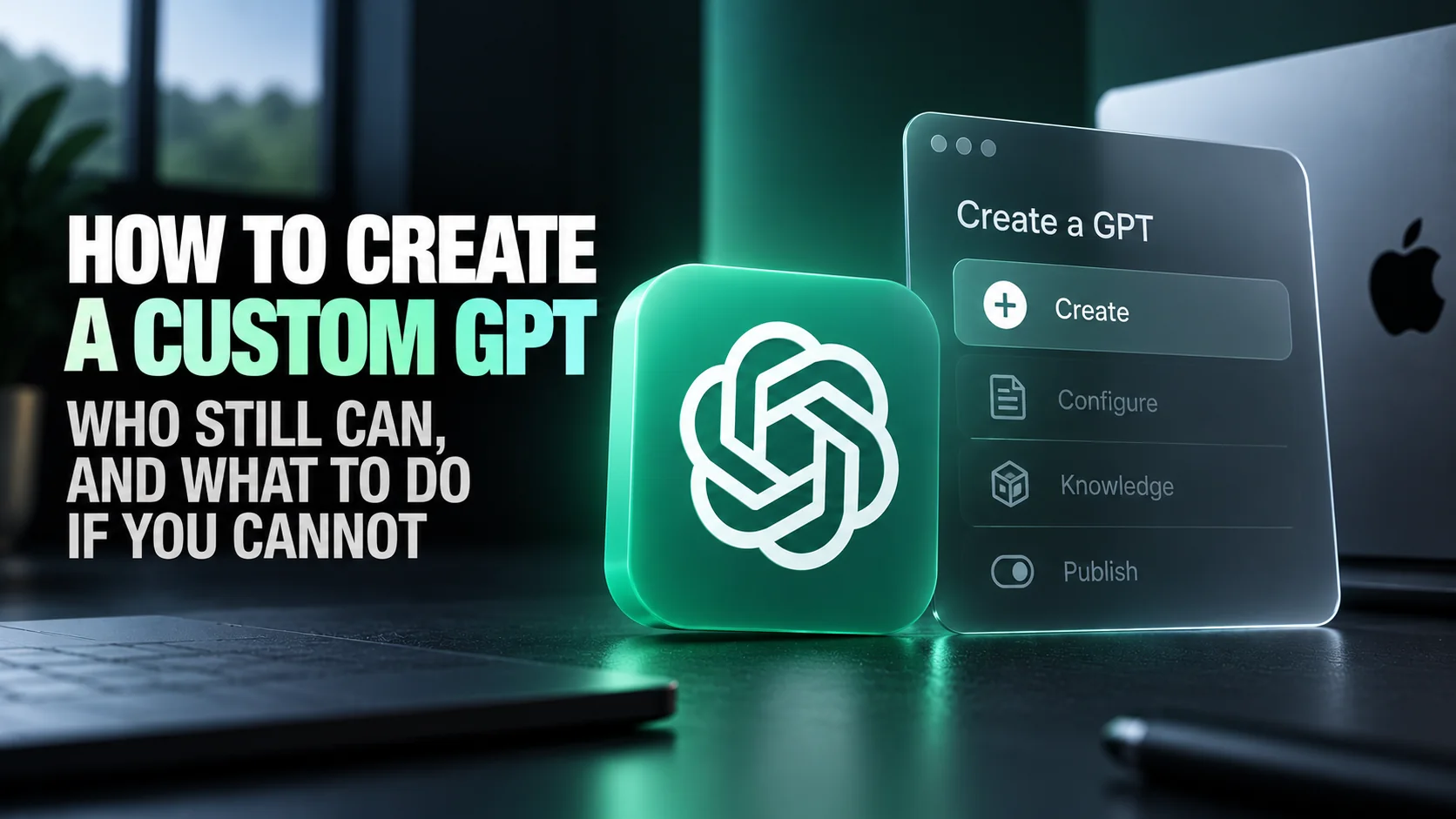
Search for how to create a custom GPT and you will find a dozen step-by-step guides that all begin the same way: open the builder, click Create, describe what you want. Every one of them is now wrong for most people reading them. OpenAI states that "new GPT creation and publishing are not available on personal ChatGPT accounts, including Free, Go, Plus, and Pro". The button those guides describe is not there any more.
Two separate changes have landed here, and most coverage blurs them together. Creation moved to managed workspaces, which is why you cannot build one. Separately, OpenAI has said it plans to retire them altogether and migrate them to plugins. This guide covers who can still create one, what one actually is, what happens to the ones that already exist, and what to use instead. Every quote comes from OpenAI's own help pages.
The Key Takeaways
- You cannot build one on a personal account: OpenAI states that new GPT creation and publishing are not available on Free, Go, Plus, and Pro. The same sentence appears on two of its help pages.
- Business, Enterprise and Edu can: those workspaces "can create, edit, and publish GPTs when their workspace settings and permissions allow it", so the answer depends on your admin, not your subscription price.
- Using GPTs is still open to everyone: once signed in you can interact with any GPT you have access to, and you can keep using and editing ones you previously created.
- Retirement is a separate change: OpenAI plans to retire custom GPTs and migrate them to plugins. The only dated milestones, 25 September and 11 December 2026, are planned dates for affected Enterprise workspaces and are subject to change.
- Custom actions do not survive migration: OpenAI states plainly that GPT custom actions do not transfer, and a migrated GPT becomes read-only, which even its creator cannot delete.
Can You Still Create a Custom GPT?
Almost certainly not, and the answer has nothing to do with how much you pay. OpenAI's documentation on creating and editing GPTs puts it without hedging: "New GPT creation and publishing are not available on personal ChatGPT accounts, including Free, Go, Plus, and Pro." That identical sentence appears on a second OpenAI help page, so it is not a stray line in one document.
| Account type | Use GPTs | Create and publish new GPTs | Edit ones you already made |
|---|---|---|---|
| Free, Go, Plus, Pro | Yes | No | Yes, where plan and permissions allow |
| Business, Enterprise, Edu | Yes | Yes, where workspace settings allow | Yes |
Note what did not change. Once you are signed in, you can interact with any GPT you have access to, whether it is public, shared with you directly or reachable through workspace settings. You can also carry on using GPTs you previously created, and edit them where your plan and permissions allow it. The wall is specifically around making and publishing new ones. If you are trying to work out which tier you are actually on, we break the plans down in what you get on the free plan and in our comparison of ChatGPT Plus versus Pro.
What a Custom GPT Actually Is
A custom GPT is a saved, reusable configuration of ChatGPT. You write the instructions once, attach any reference material, and every conversation with that GPT starts with all of it already loaded. It is the same idea Google ships as Gems, which we cover in our guide to Gemini Gems.
The parts a GPT is made of
OpenAI's own migration documentation is the clearest inventory of what a GPT contains, because it lists each part and says whether it survives the move to a plugin. Anthropic runs a parallel system on its own side, where plugins are distributed through Claude marketplaces. A GPT holds its instructions, its reference material, any connected apps, any custom actions that call an external service, a set of conversation starters, and a selected model.
Which part is the valuable one
The instructions are the asset. Everything else is either plumbing you can rebuild or a container OpenAI controls. That distinction matters more than it sounds, because the instructions are the one part that is plain text you can copy out and keep, and the one part that works just as well pasted into a different assistant.
How to Create a Custom GPT If You Are on Business, Enterprise or Edu
If you are in a managed workspace, creation is still available to you, with one condition OpenAI repeats every time it mentions the subject: workspace settings and permissions have to allow it. Your admin controls whether the builder appears at all, and whether you may publish to the GPT Store. If the option is missing from your account, that is an admin setting rather than a bug, and the fix is a conversation with whoever runs the workspace.
Building one is a configuration job rather than a coding job. You give the GPT its instructions, attach the reference files it should always have to hand, add any connected apps it needs, write conversation starters, and wire up custom actions if it has to reach an external service. Before you invest an afternoon in it, read the retirement section below, because anything you build now is being built inside a format OpenAI has already said it intends to replace.
Why the Guides You Found Are Wrong
The step-by-step guides ranking for this question were written when anyone with a paid plan could build a GPT, and most have not been touched since. They send you to a create page and describe a builder with Create and Configure tabs. On a personal account you will not get there, and at least one widely ranked guide still tells readers that custom GPTs have been made free for everyone, which inverts the current position entirely.
There is a second thing they get wrong, and it is the one that costs people time. Because the two changes landed close together, a lot of coverage treats "you cannot create one" and "custom GPTs are being retired" as the same announcement with a single deadline. OpenAI treats them as separate matters, and so should you. One is about what you can build today. The other is about what happens to what already exists.
What Happens to GPTs That Already Exist
In its ChatGPT release notes on 11 September 2026, OpenAI wrote that it is "planning to retire custom GPTs across ChatGPT plans and provide a migration path to plugins". The dates arrived in a separate support document and are scoped more narrowly than the headlines suggest.
The timeline, and who it applies to
OpenAI's retirement and migration FAQ lists four milestones for affected Enterprise workspaces: an admin notice on 11 September, a target of 17 September for the migration experience and banner, the end of new custom GPT creation on 25 September, and scheduled retirement on 11 December 2026, when GPTs stop running and leave the GPT directory. OpenAI labels these planned and says the dates are subject to change, and it calls the 17 September date a target rather than a guarantee that the option appears in every workspace.
For Free, Go, Plus and Pro, OpenAI has published no retirement date at all. It says the transition "affects all ChatGPT plans" and that other plans "are expected to follow the same timeline", with in-product notices to come. Expected is not a date. If you see a page telling Plus subscribers their GPTs die on 11 December, it is reading an Enterprise schedule and assuming it generalises.
What transfers to a plugin, and what does not
| Item | Transfers? | What to do about it |
|---|---|---|
| Instructions | Yes, as a skill inside the plugin | Keep your own copy anyway |
| Connected apps | Yes | Re-check permissions afterwards |
| Custom actions | No | Rebuild the integration by hand, and allow extra time |
| Conversation starters | May not copy | Save the wording before you migrate |
| Previous chats | May not copy | Export anything you need to keep |
| Unpublished drafts | No | Publish the GPT first, or lose the draft |
| Who had access | No, the replacement starts private | Re-share deliberately with the right people |
| The selected model | No | In Enterprise workspaces the workspace defaults apply |
Three consequences are easy to miss. After migration the original GPT becomes read-only and its creator cannot delete it. Links to the old GPT are planned to redirect to the replacement for people who already have access, and OpenAI is explicit that a redirect does not itself grant access. And permission to use someone else's GPT does not give you permission to migrate it, so if your team runs on a GPT built by someone who has since left, nobody can carry it across.
What to Use Instead
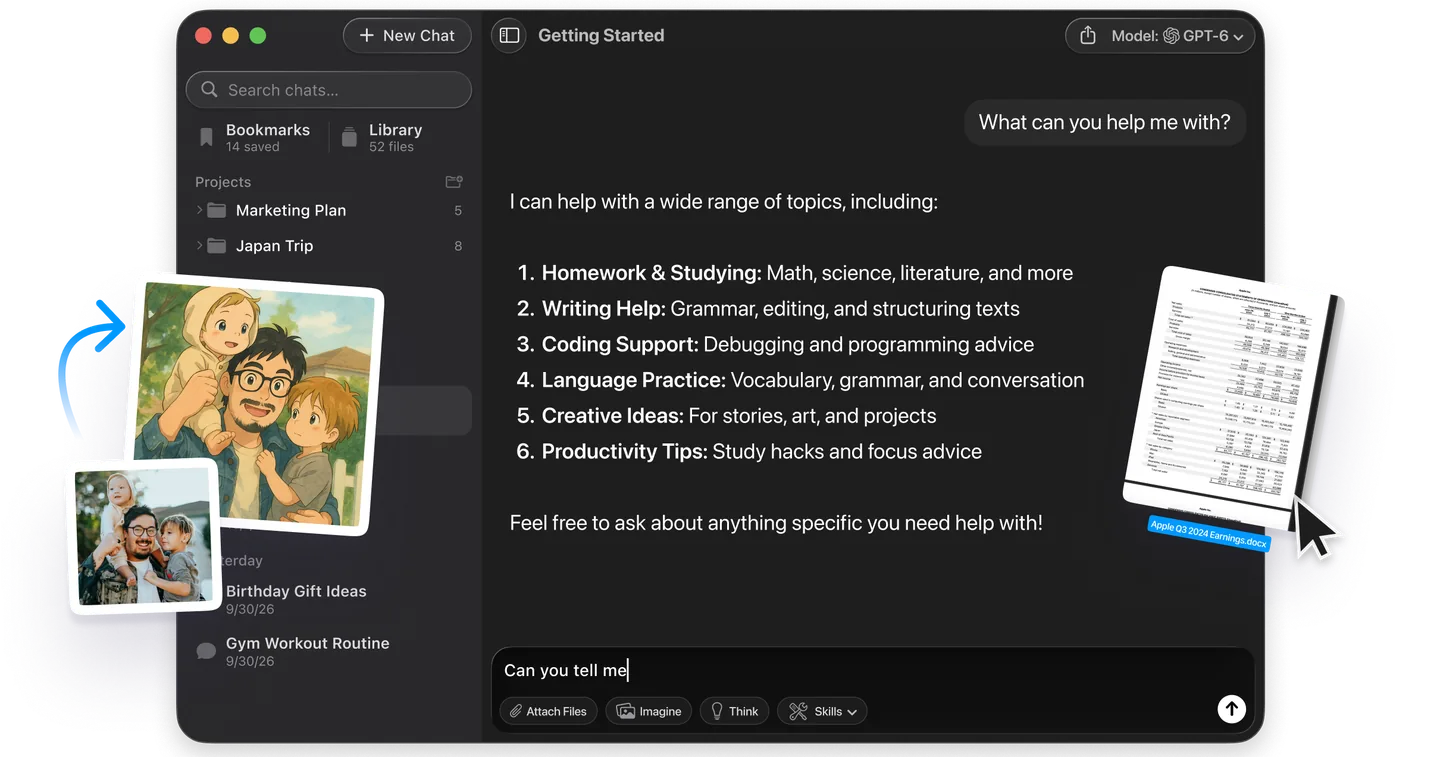
For most people on a personal plan, ChatGPT Projects is the practical answer today. A project holds files and custom instructions and keeps related chats together, which covers the most common reason anyone built a GPT: a reusable setup for recurring work. It is not identical, and one real limitation is that chats created with a GPT cannot be moved into a project. If the "Move to project" option is missing, that is the reason, and the workaround is to start a fresh chat inside the project and put your instructions in the project's own custom instructions.
The other option is to stop storing your setup inside a chatbot at all. A saved block of instructions that you paste into whichever model suits the task is less elegant than a purpose-built GPT, and it has one decisive advantage: no vendor can retire it. That is the same lesson the corpus recorded when OpenAI removed Canvas, which we covered in what replaced ChatGPT Canvas, and it sits alongside the steady stream of retirements we track in AI models discontinued in 2026. If you work across several assistants on a Mac, our comparison of the native Mac apps covers where that approach fits.
The Verdict
If you came here to build one, the honest answer is that you probably cannot, and that it would be a questionable use of an afternoon even if you could. Creation now belongs to managed workspaces, and the format itself is scheduled for replacement by plugins.
What survives all of this is the part you actually wrote. Copy your instructions and reference material out of any GPT you rely on and keep them somewhere you control. If one of them uses custom actions, start there, because that is the only piece OpenAI has confirmed will not come across.
Frequently Asked Questions
What is a custom GPT?
A saved, reusable version of ChatGPT. You write instructions once, attach reference material, and every chat with that GPT starts with all of it loaded. A GPT can also carry connected apps, custom actions that call an external service, conversation starters and a selected model.
Can free users create custom GPTs in ChatGPT?
No. OpenAI states that new GPT creation and publishing are not available on personal accounts, including Free, Go, Plus and Pro. Only Business, Enterprise and Edu workspaces can create and publish, and only where workspace settings and permissions allow it. Free users can still use GPTs they have access to.
Will my existing custom GPT stop working?
Not yet, and the published date may not be yours. Existing GPTs remain usable until their retirement date. The 11 December 2026 date is a planned, changeable milestone for affected Enterprise workspaces. OpenAI has published no retirement date for Free, Go, Plus or Pro.
Does migrating to a plugin keep my custom actions?
No. OpenAI states that GPT custom actions do not transfer through the migration workflow, and advises allowing extra time for GPTs that use them. Instructions become a skill inside the plugin and connected apps come across, but any API integration has to be rebuilt.
Can I delete a GPT after it has been migrated?
No. After migration the original remains in place but becomes read-only, and its creator cannot delete it. Links to it are planned to redirect to the replacement plugin for people who already have access.