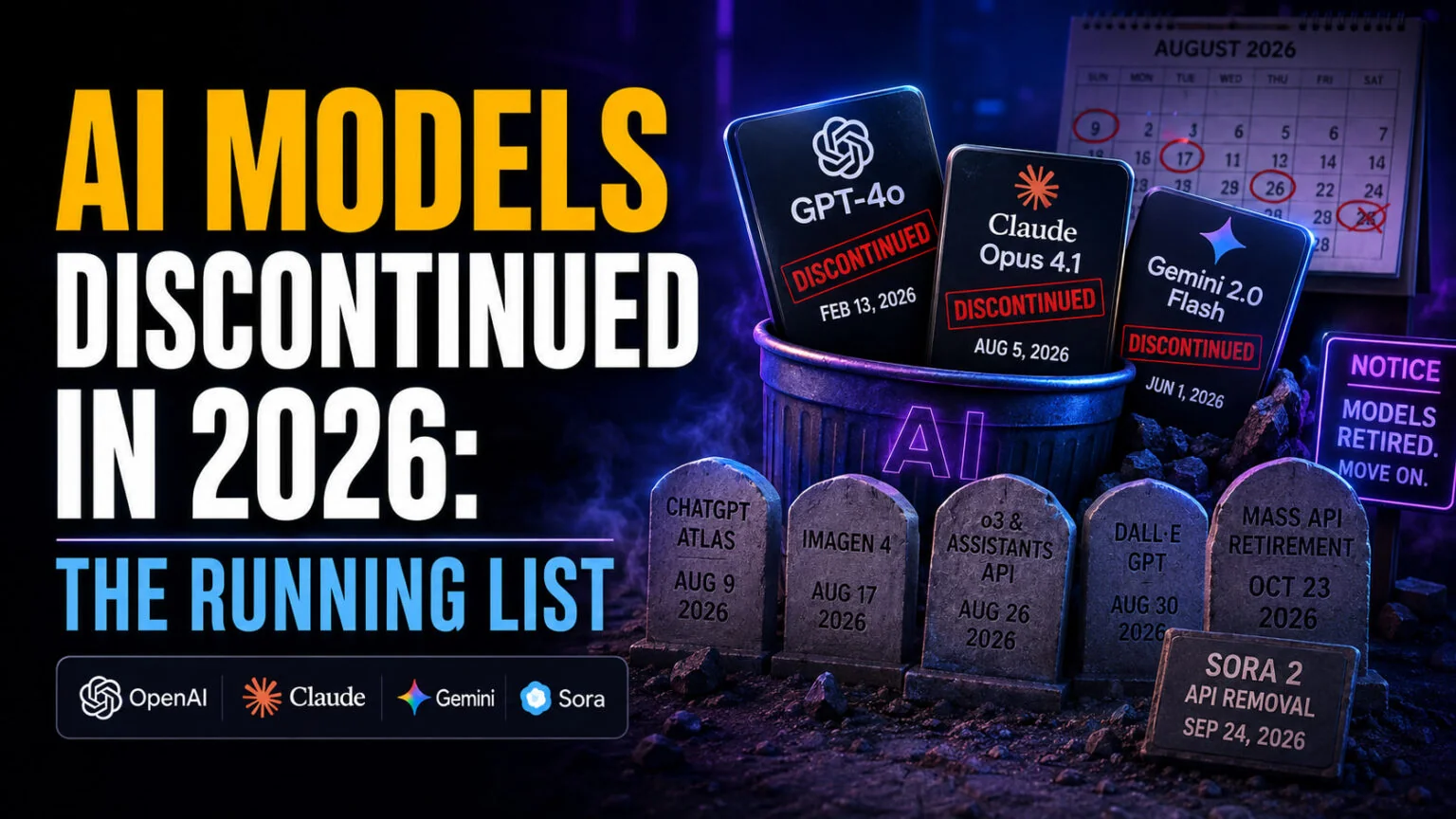
The list of AI models discontinued in 2026 is longer than most people realise, and it includes models you probably used this year. OpenAI removed GPT-4o from ChatGPT on February 13, 2026, saying only 0.1% of users chose it daily. Anthropic retired Claude Opus 4.1 on August 5, 2026. Google shut down the entire Gemini 2.0 Flash family on June 1, 2026. None of these were announced with much noise, and most people found out when something stopped working.
This page tracks all of it in one place: what has already been switched off, what disappears in the next few weeks, and what each provider says you should use instead. Every date here comes from the provider’s own deprecation documentation rather than second-hand reporting, and where the two disagree, that is called out explicitly. Last verified on September 25, 2026.
The Key Takeaways
- Five shutdowns land inside ten days. OpenAI’s legacy completion models on September 28, Google’s Gemini Omni Flash preview on September 30, gpt-5.4-cyber on October 1, gemini-2.5-flash-image on October 2 and Google’s May Antigravity agent on October 5, 2026.
- The biggest sweep is October 23, 2026, when OpenAI removes GPT-3.5 Turbo, GPT-4, GPT-4 Turbo, o1, o1-pro, o3-mini and o4-mini from the API in one go.
- Sora is now gone twice over. The app and website closed on April 26, 2026 and the API models followed on September 24, 2026. The March date everyone reported was the announcement.
- Gemini 2.5 has no announced shutdown date, but it is closed to new projects. Google’s docs say the 2.5 models are not deprecated and keep running for people who already use them, while trackers still list October 16, 2026 as fact.
- Anthropic is the only one that keeps the weights. Its notice floor is 60 days, shorter than the 6 months OpenAI now publishes for generally available models, but it stands alone in committing publicly to preserve retired models.
AI Models Discontinued From the Apps You Actually Use
Almost every deprecation tracker covers APIs only. That is useful if you write code, and useless if you are the person who opened ChatGPT one morning and found your favourite model missing from the picker. This section covers the consumer side.
GPT-4o
The one that caused real anger was GPT-4o. OpenAI retired it from ChatGPT on February 13, 2026, in an announcement titled “Retiring GPT-4o, GPT-4.1, GPT-4.1 mini, and OpenAI o4-mini in ChatGPT.” GPT-5 Instant and GPT-5 Thinking went the same day under a separate, earlier notice. The company’s stated justification was that only 0.1% of users chose GPT-4o on a daily basis, with most usage having moved to GPT-5.2.
Users disagreed loudly. A #Keep4o campaign spread across Reddit and X within days, and a Change.org petition gathered more than 20,000 signatures, echoing the backlash when OpenAI first pulled 4o at the GPT-5 launch in 2025 and then restored it. This time it stayed gone. Conversation history involving the retired models remained viewable, but no new responses could be generated from them. Crucially, the API was unaffected at the time, which is a pattern worth internalising: the same model can vanish from ChatGPT months before it leaves the API. If you kept a workflow tied to that model, our guide on how people kept using GPT-4o after GPT-5 shipped explains why those workarounds no longer apply.
GPT-4.5, o3, DALL·E GPT
Three more removals have now landed. GPT-4.5 left ChatGPT in late June 2026. o3 left on August 26, 2026 after a 90 day sunset, and that change applies to ChatGPT only, not the API, where o3 survives until December 11. The official DALL·E GPT was retired on August 30, 2026, announced on July 31. Image generation itself did not go away: it moved to ChatGPT Images, which is available on every tier including free accounts, and custom GPTs with image generation switched on are unaffected by that particular change. The format itself is a separate case: OpenAI has since said it plans to retire custom GPTs and migrate them to plugins. OpenAI advised downloading anything you wanted to keep before the cutoff. If you are picking a replacement, our breakdown of the current ChatGPT image generator covers what changed.
ChatGPT Atlas
ChatGPT Atlas is the odd one out because it is not a model at all. OpenAI announced on July 9 that the browser would stop working, and it went dark on August 9, 2026, roughly eight months after launch. Bookmarks have to be exported manually as an HTML file. Open tabs, browsing history and login sessions do not transfer at all, though your ChatGPT conversations are stored separately and survive. We covered the migration options in detail in our roundup of what to use instead of ChatGPT Atlas.
Sora
Sora is the most consumer-visible shutdown of the year and the one reported wrong most often, because it happened in three stages. OpenAI announced the deprecation on March 24, 2026, switched off the app and the website on April 26, 2026, and removed sora-2, sora-2-pro and the Videos API from the API on September 24, 2026. Three dates for one product is why you can still find pages selling Sora as a ChatGPT Plus feature months after there was nothing to sell. We covered what closed and what was left behind in our account of the Sora shutdown.
Discontinued AI Models At Glance
| What | Date | Replacement |
|---|---|---|
| GPT-4o, GPT-4.1, GPT-4.1 mini, o4-mini | February 13, 2026 | GPT-5 line |
| Sora app and website | April 26, 2026 | None |
| GPT-4.5 | Late June 2026 | GPT-5 line |
| ChatGPT Atlas | August 9, 2026 | ChatGPT desktop app, Chrome extension |
| o3 | August 26, 2026 | GPT-5.6 line |
| DALL·E GPT | August 30, 2026 | ChatGPT Images |
| Sora 2, Sora 2 Pro, Videos API | September 24, 2026 | None listed |
What Shuts Down in the Next 90 Days
This is the section worth bookmarking. As of September 25, 2026 the next ninety days hold ten separate shutdowns across all three providers, and five of them land inside ten days. Sora 2 and the Videos API went on September 24. Next is OpenAI’s legacy completion family on September 28, and the largest by a wide margin is October 23.
| Date | What goes | Provider | Replacement |
|---|---|---|---|
| September 28 | gpt-3.5-turbo-instruct, babbage-002, davinci-002, gpt-3.5-turbo-1106 | OpenAI | gpt-5.6-terra |
| September 30 | gemini-omni-flash-preview | gemini-omni-1.1-flash | |
| October 1 | gpt-5.4-cyber | OpenAI | gpt-5.6-cyber |
| October 2 | gemini-2.5-flash-image | gemini-3.1-flash-image-preview | |
| October 5 | antigravity-preview-05-2026 (managed agent) | antigravity-preview-09-2026 | |
| October 23 | GPT-3.5 Turbo, GPT-4, GPT-4 Turbo, gpt-image-1, o1, o1-pro, o3-mini, o4-mini | OpenAI | gpt-5.6 line, gpt-image-2 |
| October 31 | Existing evals become read-only | OpenAI | External eval tooling |
| November 30 | Reusable prompts, Evals dashboard and API, Agent Builder | OpenAI | Agents SDK, ChatKit |
| December 1 | gpt-image-1-mini, gpt-image-1.5, chatgpt-image-latest | OpenAI | gpt-image-2 |
| December 11 | Older GPT-5 snapshots, o3, o3-pro | OpenAI | gpt-5.6 line |
The Sora 2 removal that fired on September 24 is worth one more look, because OpenAI listed no replacement at all for it or the Videos API. That is unusual. Every other deprecation on OpenAI’s list points at a substitute model. Anyone still on Sora 2 had no official migration path, and our comparison of Sora 2 against Veo 3 is a reasonable starting point for finding an alternative elsewhere.
AI Models Discontinued From the APIs Later in 2026
The calendar above stops at ninety days. Here is the rest of the year by provider, with the detail a date column cannot carry, taken from each company’s deprecation documentation.
OpenAI
October 23, 2026 is the single largest cull of the year. It removes gpt-3.5-turbo, gpt-4, gpt-4-turbo, gpt-4-1106-preview, gpt-4.1-nano, the gpt-4o-2024-05-13 snapshot, gpt-image-1, o1, o1-pro, o3-mini and o4-mini, along with fine-tuned versions built on several of those bases. A great deal of production code written between 2023 and 2025 stops working that day.
After that the pace holds. Evals become read-only on October 31, then reusable prompts, the Evals dashboard and Agent Builder all shut down on November 30. On December 1, gpt-image-1-mini, gpt-image-1.5 and chatgpt-image-latest give way to gpt-image-2. The older GPT-5 snapshots plus o3 and o3-pro go on December 11, and the legacy audio, realtime and transcription families follow on January 20, 2027. A separate notice on August 26 put whisper-1, gpt-4o-transcribe, gpt-4o-mini-transcribe and gpt-4o-transcribe-diarize on February 26, 2027, replaced by gpt-transcribe and gpt-live-transcribe. Full details are in OpenAI’s deprecations documentation.
Anthropic
Most of Anthropic’s 2026 retirements are already behind us. Claude Opus 3 went in January, Claude Sonnet 3.7 and Claude 3.5 Haiku in February, and Claude 3 Haiku in April. Claude Sonnet 4 and Claude Opus 4 followed in June, and Claude Opus 4.1 on August 5. The next firm date arrived on September 30, 2026, when Anthropic deprecated Claude Sonnet 4.5 and set its retirement on the Claude API for November 30, 2026, naming Claude Sonnet 5.5 as the replacement. Claude Mythos Preview is also marked deprecated, with no date published yet. The labelling has moved as well, and Anthropic’s two pages disagree with each other: the models overview lists Claude Fable 5, Claude Opus 5, Claude Opus 4.5 through 4.8, Claude Sonnet 5, Claude Sonnet 4.6 and Claude Haiku 4.5 under “Legacy models (still available),” while the deprecations table records all nine of them as Active. By Anthropic’s own definitions those are different states, so treat the overview as the better guide to what it still recommends.
For every active model, Anthropic publishes a floor instead. Claude Sonnet 4.5’s floor was September 29, 2026, and its deprecation notice came the next day. The nearest floor now is Claude Haiku 4.5 at October 15, 2026, eight days after Claude Haiku 5.5 replaced it in the lineup, then Claude Opus 4.5 at November 24, 2026. The rest run into 2027: Claude Opus 5 not sooner than July 24, 2027, Claude Sonnet 5 not sooner than June 30, 2027, Claude Fable 5.1 and Claude Mythos 5.1 not sooner than September 1, 2027, the current flagship Claude Opus 5.5 not sooner than September 22, 2027, Claude Sonnet 5.5 not sooner than September 28, 2027, and Claude Haiku 5.5 not sooner than October 7, 2027. These are guarantees of minimum life rather than scheduled deaths, which is a meaningfully friendlier way to run a lifecycle. The current lineup and its dates are listed in Anthropic’s model deprecations page, and if you are weighing up a move, our writeup of Claude Opus 5.5 covers where the line stands today.
Google frames all of this differently from its rivals, and the difference matters before you read a single date. Its documentation states plainly that published shutdown dates “indicate the earliest possible dates on which a model might be retired,” with exact dates communicated later. Every Google date below is a floor rather than a deadline.
With that caveat: the Gemini 2.0 Flash family carried June 1, 2026, Veo 2.0 and Veo 3.0 carried June 30, 2026 and Imagen 4 carried August 17, 2026, all now passed. Ahead are gemini-omni-flash-preview on September 30, gemini-2.5-flash-image on October 2, the May Antigravity agent on October 5 and gemini-3.1-flash-lite on May 7, 2027. Google has also started using a softer measure than deprecation. The Gemini 2.5 models are not deprecated and have no shutdown date, but access is now limited to projects that have already used them, and new work is pointed at Gemini 3.5 Flash-Lite or Gemini 3.8 Flash. The full table lives in Google’s Gemini deprecations documentation.
Three Dates Most Trackers Get Wrong
This topic is unusually prone to bad information, because one aggregator’s error gets copied everywhere within days. Three claims are circulating widely that the primary sources do not support.
Sora did not shut down in March 2026, and it did not shut down all at once. OpenAI announced the deprecation on March 24, closed the app and the website on April 26, and removed the API models on September 24. The announcement date got reported as the shutdown date, so Sora was described as dead for a month while it was still running, and then described as a live ChatGPT feature for five months after the app had gone.
The whole o-series does not die on October 23. That date covers o1, o1-pro, o3-mini and o4-mini. Full o3 and o3-pro shut down on December 11, 2026, under a separate announcement. The two are frequently merged into one sentence.
Gemini 2.5 has no announced shutdown date. Several trackers list October 16, 2026 as a firm retirement date for Gemini 2.5 Pro and Flash. Google’s Gemini API deprecations page lists all three 2.5 models as “No shutdown date announced.” The October date appears to come from notices sent to Gemini Enterprise Agent Platform customers, a different product surface from the Gemini API. Even in those notices Google framed it as “no earlier than,” saying a confirmed date would be set once Gemini 3 reached general availability, with at least six months of warning after that. Google has since gone further and added a note that the 2.5 models are not deprecated at all and will be served until further notice, but only for projects that have already used them. If you are planning a migration, plan it against Google’s published documentation, not the trackers.
How Much Warning Each Company Gives You
The retirement policies differ more than the dates do, and the differences tell you something about how safe it is to build on each platform.
| Provider | Minimum notice | Consumer app vs API | Weights preserved? |
|---|---|---|---|
| Anthropic | At least 60 days for public models | Published dates cover the API | Yes, committed publicly |
| OpenAI | At least 6 months for generally available models, 3 months for chat, Codex and deep-research variants, as little as 2 weeks for previews | Separate schedules, often different dates for the same model | No public commitment |
| Publishes “earliest possible” dates, exact date confirmed later | Published dates cover the API | No public commitment |
Anthropic is the only one of the three that has publicly committed to preserving retired model weights. Its documentation goes further still, acknowledging the downsides of retirement, including the loss of access for researchers running comparative studies. OpenAI’s split between ChatGPT and API schedules is the detail that catches most people out. Take o3: gone from ChatGPT on August 26, still available through the API until December 11. One model, two clocks.
What To Do When Your AI Model Is Discontinued
There is a practical checklist here, and it is short.
Export anything stored inside the product before the date, because chat history, generated images and bookmarks are frequently not migrated. Check whether the replacement costs more, because it often does. Google now points new Gemini work at Gemini 3.5 Flash-Lite or Gemini 3.8 Flash, which lists at $0.75 input and $3.75 output per million tokens. Gemini 2.5 Flash cost $0.30 and $2.50. That is two and a half times the input price and one and a half times the output for the same job, and the Flash rate is introductory: it doubles to $1.50 and $7.50 on January 1, 2027, which takes the gap to five times input. Test the replacement on your actual work rather than trusting the substitution table, because a recommended replacement is a routing decision, not a promise of identical behaviour. And if a specific model’s tone or output style is the thing you care about, accept that you will have to re-tune your prompts.
The broader lesson is harder to act on but more valuable. Every model you rely on has a retirement date, whether or not it has been published yet. The people least disrupted by all of this are the ones who never depended on a single provider. Having ChatGPT, Claude, Gemini and several open alternatives in one place turns a shutdown into an inconvenience rather than a migration project. That is the entire premise behind running every major AI model from one Mac app. Our guide on picking the right AI model for each task is a good place to work out your fallbacks. And open-weight models deserve a look precisely because nobody can switch them off remotely.
The Bottom Line
Well over a hundred models, snapshots and products were retired or scheduled for retirement across OpenAI, Anthropic and Google during 2026, and the pace is increasing rather than levelling off. The useful response is not to track every date, but to stop building anything important on a single model. Check this page before you plan a migration, verify against the provider’s own documentation rather than a tracker, and keep a working alternative for every model you depend on. We update this list as new shutdown dates are announced.
FAQ
Is DALL·E discontinued?
Yes. OpenAI shut down the DALL·E 2 and DALL·E 3 API models on May 12, 2026, and the official DALL·E GPT was retired from ChatGPT on August 30, 2026. Image generation is not going away. It moves to ChatGPT Images, which runs on OpenAI’s newer gpt-image models and is available on every tier, including free accounts.
Is Sora discontinued?
Yes, completely, and in two stages. OpenAI closed the Sora app and website on April 26, 2026, then removed sora-2, sora-2-pro and the Videos API on September 24, 2026. It is the only entry on OpenAI’s deprecation list with no recommended replacement at all, so there is no official migration path for either users or developers.
Why did GPT-4o disappear from ChatGPT?
OpenAI retired it on February 13, 2026, saying only 0.1% of users chose GPT-4o on a daily basis. It went alongside GPT-4.1, GPT-4.1 mini and o4-mini. The removal prompted a #Keep4o campaign from users who preferred its warmer tone, but unlike the 2025 removal, this one was not reversed.
What is the difference between deprecated and retired?
A deprecated model still works but is no longer recommended, and it has been given a retirement date. A retired model is switched off completely, and requests to it fail. Anthropic also uses “legacy” for models that no longer receive updates but have not yet been given a date.
Are replacement models always cheaper?
No, and this catches people out. Replacements are chosen for capability rather than price. Google’s recommended successor to Gemini 2.5 Flash costs significantly more per million tokens, so a forced migration can raise your bill even when your usage stays flat. Check the pricing before you switch, not after.
Can I keep using a discontinued AI model?
Not on the provider’s platform. Once a model is retired, the endpoint is gone and requests fail. The only models you can keep running indefinitely are open-weight ones you host yourself, which is a large part of their appeal for anyone who needs long-term reproducibility.