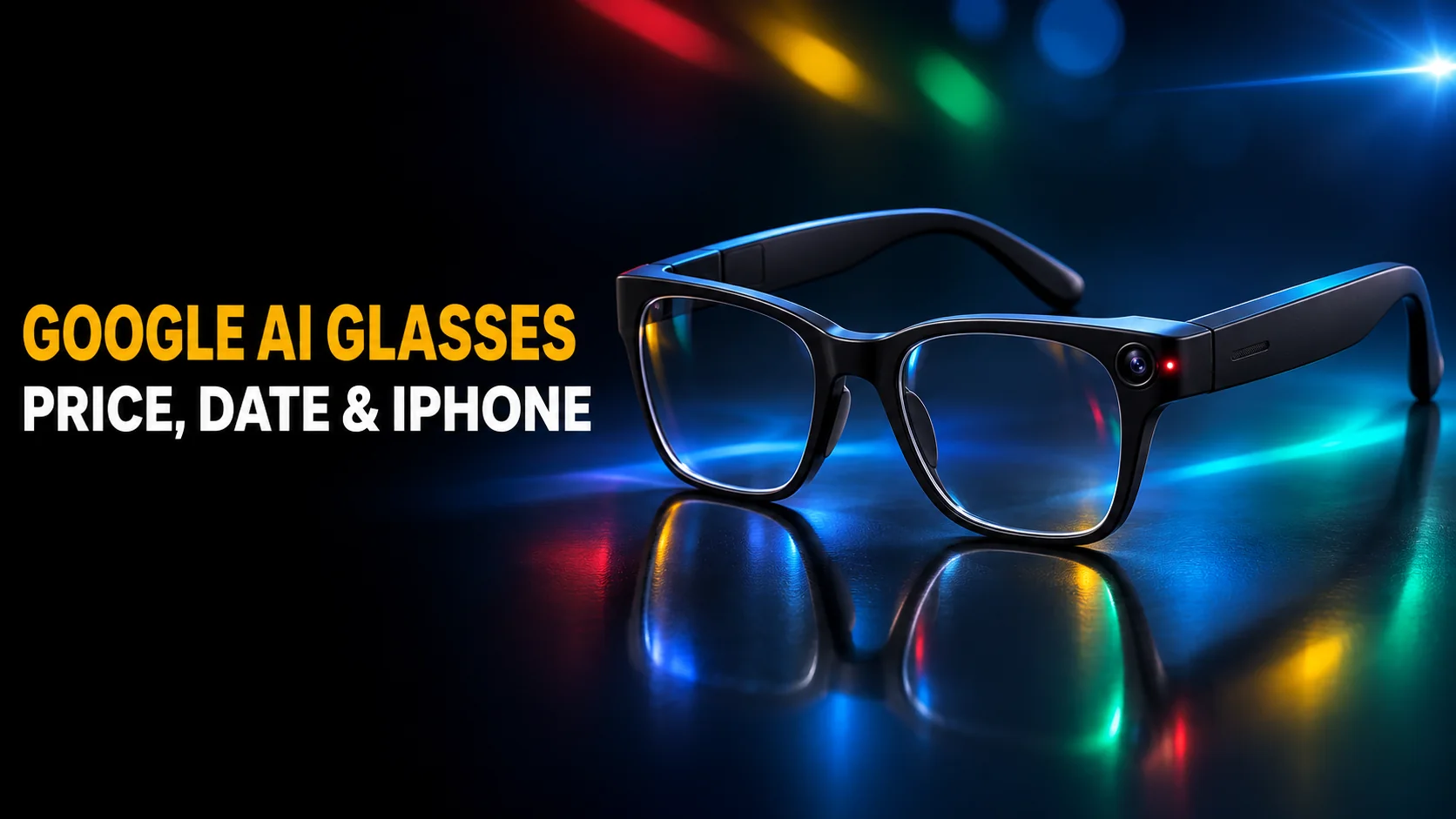
Google AI glasses are open for pre-order. Sold as Intelligent Eyewear, they start at $395 for Warby Parker frames and $449 for Gentle Monster frames, and they reach stores and online on 10 December 2026. They only work with Google accounts from the United States and South Korea. Samsung builds the hardware, Gemini runs the software, and the glasses pair with an iPhone as well as with Pixel and Galaxy phones.
That last sentence hides most of what a buyer needs to know. Google's own footnotes say several headline features are Android-only at launch, and Google's two official pages list different iPhones. This guide covers the price of every collection, the release date and where to buy, and what Gemini actually does on your face. It then shows exactly which iPhones work and what iPhone owners give up. The last sections cover how Google handles the camera and how the glasses compare with Ray-Ban Meta and Apple's rumoured 2027 glasses.
The Key Takeaways
- Price: from $395 (Warby Parker) and $449 (Gentle Monster), before prescription or lens upgrades. Both brands use the same Samsung-built hardware.
- Release date: pre-orders opened on 12 November 2026; the glasses go on sale in stores and online on 10 December 2026. They need a Google account from the US or South Korea, held by someone 18 or older.
- iPhone: supported, but Google's launch post says iPhone 13 Pro and above while its FAQ says iPhone 13 and later with at least 6GB of RAM on iOS 26.6 or later. Guided Vision, Aira and Audible are Android-only at launch.
- Hardware: no display. A 12MP camera, open-ear speakers, a "Hey Gemini" hotword, around 41 grams and up to 9 hours of battery, with a case that recharges them up to seven times.
- Privacy: images Gemini uses are not saved to Gemini History or used for training or ads, the glasses are designed to redact bystanders' faces first, and an LED lights up whenever you record.
Google AI Glasses at a Glance
Google AI glasses are audio glasses with a camera. They have no screen, Gemini talks to you through open-ear speakers, and your phone does the heavy processing. Every frame from both brands carries the same hardware, so the table below applies to all of them. The specifications come from Google's Intelligent Eyewear page and its launch post, as of 12 November 2026.
| Spec | Google AI glasses (Intelligent Eyewear) |
|---|---|
| Made by | Google (software and Gemini), Samsung (hardware), Warby Parker and Gentle Monster (frames) |
| Price | From $395 (Warby Parker), from $449 (Gentle Monster) |
| Pre-orders | 12 November 2026 |
| In stores and online | 10 December 2026 |
| Countries | United States and South Korea Google accounts only, 18+ |
| Phones | Pixel 7 and newer (Android 17 September 2026 update), Galaxy S, S FE, Z Fold and Flip phones on One UI 9.0+, iPhone (see the iPhone section) |
| Display | None, audio only |
| Camera | 12MP ultra-wide, HDR, stabilisation, video up to 3K |
| Battery | Up to 9 hours; the charging case recharges the glasses up to 7 times |
| Weight | Around 41 grams |
| Water resistance | IPX4 (splashes, light rain, sweat) |
| Controls | "Hey Gemini" hotword, touchpad on the right stem, capture button, power switch |
How Much Are Google AI Glasses?
Google AI glasses start at $395 from Warby Parker and $449 from Gentle Monster. AppleInsider notes that every pair is the same under the hood, so the $54 gap buys a different frame, not different features. Those are starting prices: Android Authority's hands-on lists both figures "before lens upgrades", so prescription or tinted lenses push the total higher.
Warby Parker Intelligent Eyewear
Warby Parker sells three styles, Alden, Reid and Wren, in optical or sun versions and in Pine, Saddle and Jet Black. Google says the line comes with "a wide range of prescription, width, and lens options", and that you can book a guided demo at more than 360 Warby Parker stores. Warby Parker announced its pre-orders with this post:
The wait is over. Preorder your Intelligent Eyewear with Google Gemini, starting now. https://warby.me/4fuuzub
— Warby Parker (@WarbyParker) November 12, 2026
Our collection features three frame styles—Alden, Reid, and Wren—inspired by our most recognizable and beloved silhouettes. The frames bring together lightweight comfort and integrated technology, designed for all-day, everyday wear.
Gentle Monster Intelligent Eyewear
Gentle Monster sells six bolder designs in colours that include dark red, pink, gray and yellow, with tinted, clear, blue or brown lenses. Google says prescription lenses are available for most of the frames. The Gentle Monster collection starts at $449 and is sold in the United States and South Korea.
Try Google AI Glasses On Before You Pay
Fit matters more than usual with Google AI glasses. The electronics sit inside the stems, so an optician can't warm and bend them the way they would on plastic frames. Android Authority puts it plainly: "You can't adjust Intelligent Eyewear stems at all." A pair that doesn't fit has to go back for another size or style. Both brands offer virtual try-on online, but a store demo is the safer way to choose.
Google AI Glasses Release Date and Where to Buy
Google AI glasses go on sale in stores and online on 10 December 2026. Pre-orders opened on 12 November 2026, online and in store at Warby Parker and Gentle Monster. Google says hands-on demos run at select Warby Parker, Gentle Monster and Google Store locations. The full announcement is in Google's pre-order post.
Two account rules decide whether you can use a pair at all. Google's footnotes say the glasses only work with Google accounts from the United States and South Korea, and they need a compatible Google account belonging to someone 18 or older. A buyer outside those two countries can't simply import a pair and sign in.
Google's Gemini account announced the pre-orders with the same examples Google uses in its launch post, quoting Android's announcement:
Keep your eyes up and your day moving with Gemini on intelligent eyewear.
— Google Gemini (@GeminiApp) November 12, 2026
Just say "Hey Gemini" to explore street art, get book recs from the shelf ahead, translate in real time, or check your calendar on the spot.
Explore the new intelligent eyewear collections and pre-order your pair today: https://goo.gle/IntelligentEyewear
What Google AI Glasses Can Do
Google AI glasses do five jobs: answer questions about what you are looking at, give spoken walking directions, translate speech, handle calls and messages, and take photos and video. Gemini runs all of them, and you start it by saying "Hey Gemini" or tapping the frame.
Look and Ask Gemini
The camera lets Gemini answer questions about the world in front of you. Google's examples include learning the story behind a street mural, getting a recommendation from a bookshop shelf, and checking your calendar against an event poster. Gemini can also add what you are looking at to a grocery list. You have to make the request explicit, though. In Android Authority's demo, "what is this thing?" got a reply that Gemini didn't know what it was looking at. Google explained that the right prompt was "Hey Gemini, look at this thing and tell me what it is." 9to5Google reports that Gemini asks a follow-up question first when a request doesn't clearly need the camera.
Directions, Translation and Calls
Google Maps reads turn-by-turn directions into your ear, and Google Translate translates speech in more than 70 languages. Each needs its app installed on your phone. Android Authority adds a limit: the glasses translate the other person to you, but they won't translate your own voice back. You can also hear and reply to messages and take calls hands-free.
Photos, Video and Music
A button on the right stem takes a 12MP photo, and Google's spec page says the camera shoots video up to 3K. 9to5Google reports that each video clip is capped at 90 seconds, that photos move to your phone straight away, and that videos wait until the glasses are charging. You can play anything from your phone through the speakers. Android Authority reports that Gemini voice control works with four apps at launch: YouTube Music, Spotify, Apple Music and Audible.
"Hey Gemini" Commands to Try
These prompts come from Google's own Intelligent Eyewear page, so they are a fair test of what the glasses were built to handle:
| Job | Say |
|---|---|
| Identify something | "Hey Gemini, what kind of plant is this and why are its leaf tips turning yellow?" |
| Get around | "Hey Gemini, do any of these bus lines go to Chelsea Market?" |
| Order abroad | "Hey Gemini, how do I say 'I'll take the vegetable soup' in Spanish?" |
| Read a sign | "Hey Gemini, translate this sign." |
| Catch up | "Hey Gemini, catch me up on the group chat." |
| Check your calendar | "Hey Gemini, am I free to go to this concert?" |
| Set a reminder | "Hey Gemini, set a reminder to pick up the birthday cake Thursday at 4:30pm." |
Do Google AI Glasses Work With iPhone?
Yes. Google AI glasses work with iPhone through Google's Glasses companion app, but not every iPhone qualifies, and several features are Android-only at launch.
Which iPhones Work
Google gives two answers. The launch post's footnote says "iPhone 13 Pro and above". The FAQ on Google's Intelligent Eyewear page says "iPhone 13 and later (min 6GB RAM) running iOS 26.6 or later". 9to5Google and Android Police both report iPhone 13 Pro or newer, while Android Authority wrote "iPhone 13 or later".
The safe reading combines the two: an iPhone 13 Pro or newer, on iOS 26.6 or later, with at least 6GB of RAM. Google doesn't translate the 6GB floor into model names.
If you own a standard iPhone 13 or 13 mini, confirm compatibility at the store or in the Glasses app before you pre-order.
What Works on iPhone
9to5Google reports that the glasses carry Made for iPhone certification, which lets them use Wi-Fi Aware for fast transfers. On iOS, the Glasses app handles photo processing and saves photos and videos to Apple Photos. Gemini can make calls, send one-to-one messages, including iMessage, and receive notifications. Apple Music is one of the four apps Gemini can control by voice.
What iPhone Owners Don't Get at Launch
| Feature | On iPhone at launch | Source |
|---|---|---|
| Guided Vision and Aira | Not available. Both are "only available when paired with a compatible Android phone" at launch, and Aira may need a subscription | Google's launch post |
| Audible | Not available; Android only at launch | Google's launch post |
| Uber ride status | Not yet; "arriving on iPhones later" | Android Authority |
| Watch gestures | Pixel Watch and Galaxy Watch are named, Fitbit Air next year; Apple Watch is not mentioned | 9to5Google |
For an iPhone owner, that is the real trade. The camera, Gemini, calls, directions and translation all work. The accessibility features Google highlights in its launch post do not, yet.
What Google AI Glasses Don't Do
Google AI glasses have no screen, depend on a phone, and are not built for sport. Each limit matters for a different buyer.
No display. Everything comes through the speakers. Android Authority reports that Google is still working on display glasses, which "won't ship this year and have no firm launch window."
A phone has to stay nearby. Google's FAQ says the glasses need a Bluetooth connection to your phone for Gemini questions about your surroundings and for streaming. Volume, battery checks and taking a photo work without it.
Splash-proof, not sport-proof. The IPX4 rating covers splashes, light rain and sweat. Google says the glasses are "not intended for extreme environments or high-impact sports."
Guided Vision is not a mobility aid. Google's footnote says it "can make mistakes" and is not meant for navigation, obstacle detection or other safety-critical tasks.
Google AI Glasses Privacy: What Google Keeps and What It Doesn't
Google says the images Gemini sees through the glasses are not saved in your Gemini History and are not used to train AI models or target ads. The details are in Google's privacy post for intelligent eyewear, and they split into three parts.
What Google Doesn't Keep
When you ask Gemini about something in front of you, the camera image answers the question and is then gone. 9to5Google reports that these captures are deleted immediately after use and that this is not a setting you can change. Data stored on the glasses is encrypted, and so is data on its way to your phone or the cloud. Before any app can use the camera for the first time, it has to ask your permission.
What Google Does Keep
Two things are saved. Photos and videos you choose to take go to your gallery; on iPhone, 9to5Google says that is Apple Photos. Your conversations with Gemini are saved in Gemini History, which you can review or delete. Google also says a setting controls whether the text of your chats is used to improve its AI models. Check it during setup if you don't want that. Our guide on how to stop AI from training on your data covers the same switch across other assistants.
What Protects the People Around You
An outward-facing light shows when you take a photo or video, and Google says the glasses stop recording if that light is covered or tampered with. Before Gemini sees an image, the glasses are designed to redact the faces of bystanders; 9to5Google reports that this happens on your phone. Gemini is also tuned to listen to your voice rather than the people around you. Before first use, wearers must agree not to record people without permission, not to record in sensitive places and not to cover the light. Google says breaking those rules can get the glasses disabled.
Google AI Glasses vs Meta Ray-Ban vs Apple Glasses
Google AI glasses land in the middle of Meta's Ray-Ban range on price and arrive about a year before Apple's. On 12 November 2026, Meta's US store listed Ray-Ban Meta Audio from $349, Ray-Ban Meta (Gen 2) from $379 and Ray-Ban Meta (Gen 3) from $449. Apple hasn't announced any glasses. Bloomberg's Mark Gurman reported in July 2026 that Apple is aiming to unveil its first AI glasses at WWDC 2027, with the glasses on sale by the end of 2027.
| Google AI glasses | Ray-Ban Meta | Apple AI glasses (rumoured) | |
|---|---|---|---|
| Starting price | $395 | $349 (Audio), $379 (Gen 2), $449 (Gen 3) | Not announced |
| Available | 10 December 2026, US and South Korea | On sale now | Reveal at WWDC 2027, on sale by end of 2027 (reported) |
| Assistant | Gemini | Meta AI | Not announced |
| Display | No | No (Meta sells a separate Meta Ray-Ban Display model) | Not announced |
| Longest video clip | 90 seconds, per 9to5Google | Up to 5 minutes, per 9to5Google | Not announced |
The Apple column is the one that changes buying decisions for iPhone owners. Gurman's report says Apple is still debating how the camera should work, so even the basic shape of Apple's glasses is open. Our Apple AI glasses guide tracks every reported detail, and Android XR glasses vs Apple AI glasses compares the two platforms' strategies.
Should You Buy Google AI Glasses or Wait?
Buy Google AI glasses if you already live in Google's apps, have a supported phone and want hands-free help from a camera and an assistant. Wait if you are an iPhone owner who wanted the accessibility features, if you need a display, or if you would rather see what Apple shows at WWDC 2027.
The strongest case is a Pixel or Galaxy owner who uses Maps, Calendar and Translate every day: every feature works for them on day one. An iPhone owner gets the camera, Gemini, calls and directions, but pays the full price for a version with three features missing, and Google hasn't given a date for them. A week after a 30-minute demo, Android Authority's reviewer still couldn't "name one task Intelligent Eyewear handles that my phone, smartwatch, and earbuds can't already do". That is the question to answer before spending $395.
If what you actually want is Gemini's answers rather than a camera on your face, you already have them. Fello AI puts Gemini next to ChatGPT and Claude in one Mac and iPhone app. You can check one model's answer against another without buying hardware or a second subscription. Our comparison of the Gemini app for Mac and our list of the best AI apps for iPhone cover the rest.
FAQ
Do Google AI glasses have a display?
No. Google AI glasses are audio-only: Gemini talks to you through open-ear speakers. Android Authority reports that display glasses are still in development, with no firm launch window.
Do Google AI glasses need a phone?
Yes, for most features. Google says the glasses need a Bluetooth connection to your phone to ask Gemini about your surroundings or to stream media. Volume, battery checks and taking a photo work without it.
Can you get Google AI glasses with prescription lenses?
Yes. Warby Parker offers prescription, width and lens options on its three styles, and Gentle Monster offers prescription lenses on most of its six frames. You add your prescription on the brand's product page, and it raises the price above the $395 or $449 starting point.
Are Google AI glasses waterproof?
No, they are water-resistant. The IPX4 rating protects against splashes, light rain and sweat, and Google says they are not meant for extreme environments or high-impact sports.
Are Google AI glasses the same as Google Glass?
No. Google Glass debuted in 2012 as Project Glass. Intelligent Eyewear is a new product line: audio-only glasses built by Samsung into Warby Parker and Gentle Monster frames, with Gemini as the assistant and a "Hey Gemini" hotword.
Úvodní obrázek k tomuto článku vznikl s pomocí AI.