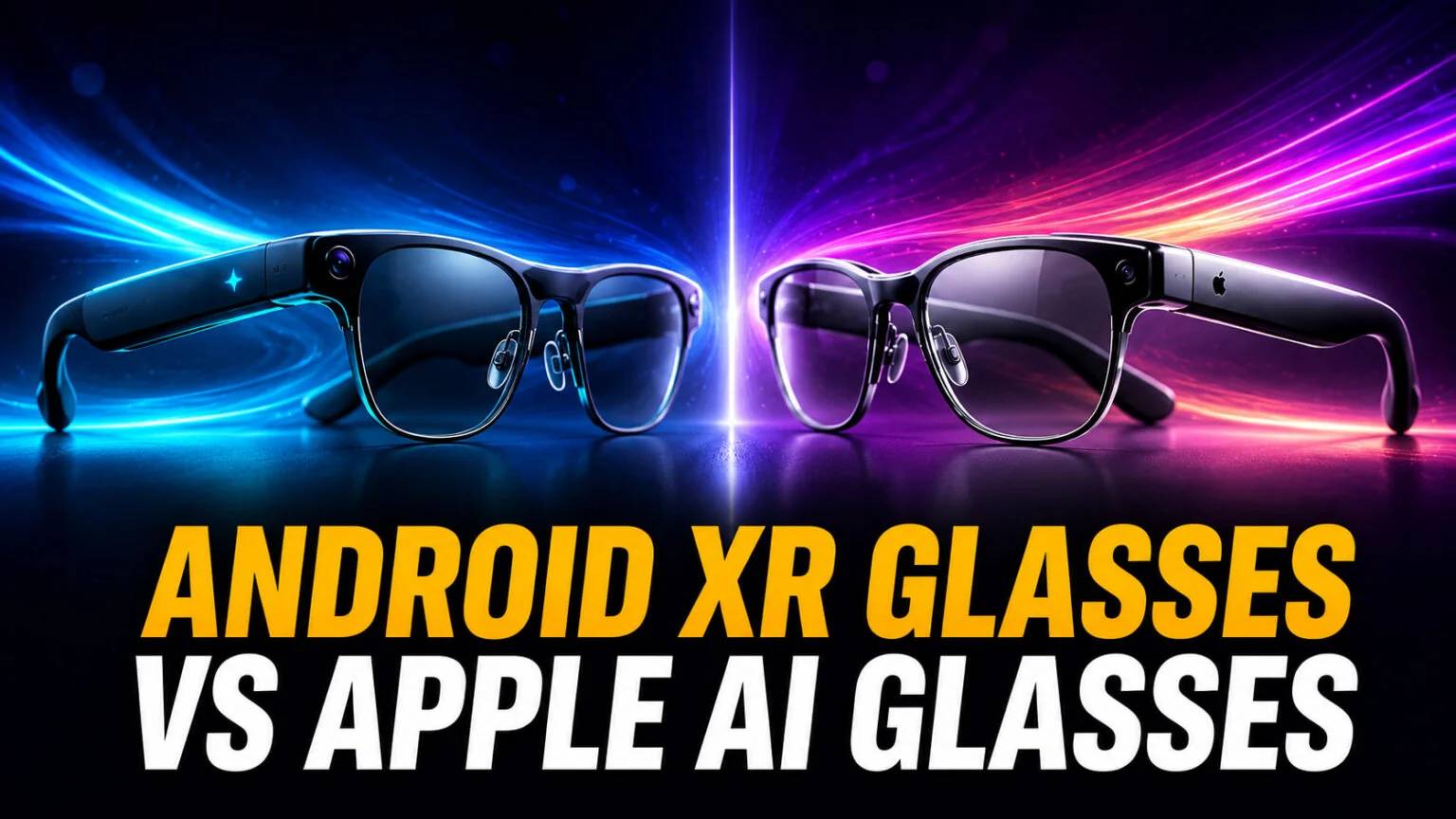
The smart glasses race just got real. Google and Samsung unveiled their Android XR glasses at Google I/O 2026 on May 19, with a confirmed Fall 2026 ship date, partnerships with Warby Parker and Gentle Monster, and Gemini AI built into every interaction. Apple’s answer, code-named N50, is still roughly a year away, with Bloomberg’s Mark Gurman pegging a 2027 launch and production starting at the end of 2026.
That roughly 9 to 12 month gap is the entire story. If you want AI glasses on your face this year, Android XR is the only ticket, and yes, it works with iPhone. If you live deep inside the Apple ecosystem and can wait, Apple’s slower, pricier, more integrated approach is worth holding out for. This article breaks down both products side by side, covering release windows, hardware, AI, ecosystem fit, and which one you should actually buy.
The Key Takeaways
- Android XR glasses launch Fall 2026, co-designed with Warby Parker and Gentle Monster, with expected pricing of $600–$900.
- Apple AI glasses (N50) target a 2027 release, with no display in Gen 1, hand-gesture controls, and an expected $799–$1,299 range.
- Android XR glasses work with both Android and iPhone; Apple’s will require an iPhone.
- Apple skips the display in Gen 1; Android XR ships an audio-only variant in Fall 2026, with the in-lens microdisplay version arriving in 2027.
- Both products run on AI assistants (Gemini AI vs Siri 2.0 with Apple Intelligence), but only Apple’s is integrating directly with macOS and Vision Pro down the line.
Android XR vs Apple AI Glasses: Quick Comparison Table
| Feature | Android XR Glasses (Google + Samsung) | Apple AI Glasses (Rumored) | Notes |
|---|---|---|---|
| Release window | Fall 2026 (confirmed) | 2027 (Bloomberg / Gurman) | Android XR ships ~12 months earlier |
| Expected price | $600–$900 | $799–$1,299 | Apple skews higher, as usual |
| Display | Audio-only this fall; microdisplay variant in 2027 | No display in Gen 1 | Edge: Android XR (eventually), tied in 2026 |
| AI assistant | Gemini AI (Gemini 3.5 era) | Siri 2.0 + Apple Intelligence | Edge: Gemini today, Apple closing fast |
| Cameras | Yes (audio variant has cameras + mic) | Two cameras (high-res + gesture sensor) | Comparable; Apple adds gesture cam |
| Hand-gesture control | Not announced | Yes (primary input method) | Edge: Apple |
| iPhone compatibility | Yes (works with iOS and Android) | iPhone required | Edge: Android XR (universal) |
| Frame design | Warby Parker, Gentle Monster | Four in-house acetate styles | Tie |
| Chip | Qualcomm Snapdragon | Apple silicon (custom) | Apple’s first wearable chip |
| OS | Android XR | iOS 27 / new wearables OS | Different ecosystems |
Android XR Glasses: Shipping Fall 2026
Google’s Android XR is the platform behind Samsung’s Project Moohan headset, and now it’s getting its first true everyday wearable. The May 19, 2026 keynote at I/O confirmed what the rumor mill had been chasing for months: Samsung built the hardware, Google built the AI layer, and two well-known eyewear brands are designing the frames.
Design partners: Warby Parker and Gentle Monster
Google explicitly named Warby Parker for “refined and timeless designs” and Gentle Monster for “disruptive yet refined aesthetics.” Both brands plan to launch full collections later in 2026, which means several frame styles at launch instead of a single hero SKU. This is the same playbook Meta used with Ray-Ban, and it’s the right call, since smart glasses fail when they look like smart glasses.
Two versions, but only one this year
Samsung is shipping the audio-only variant first, in Fall 2026. It comes with cameras, a microphone, and speakers, but no screen. A second variant with a small in-lens microdisplay for turn-by-turn navigation, messages, and contextual info is on the roadmap, but it won’t arrive until 2027. That puts the display version on roughly the same timeline as Apple’s first glasses, with Apple skipping a display entirely in Gen 1.
Gemini AI features that were demoed
Google’s I/O demo leaned hard on Gemini AI’s real-time skills. The showcase, recapped by 9to5Google, included voice-activated navigation, live text and audio translation (with voice matching), notification summaries, calendar management, restaurant ordering through DoorDash, and Nano Banana-powered photo edits captured straight from the glasses. If you want the full Gemini story from this year’s keynote, our Gemini 3.5 review breaks down the model upgrades that power these glasses.
Pricing and compatibility
Google didn’t announce final pricing. Industry estimates put the audio-only Fall 2026 glasses between $600 and $900, with the microdisplay version expected higher when it lands in 2027. The platform supports both Android phones and iPhones, which matters: an iOS user can buy Android XR glasses this fall without leaving Apple’s phone ecosystem.
Apple AI Glasses: Targeting 2027
Apple’s strategy is the opposite of Google’s. No I/O moment, no design partners, no on-stage demo. The story is being told through Bloomberg’s Mark Gurman, MacRumors, and AppleInsider, one rumor at a time. Production is targeted for the end of 2026, with a public launch in 2027.
The N50 codename and frame strategy
The internal code name is N50. Apple is currently testing four frame styles in acetate, a plant-based, lightweight material that flexes better than plastic. Reported styles include a large rectangular (Ray-Ban Wayfarer-inspired), a slim rectangular, a large oval, and a smaller refined oval. Color options reportedly include black, ocean blue, and light brown. We’ve covered the full lineup, materials, and design tradeoffs in our Apple AI Glasses breakdown.
No display, but hand gestures
Apple is skipping the display for Gen 1. No microdisplay, no AR overlay, no LiDAR, no 3D cameras. The bottleneck, per Bloomberg, is battery life. Instead, Apple is leaning on two cameras: a high-resolution sensor for photos and video, and a lower-resolution wide-angle lens dedicated to reading hand gestures. This is the same approach Vision Pro uses for input, and it’s the feature Android XR hasn’t matched.
Apple Intelligence and Siri 2.0
The glasses will run an upgraded version of Siri, often called Siri 2.0, powered by Apple Intelligence and shipping as part of iOS 27. The pitch is contextual awareness without a screen: ask Siri what you’re looking at, get answers, take photos, place calls, translate signs, and identify plants or landmarks. WWDC 2026 in June is where Apple will likely tease the broader iOS 27 + Siri 2.0 story, and our WWDC 2026 preview laid out the keynote expectations, and our WWDC 2026 recap covers what Apple actually announced.
Expected price and timing
Pricing is unconfirmed. Industry tracking puts the expected range at $799–$1,299, comfortably above Meta Ray-Ban’s $299 starting price and above the Android XR estimates. Production is set for late 2026, public reveal possibly later in 2026, and shipping in 2027. Ming-Chi Kuo expects 2027 at the earliest, with some risk of slipping to 2028 if Apple Intelligence development hits delays.
Android XR vs Apple AI Glasses: Five Key Differences
Five differences will decide which platform wins your face.
1. Ship date. Android XR ships Fall 2026. Apple ships 2027, potentially 2028 if delayed. If you want glasses this year, there is no Apple option.
2. Display. Android XR’s audio-only glasses arrive Fall 2026 with no screen. A separate microdisplay variant is confirmed for 2027. Apple’s Gen 1 has no display at all and Gen 2 with an in-lens display is rumored for 2028. Neither company is putting a screen on your face in 2026.
3. AI assistant. Gemini is the most capable consumer AI assistant right now, with Gemini 3.5 already powering live translation and image editing on the glasses. Siri 2.0 is the bet Apple needs to make work; until iOS 27 ships, the gap is real.
4. Ecosystem. Android XR is cross-platform (works with iPhone). Apple AI glasses require an iPhone, but in return you get integration with Mac, Apple Intelligence, Photos, Messages, and Find My. Apple sacrifices reach for depth.
5. Price. Android XR is expected at $600–$900. Apple sits at $799–$1,299. Roughly $200–$400 of “Apple tax,” same as every other category.
Should You Buy Android XR or Wait for Apple?
Here’s the honest answer for an iPhone user reading this in May 2026.
Buy Android XR this fall if you want the experience now, cross between Android and iOS, want live translation today, or don’t want to wait 12+ months for Apple. Android XR works with iPhone, so leaving the iOS ecosystem isn’t required, and the Gemini AI experience is strong right now.
Wait for Apple in 2027 if you live entirely inside the Apple ecosystem, care about Mac and Vision Pro integration down the line, want hand-gesture controls (Apple is the only one shipping them), prefer Apple’s privacy stance, or don’t trust first-gen products from any company. There’s also a strategic reason to wait. Apple’s Gen 2 in 2028 is rumored to add an in-lens display, on roughly the same timeline as Google’s 2027 microdisplay variant, which means Apple’s catch-up window is under two years.
For most FelloAI readers, the smarter move is to wait for Apple unless you have a specific use case (translation, accessibility, navigation) that Android XR solves now. The Apple ecosystem moat is real, and a $700 first-gen pair you replace in 18 months is rarely a good purchase.
What This Means for the Smart Glasses Market
Meta has had this category to itself for two years with Ray-Ban. That’s about to end. By Fall 2026, three major platforms will be competing: Meta Ray-Ban (cheap, social-first, no AI moat), Android XR (Gemini-powered, Samsung-built, fashion partnerships), and from 2027, Apple AI glasses (premium, iPhone-locked, gesture-driven). The result is a fast-moving market where prices will compress, AI features will leap-frog quarterly, and the platform with the best assistant will pull ahead.
Right now, that assistant edge belongs to Gemini. Apple Intelligence has work to do, and Siri 2.0 needs to land at WWDC 2026 for the 2027 glasses to compete on AI rather than ecosystem alone. If you want to track the Gemini lineup behind the Android XR glasses, our Gemini 4 tracker covers Gemini 4 Argon and what comes next. And if you’re price-sensitive on the Gemini side, the Gemini pricing breakdown shows what the full ecosystem costs today.
The Bottom Line
Android XR glasses ship first, work everywhere, and have the better AI today. Apple AI glasses ship later, cost more, and offer deeper iPhone, Mac, and gesture integration, but only if you can wait until 2027. The honest answer for most iPhone users: wait for Apple unless you have a specific Android XR feature you need this fall. The honest answer for most Android users: buy Android XR in October and don’t look back. Whichever way you go, the smart glasses category is finally past the gimmick phase.
FAQ
When are Android XR glasses coming out?
Google and Samsung confirmed a Fall 2026 launch at Google I/O 2026 on May 19. Exact ship dates and pricing are expected in the months leading up to release.
When will Apple release its AI glasses?
Apple’s AI glasses, code-named N50, target a 2027 release, with production starting in late 2026. Bloomberg’s Mark Gurman is the primary source; analyst Ming-Chi Kuo expects 2027 at the earliest, potentially slipping to 2028.
Do Android XR glasses work with iPhone?
Yes. The Android XR platform supports both Android and iOS, so iPhone users can buy the Samsung-built Android XR glasses without switching phones.
Will Apple AI glasses have a display?
No, not in the first generation. Apple is prioritizing battery life and a lightweight frame. A Gen 2 model with an in-lens display is rumored for 2028.
How much will Android XR and Apple AI glasses cost?
Android XR glasses are expected at $600–$900. Apple AI glasses are expected at $799–$1,299. Neither price is officially confirmed.
What AI do these glasses use?
Android XR glasses run Gemini AI (powered by Gemini 3.5). Apple AI glasses will run Siri 2.0 with Apple Intelligence, shipping as part of iOS 27.