92% of students now use AI tools in their studies, up from just 66% a year earlier. The biggest uses? Generating text (64%), editing and improving writing (39%), and summarizing notes (36%). Whether you are working on an essay due tomorrow, a group presentation, or cramming for finals, AI has gone from a nice-to-have to a core part of the student toolkit.
The problem is that most students end up juggling multiple apps to cover all their needs, one for writing, another for presentations, a third for study summaries, plus a grammar checker and a research tool. That gets expensive and messy fast. In this guide, we will show you exactly how to use AI for your three biggest academic tasks, with real prompts you can copy and paste, and how Fello AI lets you do it all from a single app. For the wider line-up, see our best AI tools for students roundup.
The Key Takeaways
- 92% of students use AI for schoolwork in 2026, with essay writing and note-taking as the top use cases
- Fello AI gives you access to GPT-5.4, Claude, and Gemini in one app for $9.99/month, replacing multiple subscriptions
- You can generate essay outlines, full drafts, presentation slides, and study summaries using the right prompts
- 51% of students say their top reason for using AI is saving time
- This guide includes copy-paste prompts for essays, presentations, and study documents you can use right now
How AI Is Changing Student Life in 2026
The numbers tell the story. According to a 2025 HEPI survey, 88% of students have used generative AI tools like ChatGPT for assessments, nearly doubling from 53% the year before. A separate College Board study found that 84% of high school students now use GenAI for schoolwork.
What are students actually doing with AI? The data breaks down like this:
- 64% use AI to generate text (essays, emails, reports)
- 39% use it to edit and improve their writing
- 36% use it for summarizing and note-taking
- 35% use it for translation and language support
- 19% use it to generate images, videos, or audio
The top motivation? 51% of students say it saves time. Another 50% say it improves the quality of their work. These are not students trying to cheat. They are students working smarter with the tools available to them.
Why Fello AI Is the Best AI App for Students
Most “best AI tools for students” lists tell you to download 10 different apps. ChatGPT for brainstorming. Grammarly for editing. Canva for presentations. NotebookLM for study notes. Perplexity for research. That is five subscriptions, five logins, and five different interfaces to learn. New to one of them? Our explainer on what is NotebookLM covers the research tool everyone recommends.
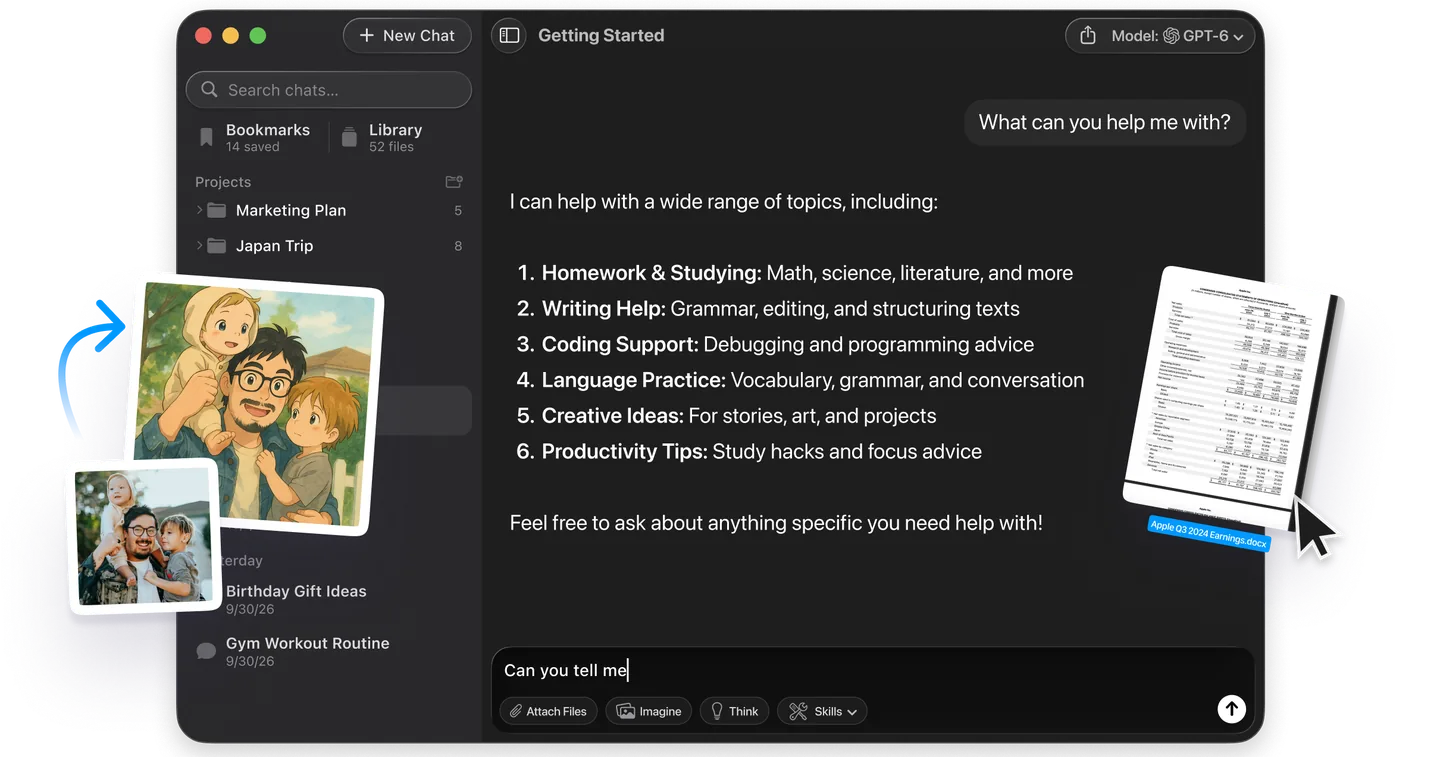
Fello AI takes a different approach. Already the first pick in our 20 must-have Mac apps, it puts ChatGPT, Claude, Gemini, Grok and many more into a single app on your Mac, iPhone, or iPad. Instead of switching between tools, you pick the best model for each task and work from one clean interface.
Here is what that means in practice:
- Write an essay using GPT-5.4’s strong text generation, then switch to Claude for a more nuanced edit
- Build a presentation outline with Gemini’s research capabilities, then flesh it out with GPT-5.4
- Summarize a 50-page PDF by dragging it into Fello AI and asking for key points
- Create study flashcards from your lecture notes in seconds
- Proofread and refine any document with AI-powered editing
All of this for $9.99/month with no ads, no hidden fees, and a free trial to get started. Compare that to paying for ChatGPT Plus ($20/month), Grammarly Pro ($30/month billed monthly, or $12/month on an annual plan), and Canva Pro ($18/month) separately. That is up to $68/month for three tools billed month-to-month, when one app covers all three use cases.
How to Use AI for Essays with Fello AI
Essay writing is the number one reason students turn to AI. Here is a step-by-step workflow you can follow in Fello AI, from blank page to polished final draft.
1. Step: Research and Brainstorm
Start by asking AI to help you understand your topic and generate ideas. Open Fello AI and try this prompt:
Prompt: “I need to write a 1,500-word essay on [your topic] for my [course name] class. Give me 5 unique angles I could take, with a brief explanation of why each one would make a strong argument.”
Fello AI lets you compare how different models respond. Try the same prompt in GPT-5.4 and Claude to see which angle resonates more. Gemini is particularly strong for pulling in recent research and sources.
2. Step: Create a Structured Outline
Once you pick your angle, generate a detailed outline:
Prompt: “Create a detailed essay outline for a 1,500-word argumentative essay on [your chosen angle]. Include a thesis statement, 3-4 main arguments with supporting evidence suggestions, counterarguments, and a conclusion structure.”
This gives you a roadmap so you never stare at a blank page. You are still doing the thinking, but AI helps you organize it.
3. Step: Draft Section by Section
Do not ask AI to write the entire essay at once. Instead, work through each section:
Prompt: “Write the introduction paragraph for my essay. The thesis is: [your thesis]. Open with a compelling hook that uses a relevant statistic or real-world example. Keep it under 150 words.”
Then move through each body paragraph the same way. If a section comes out too generic, push back: “This is too vague. Add a specific example from [field] and a statistic to support the claim.” The section-by-section approach gives you more control over voice and arguments, and the result sounds far more natural than a single “write my essay” prompt. It also means you can rewrite one weak paragraph without regenerating the entire essay.
4. Step: Edit and Refine
After you have a complete draft, use AI as your editor:
Prompt: “Review this essay for clarity, argument strength, and grammar. Highlight any weak arguments, suggest stronger transitions, and fix grammatical errors. Keep my original voice: [paste your essay]”
Claude is particularly good at this editing step. It catches logical gaps and suggests improvements without rewriting your personality out of the text. If you struggle with getting started, our guide on beating writer’s block with AI has more prompt strategies.
5. Step: Final Polish
For the last pass, check for academic tone and formatting:
Prompt: “Proofread this essay for academic tone. Check that citations are formatted in [APA/MLA/Chicago] style. Flag any sentences that sound too casual or too AI-generated.”
This five-step workflow gives you a polished essay where AI assisted at every stage, but the ideas, arguments, and final voice are yours. Before you submit, it helps to know how AI detectors for essays handle work like this. We also ranked which free AI detectors are worth using if you want to self-check a draft first. For a single-tool deep dive, see our ZeroGPT review.
How to Use AI for Presentations with Fello AI
Creating presentations eats up hours of student time, not because the content is hard, but because designing slides is tedious. Most students spend 60-70% of their presentation time on formatting bullet points and picking layouts instead of thinking about what to say. AI flips that ratio. You focus on the message, and AI handles the structure.
Here is a complete workflow for building a class presentation from scratch in Fello AI. For a general, non-student walkthrough, see our step-by-step guide on how to create a presentation with AI.
1. Step: Turn Your Notes into a Slide Outline
Start with whatever you already have, an essay, lecture notes, a textbook chapter, or even a rough list of ideas. Paste it into Fello AI and generate a full slide structure:
Prompt: “Turn these notes into a 12-slide presentation outline for a 10-minute class presentation. Include a title slide, agenda, one slide per key point, a summary slide, and a Q&A slide. For each slide, write a headline, 3-4 bullet points, and a speaker note: [paste your notes]”
The key here is specifying the number of slides and the time limit. A 10-minute presentation typically needs 10-14 slides, roughly one per minute. If AI gives you too many, ask it to merge the weakest two sections. If your outline feels thin, ask it to expand the strongest points with data or examples.
You can also try this in multiple models. GPT-5.4 tends to give you punchy, well-structured bullet points. Claude often produces more nuanced speaker notes. Run the same prompt in both and cherry-pick the best parts.
2. Step: Generate Speaker Notes That Sound Like You
Speaker notes are where most students either wing it or write full scripts they end up reading word for word. The sweet spot is conversational notes with just enough detail to keep you on track.
Prompt: “Write speaker notes for each of these slides. Each note should be 60-80 words, conversational in tone, and include one specific example or data point I can mention. Write them as if I am talking to classmates, not reading an academic paper: [paste slide outline]”
Review what AI generates and swap in your own examples where you have them. A personal story or a reference to something your professor mentioned in class will always land better than a generic example. The AI gives you the structure so you can focus on adding your voice. Your professors are running the same playbook, and what teachers get from Claude shows how the other side of the classroom uses it.
3. Step: Plan Your Visuals
A wall of text on slides is the fastest way to lose your audience. AI cannot design your slides for you, but it can tell you exactly what visual to put on each one, saving you from the “stare at a blank slide” problem.
Prompt: “For each of these 12 slides, suggest a specific visual element (chart type, diagram, image description, or icon) that would reinforce the message. Be specific, not just ‘add an image’ but describe exactly what the image should show and what data it should include.”
For example, instead of “add a chart,” AI might suggest “a bar chart comparing adoption rates across three years with the 2026 bar highlighted in a contrasting color.” That level of specificity makes building the actual slide in PowerPoint, Google Slides, or Keynote much faster because you know exactly what you need before you open the design tool.
4. Step: Build a Rehearsal Script
For graded presentations or conference talks, rehearsing with a script helps you nail your timing and transitions. This is where AI saves you the most time because writing transitions between slides is the most tedious part of presentation prep.
Prompt: “Write a full presentation script for a 10-minute talk based on these slides. Include smooth transitions between slides, mark where to pause for emphasis, and add 2-3 spots where I should ask the audience a question to keep them engaged: [paste your slides]”
Read the script out loud once and time yourself. If it runs long, ask AI to cut the weakest 2 minutes. If it runs short, ask it to expand your strongest section with another example. Most students find that one round of AI-generated script plus 2-3 practice runs out loud is enough to feel confident on presentation day.
How to Use AI for Study Documents with Fello AI
Studying is where AI delivers the biggest time savings. Instead of spending hours re-reading textbooks and organizing notes, you can create structured study materials in minutes. The trick is knowing which type of study document works best for each situation and giving AI the right instructions to produce it.
Summarize Lectures and Textbooks
Fello AI can analyze PDFs and documents directly. Drag a lecture PDF or textbook chapter into the app and use this prompt:
Prompt: “Summarize this document into a study guide. Organize it by topic, highlight key definitions, important dates, and formulas. Use bullet points and keep each section under 100 words.”
This works especially well with dense lecture slides that have minimal explanation. AI fills in the gaps between bullet points and turns a 60-slide deck into a readable 2-page study guide. For textbook chapters, you can also ask AI to flag which sections are most likely to appear on an exam based on the emphasis and repetition in the source material.
If the summary is too surface-level, follow up with: “Expand the section on [topic] with more detail and include the key relationships between concepts.” You can iterate until the depth matches what you need.
Create Flashcards from Any Source Material
Flashcards remain one of the most effective study methods because they force active recall. The problem is that making them manually takes forever. AI turns a 30-minute card-creation session into a 2-minute prompt.
Prompt: “Create 25 flashcards from these notes. Format each as Question on one side, Answer on the other. Focus on concepts most likely to appear on an exam. Mix definition questions, application questions, and comparison questions: [paste notes]”
The key to good AI flashcards is asking for mixed question types. Definition cards (“What is X?”) only test recognition. Application cards (“When would you use X instead of Y?”) test understanding. Comparison cards (“How does X differ from Y?”) test deeper analysis. By mixing all three, you study at multiple levels of comprehension.
You can copy these into any flashcard app like Anki or Quizlet, or simply review them directly in Fello AI by asking it to quiz you one card at a time.
Build Practice Exams That Match Your Course
Self-testing before an exam is one of the most research-backed study strategies, but students rarely do it because creating realistic practice questions takes time. AI solves this completely.
Prompt: “Create a 20-question practice exam based on these notes. Include 10 multiple choice, 5 short answer, and 5 essay-style questions. Provide an answer key with explanations at the end: [paste notes]”
For even better results, tell AI what type of exam your professor gives. If your class uses mostly case-study questions, say that. If your professor loves trick questions that test edge cases, mention it. The more context you give about the exam format, the more realistic the practice test will be.
After you take the practice exam, paste your answers back into Fello AI and ask it to grade them. It will tell you which answers were wrong, explain why, and suggest which topics to review again.
Compare and Contrast Complex Topics
Comparison tables are essential for subjects like biology, history, political science, or any course where you need to distinguish between similar concepts. Building these manually means flipping between textbook pages and trying to organize your thoughts. AI does it in seconds.
Prompt: “Create a comparison table for [Topic A] vs [Topic B]. Include columns for: definition, key features, advantages, disadvantages, real-world examples, and common exam questions.”
This format works for everything from comparing economic theories to contrasting historical events to distinguishing between similar biological processes. The “common exam questions” column is particularly useful because it shows you how a professor might test you on the differences, which is exactly what you need to study.
Break Down Concepts That Are Not Clicking
Every student hits topics where the textbook explanation just does not make sense. Instead of reading the same confusing paragraph five times, ask AI to explain it differently.
Prompt: “Explain [complex topic] like I am a first-year student with no background in this subject. Use a real-world analogy, then break it into 3-5 key points I need to remember for the exam.”
What makes this prompt powerful is the analogy request. AI might explain supply and demand using a concert ticket analogy, or explain neural networks using a postal sorting office comparison. These analogies stick in your memory far better than textbook definitions. If the first analogy does not click, ask for another one. Different models in Fello AI will give you different analogies, so try GPT-5.4 and Claude on the same topic to see which explanation resonates.
Fello AI vs. Free Alternatives: What You Actually Get
| Feature | Fello AI ($9.99/mo) | ChatGPT Free | Grammarly Free | Canva Free |
|---|---|---|---|---|
| Essay writing & brainstorming | Yes (GPT-5.4, Claude, Gemini, Grok and more) | Limited messages | No | No |
| Presentation outlines | Yes | Limited messages | No | Templates only |
| Study summaries & flashcards | Yes | Limited messages | No | No |
| PDF & document analysis | Yes | No | No | No |
| Grammar & proofreading | Yes (via AI models) | Basic | Basic corrections | No |
| Multiple AI models | 5+ models | GPT only | N/A | N/A |
| Mac, iPhone, iPad app | Yes | Web + app | Browser extension | Web + app |
| Price | $9.99/month | Free (limited) | Free (limited) | Free (limited) |
Free tools work for occasional use, but they come with message limits, feature restrictions, and the hassle of switching between apps. Fello AI gives you unlimited access to multiple models in one place, which is exactly what students need during exam season when workload spikes.
Best AI Prompts for Students: Quick Reference
Here are the most useful prompts you can copy directly into Fello AI. Replace the bracketed placeholders with your actual topic, thesis, or content. The more specific you are with the placeholders, the better the output will be. For prompts aimed at learning a topic rather than producing a document, see our six ChatGPT prompts for students.
Essays
- “Give me 5 thesis statement options for an essay about [topic]. For each, explain what evidence I would need to support it.”
- “Write an introduction paragraph with a hook for this thesis: [thesis]. Use a surprising statistic or counterintuitive fact as the opening line.”
- “Strengthen this argument with a counterargument and rebuttal: [paragraph]. Make the counterargument strong enough to be credible before dismantling it.”
- “Rewrite this paragraph in a more academic tone without losing the core argument: [paragraph]”
Presentations
- “Turn this 1,000-word essay into a 10-slide presentation outline with speaker notes and one suggested visual per slide”
- “Write a 2-minute opening for my presentation on [topic] that grabs attention with a question or surprising fact”
- “Suggest 3 data visualizations for these statistics and explain which chart type best communicates each point: [stats]”
- “Write transition sentences between these slides so the presentation flows naturally: [slide list]”
Studying
- “Summarize this chapter in 10 bullet points, ranked from most to least likely to appear on the exam: [paste chapter]”
- “Create a mind map outline connecting these 5 concepts, showing cause-and-effect relationships: [concepts]”
- “Quiz me on [topic] with 10 questions. After each answer I give, tell me if I am right and explain why”
- “What are the 5 most common mistakes students make when studying [topic]? How do I avoid each one?”
Pro tip: If any AI response feels too generic, follow up with “Be more specific” or “Give me a concrete example from [your field].” AI models respond well to pushback, and the second response is almost always better than the first.
How to Use AI Ethically in School
Using AI for school is not cheating, but using it wrong can be. Here is where the line sits for most universities in 2026:
Generally acceptable:
- Using AI to brainstorm ideas and create outlines
- Having AI proofread and suggest edits
- Generating study materials (flashcards, summaries, practice tests)
- Using AI to explain concepts you do not understand
Generally not acceptable:
- Submitting AI-generated text as your own without disclosure
- Using AI during exams unless explicitly allowed
- Having AI write entire assignments without any of your own input
The best approach is to treat AI like a study partner, not a ghostwriter. Use it to organize your thinking, fill knowledge gaps, and polish your work. The ideas and arguments should still be yours.
Check your school’s specific AI policy. Many universities updated their guidelines in 2025-2026 to allow AI assistance with proper attribution. When in doubt, ask your professor. For more ideas on integrating AI into your daily routine, see our guide on practical ways AI makes life easier.
Other AI Tools Students Use
While Fello AI covers the full student workflow in one app, here are a few specialized tools worth knowing about:
Grammarly focuses specifically on grammar, spelling, and tone checking. It works as a browser extension and integrates with Google Docs and Microsoft Word. The free version catches basic errors, but the premium plan ($12/month billed annually, or $30/month billed monthly) adds tone detection and full-sentence rewrites. If you already use Fello AI, its built-in AI models handle proofreading just as well.
Canva is a design platform with presentation templates. Students use it for slide decks when visual design matters more than content structure. The free plan includes basic templates, while Canva Pro ($18/month) adds premium assets, and our Canva pricing guide breaks down every plan. For the full rundown of its AI tools, see what Canva AI can do. Fello AI does not design slides visually, but it generates the content, outlines, and speaker notes that make building slides fast in any tool.
NotebookLM is Google’s free AI study tool that lets you upload documents and ask questions about them. See the full NotebookLM pricing for students. Our step-by-step NotebookLM tutorial shows exactly how to load your readings and generate study notes. Google’s newer Gemini study notebooks work the other way round, testing you first and building lessons around the gaps. It is strong for research-heavy subjects where you need to cross-reference multiple sources. Fello AI offers similar PDF analysis capabilities alongside essay writing and presentation tools, making it a more versatile choice.
Conclusion
AI is already part of student life, 92% of students use it, and the ones who use it well have a real advantage. Instead of juggling five different apps for writing, presentations, studying, research, and editing, Fello AI gives you GPT-5.4, Claude, and Gemini in one clean app for $9.99/month.
Start with the prompts in this guide. Pick one assignment, run through the workflow, and see how much time you save. You can download Fello AI on Mac, iPhone, or iPad with a free trial to test it yourself.
FAQ
How can students use AI for essays without cheating?
Use AI as a brainstorming and editing tool, not a ghostwriter. Generate outlines, get feedback on your drafts, and use AI to proofread. The ideas and arguments should come from you. Always check your school’s AI policy and disclose AI use when required.
What is the best AI app for students in 2026?
Fello AI is the most versatile option because it gives you access to GPT-5.4, Claude, and Gemini in one app. Instead of paying for separate subscriptions to ChatGPT, Grammarly, and other tools, you get everything for $9.99/month on Mac, iPhone, and iPad.
Can AI create a full presentation for you?
AI can generate your presentation outline, slide content, speaker notes, and visual suggestions. You still need to build the actual slides in PowerPoint, Google Slides, or Keynote, but AI handles the time-consuming content creation part.
Is it worth paying for AI tools as a student?
Free AI tools have strict message limits and fewer features, which become a problem during exam season when you need them most. Fello AI at $9.99/month costs less than a single textbook and replaces multiple paid tools.
Can AI summarize textbooks and lecture notes?
Yes. You can drag PDFs directly into Fello AI and ask it to create summaries, study guides, flashcards, or practice exams from the content. This works with lecture slides, textbook chapters, research papers, and handwritten notes you photograph.