AI presentation tools can turn a single prompt into a complete slide deck in under a minute. What used to take an hour of formatting, rewriting, and hunting for stock photos now takes minutes, with most users reporting they save significant time per presentation compared to starting from scratch in PowerPoint. Whether you need a sales pitch, a student project, or an investor deck, AI can generate a complete presentation from a single prompt, and the results are getting surprisingly good.
This guide walks you through the full process of creating a presentation with AI, step by step. You will learn how to write effective prompts, generate your first draft deck, refine it slide by slide, add speaker notes, translate the whole thing if needed, and export to PowerPoint or PDF. We also cover common mistakes that waste your time and show you how to build presentations directly inside Fello AI’s chat.
The Key Takeaways
- AI presentation tools generate a complete slide deck in under a minute from a single prompt
- The quality of your output depends heavily on your prompt, not just the tool you pick
- Always review every slide for accuracy before presenting, as AI can hallucinate stats and sources
- You can create, refine, add speaker notes, translate, and export to .pptx all within one workflow
- Fello AI lets you build full PowerPoint files directly in a chat conversation on Mac, iPhone, and iPad
Why Create a Presentation with AI? The Blank Slide Problem
Everyone knows the feeling. You open PowerPoint, stare at that empty white slide, and spend the next 20 minutes just figuring out where to start. You wrestle with layouts, rewrite bullet points three times, and search for images that do not look like generic stock photos.
AI presentation makers flip this process. Instead of starting from nothing, you start from a complete first draft. You describe what you need, the AI generates a structured deck with content, layouts, and even speaker notes, and your job shifts from creation to editing. That is a fundamentally different (and faster) workflow.
The best part is you do not need to be a designer. AI handles structure, formatting, and visual consistency while you focus on the message.
Step 1: Start with a Clear Prompt
The single biggest factor in your AI presentation quality is the prompt you write. A vague prompt like “make a presentation about marketing” gives you vague slides. A specific prompt gives you something you can actually use. If you want to sharpen your prompting skills beyond presentations, our guide on how to ask ChatGPT the right questions covers the fundamentals.
What to include in your prompt for the best results:
- Topic and angle, not just “sales,” but “Q1 sales performance for the EMEA region”
- Audience, who will see this? Investors, students, your team, a client?
- Number of slides, give a target (e.g., 10-12 slides) so the AI scopes the content correctly
- Specific sections or data, mention charts, comparisons, timelines, or case studies you want included
- Tone and style, formal, conversational, data-heavy, visual-first
Example prompt for a sales deck:
“Create a 10-slide sales presentation for a B2B SaaS product targeting HR directors. Include a problem/solution slide, 3 customer case studies, a pricing comparison table, and a clear call-to-action. Use a professional, data-driven tone.”
Example prompt for a student project:
“Make an 8-slide presentation about climate change impacts on coastal cities for a university geography class. Include statistics, a timeline of key events, and a map showing at-risk areas.”
The more context you give, the less editing you do later.
Step 2: Generate Your First Draft Deck
Once your prompt is ready, feed it into your AI tool of choice. Most AI presentation makers follow the same basic flow: you enter your prompt, the AI generates an outline, and then it builds slides from that outline.
Here is what typically happens:
- The AI creates a slide structure (title slide, agenda, content slides, conclusion)
- Each slide gets titles, bullet points, and supporting text
- The tool applies a design template with consistent fonts, colors, and layouts
- Some tools add stock images, icons, or charts automatically
You can also skip the prompt-from-scratch approach. Many AI tools let you upload an existing document (a Word file, PDF, or even meeting notes) and convert it into a slide deck. This works especially well when you already have the content written and just need it formatted as slides.
Popular AI presentation tools and their free tiers:
| Tool | Free Tier | Export to .pptx | Best For |
|---|---|---|---|
| Gamma | 400 credits (~10 decks) | Yes | Clean, modern design |
| Canva Magic Design | Limited free uses per month | Yes | Templates and visuals |
| Slidesgo AI | 3 presentations/month | Yes | Budget-friendly (~$5/month paid) |
| Microsoft Copilot | Requires paid Copilot add-on ($18–22/user/month) + M365 | Yes (native) | PowerPoint users |
| Google Gemini in Slides | Paid Workspace plans | Google Slides | Google ecosystem |
| Beautiful.ai | 14-day free trial | Yes | Professional layouts |
| Fello AI | Subscriber feature | Yes (.pptx native) | Chat-based creation on Mac/iOS |
Do not overthink tool selection at this stage. Pick one, generate your first draft, and focus on the next steps.
Step 3: Refine Slide by Slide
Your first AI-generated draft is a starting point, not a finished product. Plan to spend 10-15 minutes reviewing and refining.
What to check on every slide:
- Accuracy. AI can and does make up statistics, cite non-existent studies, or get dates wrong. Verify every number and claim
- Relevance. Remove slides that do not serve your audience. A 15-slide deck with 12 strong slides beats 15 slides with filler
- Text length. AI tends to put too much text on slides. Trim bullet points to 6-8 words each. If a slide has more than 5 bullets, split it
- Flow. Check that each slide logically leads to the next. Reorder if the narrative feels jumpy
- Brand consistency. Swap in your company fonts, colors, and logo if the AI used generic templates
Most AI tools let you refine individual slides with follow-up instructions. Instead of manually rewriting, tell the AI what to change:
- “Make this slide more concise”
- “Rewrite the bullet points for a non-technical audience”
- “Add a comparison table instead of bullet points”
- “Change the tone to be more formal”
This iterative approach, generate then refine, is consistently faster than building from scratch.
Step 4: Add Speaker Notes Automatically
Speaker notes are the part most people skip and then regret during the actual presentation. AI makes this painless.
After your slides are finalized, ask the AI to generate speaker notes for each slide. A good prompt for this is: “Add detailed speaker notes for each slide. Include key talking points, transitions to the next slide, and any data points I should emphasize.”
The AI will write 3-5 sentences per slide covering what to say, what to emphasize, and how to transition. You will still want to personalize them (add your own anecdotes, adjust the pacing), but having a solid starting script saves significant preparation time.
Some tools generate speaker notes automatically during the initial deck creation. Others require a separate step. Either way, do not present without them.
Step 5: Translate the Whole Presentation If Needed
If you work across markets or present to international audiences, AI translation is a genuine time-saver. Instead of translating slide by slide (or hiring a translator for a simple internal deck), you can ask the AI to translate the entire presentation into another language in one step.
Major AI tools support translation into dozens of languages. Canva’s translation feature supports 100+ languages, though AI slide generation itself is typically limited to English and a handful of major languages. Translation quality is strong for major languages like Spanish, French, German, Japanese, and Mandarin. For less common languages, do a quick review or ask a native speaker to check the output.
Keep in mind that translated text often changes length. German text runs about 30% longer than English, while Chinese and Japanese are more compact. Check that your translated slides still look clean and nothing overflows the layout.
Step 6: Export to PowerPoint or Share as PDF
The final step is getting your presentation out of the AI tool and into a format you can actually use.
PowerPoint (.pptx) is the standard for most business and academic settings. Every major AI presentation tool supports .pptx export, which means your AI-generated deck opens natively in Microsoft PowerPoint, Apple Keynote, or Google Slides with full editing capability.
PDF export works best when you need to share a read-only version, attach slides to an email, or print handouts. If you are starting from a document rather than slides, see how to turn a PDF into a presentation.
Before exporting, do a final check: run through the deck in presentation mode to catch any layout issues, orphaned text, or images that shifted during export.
How to Create a Presentation with AI in Fello AI
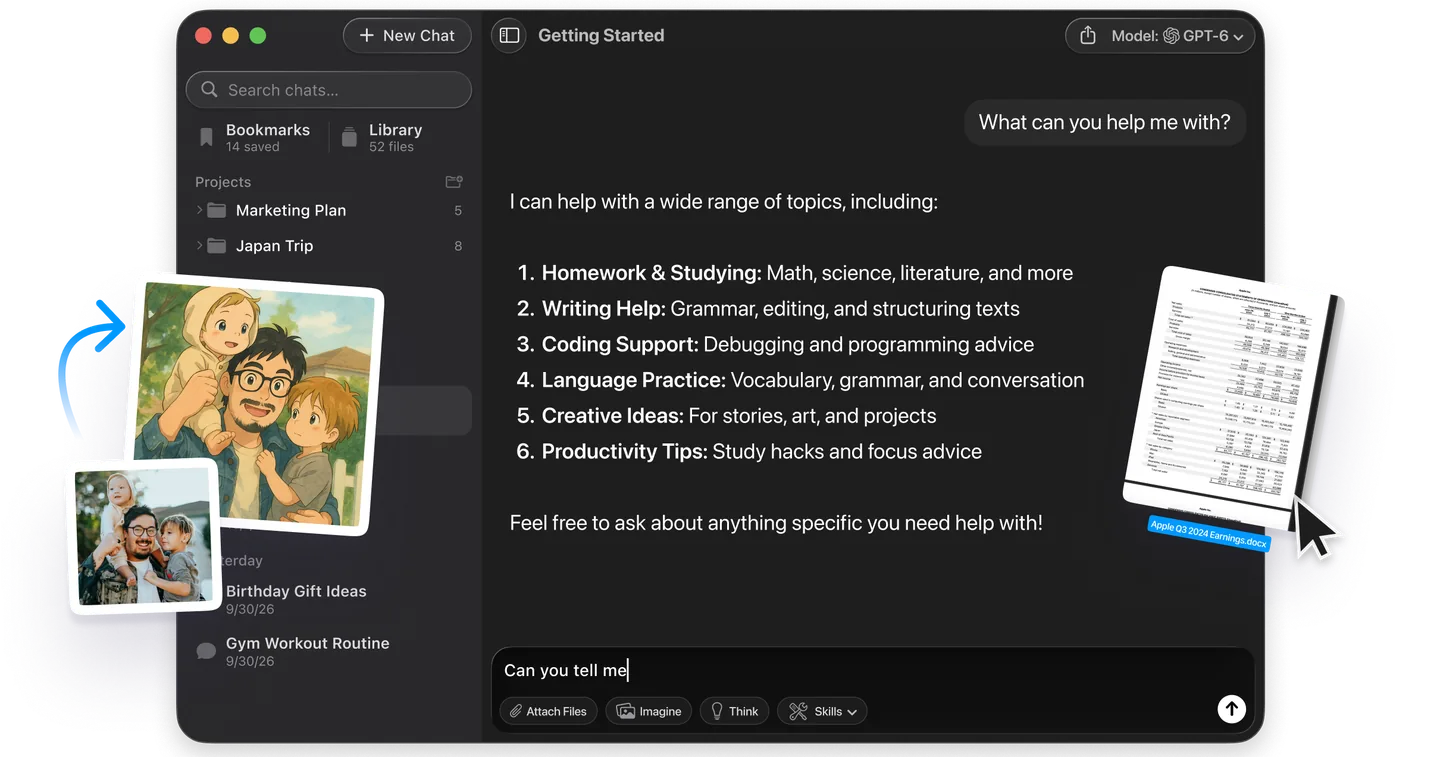
Fello AI’s PowerPoint Skill lets you create complete slide decks directly inside a chat conversation. No browser tabs, no separate apps. You describe what you need, and the AI generates a native .pptx file you can download and open in PowerPoint, Keynote, or Google Slides.
Here is how to create a presentation with AI using Fello AI:
- Tap the Skills button (the tools icon) in the chat input bar
- Toggle on the PowerPoint Skill so it is active for your conversation
- Type your prompt describing the presentation you need. Be specific about topic, audience, slide count, and any sections or data you want included
- Wait for the AI to generate your deck. You will see real-time progress updates and an expandable reasoning view showing what the AI is doing
- Download the .pptx file when it appears in the chat. The file saves locally to your device
- Refine by chatting. Ask for changes like “add speaker notes to every slide” or “translate the whole deck to Spanish” and the AI updates your file
Example prompt that works well in Fello AI: “Create a 12-slide investor pitch deck for a regional coffee shop chain planning to expand to 15 new locations in the next 3 years. Include a local market demand chart, competitor comparison table, store economics breakdown, and a rollout timeline. Use a warm modern theme.”
Fello AI can also edit existing presentations. Upload a .pptx file and ask the AI to update content, add slides, change the design, or generate speaker notes for what is already there.
The PowerPoint Skill works on Mac, iPhone, and iPad, so you can build or edit a deck from anywhere. You can also combine it with other Fello AI Skills in the same conversation. For example, search the web for the latest industry stats, then generate a presentation using that data, all without leaving the chat.
Common Mistakes and How to Avoid Them
1. Writing vague prompts
“Make a presentation about AI” gives you generic filler. Always specify your audience, slide count, key sections, and tone. The 30 seconds you spend on a better prompt saves 15 minutes of editing.
2. Accepting the first draft without editing
AI output is a first draft, not a final product. Always review for accuracy, trim excess text, and check that the narrative flows logically.
3. Ignoring factual accuracy
AI presentation tools can hallucinate statistics, invent sources, or use outdated data. Verify every number, quote, and claim before you present. This is especially critical for investor decks and client-facing presentations.
4. Overloading slides with text
AI tends to write more than you need per slide. A good rule: no more than 5 bullet points per slide, each under 8 words. If a slide is text-heavy, split it into two.
5. Skipping speaker notes
Your slides should support your talk, not replace it. Generate speaker notes so your key points live in the notes panel, not crammed onto the slides themselves.
6. Not checking the export
What looks perfect in the AI tool can shift during export. Always preview your .pptx file in the actual application you will use to present.
Use Cases: What AI Presentations Work Best For
Sales deck. AI excels at structuring problem/solution narratives, generating comparison tables, and building a clear call-to-action flow. Give it your product details and target persona for best results.
Student project. Fast turnaround for class presentations. Provide the assignment brief in your prompt and the AI will structure the content to match academic expectations. If you are a student exploring AI tools for the first time, check our 20 must-have Mac apps for more recommendations.
Investor pitch. AI can generate financial summaries, market analysis slides, and competitive landscape comparisons. But always verify the numbers manually. Investors will check.
Training materials. Step-by-step instructional decks with clear progression work well with AI. Include learning objectives in your prompt.
Team updates and reports. Weekly or monthly status presentations are a perfect AI use case. Upload your data or notes and let the AI format it into a clean deck.
Start Building Your Next Presentation with AI
Creating a presentation with AI is not about replacing your ideas. It is about getting from idea to finished deck faster. Write a specific prompt, generate your first draft, refine it slide by slide, and export a polished .pptx file in a fraction of the time it would take manually.
If you want the simplest path, try Fello AI’s PowerPoint Skill and build your first deck directly in a chat conversation. No design skills required, just describe what you need.
FAQ
Can AI make a full presentation from scratch?
Yes. AI can generate a complete presentation from a single prompt, including slide content, structure, speaker notes, and basic design. Most tools create a full deck in under a minute. However, you should always review and refine the output for accuracy, brand consistency, and audience fit before presenting.
How accurate is AI-generated content in presentations?
AI-generated slides can contain hallucinated statistics, outdated information, or fabricated sources. The structure and formatting are typically reliable, but every factual claim needs manual verification. This is especially important for business, academic, or investor-facing presentations.
What is the best free AI presentation maker?
Gamma is the strongest free option with 400 credits (roughly 10 full presentations) and clean, modern design output. Canva Magic Design offers 10 free uses with excellent template variety, and its paid tiers are detailed in our Canva pricing guide. Our step-by-step Canva presentation guide walks through the exact Magic Design flow. Slidesgo AI gives 3 free presentations per month with paid plans starting around $5/month. For a chat-based approach on Apple devices, Fello AI includes a PowerPoint Skill for subscribers. If you want the full picture of Canva’s AI suite, our guide on what Canva AI can do breaks it down.
Do AI presentations work for professional or business use?
Yes, but with caveats. AI-generated presentations work well for internal meetings, team updates, and first-draft client decks. For high-stakes presentations (board meetings, investor pitches, keynote talks), treat the AI output as a strong starting point and invest time in customizing the design, verifying all data, and adding your brand elements.