You pay $20 a month for ChatGPT or Claude. Then you download a Mac app, open its settings, and it asks you to paste in an API key. The obvious conclusion is that someone is charging you twice for the same thing. The api key vs subscription confusion is one of the most common questions in consumer AI right now. The answer is not a trick. They are two different products, sold by the same company, on two separate bills.
This guide explains what each one actually buys and runs the cost arithmetic with the assumptions written down instead of hidden. It names which Mac apps demand a key and which do not, and it covers the one risk that almost every comparison on this subject leaves out. All the prices and policy wording here were checked against the vendors’ own pages on 14 September 2026.
The Key Takeaways
- They are separate bills: OpenAI states that ChatGPT and the API platform have separate billing systems. Anthropic says a paid Claude plan does not include access to the Claude API or Console.
- A key is cheaper than you expect for light use: at $0.10 per million input tokens for Claude Haiku 5.5, a light user can spend anywhere from a few cents to a couple of dollars a month instead of $20.
- And more expensive than you expect for heavy use: a key has no ceiling. A subscription stops charging you at $20 no matter how much you type.
- The apps split cleanly: BoltAI is a perpetual licence from $79 and bundles no AI credits at all. RewriteBar sells both a key-based mode and its own gateway. Fello AI includes the models at $9.99 a month with no key.
- The risk nobody prices: the auth rules underneath a key are the vendor’s to change. Anthropic tightened them in February 2026, then announced another change for 15 June 2026 and paused it.
Why Your AI App Is Asking for an API Key
Every major AI company runs two businesses. The first sells you a seat in its own app: ChatGPT Plus, Claude Pro, Google’s consumer Gemini plans. You pay a flat monthly fee, you chat in the vendor’s window, and your usage is governed by limits rather than by a meter. The second sells metered access to the same models from any other piece of software. That is the API, and the credential that opens it is an API key.
These two businesses do not share a bill, and in most cases they do not even share an account. OpenAI’s help centre puts it flatly: “ChatGPT and the API platform have separate billing systems”, and “API usage is billed separately from your ChatGPT subscription”. You can read the detail in OpenAI’s own billing documentation.
Anthropic is even more direct, because it has a help article devoted to exactly this confusion. A paid Claude subscription, it says, “doesn’t include access to the Claude API or Console”, and the two are “separate products designed for different purposes”. If you want both, you sign up for the plan and set up Console billing separately. That is documented in Anthropic’s own help centre, in an article written specifically to answer this question. The separation cuts the other way too: if you subscribed inside an iPhone app, Anthropic cannot stop that charge either, which is the subject of our guide to cancelling an AI subscription on a Mac or iPhone.
So the app is not double-charging you
When a third-party Mac app asks for a key, it is telling you something honest about its business model: it sells you software, not intelligence. It has no deal with OpenAI or Anthropic on your behalf, so it cannot spend their models for you. You open the account, you hold the credential, and the model usage lands on your bill, not the app developer’s. The app’s own price covers the window, the shortcuts and the polish.
The alternative model is the one where the app carries the provider relationship itself and charges you a single price that includes the model usage. Neither approach is dishonest. They are just different answers to the question of who holds the account.
API Key vs Subscription: What Each One Actually Buys
The clearest way to see the difference is side by side. This is the comparison most people are looking for when they search for api key vs subscription. The rows that matter most are the last three, and they almost never appear in a pricing table.
| Your subscription | Your own API key | |
|---|---|---|
| What you buy | A seat in the vendor’s own app | Metered access to the model from any software |
| Who bills you | The vendor, flat monthly fee | The vendor, per token used |
| Light use | $20 whether you use it or not | A couple of dollars, sometimes less |
| Heavy use | Still $20, plus usage limits | No ceiling, the meter keeps running |
| At the limit | You wait for the window to reset | You keep going and keep paying |
| Model choice | Whatever the app exposes | Any model on the platform, including older ones |
| New model on day one | When the app adds it | Usually immediately |
| Extras included | Voice, memory, file handling, apps | Raw model access, you supply the rest |
| What you must guard | A password | A credential that can spend money |
| If the vendor changes the rules | You notice a feature change | Your setup can stop working |
The row about extras is the one that catches people out. A subscription is not only model access. It is the voice mode, the memory, the file handling, the mobile app and the connectors, all built and maintained by the vendor. A key gives you the raw model and nothing else. If you want the rest, you buy or build it. For a closer look at what the money buys across every provider, we keep a full breakdown in our complete AI pricing comparison.
API Key vs Subscription: The Cost Question, With the Arithmetic
Almost every page that tackles api key vs subscription gives you a break-even number and no assumptions. The figures in circulation range from about 1,400 messages a month to over 3,500, which is a threefold spread, and some of them are calculated on model prices from two years ago. A number without its workings is not useful, so here are the workings.
What the meter actually charges
API pricing is quoted per million tokens, with separate rates for what you send and what you get back. As of 8 October 2026, Anthropic charges $0.10 per million input tokens and $0.50 per million output tokens for Claude Haiku 5.5, which replaced Haiku 4.5 ($1 and $5) on 7 October, and $2 and $10 for Claude Sonnet 5.5. OpenAI quotes two tiers per model, and on its short-context tier the cheaper current model, GPT-6 Luna, runs at the same $0.10 and $0.50 per million while the flagship sits at $10 and $50. Long prompts cost more on OpenAI above 272,000 input tokens and on Haiku 5.5 above 100,000, which is the detail most comparisons quietly drop. If the word “token” is doing a lot of unexplained work there, we have a plain-English explainer on what AI tokens actually are.
A worked example, with the assumptions stated
Assume a realistic prosumer month: 20 conversations a week, four exchanges each, roughly 700 tokens in and 700 out per exchange. That is 320 exchanges, about 224,000 tokens each way. On Claude Haiku 5.5 at the rates above, the input costs about $0.02 and the output about $0.11. Call it $0.13 for the month. On Sonnet 5.5 the same month is about $2.69.
So for that pattern of use, a key is dramatically cheaper than $20.
The honest caveat is that the pattern is the whole answer. Feed a model long documents. Paste in large chunks of code, run an agent that loops, or turn on a reasoning mode that generates far more output tokens than you see. The same month passes $20 without feeling any different while you are working. The subscription’s flat fee is, in effect, insurance against your own heavy weeks.
The discount that only exists on the API side
One genuine advantage of the metered route: OpenAI’s batch rates are exactly half its standard rates across its standard text models. If your work can wait, submitting it as a batch halves the bill. Nothing equivalent exists on a consumer subscription. That matters for bulk jobs like classifying a spreadsheet or summarising an archive, and not at all for ordinary chat.
Which Mac Apps Demand a Key, and Which Do Not
This is where the abstract question becomes a purchase decision, because Mac AI apps split into three camps and the marketing does not always make clear which one you are buying.
Apps that require your own key
BoltAI is the clearest example. It sells a perpetual licence, priced at $79 for Essential, $99 for Pro and $199 for Pro+, and it states plainly that it is a client and does not bundle AI credits. You bring keys for OpenAI, Anthropic, Gemini, DeepSeek, Qwen, xAI and others, or point it at a local model through Ollama or LM Studio. The licence is a one-off, so your ongoing cost is exactly what the providers meter, and nothing else.
Apps that offer both
RewriteBar is a hybrid, and worth understanding properly because it is often filed in the wrong category. It sells a one-time licence at $29 for Standard and $59 for Pro, and supports bring-your-own-key across a very wide provider list. It also sells its own gateway subscription, for people who would rather not manage API accounts at all. Buying the app does not decide the question for you. You still choose which side of it you want to live on.
Apps that include the models
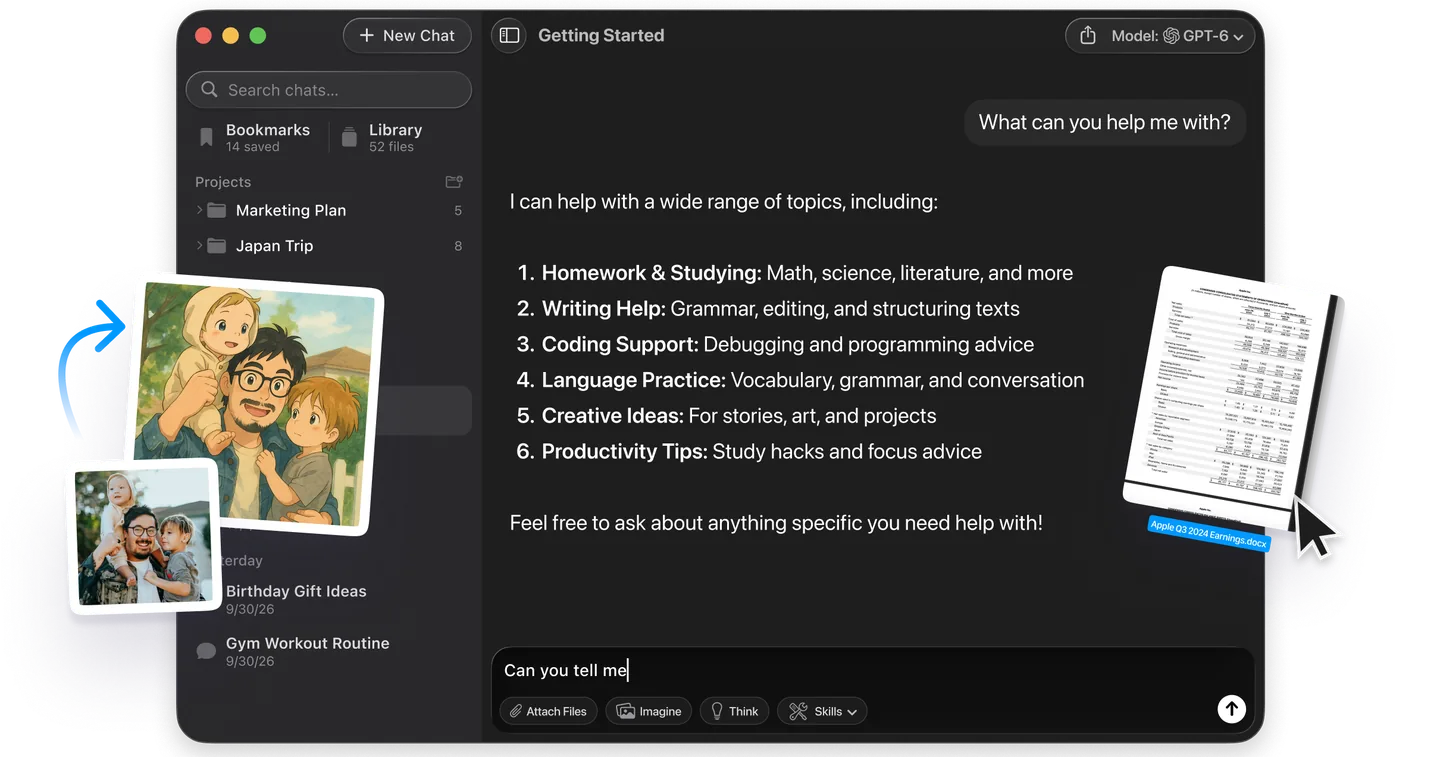
The third camp carries the provider relationship for you, so there is no key to create, no prepaid balance to top up and no meter to watch. Fello AI works this way, bundling the major models into one native Mac and iPhone app at $9.99 a month. The trade is the mirror image of BoltAI’s: you give up direct control of the provider account, and in exchange the bill is predictable and nothing breaks when a vendor changes how keys work. For a wider survey of what these apps do and how they differ, see our roundup of the best AI menu bar apps for Mac, and our comparison of multi-model Mac apps.
The Risk Nobody Prices: The Rules Underneath a Key Can Change
Every cost comparison on this subject treats the decision as arithmetic. It is not only arithmetic, because one side of it depends on a policy the vendor can rewrite. This is the part of the decision that no other guide on this topic covers, and 2026 supplied two clear demonstrations of it.
Both came from Anthropic, and neither arrived with much warning.
February 2026: Anthropic draws a line
In February 2026, Anthropic clarified its position on how third-party software may authenticate. Its published policy now states that OAuth sign-in is “intended exclusively for purchasers of Claude Free, Pro, Max, Team, and Enterprise subscription plans” and is meant to support ordinary use of Claude Code and Anthropic’s own applications. Developers building on Claude, including those using the Agent SDK, “should use API key authentication”. The company does not permit third-party developers to offer Claude.ai login inside their apps, or “to route requests through Free, Pro, or Max plan credentials on behalf of their users”, and it reserves the right to enforce this “without prior notice”. The full text sits in Anthropic’s legal and compliance page.
It is worth being precise about who that restriction targets, because the loose version of this story went around at the time and it is wrong. The rule is aimed at developers routing other people’s requests through consumer plans. The same policy explicitly says it does not prevent an end user from signing in to the unmodified Claude Code binary with their own subscription. Reporting at the time, including The Register on 20 February 2026, noted that some third-party tools dropped Claude support in response. If you want the Claude-specific version of this cost question, we cover it in our guide to whether Claude Code is free.
June 2026: a change announced, then paused
The second demonstration is better, because it shows the rules moving in both directions. Anthropic announced that from 15 June 2026, Agent SDK and claude -p usage would stop counting toward a Claude plan’s usage limits, with monthly credits offered instead on Pro, Max, Team and Enterprise plans. Then it paused the change. The help page now carries an update saying the changes are on hold and that “for now, nothing has changed”, with that usage still drawing from subscription limits. You can read the current state in Anthropic’s Agent SDK help article.
Neither event is a scandal, and neither should stop anyone from using an API key. The point is narrower and more useful: if your setup depends on a particular authentication route staying available, you are relying on something the vendor is actively revising. Price that in. A workflow you can rebuild in ten minutes is fine. A workflow you have spent a weekend wiring together is a different kind of bet.
How to Keep an API Key From Costing You Money You Did Not Plan
A key is not a password. A password lets something read your account. A key lets software spend your money, with the bill in your name, and it will keep doing so quietly until someone stops it. That is not a reason to avoid keys. It is a reason to set them up properly the first time.
Four habits worth having
First, create a separate key for every app. When you uninstall the app, or it changes hands, you revoke one key instead of auditing everything you own. Second, set a spend cap in the provider’s dashboard rather than trusting yourself to check. OpenAI notes that rate limits, monthly usage limits and enforced spend limits sit apart from your prepaid balance, so a cap is a genuine backstop.
Third, prefer prepaid. Anthropic bills Claude API and playground usage through prepaid credits you buy in advance, and OpenAI states that new API accounts use prepaid billing. Monthly invoicing in arrears exists, but it is an enterprise arrangement, not the default you will land on. A balance you top up deliberately cannot run away from you the way an open-ended monthly invoice can. Fourth, treat the key as a secret that belongs on one machine. Anything that asks you to paste it into a web page, a shared document or a chat window deserves a hard no.
So Which One Do You Actually Need?
If you chat with AI most days, want voice, memory and file handling, and would rather not think about any of this again, the subscription is the right purchase. The key would be a downgrade dressed up as a saving.
If you use AI in short bursts a few times a week, mostly for text, and you already own an app that takes a key, the meter will cost you less than $20. Take it.
If you are paying for several plans at once, the honest first move is not to buy anything. Work out what you are actually using first, which is what our AI subscription audit is for. And if the appeal of a key is mostly that you want every model in one window without three separate plans, that is a problem an app can solve without handing you a credential to manage. Fello AI takes that approach at $9.99 a month, with the major models included and no API keys to create, rotate or worry about when a vendor rewrites its rules.
Frequently Asked Questions
Does ChatGPT Plus include API access?
No. OpenAI runs ChatGPT and the API platform as separate billing systems, and states that API usage is billed separately from your ChatGPT subscription. Paying for Plus does not create API credit, and creating an API key does not give you a ChatGPT plan. They are two accounts and two bills.
Does a Claude Pro or Max plan include the Claude API?
No. Anthropic’s help centre states that a paid Claude subscription does not include access to the Claude API or Console, and describes them as separate products for different purposes. To use both, you subscribe to the plan and set up Console billing separately, which runs on prepaid usage credits.
Is an API key free?
Creating one is free. Using it is not. Both OpenAI and Anthropic run new API accounts on prepaid billing by default, so you buy credit before your requests will go through, with monthly invoicing reserved for enterprise accounts. Google’s Gemini API is the exception worth knowing about, since it does offer a free tier with limits before you move to paid usage.
Is it safe to paste my API key into a third-party app?
It is safe enough if you treat the key as something that can spend money, because it can. Use a separate key for each app, set a spend cap in the provider dashboard, keep the key on one machine, and revoke it the moment you stop using the app. Never paste a key into a web page or a shared document.
Can two people share one API key?
Technically yes, and it is a bad idea. Usage from both people lands on one bill with no way to tell whose was whose, and you cannot revoke one person’s access without breaking the other’s. The cost does not double automatically, since you pay for tokens rather than seats, but the accounting and the security both get worse.