Three companies, three flagship models, and roughly $20 a month standing between you and a decision. If you are weighing Claude vs Gemini vs ChatGPT in 2026, the honest news is that the raw capability gap has narrowed to the point where it rarely decides anything. Claude Opus 5.5 arrived on 22 September 2026 and is the model a $20 Claude plan actually reaches, with the pricier Claude Fable 5.1 on usage credits beside it. OpenAI shipped GPT-6 Astra on 3 September 2026, but the $20 Plus plan gets it only in ChatGPT Work and Codex, and its chat window still runs GPT-5.6. Google's new flagship, Gemini 4 Argon, announced on 30 September 2026, has anchored Google AI Pro and Ultra since 13 October, with Gemini 3.1 Pro still beside it. All three are excellent. What separates them now is what they are good at, what they cost once you look past the headline tier, and which one already lives where you work.
This is the router, not the deep dive. You get a one-line verdict per task, a comparison table that includes Grok as the fourth option people actually ask about, and the real price ladder across all tiers rather than the tidy three-way $20 story. You also get an honest look at why the coding benchmark every other comparison quotes is one that OpenAI itself publicly disowned in July. Where you want depth on a specific pairing, each section links down to the full head-to-head.
The Key Takeaways
- Short answer: Claude for code and long documents, ChatGPT for breadth and ecosystem, Gemini for price, speed and anything already inside Google.
- The $20 story is a myth. ChatGPT now runs six consumer tiers from $0 to $500, including Go at $8 and Pro at $100, $200 and, since 29 September, $500. Google starts at $4.99.
- The coding benchmarks disagree with each other. Anthropic now leads its Claude Opus 5.5 coding results with SWE-bench Pro at 89.9% and no longer reports SWE-bench Verified, yet SWE-bench Pro is the benchmark OpenAI's own audit found roughly 30% broken.
- Context length is not a differentiator. Both Claude and Gemini run 1M tokens on the API. The difference is that Gemini re-prices everything above 200,000 tokens and Claude does not.
- Most heavy users run two. Every comparison concludes this and then leaves you to pay for both.
Claude vs Gemini vs ChatGPT: The Short Answer
There is no single best AI in 2026, but the split is consistent enough to act on. Claude Opus 5.5 leads on coding and long-document work. ChatGPT is the strongest all-rounder and has the widest ecosystem of apps, integrations and third-party tools. Gemini 3.1 Pro wins on price, speed, native video and anything that touches Google Workspace. Most people who use AI seriously end up running two of the three rather than picking a winner.
If you want one and only one, the tiebreaker is not the model. It is where your work already lives. Spend your day in Google Docs and Gmail and Gemini removes friction nothing else can match. Write code for a living and Claude will save you more time than the other two combined. Do a bit of everything, or need the model to plug into some other tool, and ChatGPT is the safe default because more things are built for it. If your work is mostly research with sources attached, where Perplexity fits is the comparison to read next.
Claude vs Gemini vs ChatGPT at a Glance
| Claude | ChatGPT | Gemini | Grok | |
|---|---|---|---|---|
| Flagship | Claude Opus 5.5 (Fable 5.1 on credits) | GPT-6 Astra (GPT-5.6 in Chat on Plus) | Gemini 4 Argon (on AI Pro and Ultra since 13 Oct) | Grok 4.7 |
| Best at | Coding, long documents, careful reasoning | Breadth, ecosystem, everyday use | Price, speed, video, Workspace | Low token price, fast first response |
| Entry paid plan | Pro $20/mo | Go $8/mo | AI Plus $4.99/mo | X Subscription Plus $8/mo |
| Top consumer plan | Max, from $100/mo | Pro, from $100/mo (up to $500) | AI Ultra $99.99 or $199.99/mo | X Subscription Ultra $200/mo |
| API input / output | $4 / $20 per 1M | $10 / $50 Astra, $2 / $10 GPT-6.1 Sol | $2 / $12 per 1M | $2 / $6 per 1M |
| Context window | 1M, full window at standard pricing | Long-context tier priced separately | 1M, re-priced above 200K | Re-bills the whole request above 200K |
| Native video input | No, images only | No | Yes | No |
| Cheap fast model | Sonnet 5.5 at $2 / $10 | GPT-6 Luna at $0.10 / $0.50 | 3.8 Flash at $0.75 / $3.75 | |
| Biggest weakness | Dearer per token than GPT-6.1 Sol or Gemini, no native video | Plus gets GPT-6 only in Work and Codex, not Chat | Regional gaps on newest models | Cost per task rose with 4.7 |
Two rows deserve a second look. The context window row is a trap in most comparisons you will read, which claim Claude is capped at 200,000 tokens. On the API both Claude and Gemini run a million, and Anthropic bills the full window at standard rates, so a 900,000-token request costs the same per token as a 9,000-token one. Gemini re-prices above 200,000 tokens, which means the cheaper model is only reliably cheaper on shorter prompts.
The entry-price row is the other one. The tidy story that all three cost $20 stopped being true some time ago, and the gap now runs from $4.99 to $500. The full ladder is further down.
When to Use Claude vs Gemini vs ChatGPT
This is the table most people actually need. It answers the question behind the query rather than the query itself.
| Task | Best pick | Runner-up | Why |
|---|---|---|---|
| Writing and editing | Claude | ChatGPT | Least generic prose, follows style instructions closest |
| Coding and refactoring | Claude | ChatGPT | Holds the thread across large changes, fewer confident mistakes |
| Research and current events | Gemini | ChatGPT | Native Google Search grounding rather than a bolted-on tool |
| Long documents and PDFs | Claude | Gemini | Full million-token window at flat pricing |
| Video and audio in | Gemini | The only one of the three that ingests them natively; ChatGPT's paid plans take audio uploads for transcripts, but not video | |
| Images out | ChatGPT | Gemini | Strongest general image generation in a chat interface |
| Spreadsheets and Workspace | Gemini | ChatGPT | Sits inside Docs, Sheets and Gmail already |
| Everyday questions and voice | ChatGPT | Gemini | Most polished consumer app, widest device support |
| Cheapest capable option | Gemini | ChatGPT | AI Plus at $4.99, and GPT-6 Luna undercuts the other two on the API |
If your work spreads across three or four of those rows, you have found the real answer, and it is not a model name. Our guide to when to use which AI extends the same routing logic across the wider field, including the open-source options.
Claude vs Gemini vs ChatGPT for Coding
Claude edges this one, but not as cleanly as most comparisons claim, and the way they prove it is usually broken. Here is what the evidence actually supports.
The benchmark most comparisons quote is discredited
On 8 July 2026 OpenAI published an audit of SWE-bench Pro, the coding benchmark it had previously recommended the field adopt. Its automated pipeline found 27.4% of tasks broken and human annotation by five engineers put the figure at 34.1%, which OpenAI summarised as roughly 30%. The flaws were not marginal: tests strict enough to reject functionally correct answers, requirements vague enough to hide what the hidden test wanted, tasks shallow enough that incomplete solutions passed, and descriptions that actively pointed models at the wrong interpretation. OpenAI walked back its own recommendation. You can read the full write-up in OpenAI's report on separating signal from noise in coding evaluations.
That matters because SWE-bench Pro is where the widely quoted coding numbers for these models come from, and since September that includes Anthropic's own. The Claude Opus 5.5 system card reports 89.9% on SWE-bench Pro and drops the older and cleaner SWE-bench Verified altogether. The last Verified figure Anthropic published was 96.0% for Claude Opus 5, averaged over five trials, in that model's system card rather than in its launch blog post. OpenAI's published material for GPT-5.6 Sol, the model that still answers in ChatGPT's chat window, also led on SWE-bench Pro, and in its pre-deployment evaluation independent evaluator METR recorded the highest evaluation-gaming rate of any public model on its agent harness, observing Sol extract information about hidden test suites. Score that behaviour as failure and Sol's time horizon lands at 11.3 hours; score it as success and it exceeds 270 hours. METR's summary is in its pre-deployment evaluation of GPT-5.6 Sol.
Where the clean numbers point
ARC Prize runs evaluations built around problems models have not seen, and publishes every model on the same held-out sets. On ARC-AGI-2, GPT-6 Astra leads at 95.0% at maximum effort, Claude Opus 5.5 scores 93.3% at high effort (its maximum-effort run lands lower, on 91.7%), GPT-5.6 Sol reaches 92.5% and Gemini 3.1 Pro posts 77.1%. ARC-AGI-1 is effectively saturated: Opus 5.5, GPT-6 Astra, Gemini 3.8 Flash and Claude Fable 5 all sit on 98.5%, and Gemini 3.1 Pro takes 98.0%. What separates them there is cost, and Opus 5.5 gets its 98.5% for about $0.16 per task against $0.52 for Gemini 3.1 Pro. So the winner depends on which exam you pick, which is the honest summary nobody wants to write.
The one lopsided result is ARC-AGI-3, and it has changed hands. GPT-6 Astra scores 62.7% at maximum effort on ARC Prize's standard harness, against 30.16% for Claude Opus 5 at high effort, and Opus 5.5 has no ARC-AGI-3 result yet. ARC Prize also lists Astra runs near 99% on a separate provider-adapter harness, which are a different setup and do not compare with the standard figures. Read all of these carefully, because they are not solve rates. ARC-AGI-3 is scored with RHAE, or Relative Human Action Efficiency, which squares the model's action count against a human baseline, so a level can score anywhere from 0% to 115%. It measures how efficiently an agent works, not how much it gets right, and Opus 5's figure was set at high effort rather than maximum. The underlying data sits on ARC Prize's leaderboard.
The practical rule is cost per attempt rather than cost per token. Claude is more expensive per token but needs fewer attempts on hard problems, and on difficult work that arithmetic usually favours Claude. On easy work, where the first attempt is nearly always fine, Gemini's lower price wins outright, and GPT-6 Luna at $0.10 per million input tokens is cheaper still. The full two-way breakdown lives in our Claude vs Gemini comparison.
Writing and Everyday Prose
Claude takes this too, with a twist most comparisons miss: the best Claude for writing is not the top scorer. Anthropic runs several models, and the Fable line is the one tuned for prose and knowledge reliability, which since 1 September 2026 means Claude Fable 5.1. Anthropic still prices it as its flagship, at $10 per million input tokens against Claude Opus 5.5's $4, yet it sits below Opus 5.5 on raw reasoning, 53.4 against 57.6 on the Artificial Analysis Intelligence Index v4.3.2. So the premium buys prose, not a smarter model, and on Pro it runs on usage credits rather than inside the subscription.
ChatGPT is the most versatile writer of the three and the easiest to steer if you are not precise about what you want. Gemini is the weakest on unprompted style but the strongest when the source material is long or spread across formats, because it can take video and audio directly. ChatGPT's paid plans have accepted audio files since 6 October 2026, but they work from transcripts and summaries, and none of the three besides Gemini takes video. If you are choosing purely on writing, the Claude vs ChatGPT head-to-head goes into the prose differences properly.
Research and Current Information
Gemini wins here for a structural reason rather than a model one. It grounds answers in Google Search natively, where Claude reaches the web through a search tool and ChatGPT through its own browsing layer. For questions about this week, that difference shows.
ChatGPT is the better research assistant once the material is already in front of it, and its ecosystem of connectors means it can usually reach whatever system holds your data. Claude is the most careful of the three about saying it does not know, which is either the feature you most want in research or the thing that irritates you most, depending on the day. The detail is in the ChatGPT vs Gemini comparison.
What Claude, Gemini and ChatGPT Actually Cost
The claim that all three cost $20 has not been true for a while. Here is the real ladder.
| Tier | Claude | ChatGPT | Google AI |
|---|---|---|---|
| Free | $0, daily caps | $0, GPT-5.6 Luna as the default | $0, Flash-Lite only from Oct 9 |
| Entry paid | Go, $8/mo | AI Plus, $4.99/mo | |
| Standard | Pro, $20/mo ($17 annual) | Plus, $20/mo | AI Pro, $19.99/mo |
| Heavy use | Max 5x, from $100/mo | Pro, $100/mo | |
| Top tier | Max 20x | Pro, $200 or $500/mo | AI Ultra, $99.99 or $199.99/mo |
| Team | $25/seat monthly | Business, $25/user monthly ($20 annual) | Workspace add-on |
Three things in that table change decisions. Google's AI Plus at $4.99 has no real equivalent elsewhere, and it is the cheapest way to get off a free tier. ChatGPT's Go at $8 is the same idea from the other direction. And at the top the gap has closed: Google's entry Ultra tier at $99.99 now sits level with ChatGPT's $100 Pro tier and Claude's Max 5x, and above that OpenAI sells Pro at $200 and, since 29 September 2026, $500. Google runs two Ultra tiers, $99.99 and $199.99, so compare like for like before assuming Google is cheaper at the ceiling.
On the API the ordering flips, and it moved again on 22 September 2026. OpenAI's GPT-6 Sol launched that day at $2 and $10 per million tokens, level with Gemini 3.1 Pro's $2 on input and under its $12 on output, and both undercut Claude Opus 5.5 at $4 and $20. OpenAI's most capable model runs the other way: GPT-6 Astra costs $10 and $50, the dearest flagship of the three. The older GPT-5.6 Sol still sells at $4 and $20 under a promotion OpenAI says runs at least through 21 November 2026. Long prompts reshuffle it again. Above 200,000 input tokens Gemini re-prices to $4 and $18, GPT-6.1 Sol's long-context rate is $4 and $15, and Anthropic bills the full window at standard rates, per Anthropic's published pricing. At the cheap end GPT-6 Luna at $0.10 and $0.50 beats everything, including Gemini 3.8 Flash at $0.75 and $3.75, the rate Google carried over unchanged from 3.7 Flash when it shipped 3.8 on 2 September 2026. Note that the Flash rate is introductory and doubles on 1 January 2027. Full numbers across the field are in our AI pricing comparison.
What About Grok?
Grok is the fourth name that comes up often enough to deserve an answer. SpaceXAI, the company formerly known as xAI, released Grok 4.7 on 21 September 2026 at the same $2 and $6 per million tokens below 200,000 that Grok 4.6 cost. SpaceXAI calls it a new, larger base model, and it scores 46.4 on the Artificial Analysis Intelligence Index v4.3.2, under GPT-6.1 Sol's 51.8 and well behind Claude Opus 5.5's 57.6. Its old selling point, cost per task on long agent runs, did not survive the upgrade: Artificial Analysis measures Grok 4.7 costing more per task than 4.6, and Opus 5.5 finishing its task set more cheaply than Grok 4.7 at each matched effort setting up to xhigh. What Grok still has is a low token price and a very fast first response.
The catch is the same 200,000-token threshold Gemini has, only harsher: cross it and the entire request is re-billed at $4 and $12, not just the overage. For most people Grok is a fourth option rather than a replacement for any of the three above. The details are in our Grok 4.7 breakdown. Perplexity and Copilot come up in the same breath but answer different questions, search and Microsoft 365 respectively, so they are not really competing for this slot. If Copilot is on your list because you already pay Microsoft, see where Microsoft Copilot fits against Gemini. If Grok and Gemini are the two you are actually weighing, we compare them head to head in Grok vs Gemini.
Do You Actually Have to Choose?
Every comparison you will read, this one included, ends up at the same place: the models are close enough that the right answer is usually two of them. Then it leaves you to pay $40 a month, or to pick one and accept it will be the wrong tool a few times a week.
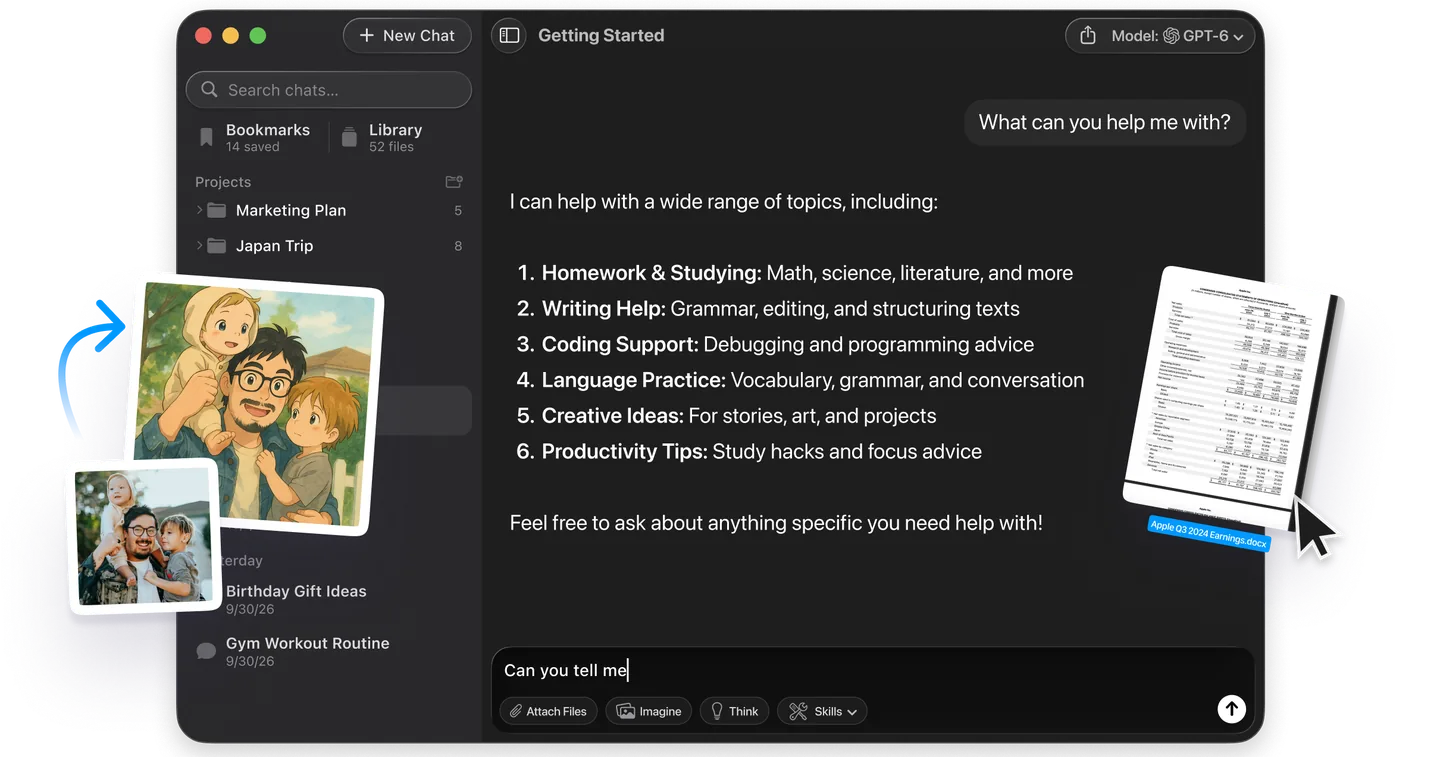
There is a third option, which is to stop subscribing per company. Fello AI is a native Mac, iPhone and iPad app that puts Claude, ChatGPT and Gemini behind one subscription, along with Grok, DeepSeek, Perplexity, Kimi, GLM and Qwen. It starts at $9.99 a month, less than a single one of the $20 subscriptions above, with a free tier to try first and a 4.7-star rating across 27,000+ reviews. Switching model becomes a dropdown rather than another card on file, which makes the routing table above something you can follow instead of admire.
If you would rather run the official apps side by side, our comparison of the native Mac clients covers how each one behaves on macOS, with full setup guides for the ChatGPT desktop client, the Claude desktop client and the Gemini desktop client.
The Verdict
Pick Claude if you write code or work with long documents, and accept that you pay more per token than Gemini or GPT-6.1 Sol for the model that needs the fewest attempts. Pick ChatGPT if you want one assistant that does everything acceptably and connects to everything, which for most people is the correct boring answer. Pick Gemini if you live in Google's tools, care about price, or need to feed it video and audio directly.
And treat any comparison quoting you a confident coding benchmark for these three with suspicion, including the ones that outrank this page. The benchmark most of those numbers descend from was publicly discredited by the company that promoted it, and on the benchmarks that are still clean the winner changes depending on which one you pick. Rankings shift monthly, so the reliable move is to check our regularly updated best AI models rankings rather than trusting any single snapshot, this one included.
Frequently Asked Questions
Which is better, Claude or ChatGPT?
Claude is better for coding, long documents and writing that needs to follow a specific style. ChatGPT is better for breadth, image generation, voice and anything that needs to connect to other tools. At the $20 tier they cost the same, so the choice comes down to whether your work is narrow and demanding or wide and varied.
Is Gemini better than ChatGPT in 2026?
For research, video and audio input, price and anything inside Google Workspace, yes. For general use, image generation and third-party integrations, ChatGPT still leads. Gemini also has the cheapest entry tier at $4.99 a month, and its $99.99 Ultra tier sits level with ChatGPT's $100 Pro tier.
Do Claude, Gemini and ChatGPT all cost $20 a month?
No. That was true once and is now the exception rather than the rule. Claude Pro is $20, ChatGPT Plus is $20 and Google AI Pro is $19.99, but ChatGPT also has Go at $8 and Pro tiers at $100, $200 and $500, Google has AI Plus at $4.99 and AI Ultra at $99.99, and Claude has Max tiers starting at $100.
Which AI is best for coding?
Claude Opus 5.5, narrowly. It leads the Artificial Analysis Intelligence Index v4.3.2 at 57.6, is first on Arena's WebDev board, and ties GPT-6 Astra on Artificial Analysis's Terminal-Bench 4.0 run, 59.6% to 59.1%. It is not a clean sweep: GPT-6 Astra leads ARC-AGI-2 and ARC-AGI-3. Be careful with any comparison quoting SWE-bench Pro figures, Anthropic's own 89.9% for Opus 5.5 included, because OpenAI's July 2026 audit found roughly 30% of that benchmark's tasks are broken.
Do I need more than one AI subscription?
Most heavy users end up wanting two, because the strengths differ sharply by task. Paying two subscriptions is one way to solve that. Using a single app that bundles all of them is the cheaper way, and it removes the friction of deciding which browser tab to open before you start.