An AI PDF reader answers questions about a document instead of just displaying it. That one change turns a 90-page report from something you skim at midnight into something you interrogate in a minute. Upload the file, ask what the Q3 revenue figure was, and the answer arrives with the surrounding context instead of a page number.
The category has grown messy. Search for an AI PDF reader today and the results mix three different products under one name: tools that analyze documents, tools that read them aloud, and general PDF editors with a chat box bolted on. This comparison covers eight of them, sorts out which does which, and answers the question almost no roundup addresses: where does your file actually go once you upload it? If the document you have in mind is a large one, check it against the file size each chatbot actually accepts first.
The Key Takeaways
- Two categories, one name: analytical readers summarize and answer questions, audio readers turn the file into speech. Buying the wrong one is the most common mistake in this category.
- Most options are websites: six of the eight tools here require uploading your document to a company server before anything happens.
- Native apps are rare: almost every tool ranking for this search is a web app or a browser extension. Fello AI runs natively on Mac, iPhone and iPad for $9.99 a month.
- Reading is not editing: most AI PDF readers answer questions but cannot merge, compress or password-protect the file afterward.
- Scanned files are the real test: a PDF made from photographs needs OCR before any model reads it, and that is where accuracy quietly breaks down.
What Is an AI PDF Reader?
An AI PDF reader is a tool that interprets a PDF's content rather than only rendering it on screen. Instead of scrolling, you ask questions and get answers drawn from the document, along with summaries, extracted tables and translations. Some also read the file aloud, which is a separate category worth knowing about before you subscribe.
Analytical readers versus audio readers
Analytical tools parse the text and feed it to a language model. You ask, they answer, and the useful output is understanding: a summary, a figure pulled from a table, a comparison between two contracts. This is what most people mean by the term.
Audio tools do something different. They convert the document to speech so you can listen while walking or commuting. The useful output is time, not understanding. Tools like ElevenReader, Speechify and NaturalReader compete here, and none of them summarizes especially well. If listening is your goal, our guide to turning documents into an AI-generated podcast covers that ground properly.
What separates it from a normal PDF viewer
Preview, Acrobat Reader and every browser render pages. They find literal strings when you press Command F, and that is the limit. An AI PDF reader works on meaning, so a question phrased in your own words still lands even when the document uses different vocabulary. Ask about "staff costs" and it finds the section headed "personnel expenditure" without you guessing the phrasing.
The 8 Best AI PDF Readers Compared
Prices move constantly in this category and vendors change their packaging several times a year, so the table below compares capability and data handling rather than quoting figures that go stale. Check each vendor's own pricing page before you commit.
| Tool | Platform | Free tier | Chat with the file | Edits or converts files | Where your file goes |
|---|---|---|---|---|---|
| Fello AI | Mac, iPhone, iPad | No, subscription | Yes | Yes, 12 operations | Saves to your device |
| Adobe Acrobat AI Assistant | Windows, Mac, web | Trial only | Yes | Yes, full editor | Adobe cloud |
| ChatPDF | Web | Yes, capped | Yes | No | Vendor servers |
| Smallpdf | Web, desktop | Yes, capped | Yes | Yes, conversions | Vendor servers |
| PDF.ai | Web, API | Yes, capped | Yes | Parse and split | Vendor servers |
| SciSpace | Web | Yes, capped | Yes | No | Vendor servers |
| UPDF | Windows, Mac, iOS, Android | Trial only | Yes | Yes, full editor | Cloud for AI features |
| PDFgear | Windows, Mac, iOS, Android, web | Yes, fully free | Yes | Yes, full editor | Local edits, cloud chat |
Which Tool Fits Which Job
Fello AI, for Mac and iPhone users
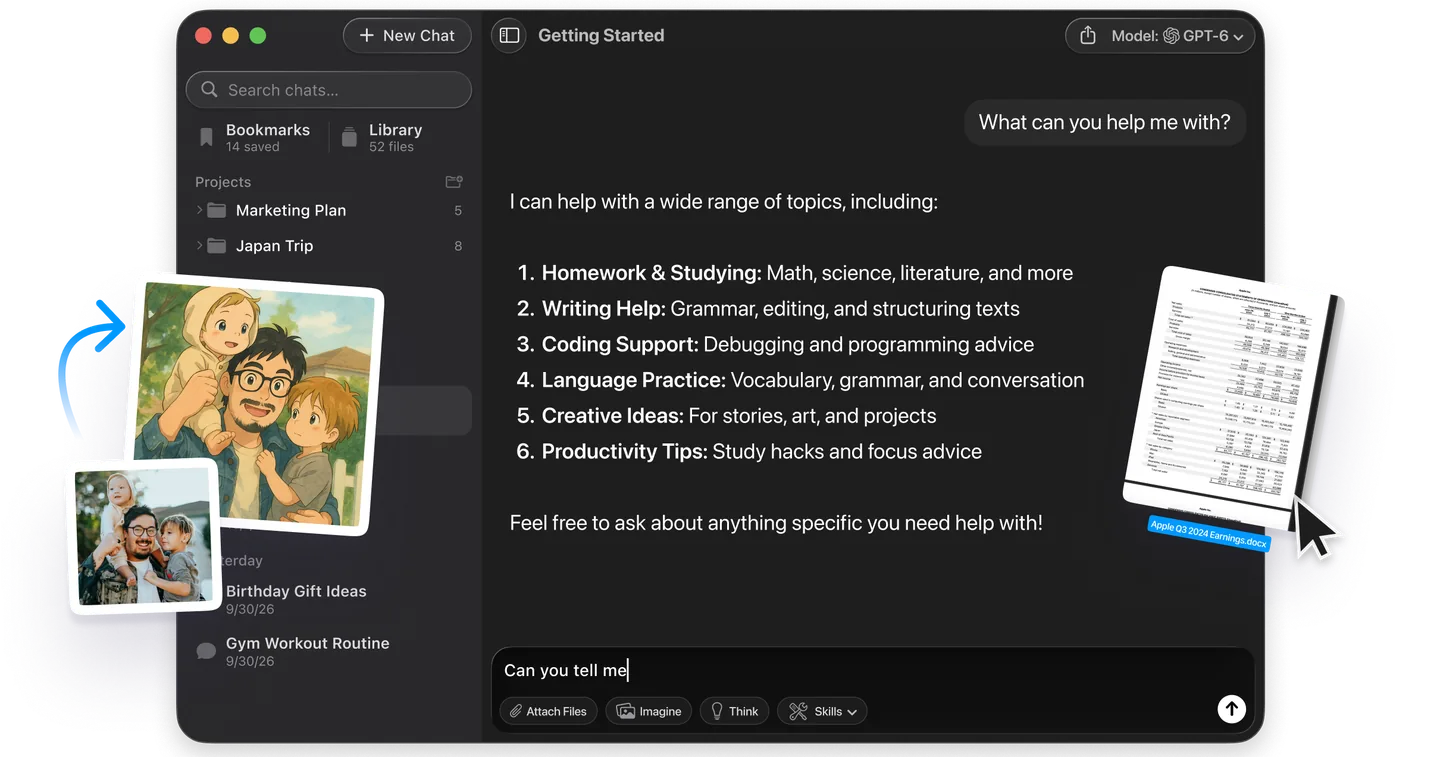
Fello AI is a native Mac and iOS app that puts several frontier models in one window, so the same subscription covers GPT, Claude and Gemini without juggling three logins. Its PDF Skill handles twelve operations including merge, split, compress, watermark, rotate and password protection with AES-256 encryption, and files save straight to your device. The practical advantage is chaining: ask it to merge three reports, compress the result and protect it with a password in a single message, instead of visiting three websites and uploading the same document three times. Full detail lives in our guide to using AI with PDFs. The obvious limitation is platform. There is no Windows version and no browser version, so it fits Apple users and nobody else.
Adobe Acrobat AI Assistant, for existing Acrobat users
Acrobat remains the most complete PDF editor available, and its AI Assistant summarizes, answers questions and cites the page it drew each answer from. Citations matter more than they sound: they let you verify a claim in seconds rather than trusting the summary. Adobe states that customer content does not train the models behind the feature. The cost structure is the drawback, since the AI capability sits behind separate packaging rather than arriving with a standard Acrobat subscription.
ChatPDF and SciSpace, for one document at a time
ChatPDF is the fastest way to ask a single PDF a question with no account and no install. Drop the file in the browser, start typing, done. ChatPDF caps free use, so it suits occasional documents rather than daily work. SciSpace targets academics specifically, handling citation graphs and research paper structure better than general tools, which makes it the pick for literature reviews and little else.
Smallpdf, PDF.ai and the utility tools
Smallpdf began as a conversion utility and added chat later, so it is stronger at turning a PDF into Word or Excel than at reasoning about the contents. PDF.ai leans toward developers with an API for parsing, extraction and splitting at volume. Neither is the tool you reach for when you want a document explained, and both are solid when you want a document processed.
UPDF and PDFgear, for Windows and cross-platform work
UPDF covers Windows, Mac, iOS and Android with one licence and pairs a real editor with an AI layer, which makes it the closest cross-platform equivalent to a native app. PDFgear is the outlier: a free desktop editor with no subscription, doing local editing with cloud-based AI chat. For anyone who edits PDFs often and wants AI occasionally, PDFgear costs nothing and does the job.
Where Your File Actually Goes
This is the question every roundup lists as a bullet point and none of them answers. When you use a browser-based tool, your document leaves your machine. That is not a scandal, it is how a web application works, but it deserves a decision rather than a reflex.
Web tools mean upload, by definition
ChatPDF, SciSpace, PDF.ai and the web side of Smallpdf all receive your file on their infrastructure before anything happens. For a public research paper this is irrelevant. For a signed contract, a medical record or an unreleased financial statement, it is a decision you should make deliberately, and one your employer may already have made for you.
What to check before uploading anything sensitive
Look for three things in a vendor's documentation: how long they retain uploaded content, whether that content trains their models, and whether processing stays in a specific region. Adobe publishes clear answers to all three and states that customer documents do not train its models. Smaller tools frequently publish none of it, and silence is an answer of its own.
The native app difference
A native app changes the shape of the problem rather than eliminating it. With Fello AI the output file writes to your own device instead of a vendor bucket, and nothing sits permanently on a remote server. The text still travels to a model provider for the reasoning step, because that is what a cloud model requires. Anyone who needs a document to never leave the machine at all wants local models, which is a different setup with different tradeoffs.
Can an AI PDF Reader Handle Scanned Files?
Most AI PDF readers handle scanned files through OCR, which converts the page image into text before the model reads it. Accuracy depends on scan quality: clean documents scanned at 300 DPI work well, while faxes, phone photographs, handwriting and rotated pages lose data. Always spot-check extracted numbers against the original before relying on them.
The failure mode here is quiet. A model given a garbled OCR layer produces a fluent, confident summary of text that was never in your document. Numbers suffer worst, because a misread decimal point does not look like an error. When a scanned financial table matters, verify the figures by eye rather than trusting the extraction, and prefer a tool that shows you the source page alongside its answer.
Getting More Out of an AI PDF Reader
Tool choice matters less than how you ask. Vague prompts produce vague summaries, and the difference between a useless answer and a useful one is usually a constraint you forgot to state.
Prompts that work on long documents
- "Summarize this 80-page report in five bullets, focused on financial performance and risk."
- "List every deadline in this contract with the clause number next to it."
- "Extract the revenue table from pages 12 to 14 and keep the column headers."
- "Compare these two versions and list only what changed in the payment terms."
- "Quote the exact sentence that supports your last answer."
That last one is the highest-value habit in this entire article. Asking for the supporting sentence turns a summary you have to trust into a claim you can check, and it exposes hallucination immediately. If you want a deeper walkthrough of the summarizing workflow, we covered it in how to summarize a PDF with AI.
Chaining a document into something else
The strongest use of these tools is not reading, it is conversion into a format someone else needs. A PDF becomes a spreadsheet you can sort, or a deck you can present. Our guides on using AI in Excel and turning a PDF into a presentation pick up where the reading stops.
How to Choose an AI PDF Reader
Answer three questions and the field narrows to one or two options. First, do you want the document understood or read aloud? Analytical and audio tools barely overlap. Second, do you need to change the file afterward, or only ask about it? Merging, compressing and protecting rules out the chat-only websites immediately. Third, can the document leave your machine? A sensitive file rules out browser tools regardless of how good their answers are.
Platform then settles it. Windows users land on Acrobat or UPDF, cost-conscious users on PDFgear, researchers on SciSpace, and Mac and iPhone users on a native app. If you want to try the chat side before deciding anything, our chat with any PDF page walks through it in three steps.
The Verdict
For Mac and iPhone users, Fello AI is the pick. It is the only tool in this comparison that reads a document, rewrites it into another format and performs twelve file operations on it without a single upload to a third-party website, and one $9.99 subscription covers several frontier models rather than locking you to one vendor's.
Outside the Apple ecosystem the answer changes. Windows users who already pay Adobe should turn on AI Assistant and stop shopping, since page-level citations are worth more than any competitor's feature list. Everyone else should install PDFgear, pay nothing, and see whether occasional AI chat is all they needed. The tools to avoid are the chat-only websites, which solve fifteen minutes of one afternoon and leave your document on someone else's server for good.
FAQ
What is the best AI PDF reader for Mac?
Fello AI, because it runs natively on macOS and iOS rather than in a browser tab, gives access to several frontier models under one subscription, and performs twelve PDF operations on top of reading. Acrobat and UPDF are the alternatives if you also work on Windows.
Is there a free AI PDF reader?
Yes. PDFgear is a free desktop app with AI chat included, and ChatPDF, Smallpdf, PDF.ai and SciSpace all offer capped free tiers in the browser. Free tiers suit occasional documents; regular work with long or confidential files hits their limits fast.
Can an AI PDF reader read scanned documents?
Most can, using OCR to convert the page image to text first. Clean 300 DPI scans work well. Faxes, photographs, handwriting and rotated pages lose accuracy, and the resulting summary stays confident even when the underlying text was misread. Check extracted numbers against the original.
Which AI can read a PDF, ChatGPT or Claude?
Both handle PDF uploads, along with Gemini. The difference is workflow rather than capability: a general chatbot reads the document but will not merge, compress or protect the resulting file. A dedicated AI PDF reader does both in one place.
Are AI PDF readers safe for confidential documents?
Browser-based tools require uploading the file to a company server, so treat them as unsuitable for anything sensitive unless the vendor documents retention, training use and processing region. Native apps that save output locally reduce the exposure, though cloud models still process the text itself.