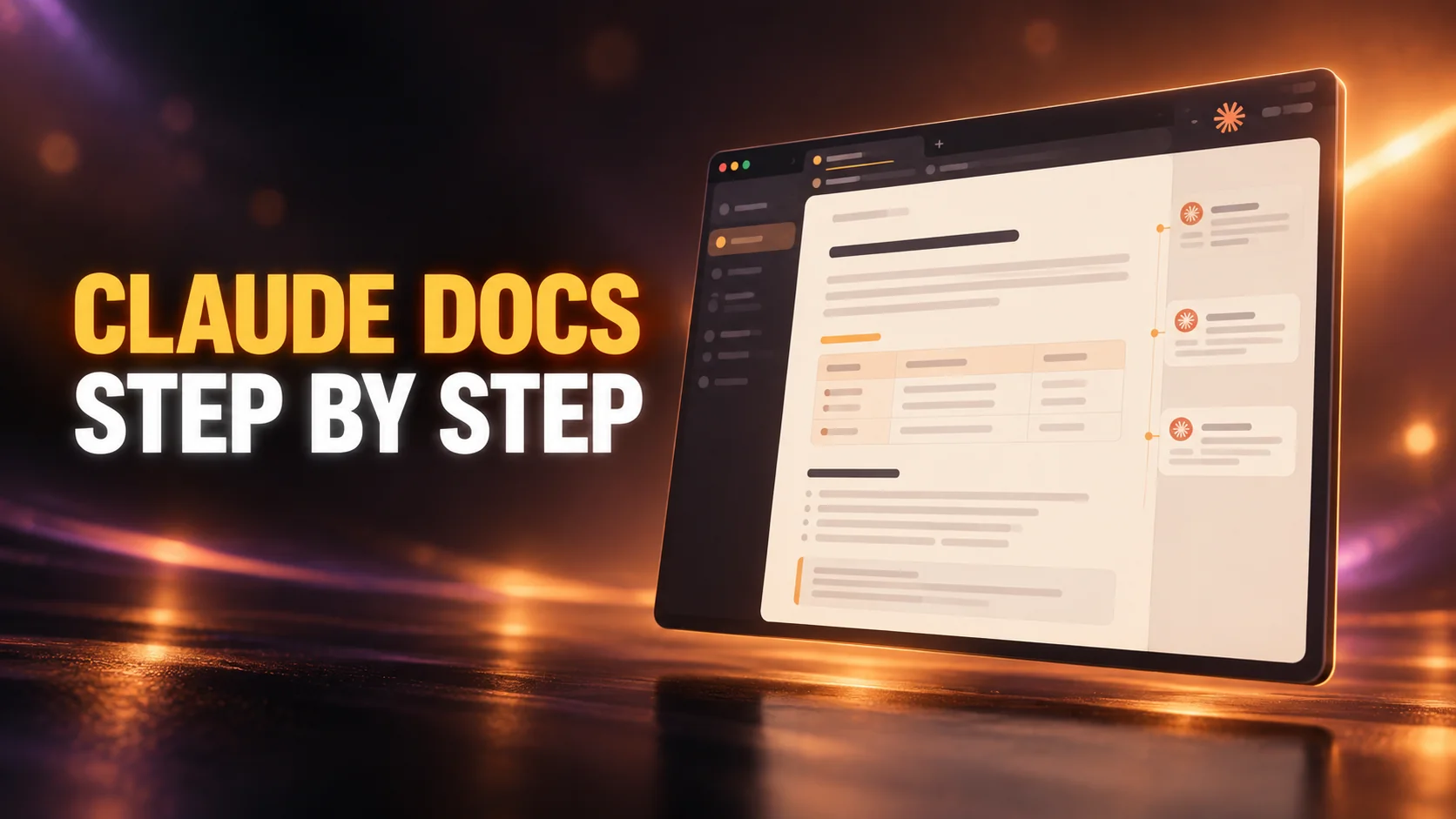
Claude Docs is the document editor Anthropic built into Claude on 16 September 2026. You ask for a doc in any conversation, and Claude drafts it on screen, asks its clarifying questions first and leaves comments in the margin explaining what it chose. You then edit the doc yourself, hand it back to Claude for another pass, or let teammates work on it with you in real time. Since 8 October it's out of beta and on every Claude plan, including Free, and it exports to Word, PDF, Markdown or Google Docs.
Most pages ranking for this product were written in its first week, and several of them are wrong. One says there's no such product and describes Claude's older file-creation feature instead. Two others treat real-time co-editing as unconfirmed, even though Anthropic's help center describes it plainly. This guide follows that help center from start to finish. It covers how to open your first doc, the three ways to edit it and who you can share it with on each plan. It ends with the limits to know before you move a team document into it.
The Key Takeaways
- What it is: a rich-text doc with headings, tables and multiple tabs that Claude drafts from your conversation, files, memory, projects and connected apps.
- Who gets it: every plan, including Free. Anthropic took the beta label off on 8 October, and it's on by default for Enterprise from 15 October.
- How you edit: type directly, ask in the chat, or mention @Claude in a comment. Teammates with edit access work alongside you live.
- Four exports: Word, PDF, Markdown and Google Docs, and Claude can also turn a doc into a Claude Slides deck.
- Still missing: no comment-only role, no sharing outside your company on Team and Enterprise, and a deleted doc is gone for good because there's no trash.
What Is Claude Docs?
Claude Docs is a document that lives in your Claude account rather than in a separate app. Anthropic calls it a way to "write living documents with Claude and the people you work with." A doc can hold headings, tables and other formatting, and it can have more than one tab, like the sections of a notebook. Every doc you make is saved to the Artifacts tab, so you can open it again from any conversation.
It launched as part of a bigger change. On 16 September Anthropic began merging Claude Cowork and ordinary chat into a single Claude, and it shipped Claude Docs and Claude Slides the same day. Claude Design, which has its own walkthrough in our Claude Design guide for the Mac, moved inside conversations too. If you used Cowork for longer jobs, our Claude Cowork guide explains what moved where. The official Claude account put the new trio like this:
You can also now make decks, docs, and designs in your conversation.
— Claude (@claudeai) September 16, 2026
Draft the one-pager in Claude Docs, turn it into a deck with Claude Slides, and mock up a matching visual in Claude Design, all from one place.
Three Different Things Share the Claude Docs Name
Part of the confusion around this search is that three different things answer to the name. Anthropic's developer documentation lives at platform.claude.com, titled Claude Platform Docs, with a separate Claude Code Docs site for the coding tool. That's where searches like claude docs mcp or claude docs prompt caching are meant to go. The second is Claude's link to Google Docs through the Google Drive connector, which we cover further down. The third is the new editor, which is what this guide is about.
Claude Docs Is Not the Same as File Creation
Claude has been able to make files for a while. Ask for a Word document on any plan, including Free, and Claude writes code in a sandbox and gives you a .docx to download. That file is finished the moment you get it. Claude Docs works differently: the doc stays open in Claude, you and Claude keep editing it, comments stay attached, and you export only once it's ready. If you just need a finished file, file creation is still the quicker tool. If you want a draft a team works on together, you need Docs.
Who Can Use Claude Docs?
Claude Docs is on every Claude plan, Free included. Anthropic moved it out of beta on 8 October, along with Claude Slides and Claude Design, after three weeks as a paid-plan beta. Here's the plan-by-plan picture from Anthropic's help center and its Claude pricing page:
| Plan | Price | Claude Docs | Default |
|---|---|---|---|
| Free | $0 | Included | On |
| Pro | $20 a month, or $17 a month billed annually | Included | On |
| Max | From $100 a month | Included | On |
| Team | $25 per standard seat monthly, or $20 billed annually | Included | On |
| Enterprise | Custom | Included | On from 15 October |
Team and Enterprise owners can still switch it off, or on, under Organization settings > Artifacts, and the 8 October update added support for customer-managed encryption keys (CMEK). On every plan, Docs needs Cloud code execution and file creation turned on under Settings > Capabilities. The full price breakdown for each tier is in our Claude pricing guide.
One thing that catches people out: Anthropic's pricing page still lists the merged Claude app as rolling out to Pro and Max, with more plans to follow. If you don't see a Docs option yet, open the Artifacts tab, where the templates live, including the newer Claude Dashboards template. One hands-on tester used the same workaround when the new Output menu didn't load.
How to Use Claude Docs, Step by Step
These are the steps as Anthropic documents them, in the order you meet them.
- Start the doc. Ask for a doc in plain words in any conversation, begin your message with
/docs, or pick Output and then Docs from the message box. You can also open the Artifacts tab and start from a Docs template. - Answer Claude's questions. Claude asks a few questions before it starts writing. Answer them properly, because this is where a generic draft becomes a usable one.
- Watch the draft appear. Claude writes the doc on screen and leaves its own comments explaining choices or asking you to confirm something.
- Edit it one of three ways. Type straight into the doc, ask for changes in the chat ("tighten the intro and add a risks section"), or select text and mention @Claude in a comment.
- Share it. Click Share and give people view or edit access.
- Export it. Click Export and pick Word (.docx), PDF, Markdown or Google Docs.
What Claude Can Draw On
The point of drafting in Claude rather than in a blank editor is context. According to the help center, Claude can use your uploaded files, its memory, your projects, your skills and the apps you've connected. One of Anthropic's own example requests is an onboarding guide built "from the benefits deck in my Google Drive." If your source material already sits in a Claude Project, start the doc from inside that project so Claude has it all.
Comments and @Claude
Comments are the part of Claude Docs that feels most unlike a chatbot. Anyone with edit access can select text and leave a comment for colleagues. Mention @Claude in the thread and Claude replies there, makes the change and explains what it did and why. Every change is attributed to whoever made it, person or Claude. Claude always works with the permissions of the person who asked, so it can't edit a doc on behalf of someone who only has view access.
Charts, Diagrams and Timelines
Instead of pasting screenshots, you can ask Claude to add a chart, diagram, graph or timeline, and it builds one in the doc from your connected apps. There's one catch the help center spells out: charts don't update on their own, even when the data comes from Google Sheets or Salesforce. To refresh one, ask Claude to pull the latest data.
Claude Docs in Claude Code and on Mobile
Docs also work inside Claude Code. Ask it to turn the session you're in into a spec, runbook or readout. On the desktop app the doc opens in the side panel, and in the terminal Claude gives you a web link. Anthropic's developer account described it as a way to point a doc "at the actual files and RFCs in the repo":
Claude Design, Claude Slides and Claude Docs also work inside Claude Code now.
— ClaudeDevs (@ClaudeDevs) September 16, 2026
Ask for a design review deck or a UI mockup and point it at the actual files and RFCs in the repo. Edit it yourself or keep going in the conversation, and share the link when it's ready.
On the iPhone and Android apps you can ask for a doc, open it full screen from the Artifacts tab and, since the 8 October update, edit it. The one job the phone still can't do is change who a doc is shared with, which needs the web or desktop app.
Copy-Paste Prompts for Your First Claude Doc
Anthropic's advice is to say what the doc is for, who will read it and what it should cover, and to name the file or connected app it should use. These four prompts follow that pattern. Swap the brackets and paste.
/docs A two-page launch brief for our [sales team] covering pricing, timing and the top three customer questions about [product]. Use [file name] as the source and flag anything you had to guess./docs Turn the plan we just worked through into a product spec I can share with engineering. One tab for requirements, one for open questions, one for the rollout timeline./docs Draft this week's status report from my notes and last week's numbers. Keep it under one page, lead with what slipped, and add a table of owners and due dates./docs Write a one-page brief for tomorrow's call with [client] from my notes on this account. Add a short timeline of what happened so far and leave a comment on any claim you could not source.The flag-your-guesses line in the first and last prompts matters more than it looks. Asking Claude to flag guesses in comments puts its uncertainty in the margin, where a reviewer will see it, instead of letting it sit silently in the text.
Sharing a Claude Doc: Who Can See and Edit It
Every doc starts private. Sharing works like any other Claude artifact, but Anthropic's help center sets a few rules specific to docs, and they depend on your plan:
| Question | Free, Pro and Max | Team and Enterprise |
|---|---|---|
| Who can you share with? | Anyone with the link | Specific people, a group, or your whole organization |
| Outside your organization? | Yes, by link | Not yet |
| Email invitations? | No | No |
| Does the reader need a Claude account? | Yes | Yes |
There are two access levels. Viewers can read. Editors can read, edit, comment and export. Only the owner can rename or delete a doc. The account requirement is the one that matters most in practice: a client without a Claude login can't open your link, so for anyone outside Claude, export the doc first.
Claude Docs Limits to Know Before You Rely on It
The beta label is gone, but Anthropic still lists known limitations, and a few of them decide whether it can hold a document that matters:
| Limit | What it means for you |
|---|---|
| Deleting is permanent | Anthropic's help center warns there's no trash, and the doc disappears for everyone it was shared with. |
| No comment-only access | Reviewers either read or get full edit rights. |
| Charts don't refresh | Ask Claude to pull new data when the numbers change. |
| No sharing changes on mobile | You can edit on the phone, but sharing settings need the web or desktop app. |
| Compliance logging is incomplete | Edits and comments inside a doc aren't in the Compliance API yet. |
| It uses your plan's allowance | A long doc drafted from several sources uses more than a normal message. |
That last one is easy to underestimate, and more so on Free, which has the smallest allowance. Our explainer on how Claude's usage limits work covers the five-hour and weekly windows that a few long drafts can eat into.
Put together, it's a strong place to draft and a weak place to archive. Draft in Claude, then keep the approved version wherever your team keeps finished documents.
Claude Docs vs Google Docs
Media coverage framed the launch as Anthropic moving onto Google's and Microsoft's turf. As Computerworld reported, Gartner analyst Arun Chandrasekaran said "the likely near-term outcome isn't wholesale replacement of alternative digital workplace tools." Put the two feature lists side by side and it's easy to see why:
| Feature | Claude Docs | Google Docs |
|---|---|---|
| Built-in AI | Claude drafts the whole doc from your chats, files and connected apps | Gemini in Docs, a separate Google feature |
| Version history | Yes | Yes |
| Comment-only reviewers | Not yet | Yes, the Commenter role |
| Email invitations | No | Yes |
| Readers without an account | No, a Claude account is required | Yes, on files shared by link |
The two don't have to compete, because Claude Docs exports straight to Google Docs. The realistic workflow is to draft and argue in Claude, then export to Google Docs when the document needs outside readers, a comment-only reviewer or a long life.
Can Claude Edit Your Existing Google Docs?
Yes, in beta, and this changed after launch. Anthropic's Google Workspace connectors page, as updated on 25 September, says Claude can now edit Google Docs, Sheets and Slides live in a pane beside the chat, while you work in the same file. Turn on the Google Docs connector from the plus sign under Connectors, then paste a link to the Doc or ask for a new Google doc by name. Ask for a doc without naming Google and Claude makes its own file instead.
Claude can also read and work with comments and suggestions in a Google Doc, though it still can't see images inside it. The pane works in Chrome on the web and in the desktop app with its built-in browser turned on; anywhere else, open the file in Google. Your Google sharing permissions still apply, so Claude can only change files your account can already edit. That gives you two routes: edit the Google Doc where it lives, or draft in Claude Docs and export to Google Docs when you're done.
Need a Finished Document Instead of a Shared Draft?
Claude Docs is built for a shared draft that lives inside Claude, and everyone who opens it needs a Claude account. Plenty of people need something simpler: a finished Word file, spreadsheet or deck from a chat, without adding another subscription or switching between apps to compare models.
That's the job Fello AI does on the Mac, iPhone and iPad. Ask for a report, a spreadsheet or a presentation, and you get a real Word, Excel or PowerPoint file back, with Claude, GPT, Gemini, Grok and DeepSeek all in the same app. There's a free tier, and the full version costs $9.99 a month, so you can draft with Claude and check the same document against another model in one window.
Is Claude Docs Worth Using Yet?
Yes, for drafting. The strongest thing about Claude Docs isn't the editor. It's where the draft starts: from everything Claude already knows about your work, with its reasoning and open questions left in the margin as comments. For status reports, specs and briefs that begin as a messy conversation, that's the part a blank editor can't give you.
It isn't yet a home for documents. Without a trash folder, a comment-only role or sharing outside your company on Team plans, the finished version belongs in Word or Google Docs. Open it from Anthropic's getting-started page, try it on next week's status report, and export the result before you share it outside Claude.
Frequently Asked Questions
Is Claude Docs free?
Yes. Since 8 October, Claude Docs is out of beta and included on every Claude plan, Free among them. It counts toward your plan's usage limits, so a long doc drafted from several sources uses up a Free allowance faster than ordinary chat.
How do I open Claude Docs?
Ask for a doc in any conversation, start your message with /docs, or pick Output and then Docs in the message box. You can also start from a template in the Artifacts tab on the web or desktop app.
Can I export a Claude Doc to Google Docs or Word?
Yes. Click Export and choose Word (.docx), PDF, Markdown or Google Docs. Viewers can't export, only people with edit access or the owner.
Can people outside my company open a Claude Doc?
On Free, Pro and Max, anyone with the link can open it, but they need a Claude account. On Team and Enterprise plans, docs can't be shared outside your organization yet, so export a copy for outside readers.
Does Claude Docs have version history?
Yes. Anthropic's help center now describes a version history panel beside the doc, and its only remaining note on it is a keyboard-access gap. Deleting a doc is still permanent, though, because there's no trash, so export a copy before you delete anything.