The digital goods market is worth $157.39 billion in 2026 and is growing at a 26.60% CAGR toward $511.43 billion by 2031, according to Mordor Intelligence. A file you make once sells a thousand times over, with no inventory, no shipping and no restocking. That is why every creator, coach and freelancer is being told to launch one.
The problem was never a shortage of digital product ideas. It is that most lists hand you 125 options and zero help choosing. This guide gives you 40 digital product ideas to sell online, grouped by type, each with a realistic price, the time it takes to build, and the skill it actually requires. Then it shows you how to validate the idea before you waste a weekend on it, and how to make the thing with AI if you cannot design or write.
The Key Takeaways
- Most digital products sell for $5 to $50. Printables sit at $5 to $20, templates at $5 to $40, ebooks at $10 to $40, and courses at $50 to $500+.
- The “90% margin” everyone quotes only holds on expensive products. Flat platform fees mean you keep about 80% on a $5 file but 88% to 90% on a $20 to $50 product.
- Templates and printables are the fastest to launch, often in a weekend. Courses and memberships earn the most per customer but take months.
- Validate before you build. If nobody is already selling a version of your idea, that is usually a warning sign, not a gap.
- The generic market is saturated; the specific one is not. “Budget planner” is crowded. “Budget planner for freelancers with irregular income” is not.
What Counts as a Digital Product
A digital product is any file, download or access pass a customer buys and receives instantly, with no physical object changing hands. That covers a $7 Canva template, a $300 video course, a Lightroom preset pack and a paid community, all sold from the same checkout page.
What matters commercially is the shape of the economics. You pay the cost once, in your own time, then every additional sale costs you almost nothing. That is what makes the category so attractive, and it is also why so many people pile in with a product nobody asked for.
40 Digital Product Ideas to Sell Online
Here are the ten groups that reliably sell, with 40 specific ideas inside them. Scan the table first to find the ones that match your time and skill, then read the section for that group. Price ranges reflect what these products typically list for on marketplaces like Etsy, Gumroad and Creative Market. For a full breakdown of your options, see where to sell digital products.
| Product type | Who buys it | Typical price | Time to create | Skill needed |
|---|---|---|---|---|
| Templates | Creators, job seekers, small businesses | $5 to $40 | A weekend | Low |
| Printables and planners | Students, parents, organisers | $5 to $20 | A weekend | Low |
| Ebooks and guides | Beginners in your niche | $10 to $40 | 1 to 3 weeks | Low to medium |
| Online courses | People with a skill gap and a budget | $50 to $500+ | 1 to 3 months | Medium to high |
| Presets and filters | Photographers, video editors, creators | $10 to $50 | A few days | Medium |
| Stock photos, fonts and graphics | Designers, crafters, marketers | $5 to $30 | Ongoing | Medium |
| AI prompt packs | Creators, teachers, freelancers | $10 to $30 | A few days | Low |
| Audio | Wellness fans, producers, video editors | $10 to $50 | 1 to 2 weeks | Medium |
| Spreadsheets and calculators | Freelancers, small businesses, budgeters | $10 to $40 | A weekend | Low to medium |
| Memberships and communities | Your existing audience | $5 to $50 per month | Ongoing | High |
Templates
Templates are the single best starting point, because the buyer is not paying for art, they are paying to skip a blank page. The four that sell hardest are social media carousel and post templates for Canva, Notion dashboards like second-brain systems and client CRMs, resume and cover letter templates, and pitch deck templates for founders.
Resume templates are the quiet winner here. The buyer has an urgent deadline, a clear outcome and no interest in designing anything themselves, which is the perfect combination for a $15 file. Editable Canva templates for social media and small business are consistently among the best-selling digital categories on Etsy.
Nobody buys a template. They buy the two hours it saves them.
Printables and Planners
Printables are cheap, instantly useful and bought on impulse. The reliable four are ADHD and wellness planners, budget trackers, meal planners with grocery lists, and printable party games and party kits. They sit at the $5 to $20 mark, so volume and bundling matter more than a high price tag.
We built one of these ourselves to see how far AI could carry the work, and the answer was most of the way. Read how we created a printable murder mystery case file using AI for the full build, including the parts the model got wrong. It is a good template for any printable that needs both writing and artwork.
Ebooks and Guides
An ebook is the classic first product because the barrier is knowledge, not software. The versions that sell are niche how-to guides, recipe collections, career and interview guides, and industry playbooks aimed at people entering a field. Note the word niche. A general guide to productivity competes with everything ever written; a guide to productivity for night-shift nurses competes with almost nothing.
Price them at $10 to $40 and keep them short. Buyers reward a 30-page guide that solves one problem over a 200-page book that surveys a field, and short guides are far quicker to write, test and revise.
Solve one problem completely. That is the whole brief.
Online Courses and Mini-Courses
Courses earn the most per customer and cost the most to make. The four formats worth considering are a full video course, an email mini-course delivered over five to ten days, a recorded workshop, and a skill bootcamp with exercises and feedback. At $50 to $500 and up, one course sale is worth thirty template sales.
The email mini-course is the underrated option here. It needs no camera, no editing and no course platform, it takes about a week to write, and it doubles as the best lead magnet for everything else you sell.
Presets and Filters
If you can make a photo or a video look like a specific thing, you can sell that look. The market wants Lightroom presets, video LUTs for colour grading, mobile photo filter packs, and Photoshop actions. Presets are pure leverage, because the file is tiny and the perceived value is the aesthetic, not the bytes.
The catch is that a preset only sells if buyers can see it working. Your before-and-after images are the product as far as the customer is concerned, so budget more time for the sales page than for the preset itself.
You are selling the after photo, not the file.
Stock Photos, Fonts and Graphics
This group covers stock photo bundles, icon sets, display fonts, and SVG and PNG cut files for crafters. Cut files and clipart are among the most dependable sellers on Etsy, because buyers use them immediately and come back for the next occasion, season or hobby.
Bundling is the whole strategy in this category. A twenty-file pack at $5 to $12 raises your average order value and outperforms selling the same files one at a time for a dollar or two.
AI Prompt Packs
Prompt packs are the newest category on this list and the cheapest to produce. The ones with real demand are image prompt packs for a specific visual style, marketing and copywriting prompt packs, lesson-plan prompts for teachers, and resume and job-hunt prompts. What buyers pay for is a tested, repeatable outcome, not a list of clever sentences.
This category rewards specificity brutally. A pack of 500 generic prompts is worthless; forty prompts that reliably produce one particular result, with the outputs shown, is a product. We asked ChatGPT which digital products it expects to explode, and prompt packs came out near the top of its list.
Audio
Audio splits into wellness and production. On the wellness side you have guided meditations and sleep stories or affirmation tracks. On the production side, sample packs and loops and sound effect libraries sell to musicians and video editors who need something specific at 2am.
Audio has a higher technical bar than most of this list, and the competition thins out accordingly. It is also one of the few categories where a subscription feels natural, because producers always need more sounds.
Fewer sellers, more repeat buyers. That trade is worth the extra effort.
Spreadsheets and Calculators
Spreadsheets are unglamorous and quietly excellent. The four that work are a personal budget spreadsheet, a freelance rate and invoice calculator, a small-business bookkeeping template, and a fitness and macro tracker. They cost nothing to make, they never go out of style, and buyers treat a working formula as worth far more than the file it lives in.
The trick is to sell the outcome rather than the tool. Nobody wants a spreadsheet; they want to know whether they can afford to go freelance, and your spreadsheet is how they find out.
Memberships and Communities
Memberships turn a one-off sale into recurring revenue. The formats that hold up are a paid newsletter, a private community, a template-of-the-month club, and a resource library that grows over time. At $5 to $50 a month, a few hundred members is a real income.
Be honest about the cost. A membership is a job, not a file, and it only works if you already have an audience that wants to hear from you regularly. Start here last, not first.
What Digital Products Actually Earn
Every list you have read promises 90% profit margins. That number is real, but only at the top of the price range, and nobody tells you why. Platforms charge a percentage plus a flat fee per transaction, and the flat fee is what quietly destroys the economics of cheap products.
So we ran the numbers ourselves. Gumroad charges 10% plus $0.50 per sale, with no monthly fee. Etsy charges a $0.20 listing fee, a 6.5% transaction fee, and 3% plus $0.25 to process the payment in the US. Here is what you actually take home.
| Sale price | Etsy fees | You keep | Gumroad fees | You keep |
|---|---|---|---|---|
| $5 | $0.93 | $4.07 (81%) | $1.00 | $4.00 (80%) |
| $20 | $2.35 | $17.65 (88%) | $2.50 | $17.50 (88%) |
| $50 | $5.20 | $44.80 (90%) | $5.50 | $44.50 (89%) |
The gap is bigger than it looks. A $5 file keeps roughly 80%, while a $20 product keeps 88% and a $50 product keeps close to 90%. Selling four $5 files earns you meaningfully less than selling one $20 product, even though the revenue looks identical on paper, and it means four times the customer support.
So price above $10 wherever you honestly can, and bundle cheap files instead of listing them individually. This is also the strongest argument for building a second and third product rather than endlessly promoting your first one, since repeat buyers cost nothing to acquire.
A pile of $3 files is not a business. It is a hobby with customer support.
Is the market saturated? At the generic level, completely. There are thousands of budget planners and nobody needs another. At the specific level it is wide open, because “budget planner” is a commodity while “budget planner for freelancers with irregular income” is a product with an obvious buyer. Every idea on this page works or fails on that distinction.
How to Validate a Digital Product Idea Before You Build It
Most people build first and discover demand later, which is how weekends get wasted. Validation takes about an hour and it works the same way for every idea on this list.
It is the cheapest hour you will spend on the entire project.
Start by searching your exact product on Etsy, Gumroad and Creative Market. If you find nothing, that is usually bad news rather than a gap in the market, because it normally means nobody is buying it. What you want to see is several sellers with genuine review counts, which proves money is changing hands.
Next, read the reviews on the products that already exist, especially the three-star ones. That is where buyers tell you exactly what is missing, and the gap they describe is your product. Check the price band those sellers cluster around too, because it tells you what the market will bear before you pick a number.
Finally, presell it. Put up a simple page describing the product and ask people to join a waitlist or pay early at a discount. Ten people paying $10 before the thing exists tells you more than a hundred people saying it is a great idea.
How to Generate Digital Product Ideas for Your Niche
If nothing on this list fits your audience, generate your own. The fastest way is to hand the problem to an AI model with enough context to be specific, then pressure-test what comes back. Paste this prompt into any capable chatbot and fill in the brackets.
You are a digital product strategist. My audience is [describe your audience in one sentence]. Their most expensive recurring problem is [problem]. I can realistically make [what you can produce, for example documents, spreadsheets, images, video]. Give me 10 digital product ideas I could build in under a week. For each one, give the exact product format, the buyer, a price between $5 and $50, and the one sentence I would put on the sales page. Rule out anything already sold as a generic template.
The output will be roughly 70% filler, which is fine. Take the two or three ideas that make you think “I could actually build that”, then run them through the validation steps above before you commit.
AI is good at generating options and terrible at knowing which ones people pay for. That part is still your job.
Digital Product Ideas by Niche
The same product type lands differently depending on who you serve. If you already have an audience, start from this table instead of from the product list, because selling to people who already trust you is the shortest path to a first sale.
| If you are a | Sell this | Why it works |
|---|---|---|
| Artist or illustrator | Clipart and SVG cut file packs, procreate brushes, printable wall art | Buyers need assets constantly and return for every season |
| Fitness creator | Workout programmes, macro trackers, meal plans with grocery lists | Results-driven buyers who will pay for a plan, not information |
| Coach or consultant | Email mini-course, client workbook, intake and onboarding templates | Productises what you already do one-to-one |
| Teacher | Worksheets, lesson-plan prompt packs, classroom printables | A large market of teachers buying back their evenings |
| Photographer | Lightroom presets, stock photo bundles, posing guides | You already have the raw material and the proof |
| Small business owner | Spreadsheets, SOP templates, industry playbooks | Business buyers price on time saved, not on file size |
Etsy sellers in particular tend to underuse AI on the marketing side, where it saves the most time. Our list of AI prompts for Etsy shop owners covers listing titles, tags and descriptions, which is the work that actually decides whether a good product gets found.
How to Make These Digital Products With AI
The reason most of these ideas never get built is not the idea, it is the making. You pick a planner, then remember you cannot design; you pick an ebook, then stall on chapter two. This is the part AI collapses, because a digital product is almost always a document, a spreadsheet, a deck or a set of images. Our full walkthrough on how to create digital products covers the seven steps in order, from picking the buyer problem to pricing against platform fees.
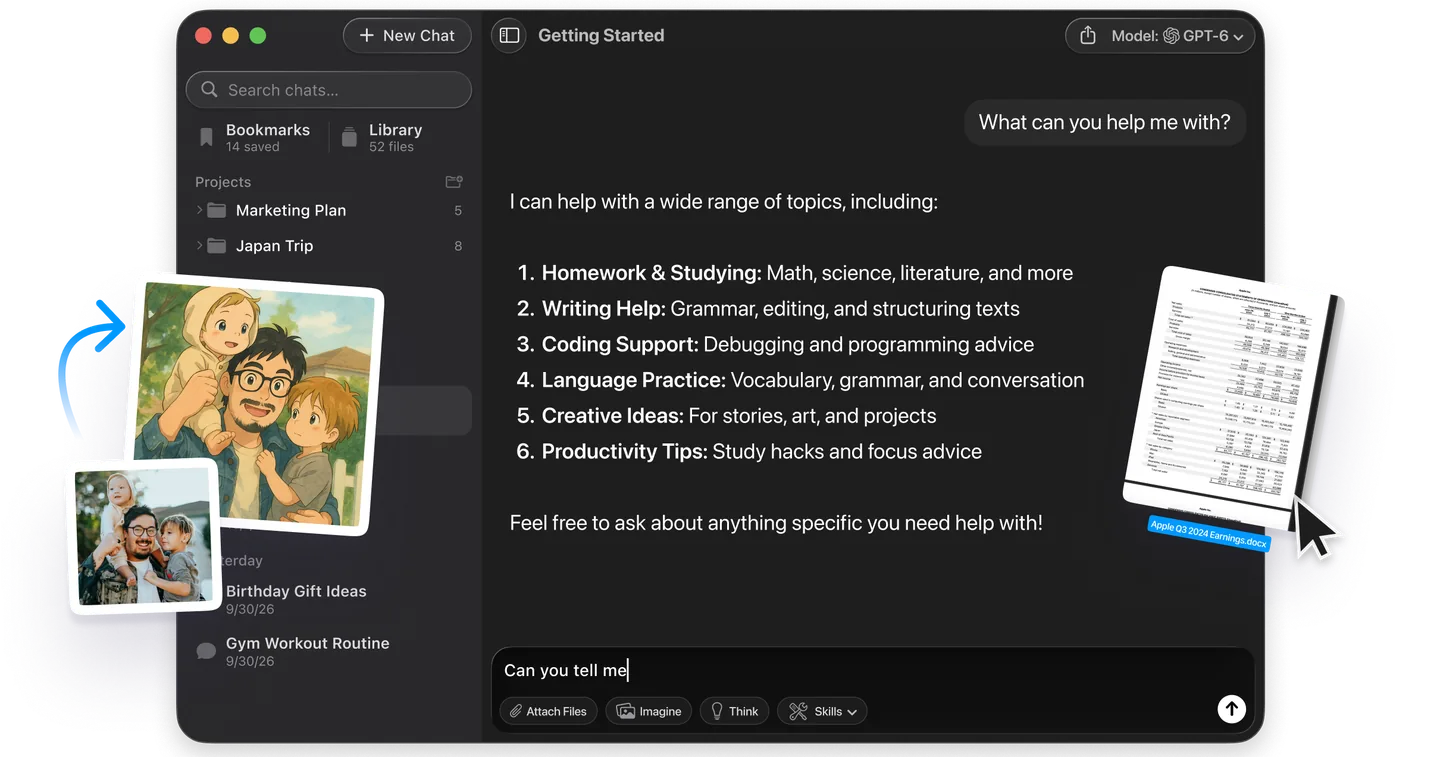
Fello AI is built for exactly this. It puts Claude, ChatGPT, Gemini, Grok and DeepSeek in one Mac app, and it does not stop at chat. It generates the images, writes the guide, builds the spreadsheet and exports the deck or the PDF, which covers most of the ten product groups above without a design tool in sight.
Having several models in one place matters more here than it sounds. One writes better sales copy. Another is stronger at the structured data behind a spreadsheet, and a third produces better artwork. Switching freely between them, without paying for three separate subscriptions, is often the difference between shipping a product and abandoning it. Fello runs on a single subscription and holds a 4.7 star rating across more than 25,000 reviews.
A realistic first build looks like this. Draft the content with one model, generate the artwork with another, lay it out in Canva or export straight to PDF, then list it. Our guide to making money with AI covers where digital products fit alongside the other eleven ways people actually earn, and making money with ChatGPT goes deeper on the writing side.
What Is Trending in 2026
Three shifts are worth building around this year. AI-adjacent products are the fastest-growing group, with prompt packs, AI-assisted workbooks and guides teaching non-technical people to use AI all rising quickly. Hyper-specific planners are the second, with ADHD and wellness-focused versions outselling general ones by a wide margin.
The third is bundling. Buyers increasingly want a kit rather than a file, so a twenty-piece pack at $12 beats a single file at $3 on both revenue and visibility. If you are choosing between polishing one product and packaging three, package. For a broader view of what else is worth starting this year, see our easy business ideas for 2026.
Conclusion
Pick one idea from the table, not five. Make it specific enough that you can name the buyer in a single sentence. Spend an hour validating it against what is already selling, build the first version in a weekend, and price it above $10. Then follow our guide on how to sell digital products to choose a platform and automate delivery.
The people earning from digital products are rarely the ones with the best idea. They are the ones who shipped a decent idea, learned what buyers complained about, and shipped the second one faster.
FAQ
What is the easiest digital product to sell for beginners?
Templates and printables. They take a weekend, need no design skills once you start from a Canva layout, and sell at $5 to $20 without a big audience. Resume templates and budget trackers are the most reliable entry points, because the buyer has an urgent problem and a clear outcome.
How much do digital products sell for?
Most sell for $5 to $50. Printables typically sit at $5 to $20, templates at $5 to $40, ebooks and guides at $10 to $40, prompt packs at $10 to $30, and online courses at $50 to $500 or more. Price above $10 wherever you can, because flat platform fees eat a much larger share of cheap products.
Are digital products still profitable in 2026?
Yes, but the margin depends on price. You keep roughly 80% of a $5 file and close to 90% of a $50 product, because platforms charge a flat fee per transaction on top of their percentage. The generic end of the market is saturated; specific products aimed at a clearly defined buyer are not.
Can I sell digital products made with AI?
Yes, and it is now one of the fastest-growing parts of the market. Use AI to draft, design and assemble, then edit it properly, check the facts and make sure the result is useful on its own merits. Check the terms of the tool you use and the marketplace you sell on, since some platforms require you to disclose AI involvement.
How do I validate a digital product idea before making it?
Search for your exact product on Etsy and Gumroad. If several sellers have real review counts, demand exists; if nobody sells it at all, that is usually a warning rather than an opportunity. Read the three-star reviews to find what buyers say is missing, then presell the improved version to a waitlist before you build it.