In July 2026, HireVue's Chief Science Officer Mike Hudy told Forbes something that should change how you prepare for your next interview. Candidates have used AI to write their applications in such volume, he said, that it "has created a sea of sameness." Recruiters, he added, "simply can't manage those volumes anymore." The response from employers was not to read more carefully. It was to put a machine in front of the recruiter. Which means AI job interview practice is no longer a clever optional extra, it is rehearsal against the thing that now decides whether a human ever hears your voice.
This guide covers what an automated screener actually measures, which is narrower and stranger than most advice online admits. It then covers how to turn ChatGPT, Claude or Gemini into a mock interviewer that will not go easy on you. It also covers what this method cannot do, because the internet is full of confident percentages about AI interview practice that fall apart the moment you check where they came from.
The Key Takeaways
- The screener exists because of your resume: HireVue's Chief Science Officer attributes the new screening layer to a "sea of sameness" created by AI-written applications.
- It stopped watching your face in March 2020: facial-expression scoring was removed then and announced in January 2021. Advice telling you to smile and hold eye contact is six years out of date.
- Language is the signal: HireVue's chief data scientist described the process as transcribing answers and "understanding the content of the answer," not analysing accent or diction.
- Voice practice beats reading: rehearse out loud, because filler words and answers that never land only show up when you speak them.
- Nobody has proven it improves hire rates: the impressive percentages circulating online come from pay-to-publish journals describing their authors' own products.
Why a Machine Now Sits Between You and the Recruiter
The sequence matters, because it explains what the screener is looking for. Employers did not add automated interviews to be cruel or futuristic. They added them because the volume of applications became unmanageable at roughly the same moment those applications stopped being distinguishable from each other.
Hudy put the second half plainly to Forbes career columnist Robin Ryan: "Many candidates assume these testing tools exist to eliminate applicants quickly. The true objective is to make better hiring decisions, not simply faster ones. We're in a period of candidate abundance, fewer jobs and lots of candidates." Read that alongside the sea-of-sameness line and the logic is clear. When written applications converge, employers look for a signal that has not converged yet. Right now that signal is whether you can describe your own work out loud, under time pressure, without notes.
This is also why the screening step has spread well past engineering. Ryan reports employers using it for marketing, sales, finance, human resources, customer service and operations roles, often before any recruiter speaks to the candidate. If you assumed automated assessment was a software-engineering ritual, that assumption is now the risk.
It is worth being honest about where this leaves the advice in our own guide to using AI for resume writing and its companion on what the evidence says about AI cover letters. Both remain useful. But a polished written application now gets you to a machine rather than to a person, and the machine wants something the document cannot supply.
What an AI Interview Actually Scores
Here is the correction that most interview advice online has never absorbed, and it is the single most useful thing in this article.
Automated video interviews do not score your face. HireVue removed facial-expression analysis in March 2020 and announced the change in January 2021, as Fortune reported at the time. The company's stated reason was that improvements in natural language processing had raised the predictive power of language analysis to the point where visual analysis no longer added value. HireVue's own leadership put the contribution of nonverbal elements at roughly 0.25% of a model's predictive power in general, and about 4% even for customer-facing roles. Those two figures belong to HireVue, not to an outside body, and they should be read as a company explaining its own product decision.
The context around that decision is worth knowing, because it is frequently retold inaccurately. EPIC, the Electronic Privacy Information Center, filed a complaint with the Federal Trade Commission on 6 November 2019 alleging unfair and deceptive practices, and asked the regulator to halt automated scoring of candidates. Separately, HireVue commissioned an audit from O'Neil Risk Consulting and Algorithmic Auditing, the firm founded by the mathematician Cathy O'Neil. That audit concluded the assessments worked as advertised on fairness and bias for the use case it examined, and it was not a comprehensive review of the company's algorithms. It did not find that facial analysis was worthless. Those are three separate events that get compressed into one story almost everywhere, and the compression is how the myth survives.
What is measured instead is language. HireVue's chief data scientist described the mechanism to SHRM as transcribing responses to the questions every candidate at that employer is asked, then "understanding the content of the answer." He was explicit about what is not measured: "We're not analyzing their accent or their diction."
The one-way recorded screen
This is the format most people mean when they say AI interview, and the one that causes the most panic. Ryan describes a client facing roughly 30 seconds to prepare each answer and two minutes to respond, with no retakes. Once recording starts, the answer is final. Treat those numbers as one reported case rather than a universal specification, because the employer configures the assessment, but the shape is consistent: short prep, hard stop, no second attempt.
The failure mode is arithmetic, not nerves. If you spend ninety seconds setting up the situation, you have thirty seconds left for what you did and no time at all for the result. A truncated answer reads as a weak answer to a system scoring for concrete outcomes.
The two-way voice interview
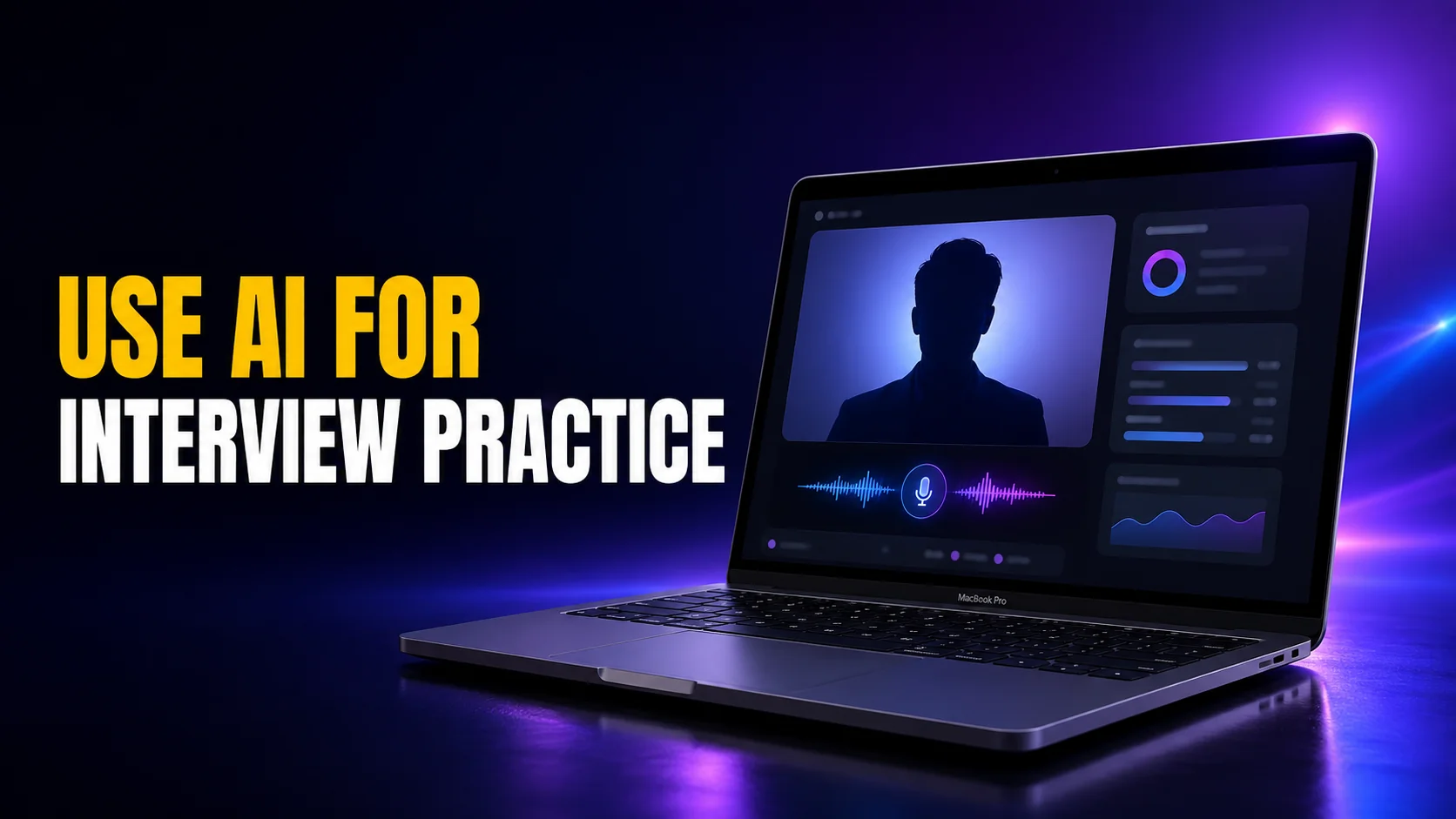
The newer format is conversational. HireVue's current product page describes its AI Interviewer as conducting "24/7 voice interviews" through "a natural two-way voice conversation," with the system comparing each answer against the employer's rubric, scoring it and explaining the score. That is the vendor's own description of its product rather than an independent assessment, so read it as a claim about intent.
It matters for preparation because a conversational system asks follow-up questions. A rehearsed monologue that survives an uninterrupted two minutes may not survive being asked "what was your specific contribution to that?" halfway through.
How to Run an AI Job Interview Practice Session
The method takes about ten minutes to set up and works in any assistant with a voice mode. Google's own Gemini Live help page lists rehearsing out loud for important moments as a supported use case, which tells you the vendors expect this.
Paste the job description and your resume, set the rules explicitly, then switch to voice and answer out loud. The rules matter more than the model. Without them, every assistant defaults to being helpful, which here means easy.
You are the hiring manager for the role described below. Conduct a
realistic screening interview with me.

Rules:
- Ask one question at a time and wait for my answer.
- Stay in character. Do not comment on my answers during the interview.
- Ask a follow-up whenever an answer is vague, unquantified, or
  claims a result without explaining my specific contribution.
- Keep me to roughly two minutes per answer and tell me when I run over.
- Ask 6 questions: 1 opener, 3 behavioural, 2 role-specific.
- After the sixth, stop and give me blunt written feedback: the two
  weakest answers, exactly what was weak, and what was missing.

Job description:
[paste]

My resume:
[paste]
Then run the rounds separately rather than in one long session. An opener round drills the sixty to ninety second version of your own story. A behavioural round pressure-tests the specific examples you plan to use. A role-specific round checks whether you can talk about the actual work at the depth the job demands. Doing all three at once produces a blur you cannot learn from.
Answer out loud every time, even though typing is faster and more comfortable. Typed answers hide the problems that lose interviews: filler words, sentences that restart, and stories that wander for ninety seconds without arriving at a result. You will not notice any of it on a keyboard. If prompting is where you tend to struggle, our guide to structuring a prompt properly applies directly here, because this whole method is one long instruction that has to hold for six questions.
Which Model to Rehearse With
All three major assistants can do this, and the differences are smaller than the difference between doing it and not doing it. Voice availability and time limits change frequently across free and paid tiers, so check your current plan rather than trusting any figure you read online, including older versions of this table.
| Model | Voice | Staying in character | Feedback style | Best for |
|---|---|---|---|---|
| ChatGPT | Advanced Voice, fast and natural | Good, drifts if the session runs long | Balanced, leans encouraging | The most realistic back and forth |
| Claude | Voice mode on mobile apps | Strongest at holding instructions | Most willing to be blunt when asked | Honest critique of your answers |
| Gemini | Gemini Live, rehearsal is a listed use case | Good, occasionally breaks to be helpful | Structured, lists over judgement | Generating questions from a posting |
If you rehearse regularly, the practical argument for keeping all three available is that they fail differently. The model that stays in character hardest is not the one that gives the most useful critique, and switching between them for the same answer surfaces weaknesses a single assistant will consistently miss.
How to Get Feedback That Is Not Flattery
Left alone, every one of these assistants will tell you that was a strong answer. That is the default behaviour and it is worthless for preparation.
Fix it by changing the question.
Ask for the failure instead of the verdict. Do not ask "how was that answer." Ask "what would make a hiring manager doubt that answer," or "which part of that would you push back on to find out whether I really did the work." Naming the adversarial role gets you specifics. Asking for a rating gets you a number and a compliment.
The highest-value version of this connects back to your written application. Have the assistant interrogate the exact bullet points on your resume, one at a time. If a line cannot survive two follow-up questions about what you specifically did, it is claiming more than the underlying work supports. Better to find that seam yourself than to have a hiring manager find it.
What AI Job Interview Practice Cannot Do
Search for evidence that this works and you will find impressive numbers: communication clarity up 34%, filler words down 41%, confidence up 30%. Follow them to the source and they come from journals that charge authors to publish, in papers evaluating the systems their own authors built. There is no independent replication.
We are not repeating those figures here. Treat any article that does as unchecked.
So the honest position is this. There is no credible evidence that practising with AI improves your chances of being hired. What it demonstrably provides is repetition, availability at eleven at night, and a counterpart that will ask a seventh follow-up question without getting bored or being polite to you. Rehearsal has always helped. The AI part changes the logistics, not the underlying principle.
Three specific limits are worth naming. The questions are generated from a job posting, so they will miss the idiosyncratic thing your actual interviewer cares about. The assistant cannot tell you how you come across to a person, only whether your answer was complete. And practising exclusively against an AI can teach you to optimise for a scoring rubric rather than for a conversation, which is a real risk when a human takes the second interview.
Is Using AI to Prepare Cheating?
No, and the line is easy to state. Preparing with AI is rehearsal, the same category as practising with a friend or recording yourself. Using AI during a live interview to generate answers in real time is misrepresentation, and it is increasingly detected. It also defeats the point of the exercise, which is to be able to do this without help.
The distinction is practice versus performance. Everything in this article is meant to happen before the interview, so that you walk in with your own stories, pressure-tested, and nothing running on a second screen.
That framing matters well beyond interviews, which we cover in our look at which jobs AI is actually changing.
Conclusion
The screening layer exists because written applications stopped telling employers anything. That is an uncomfortable diagnosis if you have spent a weekend polishing a resume, and it is also the most actionable one available, because it tells you exactly where the remaining advantage is. It is in being able to say what you did, out loud, in two minutes, with the result at the end.
Set up the mock interview tonight. Use the prompt above, answer out loud, and ask for the weakest two answers rather than a score. Then do it again tomorrow with the same questions, because the second run is where the improvement actually shows up. If you want the earlier stages of the process covered too, start with our walkthrough of using ChatGPT across a job search and work forward from there.
FAQ
Does an AI interview score my facial expressions?
Not at HireVue, which removed facial-expression analysis in March 2020 and announced it in January 2021. The company said language analysis had become predictive enough that visual analysis no longer added value. Advice telling you to hold eye contact or smile for the camera is addressing a signal that was switched off six years ago.
How long do you get to answer in an automated interview?
In the case Forbes reported, roughly 30 seconds to prepare and two minutes to answer, with no retakes. The employer configures this, so treat it as typical rather than fixed. Practise to a two-minute ceiling and make sure the result of your story arrives before the ninety-second mark.
Should I practise by voice or by typing?
By voice, every time. Typed answers hide filler words, restarted sentences and stories that never reach a result, which are the specific problems that cost you an interview. Typing is useful only for building your examples in the first place, before you rehearse them out loud.
Does practising with AI actually improve my chances of getting hired?
There is no credible evidence either way. The percentages circulating online come from pay-to-publish journals evaluating their own authors' products, with no independent replication. What AI reliably gives you is repetition and a counterpart available at any hour that will keep asking follow-up questions, which is the part of rehearsal most people skip.
Which AI is best for mock interviews?
Claude holds the interviewer instructions most reliably and is the most willing to be blunt when you ask it to be. ChatGPT's voice mode gives the most natural back and forth. Gemini is the quickest at generating likely questions from a job posting. Rotating between them surfaces weaknesses any single assistant will consistently miss.