Ask what the best AI for resume writing is and you will get a straight answer from almost every page on the internet, usually because the page is selling a resume subscription. We wanted a different test. We wrote one resume and one job description from scratch, so we knew exactly what was true about the candidate, handed both to Claude, ChatGPT and Gemini with an identical prompt, and then did the thing nobody else seems to do: we went through every output line by line and marked anything the model had added.
That last step matters more than any writing-quality score. A resume is a document you sign your name to and then have to defend in an interview. A model that writes beautiful prose while quietly adding a competency you do not have is not a good tool, it is a liability. What we found was not the failure everyone warns about. No model invented a statistic and none inflated the candidate’s seniority. One of them did something quieter and considerably harder to spot. Here is what each did, what the evidence actually says about whether recruiters can tell, and how to use AI on a job application without handing an interviewer a trap.
The Key Takeaways
- None of the three invented a statistic: the fear that AI will attach fake percentages to your resume did not survive contact with the test. All three also left the candidate’s seniority alone.
- Gemini rewrote the job ad as the candidate’s history: around nine requirements from the posting, including account-based marketing and attribution reporting, appeared as experience the resume never claimed.
- Almost nobody is scanning you: 76.6% of hiring teams now receive AI-generated applications, but only 14% have implemented AI-detection tools, according to Willo’s Hiring Trends Report 2026.
- The ATS is not the villain: in a 2025 study, 23 of the 25 recruiters interviewed said their system does not auto-reject resumes on formatting or content at all.
- Better writing does causally help: a randomised trial of 480,948 jobseekers found writing assistance produced 7.8% more hires, though the tool tested was a grammar checker, not a chatbot.
- Use it as an editor, not a ghostwriter: every piece of evidence points the same way. AI that sharpens your real history beats AI that writes you a new one.
Best AI for Resume? The Short Answer
ChatGPT produced the most trustworthy rewrite. It stayed almost entirely inside the source document, invented no figures, and left the candidate’s stated seniority alone. Claude wrote the most useful draft to work from, because it marked every place a number belonged with a bracketed placeholder instead of guessing, though it did assert the existence of metrics the resume never mentioned. Gemini was the one to watch out for, and not for the reason we expected.
None of the three invented a statistic. Not one. Going in we assumed at least one model would attach a made-up retention percentage to a vague bullet, and none did. All three also left the candidate’s seniority untouched, preserving “supported the launch” rather than promoting it to “led.” The conventional worry about AI resume writing, that it will inflate you into someone you are not, did not materialise in the way it is usually described. What we found instead was quieter and harder to catch, which is why the section below matters more than the table above. If you want the broader habit this feeds into, we cover picking a different model for each kind of task separately.
How We Tested
We built a composite resume for a mid-career marketing manager and a matching job description for a senior role at a mid-sized software company. Both are synthetic, which is deliberate: it means we know exactly what is and is not true about this candidate, so any claim appearing in the output that is absent from the input is unambiguously invented. A real resume cannot give you that certainty.
The resume was written with three soft spots. It says the candidate “supported” a loyalty programme launch rather than led it, says they took over paid search without attaching any result, and contains no numbers anywhere. The job description leans on all three, demanding quantified retention outcomes, accountability for return on ad spend, and, in its closing line, warning that vague ownership claims will not survive the interview.
Each model got the same prompt in a fresh chat with no memory or custom instructions, and we took the first response only, with no regenerating and no follow-up coaching. Then the audit: we read every rewritten bullet against the source and flagged each skill, tool, metric, job title and achievement that appeared in the output but not the input. Fair rewording did not count. Nor did a bracketed placeholder such as “[X%],” which is the model correctly flagging a gap rather than filling it. It counted only when a reader would come away believing something about this candidate that the source document did not support.
The Results At Glance
| Model | Numbers invented | Job-ad requirements written in as experience | Seniority inflated | Verdict |
|---|---|---|---|---|
| ChatGPT | None | One, and mild | No | Cleanest. Stayed inside the source almost entirely |
| Claude | None. Every figure left as a bracketed placeholder | Two, including upgrading “basic SQL” | No. Weakened “supported” to “contributed to” | Most useful structurally, but invents the existence of metrics |
| Gemini | None | Around nine | No | Worst. Rewrote the job ad as the candidate’s history |
The AI Outputs
Here are the three outputs in full, in that order. It is worth reading them side by side, because at a glance all three look like competent professional rewrites, and only one of them is safe to send.
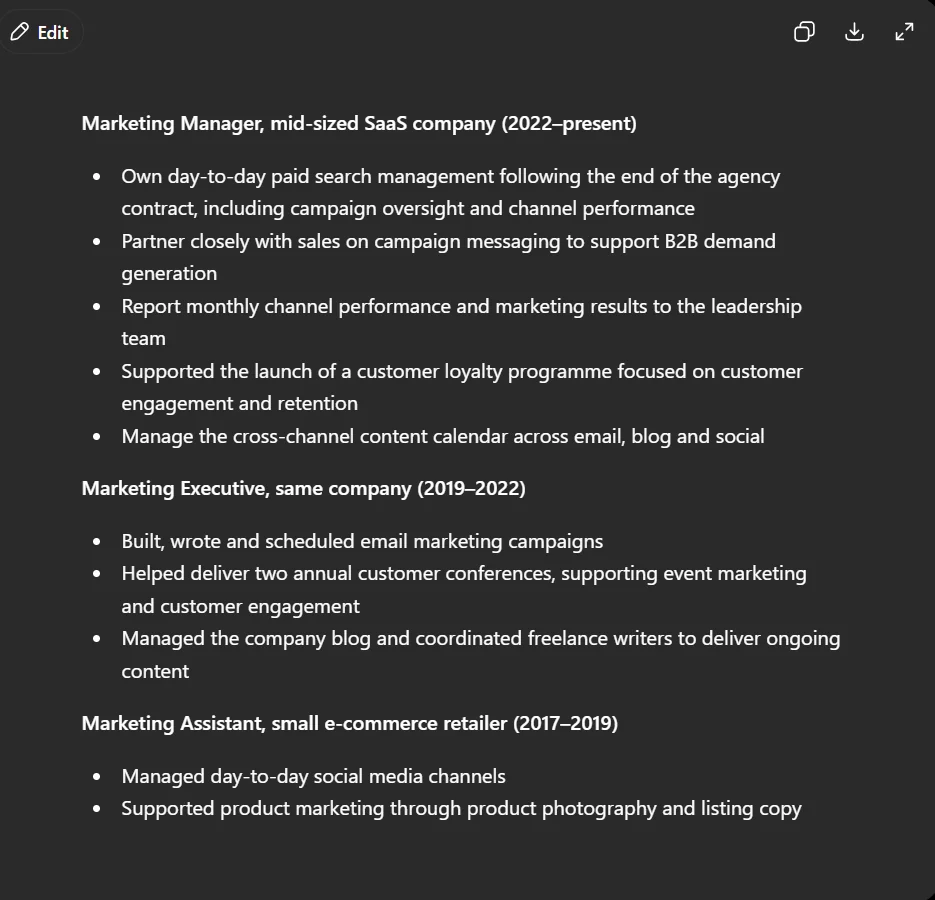
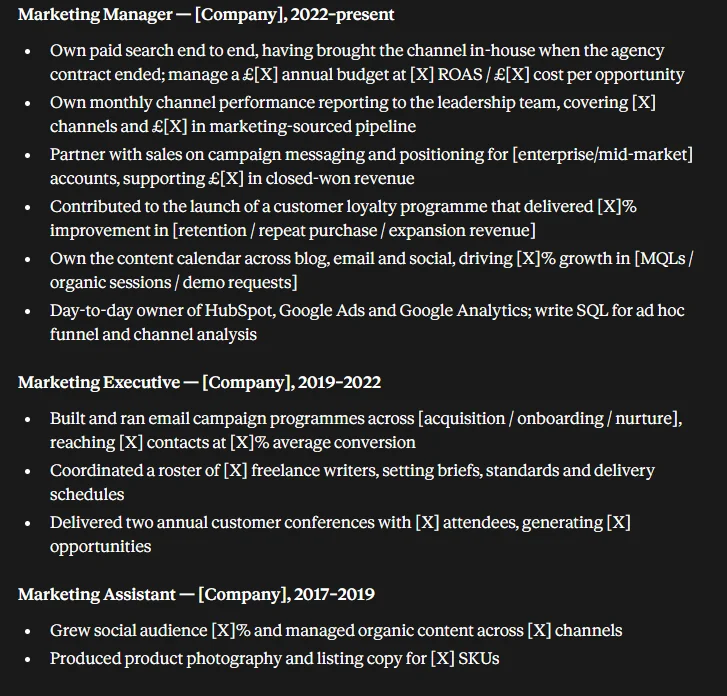
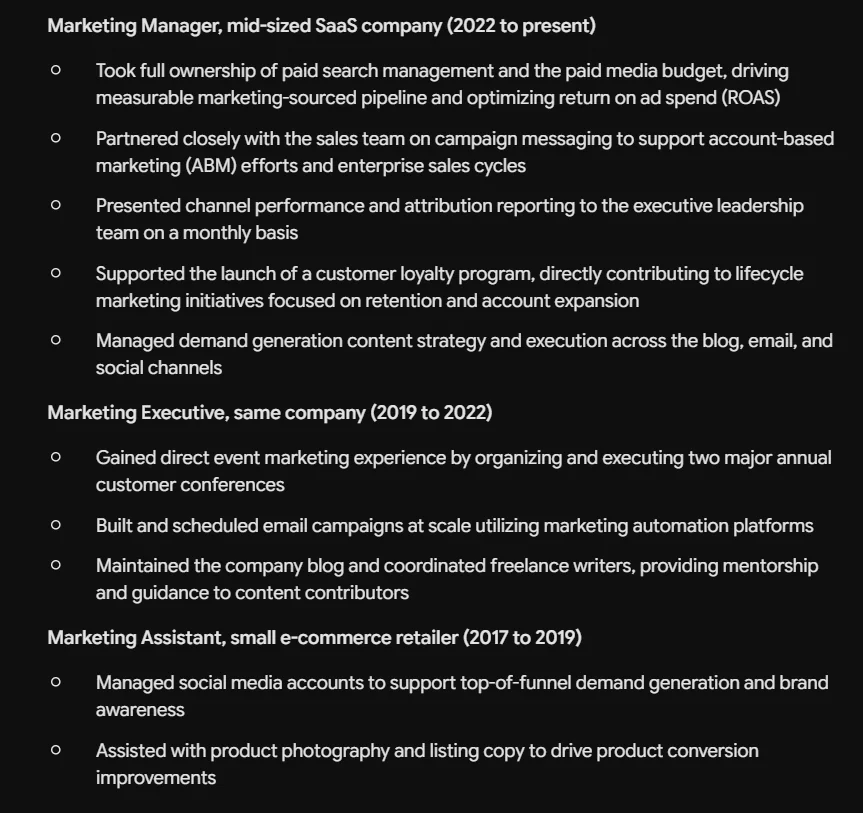
Run this on your own resume before you trust any of it, including our ranking. Your career history has different soft spots to our composite, and the model that behaves best on ours may not be the one that behaves best on yours. The only reliable way to know is to put the same resume and the same posting through several models and read the outputs side by side.
Doing that normally means three subscriptions and three browser tabs. This is the gap Fello AI was built to fill: one native Mac and iOS app that gives you ChatGPT, Claude, Gemini, Grok, DeepSeek and Perplexity behind a single $9.99 a month subscription, so you can paste your resume once, switch models from a dropdown, and compare the rewrites yourself in the same window. If you are new to it, start with the setup guide.
The Fabrication Problem Nobody Tests For
Every comparison of AI resume tools scores the same things: readability, keyword density, formatting, speed. None of them score the failure mode that actually turned up.
Gemini
Gemini read the job description and wrote its requirements back as the candidate’s experience. The posting asked for account-based marketing, so the rewrite claimed “ABM efforts and enterprise sales cycles.” They asked for multi-touch attribution, so monthly channel reporting became “attribution reporting.” The posting wanted budget ownership and return on ad spend, so “took over paid search management” became “took full ownership of paid search management and the paid media budget, driving measurable marketing-sourced pipeline and optimizing return on ad spend.” The posting mentioned mentoring, so coordinating freelance writers became “providing mentorship and guidance to content contributors.” Around nine separate competencies made that jump. Not one of them appears anywhere in the source resume.
Call it requirement bleed, and understand why it is worse than a fabricated statistic. A made-up percentage is a single visible lie you can spot and delete. Nine imported competencies read as a coherent, credible senior candidate. Nothing looks wrong. You would send it, and then sit in an interview being asked which ABM platform you ran and how you structured the attribution model, for work you have never done.
Claude
Claude’s version of the problem is subtler again. It refused to invent a single number, bracketing every figure as a placeholder, which is genuinely the right instinct. But it asserted that the metrics existed. The candidate now manages “a £[X] annual budget at [X] ROAS,” reports “£[X] in marketing-sourced pipeline,” and supports “£[X] in closed-won revenue.” The magnitudes are honestly flagged as unknown, and an explicit no-invention clause of the kind used in our Claude prompts for resumes is the cheapest way to hold it to that. And the existence of a managed budget, a pipeline number and a revenue contribution is simply assumed, and none of the three is in the resume. It also turned “basic SQL” in the skills list into writing SQL for funnel and channel analysis, which is precisely what the posting asked for.
ChatGPT
ChatGPT largely resisted both traps. Its worst offences were mild verb inflation, turning “maintained the company blog” into “managed” it and “assisted with product photography” into “supported product marketing through” it. Defensible in an interview, unlike the other two.
The general lesson holds regardless of which model you pick. Give a language model a job description and a thinner resume, and it will close the gap. The only reliable defence is to read every generated line against your source document, which is exactly the audit we ran.
Will Recruiters Know You Used AI?
Mostly no, and the more useful finding is that most of them are not looking. The fear driving this question is largely manufactured by companies that sell the cure.
Who is actually running AI detectors
Very few employers. Willo’s Hiring Trends Report 2026, based on responses from just over 100 hiring professionals, found that only 14% of hiring teams have implemented AI-detection tools or software. The same report found that 76.6% of hiring teams now receive AI-generated applications, which is the more telling pair of numbers: three quarters of employers see AI-assisted applications routinely, and roughly one in seven does anything technical about it. The rest rely on human review, interview probing and practical tasks. Where detection does happen, it tends to be a recruiter forming an impression from formulaic phrasing rather than a tool returning a score, and that impression is unreliable in both directions.
The applicant tracking systems themselves are not filling the gap either. Enhancv’s May 2026 review of ten major platforms, covering Workday, iCIMS, Greenhouse, Oracle Cloud HCM, SAP SuccessFactors, Lever, Workable, SmartRecruiters, Ashby and BambooHR, found that none of them detect AI-written resumes. Every one of them uses AI to parse applications; not one uses it to flag them.
Why do they do that?
The reasons are practical rather than philosophical. Detection tools carry false-positive rates of roughly 1% to 2% that fall hardest on non-native English speakers and neurodivergent writers, which under rules such as New York City’s Local Law 144 and the EU AI Act turns a detector into a discrimination lawsuit waiting to happen. Many systems also discard the resume text once they have extracted the structured fields, so there is nothing left to analyse. If you want to understand why the underlying technology struggles here, we have covered how AI detectors actually work and where they fail in detail.
The most-quoted evidence on this point deserves a date stamp. A widely cited study in which only 18% of hiring managers correctly identified all three ChatGPT-written cover letters was run by ResumeBuilder.com in March 2023, with 1,000 respondents. It is a real result, but it describes a world before GPT-5 and before recruiters had spent three years reading AI-assisted applications. Treat it as a historical baseline, not as a current guarantee.
What the applicant tracking system really does
The other half of the anxiety is the belief that software silently bins your resume before a human sees it. In a study of recruiters conducted in late 2025 and published by Enhancv, 23 of the 25 recruiters interviewed said their systems do not automatically reject resumes. The two who did configure content-based auto-rejection used match-score thresholds or required-skills gates, not formatting rules. The systems covered included Workday, Greenhouse, iCIMS, Lever and LinkedIn Recruiter.
Two caveats worth stating plainly, because most articles quoting this figure state neither. It is a small qualitative sample of 25 people, not a national survey, and the authors say so themselves. And it was produced by a resume-builder company, although notably the finding cuts against that company’s own commercial interest. An applicant tracking system is mainly a database. It parses your resume into fields so a recruiter can search and filter. It is not a gatekeeper with a rejection button, and optimising your life around beating it is mostly wasted effort.
Does AI Actually Help You Get Hired?
There is one piece of genuinely strong evidence here, and it is worth reading carefully because it is routinely overstated.
Economists Emma Wiles, Zanele Munyikwa and John Horton ran a randomised controlled trial across 480,948 jobseekers and found that those given algorithmic writing assistance received 7.8% more job offers and earned 8.4% more, an average of $18.62 an hour against $17.17 for the control group. The effect was strongest for non-native English speakers, who made up over 80% of the sample.
Now the caveats. The tool tested was not a chatbot. Per MIT Sloan’s write-up of the study, it corrected spelling and grammar and advised on punctuation, word usage, tone and style. The setting was a global online marketplace for contract work rather than conventional salaried hiring. So this is not proof that ChatGPT gets you hired.
What it does establish, on very solid ground, is that mechanical writing quality causally affects hiring outcomes. The study found that applicants with fewer than 90% of words spelled correctly had roughly a 3% chance of being hired in their first month, while those above 99% accuracy were hired nearly three times as often. Cleaning up your writing works. That is precisely the part of the job a language model does reliably and without inventing anything.
How to Use AI for Resume Writing Without Wrecking Your Chances
The evidence all points in one direction: use the model as an editor working from your material, never as an author working from a job title.
A prompt that does not invite invention
Most bad output comes from a prompt that asks for impressiveness without supplying facts. Give the model the raw material and an explicit prohibition instead:
Here is my current resume and the job description I am targeting. Rewrite my experience bullets so the most relevant work comes first and the language matches the posting. Use only facts present in my resume. Do not add metrics, tools, certifications or seniority that I have not stated. Where a bullet would be stronger with a number, insert [NUMBER NEEDED] instead of estimating one.
That last instruction is the useful trick. Instead of quietly hallucinating a percentage, the model hands you a list of the places where a real figure would help, and you fill them in from memory or old performance reviews. You get the benefit of the model’s instinct for where evidence belongs without letting it supply the evidence. If you want to go further on prompt structure, our guide to using ChatGPT across a job search covers the surrounding tasks.
What to never hand over
Keep three things human. Your actual job titles and dates, because these get verified and a rephrased title reads as a lie on a background check. Any number you cannot source. And the specific reason you want this particular job, which is the one part of an application that a model genuinely cannot fake for you and the part that hiring managers consistently say is missing from AI-written applications.
Cover Letters Are a Different Job
A resume is a structured list. A cover letter is a short piece of persuasive writing with a narrative arc, so the models separate differently on it, and the evidence on whether recruiters mind is different too. We took that apart on its own in the best AI for a cover letter, and compared the two most common choices across a wider set of writing tasks in Claude versus ChatGPT.
Practising the Interview Out Loud
The most underused part of AI job hunting is not writing at all. Voice mode turns any of these assistants into a mock interviewer, and the version that matters here is having it interrogate the exact bullets on your AI-assisted resume. If a rewritten line cannot survive two follow-up questions, it is too strong for what actually happened, and you should soften it before a real interviewer finds the same seam.
The full method, including what an automated screener actually measures before a human ever hears you, is in our guide to practising job interviews with AI.
How to List AI Skills on Your Resume
Worth a short section because it is a rising search and the usual advice is bad. Do not add a skills-section line that says “ChatGPT” or “prompt engineering” on its own. It reads as filler, and by 2026 it signals roughly as much as listing Microsoft Word.
Put it in the achievement instead. “Cut first-draft turnaround on campaign briefs from two days to four hours by building a reviewed AI workflow for the team” tells a hiring manager something real about judgement and process. The tool name belongs inside a result, not in a list of nouns. This matters more in some fields than others, and it is worth understanding where AI is genuinely reshaping roles before you decide how much of your application to build around it.
The Verdict
The question people ask is which AI is best for resume writing. The more useful question is which AI can be trusted with a document you have to defend under questioning, and on that test ChatGPT came out ahead, Claude came second with a caveat, and Gemini needs watching.
But the ranking matters less than the habit. Every model closed the gap between the resume it was given and the job it was shown, and each one did it differently enough that no single warning covers all three. So read every generated line against your original. Delete anything you cannot defend. Write the “why this job” paragraph yourself. Then practise out loud until each bullet survives two follow-up questions. Do that and the choice of chatbot stops mattering much, which is good news, because it means the advantage goes to whoever spends the extra twenty minutes rather than whoever picked the right subscription.
FAQ
Which AI is best for resume writing?
In our test ChatGPT was the most trustworthy, staying almost entirely inside the source resume. Claude produced the most useful working draft because it flags missing numbers as placeholders rather than guessing. Gemini imported around nine requirements from the job ad as though they were real experience, so check its output hardest.
Will recruiters know I used AI on my resume?
Usually not, and most are not checking. Willo’s Hiring Trends Report 2026 found 76.6% of hiring teams now receive AI-generated applications while only 14% have implemented detection tools. What recruiters consistently do notice is generic, unspecific writing, which is a content problem rather than an AI problem.
Does an applicant tracking system automatically reject AI resumes?
No. A May 2026 review of ten major platforms including Workday, Greenhouse and iCIMS found that none of them detect AI-written resumes, largely because false positives create legal exposure. Auto-rejection is also rarer than assumed: in a 2025 interview study, 23 of 25 recruiters said their systems do not auto-reject on formatting or content.
Can AI write my resume from scratch?
It can, and you should not let it. A resume built from a job title rather than your history will contain plausible things you never did, and you will have to defend every line of it in an interview. Give the model your real material and ask it to edit.
Is it unethical to use AI on a job application?
Using it to express your real experience more clearly is editing, and the evidence suggests employers are largely indifferent to it. Using it to manufacture experience you do not have is misrepresentation. The line is not the tool, it is whether the claims are true.