Apple has paused work on the next Vision Pro, is testing four different glasses designs, and now aims to unveil its first AI smart glasses at WWDC 2027, with the product on sale by the end of 2027, according to Bloomberg’s Mark Gurman. That is a slip from the late-2026 unveiling Gurman reported in April, and it makes the Apple AI Glasses the company’s biggest hardware bet since the Apple Watch.
This is your full breakdown of everything known about Apple AI Glasses as of September 2026, including the release window, design styles, hardware, AI features, expected price, and how they will stack up against the Meta Ray-Ban smart glasses you can already buy today and against Google’s Android XR glasses launching a year earlier. You will also see why Apple is treating glasses as the next iPhone-scale product, and whether it is worth waiting roughly 15 months instead of buying Meta’s $379 option now. Our WWDC 2026 preview shows what we expected from the June keynote, and our WWDC 2026 recap covers everything Apple actually announced, which did not include glasses.
The Key Takeaways
- Release window: unveiling at WWDC 2027, on sale by the end of 2027 (Bloomberg, July 26, 2026), a slip from the spring-2027 ship date reported in April.
- Design: four frame styles in premium acetate (black, ocean blue, light brown), modeled after the Apple Watch 2015 launch.
- No display in v1: first-generation glasses rely on cameras, microphones, speakers, and Siri AI with Visual Intelligence, paired to your iPhone.
- Two products, not one: simpler AI smart glasses ship in 2027, true AR glasses with a display target 2028 or later, with Ming-Chi Kuo pointing at the second half of 2028.
- Strategy shift: Apple has paused Vision Pro 2 development to focus on the glasses program, its biggest pivot since AirPods.
- Cameras may not record: Apple is weighing cameras that feed Siri but cannot take photos or video, or dropping cameras entirely, on privacy grounds (Bloomberg, July 26, 2026).
When Will Apple Release AI Glasses?
Apple now plans to unveil its AI smart glasses at WWDC 2027, with the glasses on sale by the end of 2027, according to Bloomberg’s Mark Gurman on July 26, 2026. That replaces the plan he reported in his Power On newsletter on April 12, 2026, which had Apple announcing the glasses in late 2026 or early 2027 and shipping in spring or summer 2027. Veteran Apple analyst Ming-Chi Kuo lines up with the newer date, forecasting mass production in the second quarter of 2027 and 3 to 5 million units shipped that year.
We said before the June keynote not to expect a glasses reveal at WWDC 2026, and that is how it played out. Apple spent June 8 on Siri AI, iOS 27, and macOS 27 “Golden Gate”, and said nothing about glasses at all. The reveal has now landed on WWDC 2027 rather than a September hardware event, which fits a product whose whole value is the Apple Intelligence software running on it: Apple wants developers building for it before it ships.
A few things could still move the date, and one already has. Gurman ties the slip to privacy work on camera-equipped glasses, after the criticism Meta absorbed over recording in public, plus Siri and Visual Intelligence not being ready for the visual workload the glasses demand. Manufacturing yield problems pushed back the Vision Pro by a year, and a repeat would land Apple AI Glasses in 2028. The reverse is also possible if Meta keeps shipping aggressively, since Apple has historically accelerated when a category starts to slip away.
Two Products, Not One: AI Glasses (2027) vs AR Glasses (2028 and Later)
This is the single biggest source of confusion in Apple glasses coverage, so let’s separate it cleanly. Apple is building two distinct glasses products, on two different timelines, with two completely different ambitions.
The first product is the AI smart glasses arriving in 2027. These have no display. They look and weigh like regular glasses, run Siri AI, carry cameras that feed what you are looking at to Siri, relay notifications, and pair with your iPhone. Think of them as the AirPods of your face, a sensor-and-speaker platform with a small AI brain. This is Apple’s answer to Meta Ray-Ban.
The second product is the true AR glasses with a real display overlaid on the world, targeted for 2028 or later. That is the long-game iPhone replacement that Tim Cook has been hinting at for a decade. Kuo puts the display-equipped model in the second half of 2028, and Apple has reportedly achieved enough optical breakthroughs to keep that date on the table, though Gurman says the timeline is still in flux. Everything in this article refers to the first product, the no-display 2027 glasses, unless noted.
Apple AI Glasses Design: Four Styles, Premium Acetate, Apple Watch Playbook
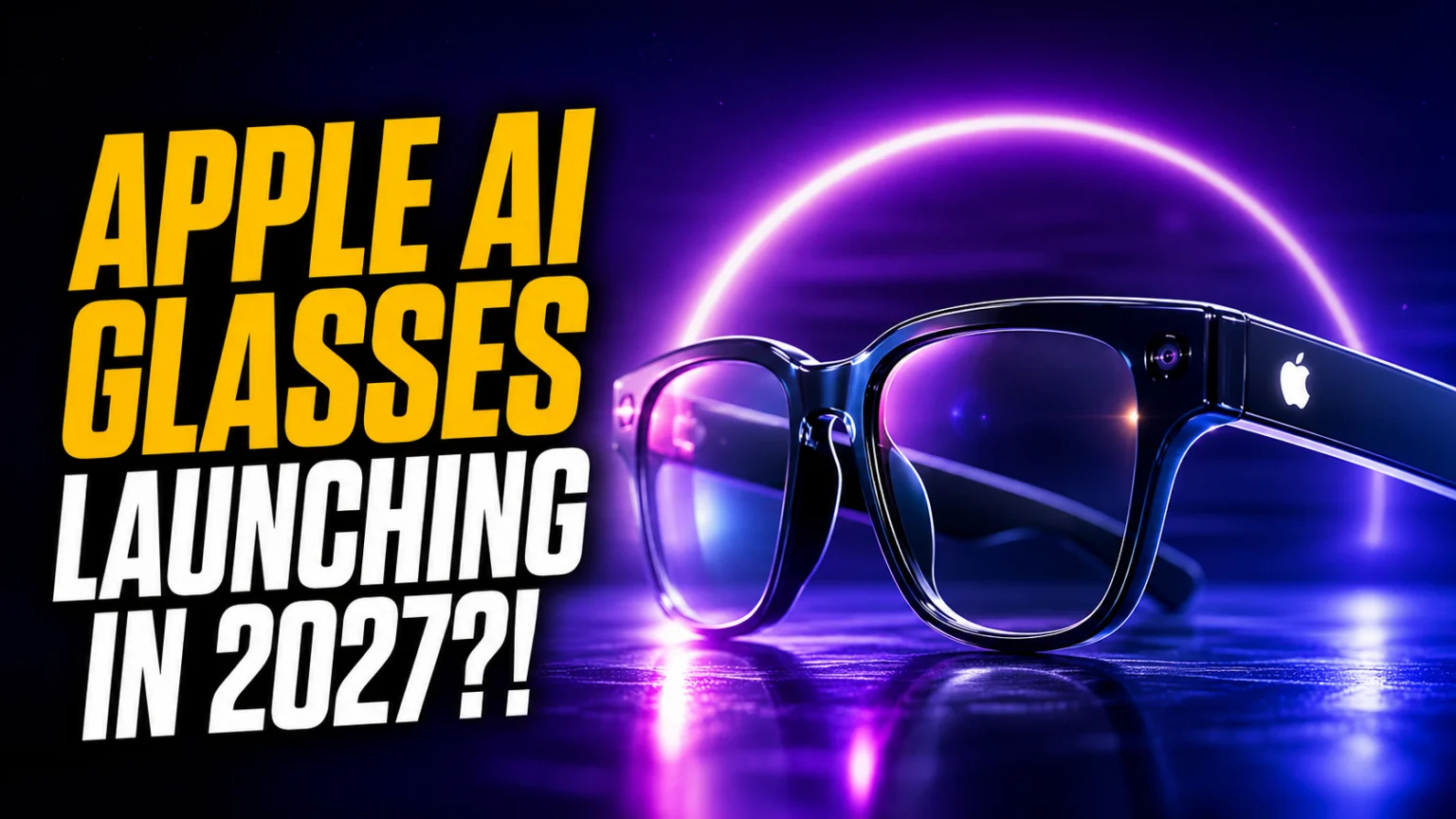
Apple is testing at least four different frame styles, according to Gurman’s April 12 report. The four shapes spotted in development are a large rectangular frame that resembles Ray-Ban Wayfarers, a slimmer rectangular design similar to Tim Cook’s own everyday glasses, a larger oval or circular frame, and a smaller refined oval or circular option. The frames are being built in premium acetate, with at least three color choices known so far: black, ocean blue, and light brown.
This is straight out of the Apple Watch 2015 playbook. When Apple launched its first watch, it shipped three editions, multiple sizes, and dozens of band combinations because the company believed that personal devices need to feel personal. Glasses are even more personal than watches. Expect Apple to push hard on fit, fashion, and material quality, since the company has a head start over Meta in design.
Front-facing cameras will reportedly sit in an oval pattern with indicator lights, similar to the recording indicator on Meta Ray-Ban, to flag when video is being captured. That detail comes from the April report, and by July Gurman said Apple was still deciding whether the cameras will be able to record at all. There is no confirmed weight, but Apple’s target is reportedly to keep the glasses close to a normal pair of acetate sunglasses, which usually weigh 30 to 45 grams. Anything heavier and the all-day promise breaks.
What Apple AI Glasses Will Actually Do
The hardware list is short by design. Each pair will include cameras for photos, video, and visual AI input, microphones for calls and voice commands, speakers for music and audio responses, and sensors for motion and orientation. There is no display, no eye tracking, and according to Gurman, no reliable hand-gesture recognition in the first version. The cameras themselves are still being argued over inside Apple, which we come back to below.
Daily use should feel a lot like wearing AirPods on your face. You will get notifications relayed through audio, call handling without pulling out your phone, and music playback through open-ear speakers. Photo and video capture is the open question. Gurman reported on July 26, 2026 that Apple is weighing cameras that can see for Siri but cannot record photos or video, and has even discussed dropping the cameras entirely, both on privacy grounds. Either way the camera is the differentiator from regular AirPods, because it feeds visual context to Siri.
A MacRumors-sourced rumor in late April 2026 claimed Apple AI Glasses would support Vision Pro-style hand gestures via two cameras. Mark Gurman pushed back hard, noting that Vision Pro uses 12 cameras (8 external, 4 internal for eye tracking) to make gestures reliable. A single low-resolution wide-angle lens is not enough. Gurman expects head gestures like nodding and shaking, similar to recent AirPods features, rather than hand tracking. Track this one carefully, it is the most contested spec on the rumor board.
The AI Behind Apple AI Glasses: Siri AI and Visual Intelligence
The reason Apple is calling these AI glasses rather than just smart glasses is the AI stack running on top. Two pieces matter most.
The first is Siri AI, the long-promised rebuild of Siri that Apple announced at WWDC 2026 and ships with iOS 27 on Monday, September 14, 2026. It holds a conversation, reads what is on your screen, and chains multi-step tasks across apps. It also arrives gated: an English-only beta behind a waitlist, on iPhone 15 Pro and newer, and not on EU iPhones, iPads or Apple Watches. On glasses that assistant is the whole product, because there is no screen to fall back on. What Apple has not announced is a third-party Extensions system that would let you put Claude, Gemini, or Grok behind Siri. Bloomberg has described the framework and matching strings turned up in iOS 27 beta builds, but it is switched off, and ChatGPT remains the only Siri extension Apple has ever shipped. Our iOS 27 tracker follows where that goes.
The second is Visual Intelligence, Apple’s name for the AI that interprets whatever the camera sees. On iPhone today, Visual Intelligence can identify plants, translate signs, read text, and explain images. On glasses, you point your face at something and ask. While you wait, you can make Siri smarter today using third-party AI apps and Shortcuts.
Most AI features will reportedly require an iPhone pairing. The glasses are a peripheral, not a standalone computer.
Apple AI Glasses vs Meta Ray-Ban: The Comparison
If you want smart glasses today, Meta is the only serious option. Here is how the rumored Apple specs line up against what you can buy on the shelf right now.
| Feature | Apple AI Glasses (rumored) | Meta Ray-Ban (Gen 2) | Meta Ray-Ban Display | Apple Vision Pro |
|---|---|---|---|---|
| Form factor | Glasses | Glasses | Glasses | Headset |
| Display | No | No | Yes (single lens) | Yes (dual micro-OLED) |
| AI assistant | Siri AI + Visual Intelligence | Meta AI | Meta AI | Apple Intelligence |
| Camera | Yes, recording undecided | Yes (12 MP) | Yes | 12 cameras |
| Ship date | Late 2027 | Available now | Available now | Available now |
| Starting price | TBD (premium tier expected) | From $379 | $799 with Neural Band | $3,499 |
| Phone requirement | iPhone (pairing) | iPhone or Android | iPhone or Android | Standalone |
Meta lists Ray-Ban Meta (Gen 2) from $379 and the Meta Ray-Ban Display at $799 including the Neural Band wristband. Its next move lands at Connect 2026 on September 23 and 24, where it has already teased new glasses.
How Much Will Apple AI Glasses Cost?
Apple has not committed to a price. Triangulating from premium acetate frames, the Apple Watch tier strategy, and Apple’s positioning against the $379 Ray-Ban Meta, a reasonable expectation is a starting price in the $799 to $1,299 range, with higher-tier materials pushing well above $1,500. Treat that as informed speculation, not a leak.
For context, Ray-Ban Meta (Gen 2) starts at $379, the Meta Ray-Ban Display variant costs $799 with its Neural Band, and Apple Vision Pro still costs $3,499. Apple AI Glasses will almost certainly slot between Meta and Vision Pro on price.
Why Apple Paused Vision Pro 2 for Glasses
The most under-discussed signal in the entire glasses rumor cycle is this: Apple has paused work on the next Vision Pro to redirect engineers and resources to the glasses program. That is a serious commitment for a company that rarely abandons a launched product.
Three reasons matter. First, Vision Pro is not selling well, despite the technical achievement. Second, Meta is winning the only mainstream wearable AI category with Ray-Ban Meta. Third, glasses are the form factor Tim Cook has personally bet on since the Apple Watch era. Cook reportedly thinks all-day wearable AI on your face is the next iPhone-scale platform, and he wants Apple there first.
If you are wondering where Vision Pro fits in the long run, our Apple’s most powerful AI Mac coverage looks at the M5-era hardware that will power both Vision Pro and future glasses workloads.
Should You Buy Meta Ray-Ban Now or Wait for Apple AI Glasses?
Here is the honest answer. If you already live in the Apple ecosystem and have about 15 months of patience, wait. Apple’s design quality, Siri AI, and tighter iPhone integration will almost certainly beat Meta on day one, and you will not feel locked into Meta’s account system.
If you want smart glasses right now, Ray-Ban Meta (Gen 2) at $379 is the strongest option on the shelf, especially for hands-free calls, music, and photos. The Display variant at $799 is interesting but niche. The risk is that Meta keeps iterating faster than you expect, and your glasses feel dated within a year, regardless of whether Apple ever ships.
A third path is to skip the wearable hardware for now and get the AI part on your iPhone today. You can already run ChatGPT, Claude, Gemini, Grok, and DeepSeek in a single app on iPhone for one monthly price using Fello AI, which is currently $9.99/month and works as a chat client, voice assistant, and document tool. It does not replace glasses, but it gets you the AI brain that Apple is promising on glasses, two years early. For more on the iPhone side, see our best AI apps for iPhone roundup, and on the Mac side, best MacBook for AI covers the hardware that will pair with your glasses when they arrive.
What to Watch Between Now and Launch
Three signals will tell you whether the late 2027 date holds. First, watch for Foxconn or Luxottica supplier leaks in the first half of 2027, which typically appear three to six months before mass production and should line up with the second-quarter window Kuo has forecast. Second, watch WWDC 2027 itself, now the expected reveal, and any Visual Intelligence session framed for glasses use cases in the meantime. Third, watch Meta’s Connect 2026 on September 23 and 24, 2026. Meta has already teased new glasses, and if it launches a serious Ray-Ban refresh or a second-generation Display, Apple will feel pressure to accelerate.
For other Apple ecosystem deep-dives that connect to the glasses story, the iPad for AI breakdown looks at which iPad will pair best with future Apple wearables, and Jony Ive’s OpenAI hardware project covers the rival AI device that could land before Apple ships.
The Bottom Line on Apple AI Glasses
Apple AI Glasses are real, the timeline is now a WWDC 2027 unveiling and a late 2027 ship, and the company is willing to slow Vision Pro to get them right. Expect four design styles in premium acetate, no display, Siri AI running Visual Intelligence, tight iPhone pairing, and a price that lands somewhere between Meta Ray-Ban and Apple Vision Pro. If you want smart glasses today, buy Ray-Ban Meta (Gen 2) at $379. If you can wait, Apple is almost certainly worth waiting for. Whichever you pick, Meta AI is already in the existing glasses, so if you also want to dial it back in your apps, see how to turn off Meta AI on Facebook, Instagram, WhatsApp, and Messenger.
Update, September 2026: WWDC 2026 came and went without a word about glasses, and in July Gurman moved the unveiling to WWDC 2027. We will update this article again when the first supplier leaks hit. Bookmark it.
FAQ
When will Apple release AI glasses?
Apple now aims to unveil its AI smart glasses at WWDC 2027, with the glasses on sale by the end of 2027, according to Bloomberg’s Mark Gurman on July 26, 2026. That is a slip from the late-2026 unveiling he reported in Power On on April 12, 2026. Ming-Chi Kuo forecasts mass production in the second quarter of 2027.
Will Apple AI Glasses have a display?
No. The first-generation Apple AI Glasses will not have a display. They rely on cameras, microphones, speakers, and Siri AI with Visual Intelligence, paired to your iPhone. A separate true AR glasses product with a display is targeted for 2028 or later, with Kuo pointing at the second half of 2028.
How much will Apple AI Glasses cost?
Apple has not announced a price. Triangulating from Ray-Ban Meta Gen 2 ($379), Meta Ray-Ban Display ($799), and Apple Vision Pro ($3,499), plus Apple’s premium-tier strategy, a reasonable expectation is a starting price in the $799 to $1,299 range, with higher-tier styles pushing above $1,500.
Did Apple announce glasses at WWDC 2026?
No. The June 8, 2026 keynote was about Siri AI, iOS 27, and macOS 27 “Golden Gate”, with no glasses of any kind and no tease. Bloomberg now expects the formal unveiling at WWDC 2027.
Apple AI Glasses vs Meta Ray-Ban, which should you buy?
Buy Ray-Ban Meta (Gen 2) at $379 if you want smart glasses today and cannot wait the roughly 15 months until Apple ships. Wait for Apple if you live in the Apple ecosystem and care about Siri integration, design quality, and tighter iPhone pairing. The Apple model will likely cost more but feel meaningfully better.