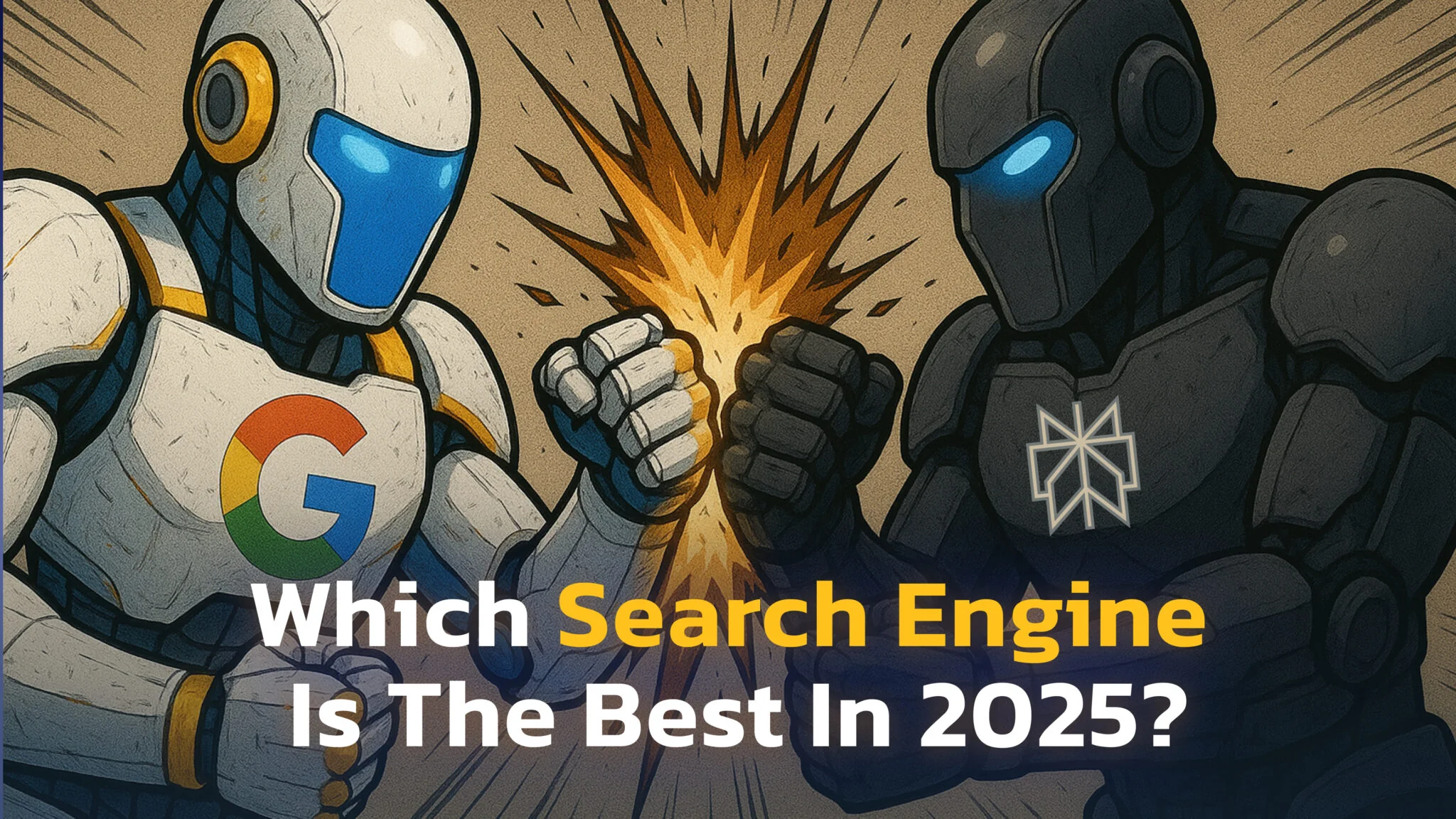
Perplexity is the better pick when you want a direct, cited answer to a research question. Google is still better for anything local, commercial or visual, such as maps, opening hours, flights and shopping. Those were the results of our May 2025 tests of Perplexity AI against Google Search. Since then Google has moved toward Perplexity’s model: Google AI Mode now answers in full sentences with links, inside Google Search, in more than 200 countries and territories. So in late 2026 the real choice is often Perplexity vs Google AI Mode.
The everyday question is simple: should you stick with Google or give Perplexity a permanent place in your browser? The answer depends on what you search for, how much you value citations, and whether you mind ads inside your answers.
We tested both tools on dozens of queries in May 2025 and looked at their business models and at how researchers, casual users and developers use them. On 23 November 2026 we re-checked every product fact in this guide, including plans, prices, models, ads and availability, against Google’s and Perplexity’s own pages. The May 2025 test results are kept as a dated record. We did not re-run them.
The Key Takeaways
- Answers vs links: Perplexity answers every query in prose with numbered citations. Google still leads with ranked links and adds AI Overviews or AI Mode on top.
- Google AI Mode is the real rival: it is free, works in more than 200 countries and territories and 98 languages, and passed 1 billion monthly active users by July 2026, according to Alphabet.
- Price: Google Search and AI Mode cost nothing. Perplexity is free with limits, Pro costs $20 a month and Max $200 a month (US prices, November 2026).
- Ads: Google shows ads inside AI Mode in the US and began adding ten more countries on 28 October 2026. Perplexity has wound down the sponsored answers it tested from November 2024.
- Traffic: Google had 91.04% of worldwide search engine referrals in October 2026, per StatCounter. AI chatbots as a group sent 0.14% of referral traffic, and Perplexity held 15.22% of that chatbot share.
What’s the Difference Between Perplexity and Google?
Google is a link index with AI layered on top, and Perplexity is an answer engine with links underneath. Type a query into Google and you get blue links, featured snippets, maps, shopping listings, ads and, often, an AI Overview: a generated summary with links to dig deeper. Google made Gemini 3 the default model for AI Overviews globally in January 2026. One tap on AI Mode turns the same search into a conversation.
Perplexity strips the page down to the answer. A single input box returns a written reply, often in bullets, with numbered citations that link to each source and suggested follow-up questions. On the free plan Perplexity’s Best setting picks the model for you, and paid plans add a model picker. Google’s AI Overviews and AI Mode show links too, so citations alone no longer separate the two. The default does: Perplexity always answers first, while Google shows an AI Overview only when its systems decide generative AI will help.
Google vs Perplexity traffic: how big is the gap?
Google’s reach remains unmatched. According to StatCounter, Google had 91.04% of the worldwide search engine market in October 2026. StatCounter measures this by the clicks search engines send to the websites it tracks, not by searches typed. By the same yardstick AI chatbots are still small: in October 2026 search engines sent 91.45% of the referral traffic StatCounter recorded and AI chatbots 0.14%. Within that chatbot slice Perplexity held 15.22%, behind ChatGPT at 51.03% and Google Gemini at 29.22%. Those chatbot shares swing month to month: in September 2026 StatCounter had ChatGPT at 80.47% and Perplexity at 5.84%, so read one month as a snapshot, not a trend.
Perplexity’s pitch is speed for research. It is built for people who would otherwise open five tabs to answer one question, and it courts students directly: verified students and educators can get Education Pro for $10 a month. For quick facts, how-tos and reading lists, Perplexity is often the faster first stop. For anything you want to see, visit or buy, Google still is.
Google AI Mode vs Perplexity
Google AI Mode is the closest thing Google makes to Perplexity, and it is free. AI Mode splits your question into subtopics, searches for each one at the same time (Google calls this query fan-out) and writes one answer with links. You can ask by text, voice, image, PDF or URL, then keep asking follow-ups. Google says AI Mode queries are on average three times longer than traditional searches, and one in five uses voice, images or documents.
Who picks the model
The two differ most on who picks the model. Google’s help page lists Gemini 4 Hydrogen for fast, all-round answers in AI Mode, and Gemini 4 Carbon, which Google AI Ultra subscribers aged 18 and over in selected countries can choose from the menu, with daily limits. Perplexity Pro lets you choose from seven models by seven providers, including GPT-6.2 Sol, Claude Sonnet 5.5 and Google’s own Gemini 4 Neon, and Max raises that to eleven with GPT-6.2 Astra, Claude Opus 5.5, Claude Fable 5.2 and Gemini 4 Carbon. That is Perplexity’s list as of 19 November 2026, and it changes often.
AI Mode vs Perplexity at a glance
Each side also has a feature that plays to its strengths. AI Mode can use your own Google data: adults with history turned on get answers shaped by past searches, and can connect Gmail, Google Calendar and Google Photos. Perplexity has Deep Research, which runs dozens of searches and writes a cited report in a few minutes. Free users get one Research query a month, and paid plans get more. The table reflects both companies’ pages on 23 November 2026.
| Feature | Google AI Mode | Perplexity |
|---|---|---|
| Price | Free; Gemini 4 Carbon needs Google AI Ultra | Free with limits; Pro $20/month; Max $200/month |
| Models | Gemini 4 Hydrogen; Gemini 4 Carbon for AI Ultra subscribers in selected countries | Best (automatic) on Free; 7 models on Pro and 11 on Max |
| Sources | Links to the web pages behind the answer | Numbered citations in every answer |
| Ads | Yes in the US; 10 more countries from 28 October 2026 | Sponsored answers wound down |
| Where | Google Search and the Google app, 200+ countries and territories | perplexity.ai, mobile apps and the Comet browser |
Pick AI Mode if you already live in Google and want free answers with Google’s maps, shopping and your own data behind them. Pick Perplexity if you want to choose the model, see a citation in every answer and avoid ads. For the assistant side of the same rivalry, see Perplexity vs Gemini.
Query by Query: Where Each Tool Won in Our May 2025 Tests
We tested four broad types of queries in May 2025: informational research, resource retrieval, local and commercial lookups, and casual exploration. The seven verdicts below are the record of that test, written as we found them. We have not re-run them. Google AI Mode was still a Search Labs experiment at the time, so it is not part of these results.
1. Informational Research
For questions like “How do I steam dumplings without a steamer?” or “Summarize the key points of the latest AI safety paper,” Perplexity consistently outperformed. It generated concise, structured answers with citations and often included relevant video links. The entire process took seconds, and there was no need to click through SEO-optimized blogs or skim through forum chatter.
This makes it especially valuable for time-sensitive research, technical writing, or academic exploration. In fact, some users describe it as what Wikipedia could have become: dynamic, cited, and constantly refreshed.
🏆 Winner: Perplexity
2. Resource Lookup: Advantage Google
When the task was to find movie showtimes, retrieve a tax form, or check a train timetable, Google had the edge. Its vertical integrations (like Flights, Shopping, and Maps) remain unmatched. Perplexity struggled to return structured data for things like restaurant hours or local business info, sometimes failing entirely unless the user refined the query repeatedly.
This illustrated a limitation LLM-based tools had in our tests: they could summarize documents but were less reliable at pulling out structured data, an area where Google’s vast ecosystem excels.
🏆 Winner: Google
3. Fact Recall
For single-fact lookups like “When is the NBA draft?” or “Where did Tim Cook go to college?”, both engines performed well. Perplexity answered instantly, always with a citation. Google provided knowledge panel info or surfaced a featured snippet. However, in cases where the answer was ambiguous or time-sensitive, Perplexity sometimes used outdated or less trustworthy sources.
When asked “Who directed Dune Part Two?” both returned the correct answer (Denis Villeneuve), but Perplexity included a citation from IMDb and a review quote, adding more depth. Google simply showed the Wikipedia snippet.
🏆 Winner: A tie
4. Meandering Exploration
Google dominated casual discovery. Searching for “Kali Reis” after watching True Detective: Night Country led to a rich journey via the knowledge panel, Wikipedia, YouTube clips, and her boxing history. In Perplexity, this required manual prompting, because it didn’t anticipate user intent as fluidly.
Likewise, when following a query thread from “What is the show ‘Severance’ about?” to “Who wrote the soundtrack?” to “What else has that composer done?”, Google’s linked ecosystem made navigation seamless. Perplexity required retyping composer names and restarting the thread.
🏆 Winner: Google
5. Academic & Technical Deep-Dives
When researching topics like “Compare current NPU designs from major chip manufacturers” or “Breakthroughs in solid-state battery storage,” Perplexity clearly outperformed. It pulled from arXiv, Nature, and institutional reports, organized the content into digestible summaries, and cited each source.
One standout example: asking Perplexity about “semiconductor supply chain challenges” surfaced trade data, TSMC’s statements, and links to financial reports, all in one thread. Google returned a mix of outdated PDFs and SEO-heavy think-pieces that required manual vetting.
This level of depth made Perplexity ideal for students, journalists, and professionals who need sourced synthesis rather than raw links.
🏆 Winner: Perplexity
6. Real-Time Breaking News & Live Data
For fast-changing topics, like “Microsoft Copilot Enterprise pricing update” or “Latest NVIDIA GPU benchmarks”, Perplexity shined with its chronological summaries and up-to-date references from blogs, press releases, and Twitter/X threads.
Google often lagged behind, and while it eventually surfaced the news, it lacked structure or chronology. In Perplexity, you could see conflicting statements from different outlets and trace them back to the original source.
That said, updates sometimes took 30–60 minutes to show up, which might be too slow for journalists on tight deadlines.
🏆 Winner: Perplexity
7. Local & Commercial Context
Looking for “best pho near me,” “grocery store hours today,” or “oil change coupon nearby” highlighted one of Perplexity’s weakest areas. It listed business names or Yelp blurbs, but rarely showed structured data like maps, operating hours, or menu previews.
Google’s dominance in local-intent queries, thanks to Maps, Reviews, Ads, and business schema, was unchallenged in our tests. Everything from “Book haircut in Shibuya” to “Flight from LA to Austin this weekend” worked seamlessly in Google. Perplexity? Not so much.
🏆 Winner: Google
Trust and Transparency
Google and Perplexity now both show sources, but they ask for different amounts of trust. Google’s AI Overviews come with links to dig deeper, and Google’s own help page warns that “AI Overviews can and will make mistakes.” AI Overviews are a core Search feature that cannot be turned off, although the Web filter shows links only. Our guide on how to turn off Google AI Overviews covers the workarounds.
Perplexity puts numbered citations in every answer, so each claim can be checked. The catch is which sources it picks. One analysis, an SE Ranking study first published in April 2025, found that 92.78% of the pages Perplexity cited had fewer than 50 referring domains, so many are small sites rather than established publishers. Perplexity now marks some cited domains with a Government, Academic or Trusted label to help you judge them.
Perplexity has also been accused of ignoring publishers’ crawling rules. On 4 August 2025 Cloudflare reported that when its customers blocked Perplexity’s declared crawlers in robots.txt and firewall rules, Perplexity reached their sites through an undeclared crawler that impersonated Google Chrome on macOS. Cloudflare de-listed Perplexity as a verified bot. Perplexity disputed the report, saying Cloudflare had confused its traffic with a third-party cloud browser service. The case matters for attribution, because Cloudflare also saw that when its block worked, Perplexity built answers from other websites instead of the original.
Even so, Perplexity’s transparency is a real advantage. A flawed citation can be checked and rejected, while an uncited summary has to be taken on trust. Click through before you repeat anything important, whichever tool gave you the answer.
Business Models, Ads, and Privacy
Google: ads pay for the answers
Google’s business model is advertising, and AI answers have not changed that. In the third quarter of 2026 alone, Google advertising brought in $82.0 billion, $63.35 billion of it from Google Search & other, out of Alphabet’s $127.6 billion in revenue. That gives Google a reason to keep you on its results page, not necessarily to give you the shortest path to an answer.
Those ads now sit inside the AI answers too. Google shows ads in AI Mode in the US, where on 28 October 2026 it started adding them to follow-up questions. The same day it began scaling AI Mode ads to Australia, Canada, India, Kenya, Malaysia, New Zealand, Nigeria, Pakistan, the Philippines and Singapore, with Brazil, Mexico and the UK planned for the fourth quarter of 2026. Google labels them “Sponsored.”
Perplexity: subscriptions instead of ads
Perplexity sells subscriptions. Perplexity’s free tier gives practically unlimited basic searches, 3 Pro Searches a day and 1 Research query a month, and Perplexity picks the model for you. Pro costs $20 a month and adds the model picker, image and video generation and higher limits. Max costs $200 a month, or $2,000 a year on the web, and adds the top models and the most room for Research and Create files and apps. The full breakdown is in our Perplexity pricing guide.
Perplexity did try ads. In November 2024 it began showing sponsored follow-up questions in the US, labelled “sponsored,” with answers still written by its own AI. It has since wound that experiment down: a Perplexity executive told the Financial Times, as reported in February 2026, that with ads “a user would just start doubting everything.” That makes Perplexity the one of the two that is not built around advertising.
Privacy: what each one keeps
Both keep a record of what you ask. Perplexity saves your searches as sessions in your account. Its Incognito sessions expire within 24 hours, and Pro and Max subscribers can opt out of AI training in settings. Google saves signed-in searches, including AI Mode history, and says it uses Search interactions to improve its generative AI. You can stop that for future signed-in searches by turning off your history setting in My Activity, but Google says signed-out searches may still be used. Neither is a privacy tool, so keep sensitive data out of both.
What Changed Since 2025, and What Comes Next
Google turned the AI-first search mode it was testing in Search Labs into a main feature. AI Mode began rolling out to everyone in the US on 20 May 2025, expanded globally in October 2025 and had passed 1 billion monthly active users by July 2026, Sundar Pichai said on Alphabet’s second-quarter call. Google has since brought AI Overviews and AI Mode together into one Search experience, and it now sells ads inside AI Mode. The golden goose survived: the ads moved into the AI answer.
Perplexity shipped the AI-native browser it was working on. Comet launched to a waitlist on 9 July 2025 and became free for everyone on 2 October 2025. It runs on Windows and Mac, and Perplexity’s help centre has an Android quick-start guide. The browser is free, but Comet Assistant agent tasks are not part of the free plan. Perplexity also added Model Council, which consults several models at once on Max, and Perplexity Computer, an agent for long-running work that needs a paid plan and credits. For how Comet compares with OpenAI’s browser, see ChatGPT Atlas vs Perplexity Comet.
Ultimately, the battle won’t be winner-take-all. Google’s unmatched infrastructure and commercial tools will keep it dominant for many workflows. But Perplexity has carved out a niche among those who value clean summaries, citations, and speed.
For users, the smartest strategy may be hybrid: Google for commerce and location-based results; Perplexity for research, technical content, and fast answers. Just as people use both Reddit and Quora for different kinds of knowledge, they may soon come to view Perplexity and Google as complementary tools in a broader information stack.
Use both without a second subscription
You do not have to pick one research engine and live with its blind spots. Fello AI puts Perplexity in the same app as GPT, Claude, Gemini and Grok, so you can get a cited answer from Perplexity and then ask Claude to turn it into a draft, without opening a second tab or paying a second bill. Its Adaptive Search decides for each message whether to go online. On a Mac it runs as a native app, which is the easiest way to keep Perplexity next to your usual browser, and it also works on iPhone and iPad.
Final Thoughts
If Google is a vast encyclopedia of the internet, then Perplexity is the sharp assistant who reads it for you. Each has strengths and blind spots.
Google wins on breadth, structured data, and familiarity. It excels when you want a map, a product, or a restaurant menu. Its cluttered results pages and SEO-heavy links made it less useful for research in our tests, and AI Mode narrows that gap at the price of ads inside the answer.
Perplexity, while still developing, offers a glimpse of what search could become: direct, verifiable, and focused. It doesn’t replace Google, but in many contexts it does something better.
The bottom line? Don’t be loyal. Be effective. Use Google when it works best. Switch to Perplexity when you need answers, not links. And keep both tools close. The future of search isn’t one engine. It’s the ability to move between them intelligently.
FAQ
Is Perplexity better than Google?
For research questions, usually yes, and for local, shopping and navigation searches, no. In our May 2025 tests Perplexity won informational research, academic deep-dives and breaking news, while Google won resource lookups, casual exploration and local queries, and fact recall was a tie. Google AI Mode has since narrowed the gap, for free.
What is the difference between Perplexity and Google?
Perplexity answers your question directly, with numbered citations to its sources. Google returns ranked links and adds an AI Overview or AI Mode on top. Google is funded by advertising, while Perplexity sells subscriptions, with Pro at $20 a month in the US.
Is Google AI Mode better than Perplexity?
It depends on what you value. Google AI Mode is free, built into Google Search and can use your Google data. Perplexity lets paying users choose the model, cites sources in every answer and has wound down its ads. AI Mode shows ads in the US and, since 28 October 2026, Google has been adding them in ten more countries.
How is Google AI Overviews different from Perplexity?
An AI Overview is a summary Google adds to some search results when its systems decide generative AI will help, while Perplexity answers every query that way. AI Overviews cannot be switched off, according to Google’s help page, but the Web filter shows links only.
How does Perplexity’s traffic compare with Google’s?
Google is far bigger. StatCounter measured Google at 91.04% of worldwide search engine referrals in October 2026. AI chatbots as a group sent 0.14% of the referral traffic StatCounter tracked that month, and Perplexity held 15.22% of the chatbot share.
Is Perplexity free?
Yes. The free plan gives practically unlimited basic searches, 3 Pro Searches a day and 1 Research query a month, with Perplexity choosing the model. Pro costs $20 a month and Max $200 a month in the US, as of November 2026.