Google announced Gemini 4 Carbon on October 28, 2026, and on day one you cannot use it. Carbon ranks first on the Artificial Analysis Intelligence Index v5.0 with a score of 59, one point ahead of Claude Opus 5.5. But Google is giving it first to a subset of cyber defenders. Developers, businesses and Gemini app subscribers get it "as soon as possible", with no date attached.
Carbon arrives just two weeks after Gemini 4 Argon opened to the public, and Google pitches it at the same work: long software engineering jobs and cybersecurity defense. This guide covers who can use Gemini 4 Carbon today and when everyone else is likely to get it. It also covers the price, and how Carbon's benchmarks compare with Argon, Claude Opus 5.5 and GPT-6 Astra.
The Key Takeaways
- Top of the board: Gemini 4 Carbon scores 59 on the Artificial Analysis Intelligence Index v5.0, ahead of Claude Opus 5.5 at 58 and GPT-6 Astra at 57.
- Not public yet: only a subset of cyber defenders get access this week, followed by more partners in Google's Fairwind Program. There is no release date for the Gemini app or the API.
- Same price as Argon: an introductory $2 per million input tokens and $10 per million output tokens, rising to $4 and $20 later. Google has not said when the introductory period ends.
- Use Argon meanwhile: Gemini 4 Argon is the newest Gemini you can use today, on Google AI Pro and Ultra and the paid API. Argon went from defenders-only to public in 13 days.
What Is Gemini 4 Carbon?
Gemini 4 Carbon is Google's newest frontier model and, in Google's announcement, "our strongest model with state-of-the-art cybersecurity and long horizon capabilities." Carbon is the second public model of the Gemini 4 generation. The first, Gemini 4 Argon, was announced on September 30, 2026 and opened to paying users on October 13.
Google built Gemini 4 Carbon for long, multi-step engineering work. The announcement says Google's internal teams "have seen Carbon run for days" on hard bugs. The examples are finding the root cause of subtle bugs across large codebases and low-level systems, then patching them. Google also says it improved Carbon at agentic work, scientific tasks, full-stack web development and multimodal understanding, building on user feedback from Argon.
The name was not a surprise to people following the Gemini 4 rollout. Business Insider reported on October 9 that Google employees were testing a new internal version of Gemini 4 called Carbon, and our Gemini 4 tracker had logged that report as unverified. The October 28 announcement confirms Carbon as a real, named model, not an internal codename that disappeared.
Google's official account announced Gemini 4 Carbon with the same headline claims as the blog post, including the staged rollout:
Introducing Gemini 4 Carbon, our latest frontier model.
— Google (@Google) October 28, 2026
Carbon delivers improved performance across domains — ranking #1 on v5.0 of the @ArtificialAnlys Intelligence Index and sets a new state-of-the-art in cybersecurity and long-horizon capabilities.
It’s rolling out starting this week to cyber defenders through our Fairwind Program, with expanded access coming soon 🧵
Can You Use Gemini 4 Carbon Yet?
No. As of October 28, 2026, Gemini 4 Carbon is not available in the Gemini app, in AI Mode in Search, or on the public Gemini API. Google says it will make Carbon available "to a subset of cyber defenders" starting this week, then "gradually phase access to additional trusted partners." Developers, businesses and consumers come last, "via our product surfaces as soon as possible."
Who Gets Gemini 4 Carbon First: the Fairwind Program
The first Gemini 4 Carbon users come from Google DeepMind's Fairwind Program. Google describes Fairwind as early access for "high-priority defenders (like governments, healthcare providers, and telecommunications services)" and says it works with more than 650 partners globally.
Fairwind is not a waitlist an individual can join. Google DeepMind runs background checks on organizations that apply. The program's published terms, written for Argon, say partners must use phishing-resistant multi-factor authentication, limit model access to internal cybersecurity, incident response or penetration testing teams, and may not share, redistribute or sell access. Partners may only run permitted dual-use tasks, such as authorized threat simulation, reverse engineering and malware analysis for defense or academic research.
Google also says it is "actively engaged in the U.S. government's voluntary process for pre-release model testing." The cyber-first rollout follows the same logic as Argon. Carbon is good at finding and exploiting software flaws, so Google wants defenders to have it first.
When Will Gemini 4 Carbon Be Released to Everyone?
Google has not given a public release date for Gemini 4 Carbon. The best evidence for timing is the Gemini 4 Argon rollout, which used the same sequence. Google announced Argon on September 30, 2026 for Fairwind cyber defenders only. On October 13, 13 days later, Google opened Argon to the paid Gemini API and to Google AI Pro and Ultra subscribers in the Gemini app and AI Mode in Search. Ultra subscribers also got it in Google Antigravity and AI Studio.
If Google repeats that pattern, a public Gemini 4 Carbon launch around mid-November 2026 is plausible. Treat that as an inference from one precedent, not a Google commitment. Sundar Pichai's own post asks people to "hang tight" and promises "wider availability soon":
I did say we'd be releasing our models periodically...introducing Gemini 4 Carbon, our next frontier model.
— Sundar Pichai (@sundarpichai) October 28, 2026
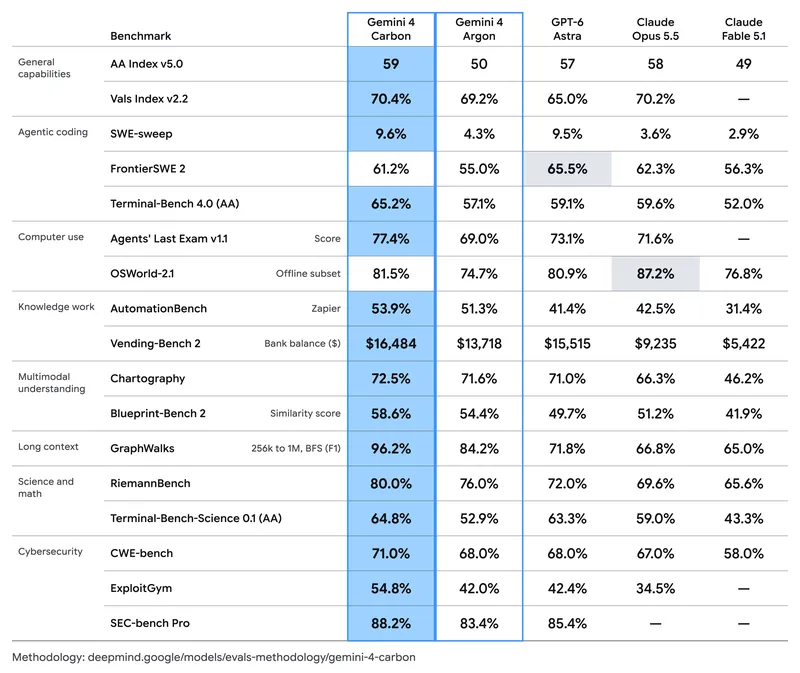
Following Argon's release just two weeks ago, Carbon shows the pace at which we’re pushing the frontier, it ranks #1 on the recently updated v5.0 of @ArtificialAnlys Intelligence Index at 59. It also leads across key cybersecurity evaluations scoring 88.2% on SEC-bench Pro for finding vulnerabilities, 54.8% on ExploitGym for exploitation, and 71.0% on CWE-bench for patching.
We’re seeing significant improvements in long-horizon tasks even compared to Argon, and we’ve strengthened frontier safeguards.
As we did with Argon, we’re going to roll it out gradually + responsibly. Some trusted cyber defenders will get access starting this week. We'll be expanding it to more partners through our Fairwind Program, ahead of wider availability soon, so hang tight!
What to Use While You Wait for Gemini 4 Carbon
Gemini 4 Argon is the newest Gemini model you can use today. It runs in the Gemini app for Google AI Pro and Ultra subscribers. On the paid Gemini API it costs the same introductory $2 and $10 per million tokens that Carbon will launch at. Free and Google AI Plus users do not get Argon. Our Gemini 4 Argon guide covers its plans, limits and benchmarks in full. Need a strong model for writing, research or coding on a Mac this week? Fello AI puts Gemini, Claude and GPT in one app, so you can keep working with what is available instead of waiting on one vendor's rollout.
Gemini 4 Carbon Pricing
Gemini 4 Carbon will launch at an introductory $2 per million input tokens and $10 per million output tokens on the Gemini API, with cached input tokens 95% off. That is the same introductory price as Gemini 4 Argon. A footnote in Google's announcement says that after the introductory period, "the price of $4 per 1M input tokens and $20 per 1M output tokens will apply."
Google has not said when the Carbon introductory period ends. Argon's introductory rate runs until November 30, 2026, with the higher rates from December 1. Independent evaluator Vals AI already lists Gemini 4 Carbon at the later $4 and $20 rates, so expect to see both prices quoted. Neither applies to anyone yet, because there is no public Carbon endpoint.
| Gemini API price per 1M tokens | Gemini 4 Carbon | Gemini 4 Argon |
|---|---|---|
| Introductory input | $2 | $2 |
| Introductory output | $10 | $10 |
| Later input | $4 | $4 |
| Later output | $20 | $20 |
| Introductory period ends | Not announced | November 30, 2026 |
| Publicly available | No | Yes, since October 13 |
For Gemini app users the question is which plan, not which token price. Google has not said which subscription tiers will get Gemini 4 Carbon. Argon went to Google AI Pro and Ultra at launch, so those two plans are the likeliest first stop for Carbon too.
Gemini 4 Carbon Benchmarks
Gemini 4 Carbon leads the broadest independent benchmark available today: Artificial Analysis Intelligence Index v5.0 lists Gemini 4 Carbon (High) first at 59, followed by Claude Opus 5.5 (Max) at 58. Artificial Analysis published v5.0 on October 27, the day before Carbon. It is a harder rescale built from nine evaluations, so v5.0 scores cannot be compared with older index numbers. Our explainer on how AI benchmarks work covers what composite indexes like this one measure.
Google's Cybersecurity Numbers
Google's headline Gemini 4 Carbon scores are on cybersecurity, and Google ran all three external evaluations without guardrails. That means the public version, when it ships with safety filters, may not score the same.
| Benchmark (Google-reported) | What it tests | Gemini 4 Carbon |
|---|---|---|
| SEC-bench Pro | Finding real vulnerabilities | 88.2% |
| ExploitGym | Proving a vulnerability is exploitable | 54.8% |
| CWE-bench | Patching the root cause | 71.0% |
| WebDev Arena | Web development, human votes | #4, 1768 (+89 Elo) |
Google adds internal results it does not publish in full. It says Gemini 4 Carbon has more than twice Argon's success rate at generating secure code. It also says the Chrome team found Carbon "more than 10X better than another lab's large frontier model" at producing high-quality patches. Google does not name the rival lab, so that comparison cannot be checked.
What Independent Testers Found
Independent results mostly back Google, with one caveat on factual accuracy. Vals AI ranks Gemini 4 Carbon second of 29 models on its Vals Index at 70.36%, behind Claude Sonnet 5.5 at 70.85% and ahead of Claude Opus 5.5 at 70.18%. Artificial Analysis gives Carbon the top score on its AA-Omniscience knowledge test at 54, six points ahead of Opus 5.5.
The caveat sits inside that same AA-Omniscience test. Gemini 4 Carbon's hallucination rate is 11%, up from Argon's 4%. Carbon still has the second-lowest hallucination rate Artificial Analysis lists, behind only Argon, but it answers wrongly more often than its predecessor when it does not know. Google's internal testing points the other way. It says Carbon "cuts unsupported claims by approximately 2x over Argon." The two results measure different things and do not cancel out, so check Carbon's factual answers the way you would check any model's.
Gemini 4 Carbon vs Argon vs Claude Opus 5.5 vs GPT-6 Astra
Gemini 4 Carbon is the highest-scoring model on the Artificial Analysis Intelligence Index v5.0, but the three models just behind it are ones you can actually use. The gap between first and third place is two points.
| Model | AA Intelligence Index v5.0 | Available to the public |
|---|---|---|
| Gemini 4 Carbon (High) | 59 | No, cyber defenders only |
| Claude Opus 5.5 (Max) | 58 | Yes |
| GPT-6 Astra (Max) | 57 | Yes |
| Gemini 4 Argon (High) | 50 | Yes, since October 13 |
The nine-point jump from Gemini 4 Argon to Gemini 4 Carbon is the real story for Google users. Argon trailed both Claude Opus 5.5 and GPT-6 Astra on the v5.0 index; Carbon edges past both. Google's own comparison chart is less one-sided than the headline, though. In that chart GPT-6 Astra still leads the FrontierSWE 2 coding test (65.5% against Carbon's 61.2%), and Claude Opus 5.5 leads the OSWorld-2.1 computer-use subset (87.2% against 81.5%). Carbon leads the other 15 of the 17 rows.
Gemini 4 Carbon Safety: What Google Says Changed
Gemini 4 Carbon uses the same safety stack as Argon, according to Google: model training, real-time misuse defenses, prompt-injection resistance and chain-of-thought monitoring. Google says it went further on alignment with Carbon, and reports these internal results:
| Safety measure (Google internal) | Gemini 4 Carbon result |
|---|---|
| Cheating on Terminal-Bench 4.0 | 0.0% successful, 0.4% attempted |
| High-severity misalignment alerts | Down almost 80% in Google's live coding environments |
| Overreach on multi-step plans | Down 26% |
| Under-service on multi-step plans | Down 29% |
| Gray Swan indirect prompt injection | 0.0% attack success, against 0.7% for Argon |
All five figures are Google's own measurements. No outside lab has published matching numbers yet, and as of October 28 Google's model card page lists Gemini 4 Argon but no card for Gemini 4 Carbon.
The Verdict on Gemini 4 Carbon
Gemini 4 Carbon puts Google back at the top of the independent rankings, two weeks after Argon trailed Claude Opus 5.5 and GPT-6 Astra by seven points or more. For now that lead is on paper. The only people who can use Carbon are vetted cyber defenders, the price will double after an introductory period Google has not dated, and its factual-accuracy record is mixed.
If you pay for Google AI Pro or Ultra, keep using Argon and watch the Gemini app for Carbon; on Argon's precedent it could arrive within weeks. If you need the best model you can use today, Claude Opus 5.5 and GPT-6 Astra sit one and two points behind Carbon and are available now.
Frequently Asked Questions
Is Gemini 4 Carbon available in the Gemini app?
No. As of October 28, 2026, Gemini 4 Carbon is limited to a subset of cyber defenders in Google's Fairwind Program. Google says it will reach developers, businesses and consumers "as soon as possible" but has not given a date or named the plans that will get it.
When is the Gemini 4 Carbon release date?
Google has not announced one. Gemini 4 Argon followed the same staged rollout and went from defenders-only on September 30 to public on October 13, 13 days later. A similar gap would put Carbon's public launch around mid-November 2026, but that is an estimate, not a Google date.
How much does Gemini 4 Carbon cost?
Gemini 4 Carbon will launch on the Gemini API at $2 per million input tokens and $10 per million output tokens, with cached input 95% off. After an introductory period Google has not dated, the price rises to $4 and $20 per million tokens.
Is Gemini 4 Carbon better than Gemini 4 Argon?
On benchmarks, yes. Gemini 4 Carbon scores 59 on the Artificial Analysis Intelligence Index v5.0 against Argon's 50, and Google reports gains on every benchmark it compared. Argon keeps one edge: a 4% hallucination rate on AA-Omniscience against Carbon's 11%.
What is the Fairwind Program?
The Fairwind Program is Google DeepMind's early-access scheme for cyber defenders such as governments, healthcare providers and telecom companies. It has more than 650 partners, runs background checks on applicants, and lets members use frontier models only for defensive security work.