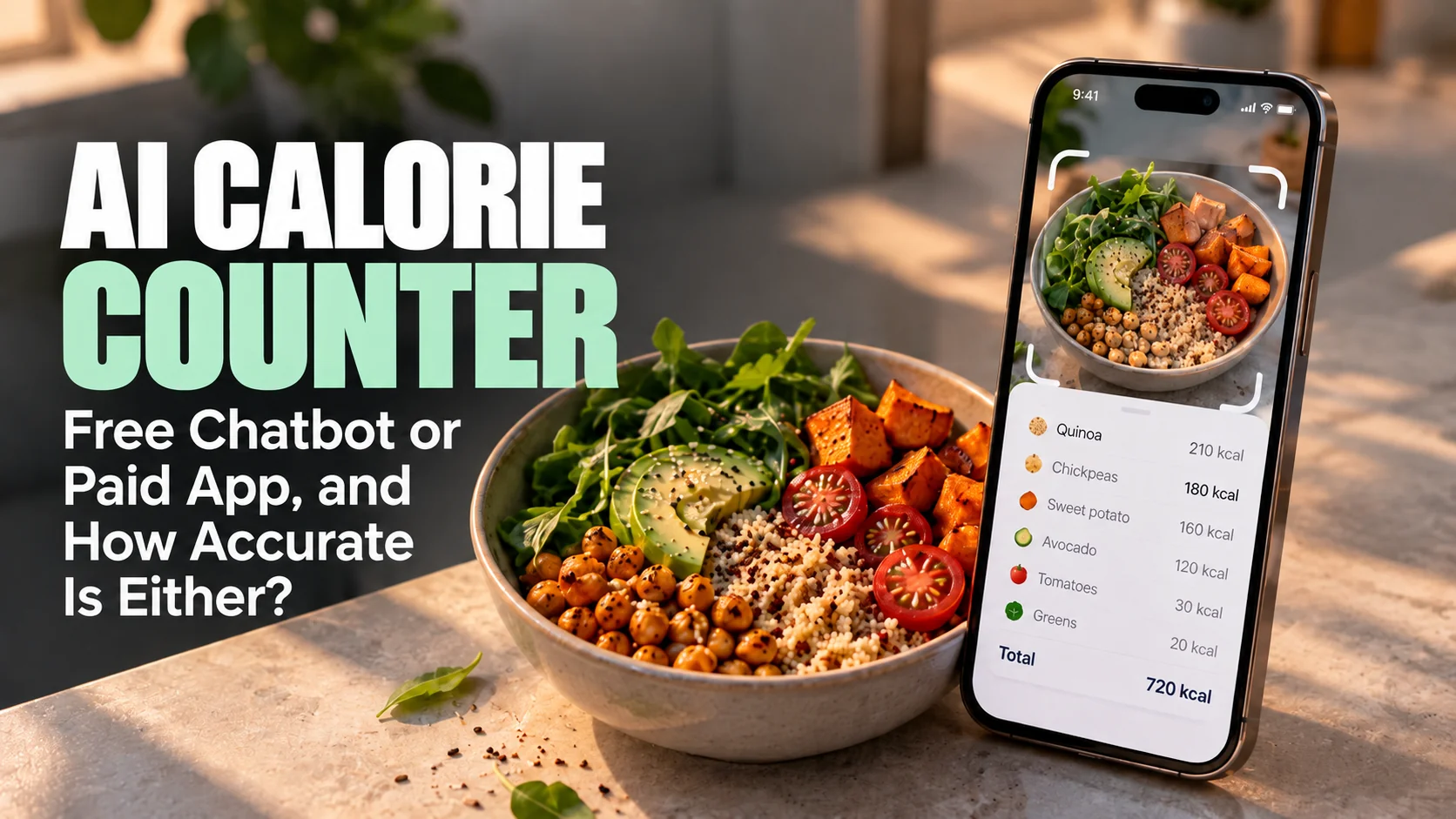
An AI calorie counter reads a photo of your meal and tells you what's on the plate, but it is not accurate enough to trust meal by meal. In July 2026 a team at the National Institutes of Health ran photos of 102 weighed meals through four popular apps, Cal AI and MyFitnessPal among them. Every app came back low, by 250 to 345 calories per meal on average, or about a third.
That finding matters for the question most people are actually asking, which is whether to pay for an app or just show the photo to ChatGPT, Gemini or Claude for free. Nearly every page ranking for this search is written by a calorie app recommending itself. This one sells no calorie app. It sets the independent studies side by side: what the paid apps and the free chatbots each get wrong, what each costs, and how to get a number you can actually use.
The Key Takeaways
- Paid apps run low: NIH researchers found four photo apps underestimated calories by 250 to 345 per meal and fat by about 30 grams. The results are preliminary and not yet peer reviewed.
- Free chatbots miss by a similar margin: in a peer-reviewed study, ChatGPT and Claude missed energy by about 36% on average, and Gemini did far worse.
- The error grows with the plate: ChatGPT put large meals at 530 g when they weighed 798 g, and it underestimated weight in 76% of photos.
- Cal AI's scan is not free: its App Store listing states that food scanning results require a subscription. ChatGPT Free is capped at 3 uploads a day.
- The fix is words, not a better app: telling the model the real weight cut one model's carbohydrate error from 56.6% to 20.2%.
How Accurate Is an AI Calorie Counter?
Not very. Independent tests of both paid photo apps and free chatbots find single-meal estimates off by roughly a third. The misses lean low, and they are worst on large portions and on fat you can't see. And a shortfall that repeats at every meal doesn't cancel out over a week. It adds up.
The paid apps: a third too low
The cleanest test so far comes from the NIH Clinical Center, where meals for a diet trial are prepared in a metabolic kitchen and every ingredient is weighed to the nearest 0.1 gram. Researchers photographed 102 of those meals and ran them through MyFitnessPal, Lose It!, Cal AI and Appediet. According to the American Society for Nutrition's release, all four underestimated calories by about 250 to 345 per meal and fat by about 30 grams.
Aaron Hengist is a postdoctoral fellow at the NIH's diabetes and digestive diseases institute. He put the practical upshot plainly: "People using a photo-based tracking app without adjusting the portions or entering the amounts of food should take the results with a grain of salt." Early results from a further 200 meals suggest the apps do worse still on low-carb ketogenic meals, because their higher fat is the part that goes missing.
One caveat keeps this honest. The work was presented as an abstract at NUTRITION 2026 in July, and the society says such findings "should be considered preliminary until a peer-reviewed publication is available."
The free chatbots: about 36% off
General chatbots have had more formal scrutiny. A 2025 study in Current Developments in Nutrition gave 52 standardized food photos to ChatGPT, Claude and Gemini and compared their answers with weighed reference values. ChatGPT-4o and Claude 3.5 Sonnet both missed energy by a mean absolute percentage error of 35.8%. Gemini 1.5 Pro was much worse, at 64% to 110% across nutrients.
For context, the same authors note that written food diaries kept by athletes, checked against the doubly labelled water method in four studies, averaged 26.5% error. A photo in a chatbot was roughly ten points worse than writing down what you ate.
Identification is not the weak point. An Irish study in Nutrients uploaded 114 meal photos to ChatGPT, and it named the foods correctly with 93% precision. It also agreed with a panel of seven dietitians about as well as they agreed with each other. The trouble started when it had to decide how much food was on the plate.
These models are a generation old now. Newer ones have been tested on different photo sets, so their numbers don't line up neatly with the older studies. A 2026 study in Nutrients found Claude Sonnet 4.6 missed energy by 117 kcal per meal on a US photo set, against the 123 kcal its authors cite from an earlier, smaller ChatGPT-5 study. Better, not solved.
Why they miss: portion size and fat
Two failures explain most of the gap. The first is portion size, and it gets worse as the plate fills up. In the Irish study, ChatGPT judged small meals about right but put large meals at 529.5 g when they actually weighed 798.1 g. It underestimated weight in 87 of 114 photos.
The three-model study found the same pattern in every model, with underestimation growing as portions grew.
The second is fat. Oil in a stir-fry, butter melted into toast and dressing tossed through a salad barely show up in a photo. The NIH apps lost about 30 grams of it per meal. A 2026 study of hospital meals in Nutrients found the opposite direction, with the AI models overestimating fat by more than 20%. The direction varies. The unreliability doesn't.
Then there are the plain misreads. Gemini took falafel for meatballs and overestimated protein by 360%. Claude read scrambled eggs as a pasta dish and overestimated carbohydrates by 1,788%. One wrong guess like that wrecks a day's log.
Free Chatbot vs Paid AI Calorie Counter App
The studies were run on different meals with different methods, so they can't crown a winner. What they do show is that the gap between free and paid is smaller than the paid apps imply. Both land in the same range of error. What you pay for is everything around the estimate.
| Tool | Cost | Photo estimate on the free tier | Independent accuracy evidence | What you actually get |
|---|---|---|---|---|
| ChatGPT | Free plan available | Yes, capped at 3 uploads a day | ~36% energy error (GPT-4o, 2025) | An estimate you have to log yourself |
| Claude | Free plan available | Yes, JPEG, PNG, GIF or WebP | ~36% energy error (3.5 Sonnet, 2025) | An estimate you have to log yourself |
| Gemini | Free plan available | Yes, from Photos or Camera; paid plans raise limits | ~64% energy error (1.5 Pro, 2025) | An estimate you have to log yourself |
| Cal AI | Subscription, price shown in-app | No, scan results require a subscription | Underestimated with the other 3 apps (NIH, 2026) | A plan built from lifestyle questions, MyFitnessPal's food database, Apple Watch app |
| SnapCalorie | In-app purchases from $9.99 to $149 | Free to download; free scans not stated on the listing | None independent; vendor cites its own research | Goals, voice logging, LiDAR portion measuring on iPhone Pro |
That last column is the honest case for paying. A chatbot gives you a number in a chat window and then forgets about it unless you build your own log. A dedicated app keeps the diary, totals the day and tracks you against a goal. None of that makes the photo estimate more accurate.
Is an AI Calorie Counter Free?
The chatbots are, with limits. The dedicated apps mostly aren't, whatever the download button says.
What Cal AI costs and who owns it
Cal AI is free to install, and its App Store listing is blunt about the rest: "FOOD SCANNING ANALYSIS RESULTS REQUIRE A SUBSCRIPTION." The listing shows in-app purchases including $2.99, $9.99, $19.99 and $29.99 without saying which period each one covers, so the price you see depends on the paywall you're shown. The app holds a 4.8 rating from 367,000 reviews, so plenty of people decide it's worth it.
Two recent events are useful before you subscribe. MyFitnessPal bought Cal AI in a deal that closed in December 2025 and was announced on 2 March 2026. TechCrunch reported the app had more than 15 million downloads and over $30 million in annual revenue, and that it now draws on MyFitnessPal's database of 20 million foods. Then in April 2026, Apple briefly pulled Cal AI from the App Store. According to MacRumors, Apple said the app bypassed its required in-app purchase option. Its paywall also showed the weekly price more prominently than the amount users would actually be billed, and a free-trial toggle hid the automatic renewal. The app fixed the issues and returned.
SnapCalorie lists purchases from $9.99 up to $149.00 for its annual plan, with a monthly plan at $19.99. If you already pay for a few AI tools, run an audit of your AI subscriptions before adding one more.
The free chatbot catch: upload caps
The free route has its own ceiling. OpenAI's file uploads FAQ, the same page that sets its image limits, says "Free users are limited to 3 file uploads per day." At three photos a day, that's breakfast, lunch and dinner, and no snacks. The full picture of what OpenAI gives away is in our guide to what ChatGPT's free plan includes.
Google's help center lets you add a meal straight from Photos or the Camera in the Gemini app on iPhone. It doesn't publish a free upload number, only that a paid plan raises the limits. Our breakdown of what free Gemini includes covers the rest of the free tier. Claude's help center lists JPEG, PNG, GIF and WebP photos and up to 20 files per chat, with no separate free-plan photo cap stated.
How to Get a Better Estimate From ChatGPT, Gemini or Claude
The research points the same way every time: the model is good at naming food and bad at weighing it. So do the weighing for it. When one benchmark gave the model the real food weight, Gemini 2.5 Flash's carbohydrate error fell from 56.6% to 20.2%. A 2025 study of ChatGPT-5 found the same thing on 195 dishes: its estimates improved with every layer of written context, and most once it had the ingredient amounts.
Weigh what you can, estimate the rest in spoons or palm-sized pieces, and name every fat that went into the pan. Then paste a prompt like this under the photo:
Estimate the calories and macros in this meal.
What's in it: [food, weight in grams or a household measure]
Cooking fat and sauces: [e.g. 1 tbsp olive oil, 10 g butter, 2 tbsp dressing]
Cooking method: [fried / baked / grilled / raw]
List each item with its weight and calories, then the total.
Give a low and a high estimate, not one number.
Tell me which item you are least sure about.
Each line of that prompt targets one of the failures above. The weights fix the portion problem, the fats line covers what the photo can't show, and the range stops you treating a guess as a measurement. Asking which item is shakiest catches the falafel-for-meatballs kind of misread before it lands in your log.
Two more habits help. Photograph the plate from above before you mix anything in, and keep a fork or your hand in frame for scale. Stick with the strongest model you have access to, too. A 2026 study of Claude models found better prompts helped only when the model was capable enough to use them. For recipes you cook often, work the numbers out once from the ingredient list. Our guide to AI nutritional analysis for recipes shows how.
A second opinion in one app
The weighed, written description is where the accuracy comes from, which means you don't need a calorie app to use it. Fello AI puts GPT, Claude and Gemini in one app on iPhone, iPad and Mac, with a free tier. Type your meal description once, ask two models, and if their totals are far apart, you know which dish to weigh next time.
When a Paid AI Calorie App Is Worth It
Pay for a dedicated app if what you need is the habit: a diary that totals your day, a goal to measure against, and a history you can look back on. MyFitnessPal's own chief executive drew the line, as TechCrunch summarized it: Cal AI is for people who prefer speed over accuracy, and MyFitnessPal for those who want the reverse. That's a vendor admitting the fast photo scan isn't the accurate option.
Don't pay for a sharper photo estimate, because the evidence says you won't get one. The NIH researchers' own suggestion was to pair photo features with more traditional tracking. In practice, that means correcting the portion the app guessed.
If you track calories for a medical reason, such as diabetes, kidney disease or recovery from an eating disorder, a registered dietitian beats any app. And if you want your meals next to your step count and workouts, see how ChatGPT Health connects to Apple Health.
The Verdict
An AI calorie counter is a fast way to get a rough number. The free chatbots and the paid apps both miss by roughly a third, and both come in low on big plates. Paying for Cal AI or SnapCalorie buys you a tidy diary, not a truer estimate. If accuracy is the point, the free route with a kitchen scale and a detailed prompt beats a subscription's photo scan. Add a paid app only once you know you'll keep logging.
Frequently Asked Questions
Is an AI calorie counter accurate?
Not meal by meal. NIH researchers found four popular photo apps underestimated calories by 250 to 345 per meal, and a peer-reviewed study found ChatGPT and Claude missed energy by about 36%. Both miss large portions and hidden fat, so treat any single number as a rough range.
Is there a free AI calorie counter?
Yes. ChatGPT, Gemini and Claude all estimate calories from a meal photo on their free plans, though ChatGPT Free allows only 3 uploads a day. Dedicated apps such as Cal AI are free to download but put photo scanning behind a subscription.
How much does Cal AI cost?
Cal AI is free to install, but its food scanning results require a subscription. The App Store lists purchases including $2.99, $9.99, $19.99 and $29.99 without naming the billing period, so check the renewal amount on the paywall before you start a trial.
Can ChatGPT count calories from a photo?
Yes. It identifies foods well, with 93% precision in one study, but it underestimates the weight of medium and large meals. Tell it the weights, the cooking fat and the cooking method, and ask for a low and high estimate rather than one number.
Why do AI calorie counters underestimate?
Mostly portion size: the bigger the plate, the bigger the miss. Fat is the other blind spot, because oil, butter and dressing barely show in a photo, and in NIH testing the apps missed about 30 grams of it per meal.