Is ChatGPT allowed in school? Usually yes, with conditions. The blanket bans of 2023 have almost entirely given way to a different rule: you may use AI for a defined set of tasks, you must declare it, and the person who decides where the line sits is not your school. It is your individual instructor. That is the single fact most students get wrong, and it is the reason a classmate can use AI on one assignment and be reported for misconduct on the next.
This guide is written to you, the student, rather than to the people writing the policy. You get the three-layer rule that determines what you are actually permitted to do, and a task by task table covering the twelve things students usually want AI for. Then a disclosure statement you can copy and paste, the mechanical referencing format UK exam boards require, and an honest answer about what happens if you get it wrong. Every rule stated here names the institution it comes from and the date it was published.
The Key Takeaways
- Short answer: usually allowed, almost always conditional on disclosure, and never during a graded assessment.
- The rule is three layers deep. Your institution sets a floor, your department adds to it, and your individual instructor can override both. Check the assignment brief first, not the school policy.
- Undisclosed generation is the offence, not AI use. Passing off generated text as your own is treated like copying. Declaring the same use usually is not misconduct at all.
- UK coursework has a mechanical rule. JCQ requires the AI source name and the generation date in the reference, plus a saved non-editable copy of your prompts and the output.
- The age gate comes first. OpenAI sets a minimum of 13 and requires parental permission for anyone under 18. Gemini is the one major assistant with a sanctioned route for under-13s.
- If you are under 18, ChatGPT now behaves differently on homework. Since 18 August 2026 it places you in ChatGPT for Teens automatically, and it will push back and steer you toward Study Mode when it thinks you are trying to shortcut an assignment.
Is ChatGPT Allowed in School? The Short Answer
Usually yes, with conditions. Most schools and universities have moved from banning AI outright to requiring that you disclose it. The rule that matters is layered: your institution sets a floor, your department or faculty can add to it, and your individual instructor can override both. Check the assignment brief first, then the syllabus, then the school-wide policy. Anything you find at the school level is the minimum, not the answer.
The second half of the answer is where students trip. Permission is task-shaped, not tool-shaped. No policy worth reading says "ChatGPT is allowed" or "ChatGPT is banned". They say brainstorming is fine, editing your own prose is probably fine, generating the prose you submit is not, and using anything at all during a graded assessment is out. The tool is irrelevant. What you asked it to do, and whether you said so, is the whole question.
The Three Layers of AI Rules at School
Assume nothing carries across from one class to the next. The University of Warwick Library's AI guide for students, last updated on 30 June 2026, tells students to "always refer to your assessment brief and your department's guidance and/or referencing guidelines" before relying on anything a university-wide page says. That is two layers named explicitly in a single sentence, and the brief comes first.
The third layer is the instructor. Harvard's Graduate School of Education states that, given the wide range of learning goals in its courses, "individual instructors may create course-specific policies that differ from and supersede these guidelines". Its default, absent an instructor saying otherwise, is that using generative AI to create all or part of an assignment and submit it as your own violates the academic integrity policy. Read that carefully: a school policy that permits AI editing does not permit AI editing in a class whose instructor has banned it. The narrowest rule wins, always.
Where to look, in order
Give this two minutes before every assignment rather than once a term. First, the assignment brief or task sheet, which is where instructors put a per-task exception. Second, the syllabus or module handbook, which is where a standing course policy lives. Third, the department or faculty guidance. Fourth, the institution-wide academic integrity policy. If layers one through three are silent, the institutional policy applies. If they conflict, the most restrictive one applies.
If nothing anywhere addresses AI, you have not found permission. You have found a gap, and gaps get resolved after the fact by whoever is marking your work. Email the instructor, ask the question in writing, and keep the reply. A one-line email is a cheap insurance policy against an academic misconduct hearing.
Can I Use AI for This? A Task by Task Table
This is the grid the policies imply but rarely print. Statuses reflect the common position across the institutional guidance surveyed for this article. None of them override your own brief.
| Task | Typical status | What to check |
|---|---|---|
| Explaining a concept you do not understand | Usually allowed | Nothing. This is studying, not submitting |
| Brainstorming ideas or angles | Usually allowed | Whether the brief asks you to declare it anyway |
| Building a revision or study plan | Usually allowed | Nothing. This is your own time |
| Generating practice questions | Usually allowed | That the questions are not themselves the assessment |
| Summarising a source you have read | Check first | Whether comprehension is the thing being marked |
| Finding sources to read | Check first | Required databases, and verify every citation exists |
| Translating a source | Check first | Language courses commonly ban this outright |
| Outlining an essay | Check first | Whether the outline is itself submitted or graded |
| Editing prose you wrote yourself | Check first | The instructor policy. Some ban language polishing |
| Drafting prose that goes in your submission | Prohibited unless permitted and disclosed | Explicit written permission, then disclose it |
| Writing code for a graded assignment | Usually prohibited | The module handbook, which often has a separate rule |
| Anything during a graded assessment or exam | Prohibited | Nothing. This is the universal hard line |
The pattern is consistent. AI aimed at your understanding is fine. AI aimed at your output needs permission. AI during an assessment is out everywhere, with no exceptions worth planning around.
The Hard Line: Graded Assessments
Every framework converges here. The JCQ, the body that sets the rules for GCSEs and A-levels in the UK, is explicit that its guidance is primarily about non-examination assessment and coursework, and that in supervised exams "students must not be able to use such tools" at all. Those are two different regimes and blurring them is how students get into trouble. Coursework has a disclosure route. Supervised assessment has none.
The same line shows up in what students themselves proposed. In July 2026, the inaugural Student Senate convened at the Edward M. Kennedy Institute produced the STUDENT FIRST Act of 2026, a national framework written by students representing all 50 states and adopted by an 82 to 16 vote. The bill text styles it STUDENT FIRST, singular, though some coverage writes STUDENTS FIRST. It is a proposal rather than law, and it binds nobody. That is exactly what makes it interesting: given the chance to write their own rules, students wrote that AI use is "strictly prohibited on all graded assessments", with a default penalty of a zero on that assignment unless the teacher decides otherwise. Studying with AI stays permitted even during assessment periods. The framework also prohibits students from inputting assignments directly into AI platforms.
The rest of that framework is stricter than most school policies. It requires teacher permission before using AI on an assignment and treats undisclosed use as plagiarism outright. It permits editing, brainstorming and studying with AI only after eighth grade, on the grounds that students should master editing without it first, and it rules out AI for "the act of writing" entirely. And where AI was used during the drafting phase, it expects students to be ready to demonstrate independent mastery through in-person discussions, handwritten assessments or oral defences. If your school's rules feel harsh, they are probably looser than what students proposed for themselves.
How to Disclose AI Use, With a Template You Can Copy
A disclosure statement names the tool, the date, what you asked it to do, and how you used the output. Place it at the end of your assignment, before the reference list, unless your instructor specifies otherwise. Warwick's library guide puts the requirement plainly: if you use an AI, you must set out why, where, and how you have done so. Four elements, one short paragraph, and the misconduct question disappears.
AI use declaration. I used [tool name and version] on [date] to [what you asked it to do, for example: generate three possible angles for this essay, and to check the grammar of my own draft]. I reviewed and edited all output, and the argument, structure and final wording are my own. I did not use AI to generate any text submitted here. A record of my prompts and the outputs is available on request.
Cut any sentence in that template that is not true of your own work, and never add one that is not. A declaration that overstates how little you used AI is worse than no declaration, because it converts a permitted use into a deliberate misrepresentation. Where the declaration belongs varies by citation style. APA Style tells you to describe how you used the tool in your method section, or in the introduction for an essay or response paper, and to put long responses in an appendix or online supplemental materials. MLA asks you to acknowledge functional uses in a note, in your text, or in another suitable location. Chicago accepts a plain acknowledgement in your text, or a numbered footnote or endnote if you need something more formal.
The UK rule that has an exact format
UK exam boards go further than a prose statement. The JCQ's guidance, AI Use in Assessments, last revised 30 April 2025, requires your acknowledgement to show the name of the AI source used and the date the content was generated. The worked example it gives includes the tool's URL as well: ChatGPT 3.5 (https://openai.com/blog/chatgpt/), 25/01/2025. That date is the day you generated the content, not the day you submitted.
The second half of the JCQ rule is the one students forget. You must retain a copy of the questions you asked and the computer-generated content in a non-editable format, a screenshot being the example the document itself gives, plus a brief explanation of how you used it. Take the screenshot at the time. Reconstructing a prompt log three weeks later, after a query has been raised, looks exactly like what it looks like.
How Old Do You Have to Be to Use AI for School?
This gate comes before every other rule and most guides skip it. OpenAI's terms require you to be at least 13, or the minimum age required in your country, and state that if you are under 18 you must have your parent or legal guardian's permission. Note the shape of that: it is not "13 to 17 needs permission and 18 is fine". Seventeen-year-olds need permission too, sixth-formers and high-school seniors included.
OpenAI also began rolling out age prediction on ChatGPT consumer plans from 20 January 2026, saying the EU would follow in the coming weeks to account for regional requirements. Where the system judges an account to belong to a teenager, ChatGPT automatically applies additional protections designed to reduce exposure to sensitive content, which means your account may behave differently from a classmate's on identical prompts. Since 18 August 2026 that set of defaults has a name, ChatGPT for Teens, and it is applied without anyone opting in: if OpenAI's system predicts you are under 18, or you have stated an age between 13 and 17, it simply becomes your default experience. Google takes a different route: a parent can give a child under 13, or the applicable age in your country, access to Gemini Apps through a Family Link supervised account, making it the one major assistant with a sanctioned path for younger students. That route has a hard geographic limit, though. Google states that Gemini Apps are not available for supervised accounts in the European Economic Area, Switzerland or the United Kingdom, so it is a US and rest-of-world option rather than a global one. We covered the practical side of that in our guide to whether ChatGPT is safe for kids.
That matters more for schoolwork than the safety headlines suggest, because two of the new features act directly on homework. Responsible homework reminders fire when the model decides you look like you are trying to shortcut an assignment, and redirect you toward Study Mode rather than answering. Study Hours lets you, or a parent with a linked account, set times of day when Study Mode is on by default. Neither is a lock, and ChatGPT for Teens does not turn Study Mode on by default outside those windows, but if you are 16 and wondering why ChatGPT started asking you questions instead of writing your essay, this is why.
None of it changes your school's rules. A model that walks you through the problem is still AI use, and it still needs declaring wherever your instructor requires disclosure. The task by task table above does not shift because the tool got more Socratic.
Is ChatGPT Allowed in School on the Network and on School Devices?
Network blocking and policy permission are separate things, and confusing them is common. A school can block a domain on its wifi while its academic integrity policy permits the tool, usually because the block predates the policy or exists for bandwidth and safeguarding reasons rather than academic ones. The reverse also happens: a tool that loads fine on the school network can still be prohibited for your assignment.
On a school-issued laptop, assume the school can see what you do, including in the browser. That is not paranoia, it is what device management is for. If your school runs Google Workspace, it is worth understanding what Google Classroom's AI tools can see before you decide where to do your drafting.
| Tool | Typical school status | Age requirement | Notes |
|---|---|---|---|
| ChatGPT (consumer) | Often blocked on the network, widely used off it | 13 minimum, parental permission under 18 | Not a managed account, so the school does not administer your chats. Under-18s are placed in ChatGPT for Teens automatically |
| ChatGPT Edu | Approved where the institution has bought it | Set by the institution | Usually the tier a policy means by "approved AI" |
| Gemini (consumer) | Varies, often permitted at Workspace schools | Under-13s possible via a Family Link supervised account | The only sanctioned under-13 route, but not in the EEA, Switzerland or the UK |
| Google Workspace for Education | Approved where the school runs Workspace | Set by the school | Teacher-visible activity inside Classroom |
| Claude | Frequently not named in the policy at all | Check Anthropic's consumer terms before signing up | Silence in a policy is not permission |
| Microsoft Copilot | Approved where the school runs Microsoft 365 | Set by the school | Often preinstalled on school laptops |
| Local or on-device models | Almost never mentioned | None | Still AI use, and still needs disclosing |
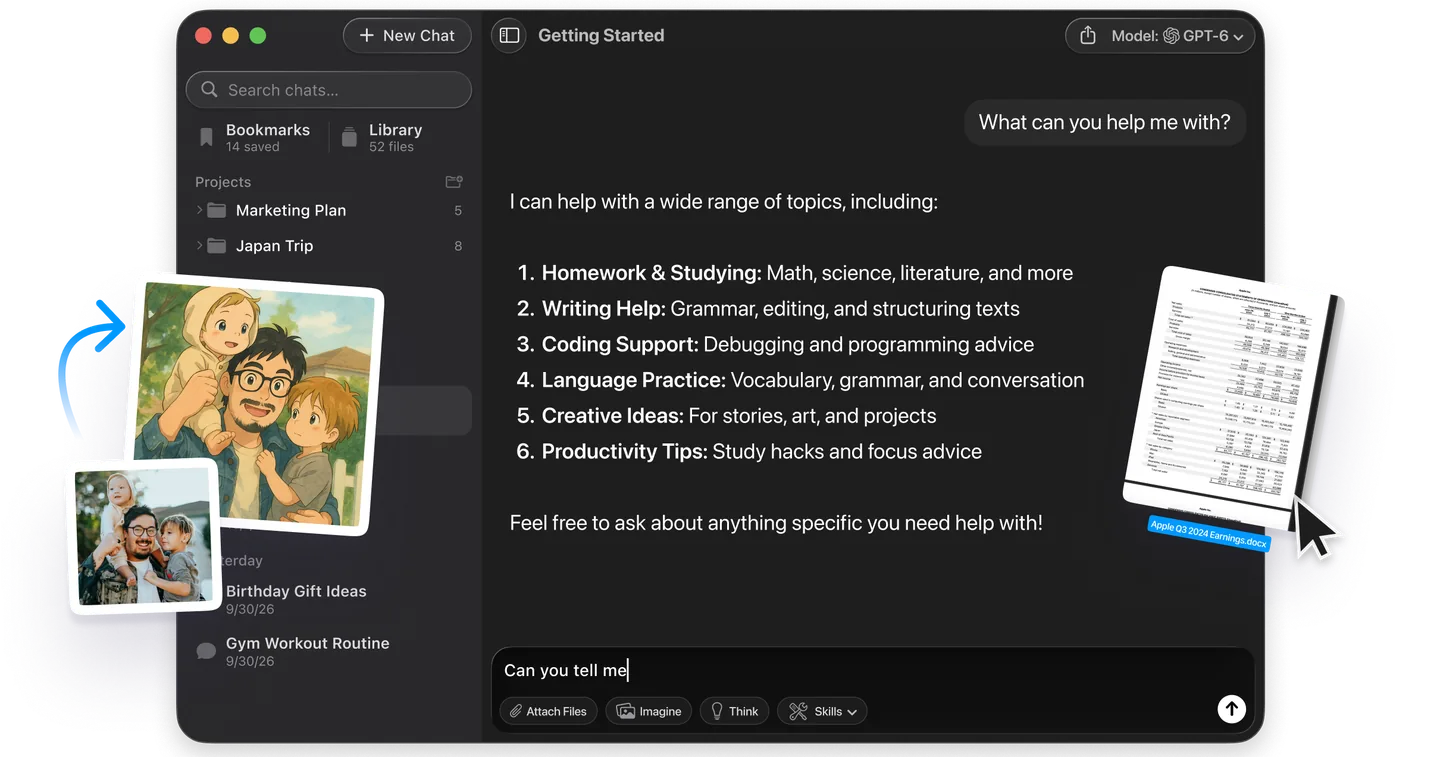
The practical problem this table creates is real: your permitted model changes per class, the network blocks one vendor and not another, and your disclosure has to name which tool produced which output. That is three subscriptions and a naming problem. Fello AI puts ChatGPT, Claude, Gemini, Grok and DeepSeek in one native Mac app for $9.99 a month, which is less than a single ChatGPT Plus subscription, and keeps each conversation labelled with the model that produced it. For studying rather than submitting, ChatGPT Study Mode, which is free on every plan, is the safest default because it is designed to walk you through a problem instead of answering it. If you are choosing between models by subject rather than by policy, our breakdown of which model helps with which subject goes deeper than this page needs to.
What Happens If You Get It Wrong
The consequences ladder is broadly the same everywhere and it escalates on intent, not on the fact of AI use. A first, ambiguous case usually ends in a conversation and a resubmission. A clear case of undisclosed generated text is normally a capped or zero grade for the assignment. A repeat case, or one involving a formal assessment, goes to an academic misconduct panel and lands on your record. Expulsion exists but sits at the far end, reserved for repeated or aggravated cases.
Two things reliably improve your position. The first is a contemporaneous record: prompts, outputs, drafts with version history, and the email where you asked permission. The second is being able to explain your own work out loud. The student framework's proposed test, demonstrating independent mastery through discussion, handwritten work or an oral defence whenever AI was used in drafting, is precisely what an integrity panel will ask you to do. If you can, the AI question usually resolves in that meeting.
Institutions are still writing these rules as they go. New York City Public Schools issued preliminary AI guidance on 24 March 2026, with a feedback window running to 8 May and a fuller playbook due in June. That playbook has still not appeared. As of August 2026 the department's own pages still describe it in the future tense, and officials have declined to commit to a date. The preliminary document drew firm red lines, keeping AI out of decisions made about students: grading, the development of special education and 504 plans, discipline, counselling and crisis intervention, and academic placement. It explicitly left one question open: whether students may use personal AI chatbot accounts alongside school-approved tools. If the biggest district in the country has not resolved that, your school probably has not either, which is another reason to get permission in writing.
Can Teachers Actually Tell?
Less reliably than either side assumes, and this cuts both ways. Detection scores are probabilities, not evidence, and they produce false positives on perfectly human writing, particularly from students writing in a second language. Schools know this, which is why most integrity procedures now treat a detector flag as a prompt to open a conversation rather than as proof. The honest version of what that means for a homework prompt is in our guide to the ChatGPT homework prompt that actually works. The full picture on detection is in our piece on why AI detectors are far less reliable than schools assume. Do not read any of that as an invitation to gamble. The point is that a detector score is not what decides these cases; your ability to account for your own work is.
The Verdict
You are almost certainly allowed to use AI at school. You are almost certainly required to say so, and you are definitely not allowed to use it during a graded assessment. The two minutes that matter are the ones you spend on the assignment brief before you start, because the instructor sitting closest to your work is the one whose rule actually binds you.
So do three things before your next deadline. Read the brief for an AI clause and email the instructor if there is not one. Save your prompts and outputs as you go, in a format you cannot edit later. Paste the declaration above into the end of your submission and fill in the blanks honestly. The wider argument about what all this is doing to education is worth having, and we cover how schools are responding more broadly elsewhere, along with what your teacher is being told about AI. None of it changes what you have to do on Monday.
Frequently Asked Questions
Is using AI to write an essay cheating?
Submitting AI-generated text as your own writing is academic misconduct, treated the same way as copying from another student. Using AI to brainstorm, explain a concept or edit prose you wrote yourself is usually permitted when your instructor allows it and you declare it. The dividing line is not whether you used AI, it is whether you declared it and whether you did the thinking.
Do I have to say I used AI if it was only for brainstorming?
Check the assignment brief, because practice varies. Many policies only require disclosure when AI output influenced the submitted work, but several require it for any use at all, and the student-written STUDENT FIRST Act of 2026 treats non-disclosure as plagiarism regardless of the task. Declaring a use that did not need declaring costs you nothing. The reverse can cost you a grade.
How do I reference ChatGPT in GCSE or A-level coursework?
Your acknowledgement must show the name of the AI source and the date you generated the content. JCQ's own worked example includes the URL too, written as ChatGPT 3.5 (https://openai.com/blog/chatgpt/), 25/01/2025. You must also keep a non-editable copy, such as a screenshot, of the questions you asked and the content produced, plus a short explanation of how you used it. That applies to coursework and non-examination assessment. In supervised exams you cannot use these tools at all.
How old do you have to be to use ChatGPT for school?
OpenAI's terms set a minimum of 13, or the minimum age required in your country, and require parental or guardian permission for anyone under 18. That includes 17-year-olds, and in the EU, the UK and some other jurisdictions the local minimum is higher than 13. Google allows under-13s to use Gemini Apps through a Family Link supervised account, which is currently the only sanctioned route for younger students among the major assistants, though Google says that route is not available in the European Economic Area, Switzerland or the UK.
What if my school has no AI policy at all?
Silence is not permission. Ask your instructor in writing, keep the reply, and disclose your use anyway. New York City Public Schools left the question of personal student AI accounts explicitly open in its March 2026 preliminary guidance, so unresolved policy is normal rather than a loophole. Gaps get resolved after the fact by whoever marks your work.