OpenAI launched ChatGPT Work on July 9, 2026, and it turns ChatGPT from a chat window into an agent that finishes real projects on its own. Instead of answering a question and stopping, ChatGPT Work takes a brief, works in the background for minutes or even hours, and hands you a finished file: a spreadsheet, a slide deck, a report, or a working web app. It launched on GPT-5.6, which reached general availability the same day, and since September 22, 2026 it also runs OpenAI’s newer GPT-6 models, which ChatGPT’s ordinary chat window still does not offer on most plans.
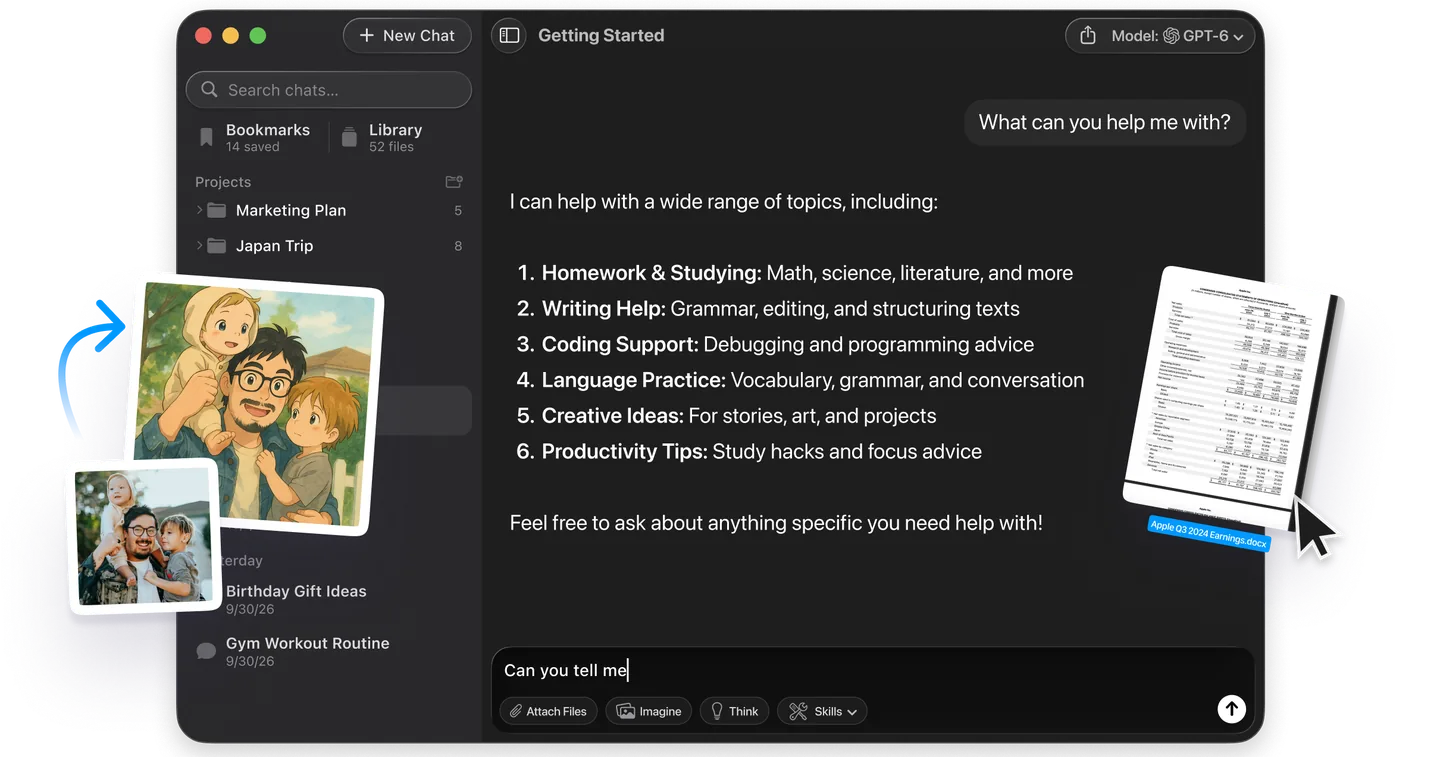
The same release rebuilt the ChatGPT desktop app on Mac and Windows, merging Chat, Work, and Codex into one application and renaming the old app ChatGPT Classic. This guide breaks down what ChatGPT Work actually does, how it plugs into your apps, which GPT-6 and GPT-5.6 models power it, which plans genuinely get it, and what it costs. You will also see where it still needs a human in the loop, so you know when to trust the output and when to double-check it before it ever reaches your boss or your client.
The Key Takeaways
- ChatGPT Work launched July 9, 2026, an agent mode inside ChatGPT that completes multi-step projects independently.
- It ships finished deliverables (spreadsheets, slides, documents, and interactive web apps) instead of chat replies.
- It connects to your tools through a plugin directory, including Slack, Microsoft Teams, Google Drive, email, and calendars.
- The ChatGPT desktop app was rebuilt the same day, merging Chat, Work, and Codex into one Mac and Windows app; the previous app is now ChatGPT Classic.
- Since September 22 it runs GPT-6, with Astra, Sol, and Luna selectable per task on paid plans, while Free and Go get GPT-6 Luna in the desktop app.
- Access splits by surface. Work is in the desktop app on every plan, including Free, but launched on web and mobile for paid plans only; usage is metered like Codex, not flat-rate.
What Is ChatGPT Work?
ChatGPT Work is an agent mode inside ChatGPT that takes on ambitious tasks and completes them from start to finish. Regular ChatGPT answers questions and drafts text inside a conversation. ChatGPT Work takes an outcome you describe, gathers the information it needs across your connected apps, breaks the job into smaller steps, and carries them out on its own. That shift from answering to acting is the essence of what agentic AI means.
The key shift is the output. You do not get a wall of text to copy and paste. You get the actual artifact, a budget tracker with monthly summaries, a deck built from your meeting notes, or a working signup form, delivered as a file you can open and use. In its official announcement, OpenAI describes it as ChatGPT becoming a partner for your most ambitious work, and it can stay on a single project for hours by working through steps one at a time.
It builds on Codex, OpenAI’s coding agent that already had 5 million-plus weekly users at launch. ChatGPT Work extends that same agent approach beyond code to everyday knowledge work, so marketing, finance, sales, and operations teams get the same hands-off execution developers already had.
How ChatGPT Work Works
ChatGPT Work follows a simple loop: you describe the result, it plans the steps, you approve, and it executes. The difference from a normal chat is that each of these stages is built for long, multi-step jobs rather than a quick back-and-forth. Here is how each piece fits together.
Give It a Clear Brief
You start by describing the deliverable, not the steps. Tell it what you want, who it is for, and what “done” looks like, then let it figure out the path. A vague prompt produces a competent but generic result, so the quality of your brief matters more here than in a normal chat. Our GPT-5.6 prompting guide goes deeper on writing briefs that get sharp output.
Connect Your Apps With Plugins
ChatGPT Work reaches your real data through a unified plugin directory. These plugins connect ChatGPT to apps and systems like Slack, Microsoft Teams, Google Drive, SharePoint, email, calendars, CRMs, and project trackers. You can @-mention an app to pull its context into a task, and ChatGPT auto-suggests relevant plugins as the work unfolds. A built-in browser lets it research the open web and use online tools when the answer is not in your own files. Anthropic answers the same problem from the other direction, putting Claude inside the chat app rather than beside it: Claude Tag is a shared @Claude an entire Slack channel can tag.
On macOS the directory now includes Apple Messages. Added on August 20, 2026, it reads and searches iMessage, SMS and RCS on Apple silicon Macs and can send replies once you approve them. It runs in Work and Codex but not in a regular chat, and our guide to the ChatGPT Mac app and what it can reach covers the permissions involved.
Plan Mode and Check-Ins
Before it runs, ChatGPT Work can produce a step-by-step plan that you approve first. This “Plan mode” keeps you in control of long tasks, so the agent does not run off in the wrong direction for an hour. You can also set check-ins and approval gates at specific points, which means it pauses for your sign-off on anything sensitive before continuing.
Scheduled Tasks
Work does not have to run once. You can set it to repeat on a schedule, trigger when an event happens, or run continuously as a monitor. That means it can review your Slack updates every Monday, refresh a dashboard when new data lands, or summarize account activity on a recurring basis, and it only pings you when something needs a human decision.
What ChatGPT Work Can Build
The whole point of ChatGPT Work is finished material, so it is built to produce artifacts you would normally make by hand. The four main output types cover most knowledge work.
Spreadsheets come with formulas and summaries, not just raw data, so a messy CSV can become a budget tracker or a cleaned report. Slide decks are built from outlines or meeting notes, ready to present. Long-form documents like proposals, plans, and research briefs come out structured and formatted. And through the Sites feature (in public beta), it builds interactive web apps such as calculators, signup forms, dashboards, and internal portals.
Early testers put numbers to it. OpenAI says teams at companies like Zapier, Virgin Atlantic, and NVIDIA used ChatGPT Work to compress tasks that took weeks into hours, from competitor analysis to lead triage. As MacRumors reported at launch, those results are self-reported by OpenAI, so treat them as a ceiling rather than a guarantee, but they show the kind of workload the tool is aimed at.
Work Lives in a Rebuilt ChatGPT Desktop App
ChatGPT Work did not arrive on its own. The same July 9 release rebuilt the ChatGPT desktop app for macOS and Windows, folding Codex into it so that Chat, Work, and Codex now sit inside a single application. If you use ChatGPT on a Mac, this is the bigger practical change, because it altered which app you open and what it is called.
What Happened to Your Old App
The path depends on which app you already had. Codex users update the Codex app as normal and it simply becomes the new ChatGPT desktop app, keeping existing Codex chats and projects, opening in Codex by default, and letting you keep the Codex icon in settings if you prefer it.
Before you go looking for it, check your machine. OpenAI lists macOS 14 as the minimum for its Mac app and has said it will not ship a build for older versions, so an unsupported Mac stays where it is.
Previous ChatGPT desktop users get a prompt to download the new app, and here is the part that confuses people. The new app installs alongside the old one rather than replacing it, so you end up with two icons. The new one is called ChatGPT. The old one is renamed ChatGPT Classic. According to OpenAI’s migration guide, no migration is required, and Classic keeps receiving model updates, bug fixes, security patches, and its existing Enterprise capabilities. The catch is that new agent features may land only in the new app, so Classic is a holding position rather than a permanent home.
How the New App Is Organised
A follow-up update on July 16, live for all plans on both Mac and Windows, cleaned up the navigation. You pick ChatGPT or Codex from a global switcher, then toggle between Chat and Work at the top of the page. Chat and Work conversations share one Recents list that you can sort, filter, and pin, and your existing Projects carry over. Opening a project lets you start either a normal chat or a Work chat that inherits the project’s context, which is the fastest way to give the agent background without re-explaining it.
Codex stays deliberately separate, with its own view and its own history. Cloud Work chats sync across web, mobile, and desktop, so a task you start on your Mac can be checked from your phone. Codex is the exception, since it is not selectable on web or mobile at all, though supported desktop Codex chats show up under the Remote tab in the mobile app. For teams, the reorganisation is cosmetic in the ways that matter: it does not change workspace permissions, security settings, governance controls, or the spend model.
Which Models Power ChatGPT Work
ChatGPT Work launched on the GPT-5.6 family, which shipped the same day, and moved up a generation on September 22, 2026, when OpenAI made GPT-6 Sol and Luna available in Work and Codex but not in Chat. Our GPT-5.6 launch coverage explains where the older tiers came from, but here is how the models map to Work today.
GPT-6 Astra is the top model, for the hardest end-to-end work across code, apps, and research. GPT-6 Sol is the everyday and complex-work model, and the Power control starts on its Light setting by default. GPT-6 Luna suits clear, repeatable tasks such as extraction, classification, and structured summaries. The GPT-5.6 Sol, Terra, and Luna tiers stay selectable while the rollout finishes, and GPT-5.5 leaves Work on October 14, 2026. On Plus, Pro, and Business you pick per task, so you can spend Astra budget only where it counts, while Enterprise and Edu admins decide which models their workspace offers.
Free and Go accounts get one model, GPT-6 Luna, in the desktop app. They cannot switch to Sol or Astra, which is the practical difference between a free seat and a paid one once you are inside the agent. Work and Codex draw on the same usage pool, so a long Work run and a long Codex run eat the same allowance.
One point catches people out. GPT-6 Sol and Luna cannot be selected in a normal ChatGPT conversation at all, only inside Work, Codex, and the API. That is why a free account can reach GPT-6 Luna through Work while its ordinary chats run on the older GPT-5.6 Luna, as our guide to whether ChatGPT is free explains in full.
Who Gets ChatGPT Work and When
This is the part most coverage gets wrong, because the answer depends on where you open ChatGPT rather than on your plan alone. In the rebuilt desktop app, Chat, Work, and Codex are available on every plan, including Free. On web and mobile, Work launched for paid plans only, rolling out in waves from July 9 with Pro, Pro Lite, Enterprise, and Edu first and Plus and Business behind them.
OpenAI’s own pricing documentation now lists Work mode and Codex as included in the Free, Go, Plus, Pro, Business, Edu, and Enterprise plans, and notes that the two share a usage pool. Treat the table below as who is entitled to Work, not who has already been switched on, because OpenAI still describes the rollout as in progress and its support pages carry a banner saying availability continues to expand.
| Plan | Work in the desktop app | Work on web and mobile | Models in Work |
|---|---|---|---|
| Free | Included | Not at launch | GPT-6 Luna only |
| Go | Included | Not at launch | GPT-6 Luna only |
| Plus | Included | Included, second wave | GPT-6 Astra, Sol, Luna, plus GPT-5.6 |
| Pro | Included | Included, first wave | GPT-6 Astra, Sol, Luna, plus GPT-5.6 |
| Business | Included | Included, second wave | GPT-6 Astra, Sol, Luna, plus GPT-5.6 |
| Enterprise | Included | Included, first wave | Set by workspace admins |
Why the Launch Wording Confused Everyone
Two OpenAI statements from launch week look like they contradict each other, and both are accurate. The July 9 announcement said Free and Go users reach GPT-5.6 Terra in ChatGPT Work and Codex. A support page from the same week said Work was rolling out to paid plans except Free and Go. The reconciliation is the surface, not the plan.
The support note describes the web and mobile rollout, which started with paid tiers. The announcement describes the desktop app, where OpenAI put Chat, Work, and Codex on every plan from day one. So a free user who opened the new desktop app did find Work, running Terra, while the same account on chatgpt.com in a browser did not see it at launch. If Work is missing for you, check which surface you are on before you check your plan.
How Much Does ChatGPT Work Cost
There is no separate price tag for ChatGPT Work. It is included with your existing ChatGPT plan, but usage is metered like Codex rather than flat-rate. Longer, more complex tasks eat more of your plan’s allowance, so a single multi-hour job can take a visible bite out of your daily capacity.
For teams, enterprise admins get spend controls, including workspace defaults, group limits, individual overrides, and a request-for-credits flow. The practical takeaway is to default to the cheaper Luna or the starting Sol setting for routine work and save Astra for tasks where judgment and accuracy really matter.
ChatGPT Work vs Regular ChatGPT
The simplest way to think about it: regular ChatGPT is a conversation, ChatGPT Work is a coworker you delegate to. In a normal chat you stay in the loop for every message and assemble the final result yourself. With Work, you hand over the whole task, walk away, and come back to a finished file. Anthropic’s take on the same delegate-the-work idea is Claude Cowork, its agent for knowledge work.
That also changes how you review the output. You check Work’s results the way a manager checks a junior’s, verifying accuracy against the source rather than reading every step. If you want to compare how ChatGPT stacks up against rivals for this kind of agentic work, see our ultimate ChatGPT model comparison.
Limitations to Know Before You Rely on It
ChatGPT Work is powerful, but it is not a replacement for domain expertise. It does not know your company’s specific standards, so it produces a competent generic version unless your brief spells out the details. It also will not reliably verify its own numbers, which means a polished-but-wrong spreadsheet is a real risk, and polished-but-wrong is more dangerous than rough-but-wrong because you are tempted to skip the check.
Cost is the other watch-out. Because usage is metered and tasks can run for hours, careless use burns through your allowance fast. Treat it strategically, use Plan mode to catch bad directions early, and always review the final artifact before it goes anywhere important. It handles the execution; you still own the judgment.
The Bottom Line
ChatGPT Work is OpenAI’s biggest step yet toward AI that finishes jobs instead of just drafting them. Now running GPT-6, it connects to your apps, plans multi-step projects, and delivers real files, which makes it useful for anyone who spends their day building decks, reports, and trackers. Start on the cheaper Luna model or the default Sol setting, write tight briefs, and check the output before you trust it.
If you would rather test OpenAI’s models alongside other top models before committing to one workflow, Fello AI puts ChatGPT, Claude, Gemini, and Grok in a single app so you can run the same brief across all of them and keep whichever result is best. It is a fast way to see where each model shines before you lean on any one agent. And for a look at another new ChatGPT feature that landed this month, check out our breakdown of ChatGPT Live. Anthropic offers a comparable free agentic workspace for educators through Claude for Teachers.
FAQ
What is ChatGPT Work?
ChatGPT Work is an agent mode inside ChatGPT, launched July 9, 2026 on GPT-5.6 and running OpenAI’s GPT-6 models since September 22. It takes a project brief, works independently for minutes or hours, and delivers a finished file such as a spreadsheet, deck, document, or web app instead of a chat reply. For how an agent like this differs from a plain chatbot or an RPA bot, see our breakdown of agentic AI vs generative AI vs automation.
Is ChatGPT Work free?
Partly. In the ChatGPT desktop app, Work is available on every plan including Free, and free and Go accounts run it on the GPT-6 Luna model. On web and mobile it launched for paid plans only. Picking between Astra, Sol, and Luna needs Plus or above. There is no separate charge for Work on top of your subscription, but usage is metered and shared with Codex, so heavy tasks consume more of your allowance.
How is ChatGPT Work different from regular ChatGPT?
Regular ChatGPT answers questions inside a conversation you stay in. ChatGPT Work takes over the whole task, breaks it into steps, connects to your apps, and returns a completed artifact. You review the result the way a manager reviews a report, rather than guiding every message.
Which apps does ChatGPT Work connect to?
It connects through a unified plugin directory, covering Slack, Microsoft Teams, Google Drive, SharePoint, email, calendars, CRMs, and project trackers. A built-in browser lets it research the web and use online tools when the answer is not in your own files.
What is ChatGPT Classic?
ChatGPT Classic is the name OpenAI gave the previous ChatGPT desktop app after the July 9, 2026 rebuild. The new app installs alongside it rather than replacing it, so many Mac users end up with both icons. Classic still receives model updates, bug fixes, security patches, and its existing Enterprise capabilities, but new agent features may appear only in the new app.
What model does ChatGPT Work use?
Since September 22, 2026, ChatGPT Work runs on GPT-6. Astra is the most capable model for the hardest end-to-end work, Sol is the everyday model and the default starting point, and Luna, the model Free and Go users get, suits clear, repeatable tasks. The GPT-5.6 tiers remain selectable while the rollout finishes.