Muse Spark 1.1 landed on July 9, 2026, and Meta is calling it its strongest model yet for real-world coding and agentic work. The upgrade comes from Meta Superintelligence Labs, the team Meta assembled to close the gap with OpenAI, Anthropic and Google, and it arrives with a feature that changes Meta’s whole strategy; a paid developer API. Alongside the model, Meta opened a public preview of the new Meta Model API, marking the first time the company is charging money for access to one of its frontier models.
This is a big shift. Meta built its reputation on giving models away, so putting Muse Spark 1.1 behind a metered API puts it head to head with the businesses that fund Anthropic and OpenAI. Below we break down what Muse Spark 1.1 actually does, how much it costs, how you can try it today, and how it compares to the models you already use.
Update, September 3, 2026. Meta has shipped three releases since this article. Muse Spark 1.2 and Muse Code landed on August 5, 2026, adding a terminal coding agent for macOS and Linux and replacing the US-only preview described below with what Meta calls expanded global access. On the Artificial Analysis Intelligence Index v4.1.1, Muse Spark 1.1 now scores 53, Muse Spark 1.2 scores 57, and Muse Spark 1.3, released September 2, 2026, scores 61. Anthropic’s comparator has moved on too; Claude Opus 5 replaced Opus 4.8 on July 24, 2026, and Claude Fable 5.1 took the flagship spot on September 1, 2026. The benchmark chart further down is Meta’s own July launch chart and is kept exactly as Meta published it.
Key Takeaways
- Muse Spark 1.1 launched July 9, 2026 as Meta’s most capable model for coding and agentic tasks.
- It ships with a 1 million token context window and can run as both a lead agent and a subagent.
- API pricing is $1.25 per million input tokens and $4.25 per million output tokens, with $20 in free credits to start.
- It is free to try in Thinking mode inside the Meta AI app and on meta.ai.
- This is Meta’s first paid model, a direct move against Anthropic and OpenAI’s API business.
What Is Muse Spark 1.1?
Muse Spark 1.1 is Meta’s upgraded multimodal reasoning model, built for agentic tasks that involve many steps and real tools. It follows the original Muse Spark from April 2026, which was Meta Superintelligence Labs’ first text and reasoning model. Where the original was pitched as a reasoning system with a private developer preview, version 1.1 is a broader release aimed squarely at builders who want an autonomous coding and computer-use engine. If the term is new to you, our guide explains what agentic AI means.
Meta frames the model as a step toward what it calls “personal superintelligence.” In practice, Muse Spark 1.1 can write and debug code, use software and external tools, understand text, images and video, and carry out complex multi-step tasks with far less human hand-holding. If you want the full backstory on the model line, our guide to the original Muse Spark model covers where it started.
What’s New in Muse Spark 1.1
The headline change is focus. The original Muse Spark leaned on reasoning and stayed inside a private preview, while Muse Spark 1.1 is tuned for agents, coding and computer use, and it comes with a public API. Here is how the two versions line up.
| Feature | Muse Spark (April 2026) | Muse Spark 1.1 (July 2026) |
|---|---|---|
| Main focus | Text and reasoning | Agentic tasks, coding, computer use |
| Context window | Not detailed publicly | 1 million tokens with active management |
| Multi-agent orchestration | Limited | Runs as lead agent and subagent |
| Developer access | Private preview | Public Meta Model API |
| Pricing | Not sold | $1.25 input / $4.25 output per million tokens |
| Consumer access | Meta AI app | Meta AI app and meta.ai, Thinking mode |
A 1 million token context window
Muse Spark 1.1 handles up to 1 million tokens of context, enough to hold large codebases, long documents and multi-file projects in a single session. Meta pairs that with active context management, so the model can compact older material while preserving the critical steps of a task. For long agent runs that would otherwise lose the thread, that memory management matters as much as the raw window size.
Stronger coding and agentic performance
Meta positions 1.1 as its strongest model for agentic and coding work yet. It can diagnose complex bugs, implement features inside enterprise systems and execute code migrations, and it works well with planning mode, goal conditioning and subagent delegation. On the computer-use side, it handles multi-application workflows and decides when to automate with scripts versus clicking through an interface directly.
Multi-agent orchestration
One of the more ambitious upgrades is orchestration. Muse Spark 1.1 can coordinate multi-agent systems, delegating work across parallel subagents while managing its own context. Crucially, it is built to function as both a primary agent and a subagent, so developers can drop it into an existing agent stack rather than rebuilding around it. It also generalizes zero-shot to new native tools, MCP servers and custom skills. For some labs orchestration is the whole product rather than a feature, and our breakdown of Sakana’s Fugu-Ultra v1.1 covers a model that does nothing but route work across a pool of others.
Broad multimodal input
The model reads more than text. Muse Spark 1.1 accepts images, video, PDFs and audio, and it can generate visual-to-code artifacts, turning a screenshot or mockup into working output. Meta highlights strengths in perception, descriptive captioning and agentic workflow execution, which makes it useful for tasks that blend visual understanding with action. Meta’s image generation tool is covered separately in our Meta AI image generator guide.
Muse Spark 1.1 Pricing and the Meta Model API
The pricing is the part that signals a new era for Meta. Access runs through the new Meta Model API, an OpenAI-compatible endpoint now in public preview for developers in the United States. Every new account starts with $20 in free credits, then moves to pay-as-you-go rates.
| Meta Model API (Muse Spark 1.1) | Price |
|---|---|
| Input tokens | $1.25 per million |
| Output tokens | $4.25 per million |
| Free credits for new accounts | $20 |
| Billing model | Pay-as-you-go after credits |
According to reporting from Reuters and other outlets, that pricing sits above OpenAI’s entry-level GPT-5 mini and Anthropic’s low-cost Claude Haiku 4.5, but below Anthropic’s pricier Sonnet tier. In other words, Meta is not undercutting the market on price; it is betting that its coding and agentic performance justifies a mid-market rate. Early API partners already testing the model include Replit, Cline and Box.
How to Use Muse Spark 1.1
There are two ways to get hands on Muse Spark 1.1 right now, one for everyday users and one for developers. Consumers can try it for free, while builders pay per token through the API.
Try it free in the Meta AI app
- Open the Meta AI app or head to meta.ai in your browser.
- Start a new chat and switch on Thinking mode, which routes your prompt to Muse Spark 1.1.
- Ask it to reason through a problem, plan a project or work through code, then review the step-by-step output.
Build with the Meta Model API
- Sign up for the Meta Model API public preview if you are a developer based in the United States.
- Claim your $20 in free credits and generate an API key.
- Point your existing OpenAI-compatible code at the endpoint, since Meta ships an OpenAI-compatible package.
- Test prompts, compare outputs and wire the model into your agents before moving to pay-as-you-go pricing.
How Muse Spark 1.1 Compares to ChatGPT and Claude
Muse Spark 1.1 walks into a crowded field. OpenAI and Anthropic already dominate the agentic coding space, and Google’s Gemini line is close behind, so Meta’s pitch rests on price plus performance rather than one killer feature. You can see where all of these land in our roundup of the best AI models available right now.
Meta backed the launch with its own benchmark comparison in its official announcement, pitting Muse Spark 1.1 against the original Muse Spark, Google Gemini 3.1 Pro, Anthropic Opus 4.8 and OpenAI GPT 5.5 across agent, coding and multimodal tests.
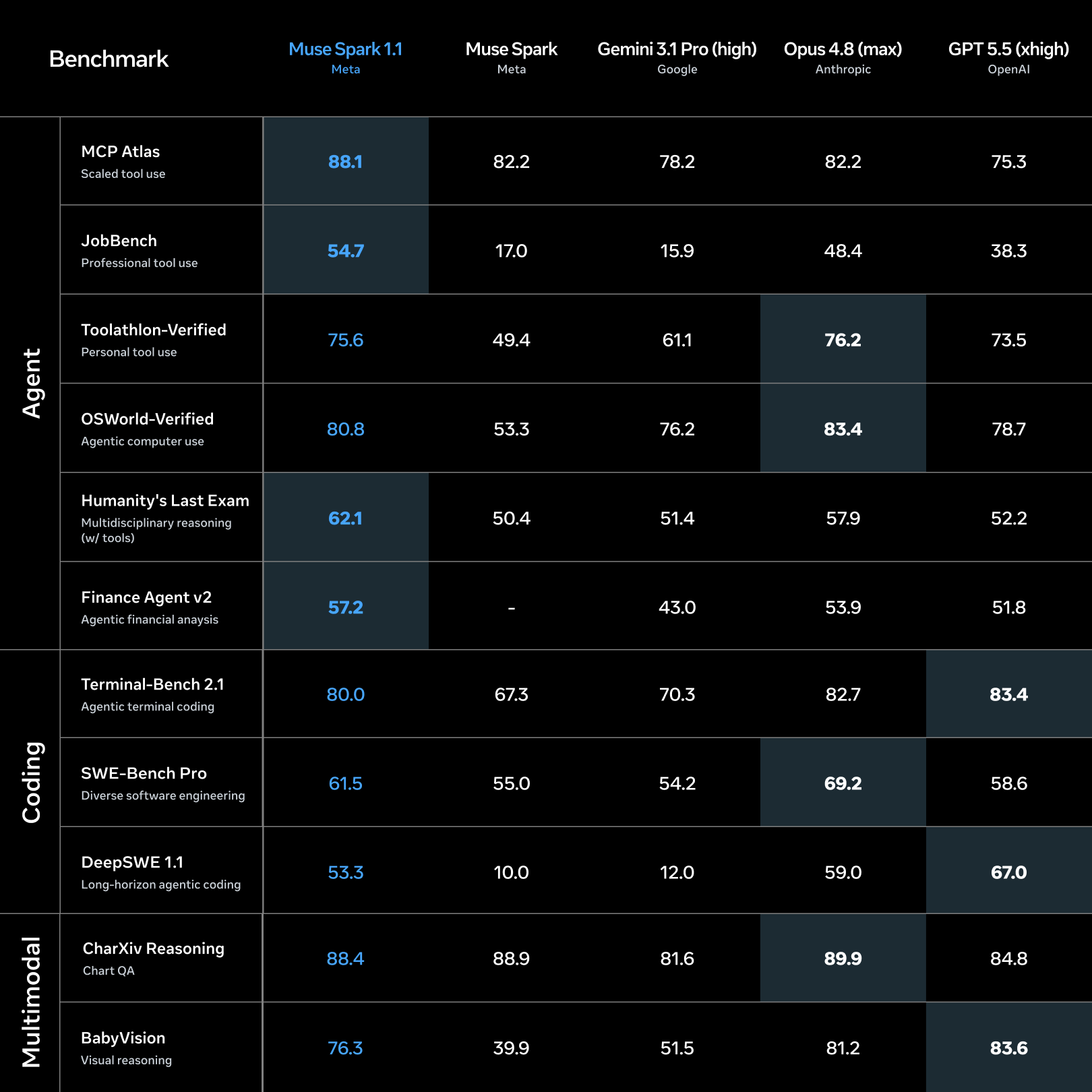
The numbers tell a focused story. Muse Spark 1.1 is strongest on agentic tool use, topping the chart on MCP Atlas (88.1), JobBench (54.7), Humanity’s Last Exam with tools (62.1) and Finance Agent v2 (57.2), where it beats every rival including Opus 4.8 and GPT 5.5. That lines up with Meta’s pitch that this is a model built for real-world agents and tool calling.
On pure coding and multimodal work, it trails the leaders. Opus 4.8 wins SWE-Bench Pro with 69.2 to Muse Spark 1.1’s 61.5, and GPT 5.5 leads Terminal-Bench 2.1, DeepSWE 1.1 and the BabyVision visual test. These are Meta’s own figures, so independent testing may land differently, yet the shape is clear; Muse Spark 1.1 is an agent-first model that is competitive rather than dominant on classic coding.
What we can say is how it is positioned. Meta prices Muse Spark 1.1 as a capable mid-market option, cheaper than the top Anthropic tiers but more expensive than the budget-friendly rivals like DeepSeek’s low-cost models. If your workload is heavy on multi-step agents and computer use, the 1 million token context and orchestration features are the real draw. If you mostly need a coding assistant, tools like Claude are still the reference point, and our look at Claude for coding is a useful comparison.
What Muse Spark 1.1 Means for the AI Race
The strategy shift is bigger than the model. For years, Meta released its AI weights freely and let others build on top, funding the work through advertising rather than API fees. Charging for Muse Spark 1.1 flips that, putting Meta in direct competition with the metered-token businesses that keep Anthropic and OpenAI running.
The stakes are high because the same model family is expected to power Meta’s consumer products, from chatbots across WhatsApp, Instagram and Facebook to its smart glasses. A stronger agentic engine feeding both a developer API and billions of consumer touchpoints is exactly the kind of flywheel Meta needs to catch up. It also sits alongside Meta’s other recent launches, including its Meta AI video generator, as the company builds out a full lineup rather than a single flagship.
Want Every Top AI Model in One App?
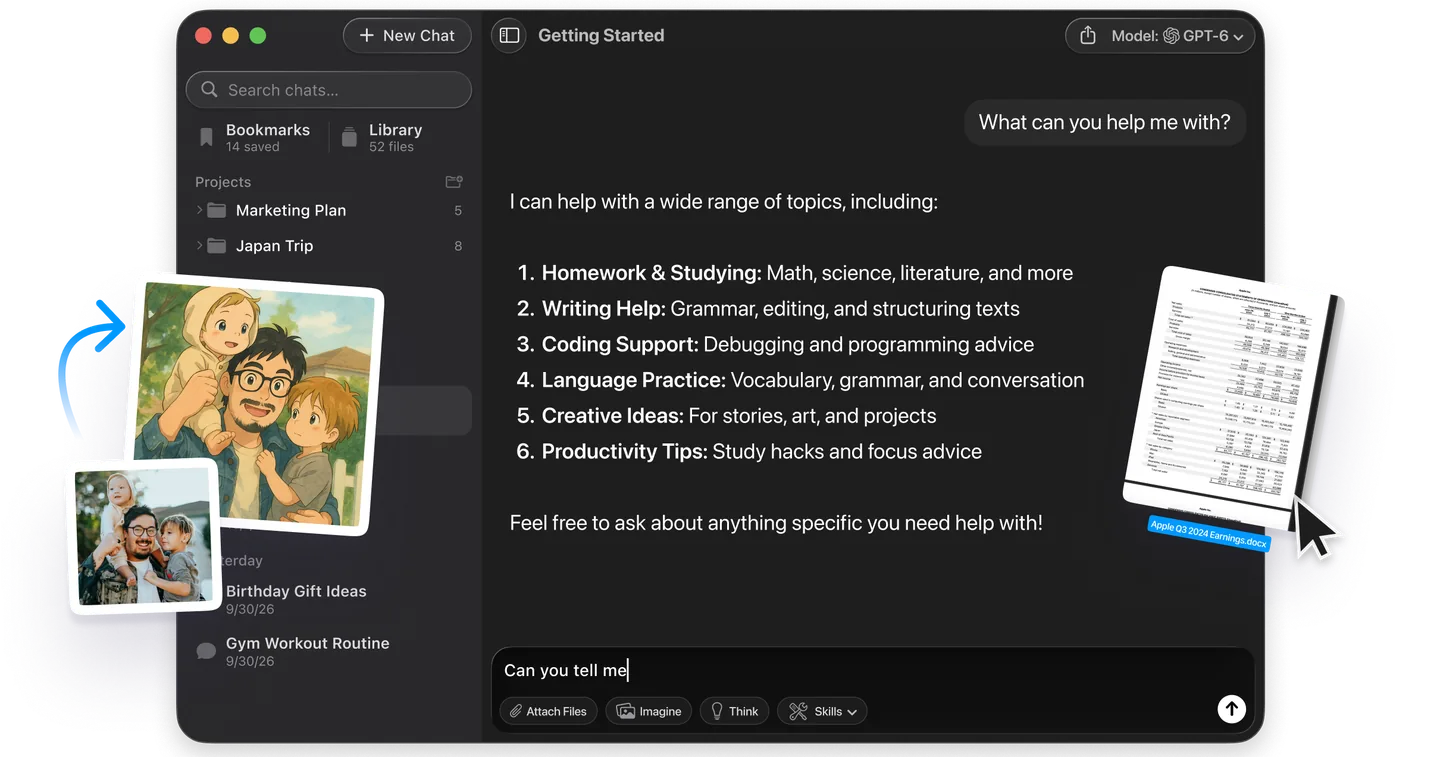
Muse Spark 1.1 is powerful, but it is aimed at developers, and juggling separate apps and APIs for each model gets old fast. Fello AI puts the leading models, including Claude, ChatGPT, Gemini, Grok and DeepSeek, together in one clean Mac app, so you can compare answers and pick the best tool for each task without managing keys or credits. Fello also goes beyond chat, helping you create images, decks, documents and spreadsheets from a single prompt.
That wait is over: Muse Spark is now in Fello AI. You can use Meta’s model right inside the app, with no API keys or credits to manage, and put it head to head with Claude, ChatGPT, Gemini, Grok and DeepSeek on the exact same prompt. Our guide to the Muse Spark desktop client for Mac walks through it.
If you want an easy way to test how different models handle the same problem, download Fello AI and try a few side by side.
Conclusion
Muse Spark 1.1 is more than a routine update; it is Meta stepping onto the paid-API battlefield with a model built for agents, coding and computer use. The 1 million token context, multi-agent orchestration and broad multimodal input make it a serious tool for developers, while the free Thinking mode in the Meta AI app lets anyone kick the tires today. If you build agents or write code for a living, the $20 in credits are worth spending to see how it handles your workload. For everyone else, the smart move is to keep comparing, because the fastest way to find the right model is to run the same prompt across several and judge the results yourself.
Frequently Asked Questions
What is Muse Spark 1.1?
Muse Spark 1.1 is Meta’s most capable agentic and coding AI model, launched on July 9, 2026 by Meta Superintelligence Labs. It handles a 1 million token context, writes and debugs code, uses tools and computers, and can orchestrate multi-agent systems as both a lead agent and a subagent.
How much does Muse Spark 1.1 cost?
Through the Meta Model API, Muse Spark 1.1 costs $1.25 per million input tokens and $4.25 per million output tokens. New accounts get $20 in free credits before switching to pay-as-you-go pricing.
Is Muse Spark 1.1 free?
Yes, in part. You can use Muse Spark 1.1 for free in Thinking mode inside the Meta AI app and on meta.ai. The Meta Model API is paid after the initial $20 in free credits run out.
How do I access Muse Spark 1.1?
Everyday users can enable Thinking mode in the Meta AI app or on meta.ai. Developers in the United States can sign up for the Meta Model API public preview, claim $20 in credits and connect through its OpenAI-compatible endpoint.
How does Muse Spark 1.1 compare to ChatGPT and Claude?
Meta’s own benchmarks show Muse Spark 1.1 leading on agentic tool-use tests like MCP Atlas and JobBench, while Anthropic’s Opus 4.8 and OpenAI’s GPT 5.5 lead on several coding and multimodal benchmarks. On price it sits above OpenAI’s GPT-5 mini and Anthropic’s Claude Haiku 4.5, but below Anthropic’s pricier tiers. Because these are vendor benchmarks, running the same prompt across each model is still the best real-world check.